
Symptom or signal
For Business-to-Business (B2B) sales teams selling deals valued under 50,000 United States Dollars (USD) in annual contract value, the primary symptom of an ill-fitted lead scoring model is an calendar filled with low-intent meetings and an inbox flooded with unengaged replies. Traditional scoring models often rely heavily on static demographic data, which fails to capture real-time intent. This misalignment becomes highly visible when sales development representatives (SDRs) spend more time cleaning list data than conducting meaningful outreach.
A key signal of this inefficiency is when the sales team is forced to prioritize volume over precision. For instance, some prospecting tools work with credits: according to Factors AI, some organizations outgrow Apollo's credit limits or need more flexible renewal options, which can shift attention from pipeline health to credit consumption.
When sales teams rely on these legacy frameworks, they often face a stark choice between lead scoring, which evaluates individual actions, and account scoring, which looks at the target company as a whole. Landbase draws the line: lead scoring evaluates individual contacts based on their engagement and demographic fit, while account scoring evaluates entire companies based on firmographic fit, technographic signals, buying intent, and organizational readiness. For smaller sales teams, setting up complex scoring rules can be paralyzing. The Prometheus Agency warns that generic scoring systems often prioritize activity over intent, flooding the pipeline with leads that look busy but will never buy. Similarly, the Small Business Expo advises small businesses to begin with a simple point-based system and to move toward AI-driven predictive scoring as their data grows.
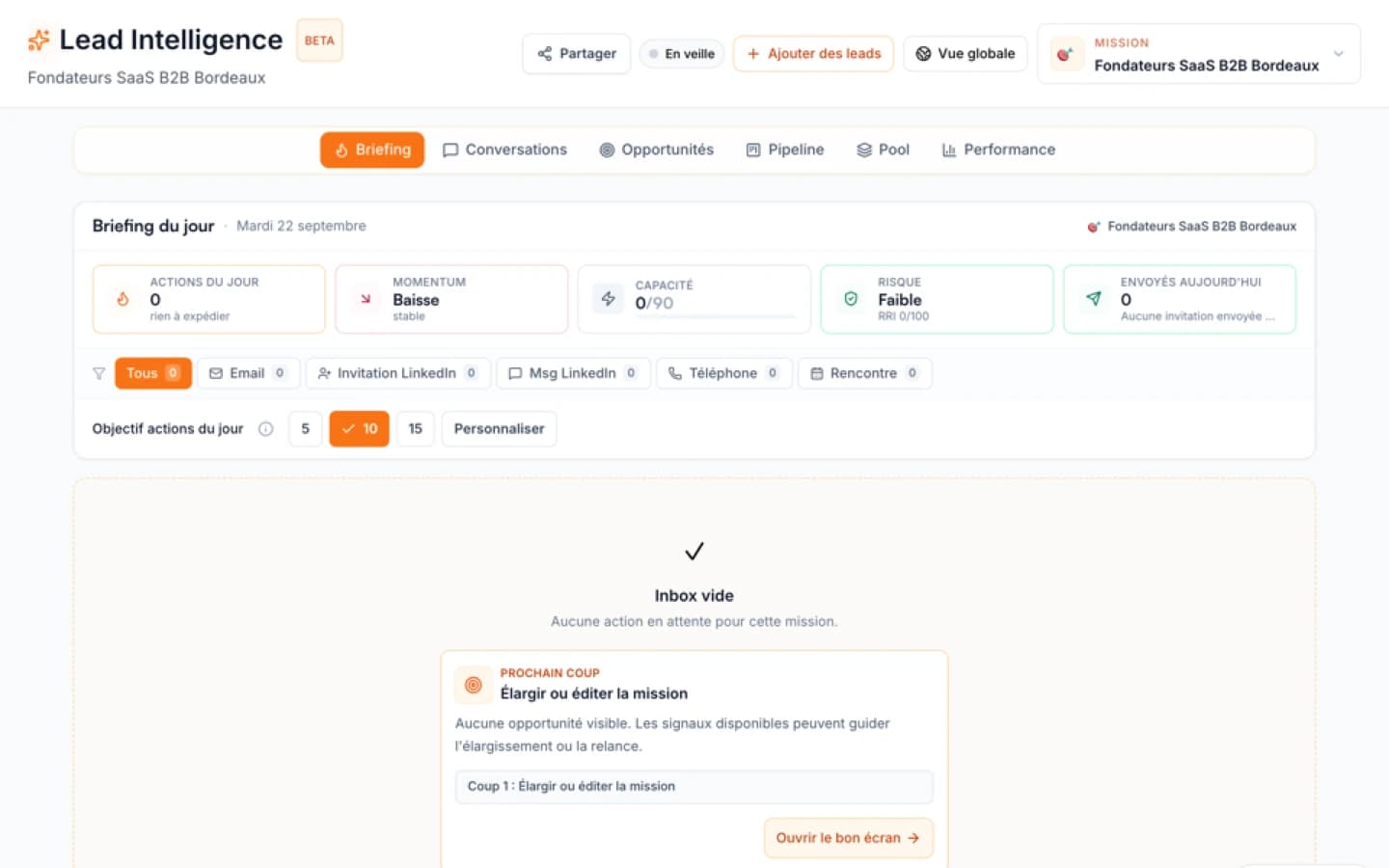
This is where modern, context-driven prioritization changes the dynamic. Instead of requiring a massive database or a high minimum contact threshold to begin generating value, tools like Ember's Lead Intelligence can find and prioritize contacts directly. Whether a sales team starts with 10, 100, or 1,000 contacts, the platform operates without any minimum contact threshold. By focusing on context and real-time signals rather than arbitrary point systems, the system proposes the next action and channel that fit the specific lead situation. This allows mid-market sales teams to move away from the high-volume, high-noise trap and focus their energy on the opportunities most likely to convert.
To place this decision in context, the Knowledge guides for founders brings together deeper guidance on the same field.
What changed
The landscape of Business-to-Business (B2B) lead scoring has undergone a fundamental shift. Historically, sales teams relied on static, point-based systems that assigned arbitrary values to superficial actions, such as downloading a whitepaper or visiting a pricing page. In 2026, this approach quickly shows its limits for teams managing deals under 50,000 United States Dollars (USD) in Annual Contract Value (ACV).
One driver of this change is the sheer volume of automated outbound activity. Platforms built for scale have made it incredibly easy to flood the market with messages. According to Apollo's company history page, Apollo.io reached 150 million dollars in annual recurring revenue in May 2025. As message volume grows, the resulting noise dilutes the value of traditional activity-based scoring. This volume-heavy environment pushes many teams toward a transition from traditional lead scoring to dynamic, signal-based account scoring, which prioritizes companies showing active buying signals rather than isolated individual actions. Landbase sums up the difference this way: lead scoring tells you who is interested, while account scoring tells you which company is worth pursuing.
For small and medium-sized businesses, the challenge is to maintain efficiency without the massive budgets required for complex enterprise setups. According to The Small Business Expo, the most effective systems use a "hybrid" approach that combines Fit (who they are) and Engagement (what they do), with a score that automatically drops when a lead goes silent. Instead of relying on rigid rules, Prometheus Agency recommends combining explicit and implicit scoring and aligning the model with the sales team's qualification criteria.
Data enrichment platforms like Clay, for instance, offer 4 distinct plans to help teams build highly customized data pipelines, as shown on the Clay pricing page. However, managing these complex data flows still requires significant operational overhead. To solve this, some sales teams are turning to agentic solutions that handle both discovery and prioritization natively. Ember's Lead Intelligence capability addresses this shift by finding and prioritizing contacts directly, whether a sales team starts with 10, 100, or 1,000 contacts, with no minimum contact threshold required to begin. By focusing on context and real-time signals rather than arbitrary point accumulation, sales teams can bypass the noise of high-volume outbound and focus their energy on prospects that are genuinely ready to engage.
Facts and sources
To build a reliable foundation for evaluating modern scoring methodologies, here is what the sources consulted say. According to Apollo's company history page, Apollo.io reached 150 million dollars in annual recurring revenue in May 2025, and Factors AI describes Apollo.io as a platform that combines prospecting data, enrichment, and engagement tools. Meanwhile, other platforms focus heavily on data enrichment and flexibility. For example, Clay offers 4 plans, which are Free, Launch, Growth, and Enterprise, using a two-metric model consisting of Actions and Data Credits priced in United States Dollars (USD), as detailed on the Clay pricing page. To support lead discovery and connection insights, Clay also features a Sales Navigator data point, described as a way to discover potential leads and gain insights into professional connections, as shown on the Clay integrations page.
The distinction between account level and individual level prioritization is presented by Landbase in their analysis of account scoring versus lead scoring. Furthermore, lead scoring best practices for small B2B teams are discussed by The Small Business Expo and further detailed in the 2026 guide by Prometheus Agency.
For sales teams seeking to move away from rigid, point-based legacy systems, modern solutions offer a more contextual approach. Ember's Lead Intelligence capability helps sales teams prioritize opportunities by finding and prioritizing contacts itself, whether the team starts with 10, 100, or 1,000 contacts, with no minimum contact threshold. Instead of relying on arbitrary point accumulation, the platform proposes the next action and channel that fit the lead situation. This ensures that sales teams can focus their energy on the conversations that are genuinely ready for engagement.
To explore this point further, How to qualify B2B leads without a marketing department? details a step directly related to this decision.
Why the common explanation is incomplete
The common explanation of lead scoring is incomplete because it treats individual actions as isolated events rather than symptoms of account-level intent. For sales teams managing deals under 50,000 United States Dollars (USD) in annual contract value, this oversight leads directly to inefficient outreach. Traditional models assign arbitrary points to single contacts who download a whitepaper or visit a web page, ignoring whether the target company actually has an active business need. Landbase notes that most teams keep both, using account scoring for prioritization and lead scoring for routing. Without this context, Sales Development Representatives (SDRs) waste valuable time chasing low-intent leads who happened to click a link.
This point-based approach persists partly because it is simple to set up. While high-volume outbound works for some organizations, it often forces smaller sales teams into a cycle of sending thousands of generic messages to hit arbitrary activity metrics. Basic scoring frameworks, such as the one outlined by The Small Business Expo, suggest starting with a simple point-based system. Similarly, Prometheus Agency recommends recording every change to the scoring model with its date, rationale, and expected impact, which takes ongoing upkeep. For a team selling mid-market deals, these complex systems quickly become unmanageable.
To break this cycle, sales teams need a model that prioritizes actual context over raw activity. Instead of relying on rigid point thresholds that require constant manual adjustment, modern systems evaluate the complete situation of an account. This is where Lead Intelligence by Ember changes the workflow. Lead Intelligence finds and prioritizes the contacts itself whether the team starts with 10, 100, or 1,000 contacts, with no minimum contact threshold. By focusing on the actual signals and context of each account, the platform proposes the next action and channel that fit the lead situation. This allows sales teams to focus their energy on high-probability conversations rather than managing complex, outdated scoring spreadsheets.
The real problem
The core of this issue for Business-to-Business (B2B) sales teams selling sub-50k deals is the efficiency trap. In this segment, deals are too small to justify high-touch, manual enterprise account-based marketing, yet they are too large to be closed via completely unsegmented, spam-like outbound blasts. When sales teams fall into the trap of volume-oriented outbound, they run into severe operational friction. When a tool works with credits, every wasted send or enrichment has a cost, and Factors AI reports that some organizations outgrow Apollo's credit limits. This reliance on raw volume is compounded by the complexity of modern data enrichment workflows. Teams often try to patch their targeting gaps by chaining multiple data providers together. For instance, Clay offers 4 plans, which are Free, Launch, Growth, and Enterprise, using a two-metric model of actions and data credits, as detailed on the Clay Pricing Page. While highly customizable, managing these complex credit-burning actions manually forces Sales Development Representatives (SDRs) to act as data engineers rather than focusing on actual conversations. The real problem in 2026 is that traditional lead scoring models fail to distinguish between individual noise and true account readiness, a challenge discussed by Landbase. Furthermore, The Prometheus Agency warns that generic scoring systems flood the pipeline with leads that look busy but will never buy. When a single contact downloads a generic PDF, static point-based systems flag them as hot, ignoring the fact that no one else in their organization is engaged. For a team selling deals under 50,000 USD in annual contract value (ACV), chasing these false positives wastes precious sales hours on accounts that have zero intent to buy. Without a way to automatically prioritize leads based on deep, contextual signals, sales teams remain stuck in a cycle of high activity and low conversion.
This approach also connects with How Small Sales Teams Qualify Inbound Leads Without a CRM?, which clarifies the next choice.
How the mechanism works
To build a functional scoring mechanism for deals under 50,000 United States Dollars (USD) in Annual Contract Value (ACV), Business-to-Business (B2B) sales teams must shift from arbitrary point-allocation to a dynamic, context-driven model. A modern scoring mechanism operates by merging account-level intent with individual contact readiness, ensuring that outreach is both timely and highly relevant. According to Landbase, account scoring evaluates entire companies based on firmographic fit, technographic signals, buying intent, and organizational readiness.
The mechanism functions in three distinct phases: signal discovery, contextual synthesis, and action recommendation.
First, the system gathers signals across multiple layers. Instead of relying solely on static database fields, it monitors real-time changes such as executive hires, funding announcements, or technology stack shifts. For instance, platforms like Clay offer specialized integrations such as a Sales Navigator data point, presented on Clay Integrations as a way to discover potential leads and gain insights into professional connections. However, simply gathering data is not enough.
Second, the mechanism synthesizes these signals to determine the actual readiness of an opportunity. Traditional scoring models can struggle with small datasets. In contrast, a context-grounded approach evaluates the relationship between the target company's current pain points and the seller's specific value proposition. This is where Ember's Lead Intelligence changes the dynamic. It requires no minimum contact threshold, finding and prioritizing the contacts itself whether the sales team starts with 10, 100, or 1,000 contacts. By focusing on the strength of the context rather than sheer volume, the mechanism avoids the noise of raw volume.
Third, the mechanism translates the score into a concrete next step. A numerical score of eighty-five is useless without execution context. The system must tell the Sales Development Representative (SDR) exactly what to do next. Prometheus Agency recommends simple, documented routing rules that assign high-scoring leads to a rep quickly. To solve this, Lead Intelligence proposes the next action and channel that fit the specific lead situation. This ensures that sales teams do not waste time wondering how to approach a prioritized lead, but instead move immediately into a tailored conversation.
Concrete examples
To understand how these concepts apply in practice for Business-to-Business (B2B) sales teams managing deals under 50,000 United States Dollars in Annual Contract Value, we can look at three distinct operational models. The first model is the volume-driven outbound approach. In this scenario, sales teams rely on massive contact databases to fuel their outbound sequences. For example, Apollo.io combines prospecting data, enrichment, and engagement tools, according to Factors AI. In this setup, lead scoring can be basic and linear, focusing on email opens or link clicks. While this keeps the outbound engine running, it can reward volume over actual outcomes. The second model is the data-enrichment and trigger-based scoring approach. Here, sales teams build custom scoring pipelines using advanced data enrichment tools. For instance, Clay offers four plans including Free, Launch, Growth, and Enterprise, using a two-metric model of actions and data credits as detailed on the Clay Pricing Page. Sales teams use these platforms to pull real-time data points, such as the Sales Navigator data point presented on Clay's integrations page. When a target account triggers a specific signal, such as a new executive hire or a technology stack change, the lead score increases. This model is highly customizable but requires significant operations support to maintain the scoring logic and prevent data decay. The third model is the context-driven agentic approach, which focuses on opportunity readiness rather than arbitrary numerical points. Instead of manually configuring complex scoring rules, sales teams can use Ember Lead Intelligence. Rather than leaving a Sales Development Representative (SDR) to guess why a lead has a high score, the system proposes the next action and channel that fit the specific lead situation. This shifts the focus of the sales team from managing complex scoring spreadsheets to executing highly relevant, timely conversations.
When to use this diagnosis
A Business-to-Business (B2B) sales team should apply this lead scoring diagnosis when their outbound engine begins to feel like an expensive utility bill rather than a predictable revenue driver. For teams closing deals valued under 50,000 United States Dollars (USD) in Annual Contract Value (ACV), the tipping point arrives when the cost of data acquisition and validation begins to erode the unit economics of the sales cycle. This tension is common when scaling a Sales Development Representative (SDR) team, as wasted exports, bounced emails, and repetitive enrichment cycles compound the overall operational expense.
This diagnosis is highly relevant when a team realizes that their current tools reward sheer volume over actual outcomes. For example, Factors AI reports that some organizations outgrow Apollo's credit limits or need more flexible renewal options. Similarly, platforms like Clay offer 4 plans, which are Free, Launch, Growth, and Enterprise, structured around a two-metric model of Actions and Data Credits priced in United States Dollars (source). When Revenue Operations (RevOps) managers spend more time auditing credit usage than analyzing lead quality, it is time to transition to a context-driven scoring model.
You should also use this diagnosis when your sales team needs to prioritize prospects dynamically without being forced to manage massive, unsegmented databases. Traditional scoring models can require a high minimum volume of contacts to yield any meaningful patterns. In contrast, modern intelligence workflows allow teams to focus on high-intent opportunities quickly. For instance, Lead Intelligence finds and prioritizes the contacts itself, whether the team starts with 10, 100, or 1,000 contacts, with no minimum contact threshold. By analyzing the specific context of each prospect, Lead Intelligence proposes the next action and channel that fit the lead situation, allowing sales teams to prepare personalized outreach.
In practice, Qualify B2B prospects without a CRM completes this framework with another angle on the same topic.
When not to use it
This context-driven lead scoring model is not a universal solution for every Business-to-Business (B2B) sales team. If your sales organization operates on a pure Product-Led Growth (PLG) model where deals are closed entirely self-serve without human intervention, traditional product usage analytics will serve you far better than an outbound-oriented scoring system. Similarly, if your team is pursuing massive enterprise accounts with an very high Annual Contract Value (ACV), a highly manual, high-touch Account-Based Marketing (ABM) strategy is more appropriate than any automated scoring framework.
For teams that rely on sheer outbound volume rather than targeted relevance, established prospecting platforms can be sufficient. For instance, Apollo.io combines prospecting data, enrichment, and engagement tools, according to Factors AI. If your primary objective is to maximize the quantity of outgoing emails and your Customer Relationship Management (CRM) workflow is optimized for bulk outreach, such volume-driven tools are a logical choice.
Additionally, if your operations require highly customized, multi-source data enrichment pipelines with complex logical branching, a dedicated data orchestration platform is a better fit. For example, Clay offers 4 plans to accommodate different scales of data operations (source). This is ideal for teams with dedicated marketing operations resources who want to build bespoke databases from scratch.
Finally, this model is not suitable for teams that are unwilling to align their sales and marketing context. If your sales representatives prefer to work in isolation without a shared definition of the Ideal Customer Profile (ICP), introducing a context-driven scoring mechanism will only create friction. Ember designed its Lead Intelligence capability specifically for teams that want to escape the noise of raw volume and focus on high-intent opportunities. It is built to find and prioritize contacts directly, whether your team starts with 10, 100, or 1,000 contacts, with no minimum contact threshold. If your team is not ready to transition from a quantity-first mindset to a strategy focused on conversation quality, continuing with basic, volume-based filtering is the more practical path.
Next step
Transitioning your Business-to-Business (B2B) sales team to a context-driven lead scoring model does not require a complete overhaul of your existing technology stack, but it does require a shift in your operational focus. For teams managing deals under 50,000 United States Dollars in Annual Contract Value (ACV), the immediate priority is to stop optimizing for raw outbound volume and start optimizing for situational relevance.
Your first step is to audit your current data enrichment and prospecting tools to identify where volume is creating unnecessary noise. If your team relies heavily on database providers like Apollo, keep in mind that, according to Factors AI, some organizations outgrow Apollo's credit limits or need more flexible renewal options. However, sending thousands of generic emails to hit arbitrary activity metrics ultimately dilutes your brand and exhausts your market.
If you are using advanced data orchestration platforms like Clay, you can leverage their structured workflows to gather deeper context. Clay operates with 4 plans, which include Free, Launch, Growth, and Enterprise, using a two-metric model of actions and data credits as outlined on the Clay pricing page. They also provide a Sales Navigator data point for lead discovery, as detailed on the Clay integrations page. These tools are excellent for pulling raw signals, but your sales team still needs a clear mechanism to translate those signals into immediate, prioritized actions.
To bridge this gap, your sales team can deploy Ember Lead Intelligence to prioritize opportunities and propose the next action. Instead of spending hours manually reviewing spreadsheets or configuring complex scoring rules that require a massive database to function, Ember Lead Intelligence finds and prioritizes the contacts itself, whether the team starts with 10, 100, or 1,000 contacts, with no minimum contact threshold.
By focusing on the most promising opportunities first, your Sales Development Representatives (SDRs) can spend their time crafting highly tailored messages instead of chasing cold leads. The platform helps reduce outbound noise by proposing the next action and channel that fit the lead situation. Begin by describing your target or importing your current list (Excel or CSV), letting the system prioritize the contacts, and working through the next actions it proposes for each account. This immediate transition from static lists to dynamic, context-driven prioritization ensures your team focuses its energy where it actually converts.
Before deciding, How to Build a B2B Prospect List from Scratch for Founders? helps connect this method with adjacent priorities.
Sources and methodology
Sources consulted on 2026-09-28: Landbase (account scoring versus lead scoring), Prometheus Agency (lead scoring best practices), The Small Business Expo (B2B lead scoring for small businesses), Apollo (Apollo.io revenue), Factors AI (Apollo alternatives), Clay pricing and Clay Sales Navigator data point.
Sources
FAQ
Free diagnostic
Test your sales file
Drop an Excel or CSV and check its readiness without sending its rows to Ember.