
Context and ICP
For early stage founders, the decision to bootstrap is often a deliberate choice to maintain control, preserve equity, and build a self-sustaining business model. According to the insights on bootstrapping shared by PayPro Global, this path relies heavily on organic revenue and personal resources rather than immediate venture capital. However, staying bootstrapped does not mean operating without a structured financial strategy. As a business matures from its initial setup toward sustainable growth, founders must still navigate complex development phases, a progression outlined in the startup framework by Hectelion.
At this critical juncture, bootstrapped entrepreneurs often require external non-dilutive funding, such as government grants, bank loans, or revenue-based financing, to accelerate their growth without giving up equity. Choosing the right mechanism requires a deep understanding of available funding sources and stages, as detailed in the guide by Stripe. To secure these options, founders must present a rigorous financial case that proves their traction and viability.
This is where Ember, acting as an AI team for entrepreneurship, provides direct support through its Fund Your Growth capability. Instead of forcing founders into generic templates, this capability structures funding options directly from the project context, as detailed on the Ember Fund Your Growth Page. By reusing project information as shared context across modules, the platform ensures that every financial assumption aligns with the operational reality of the business.
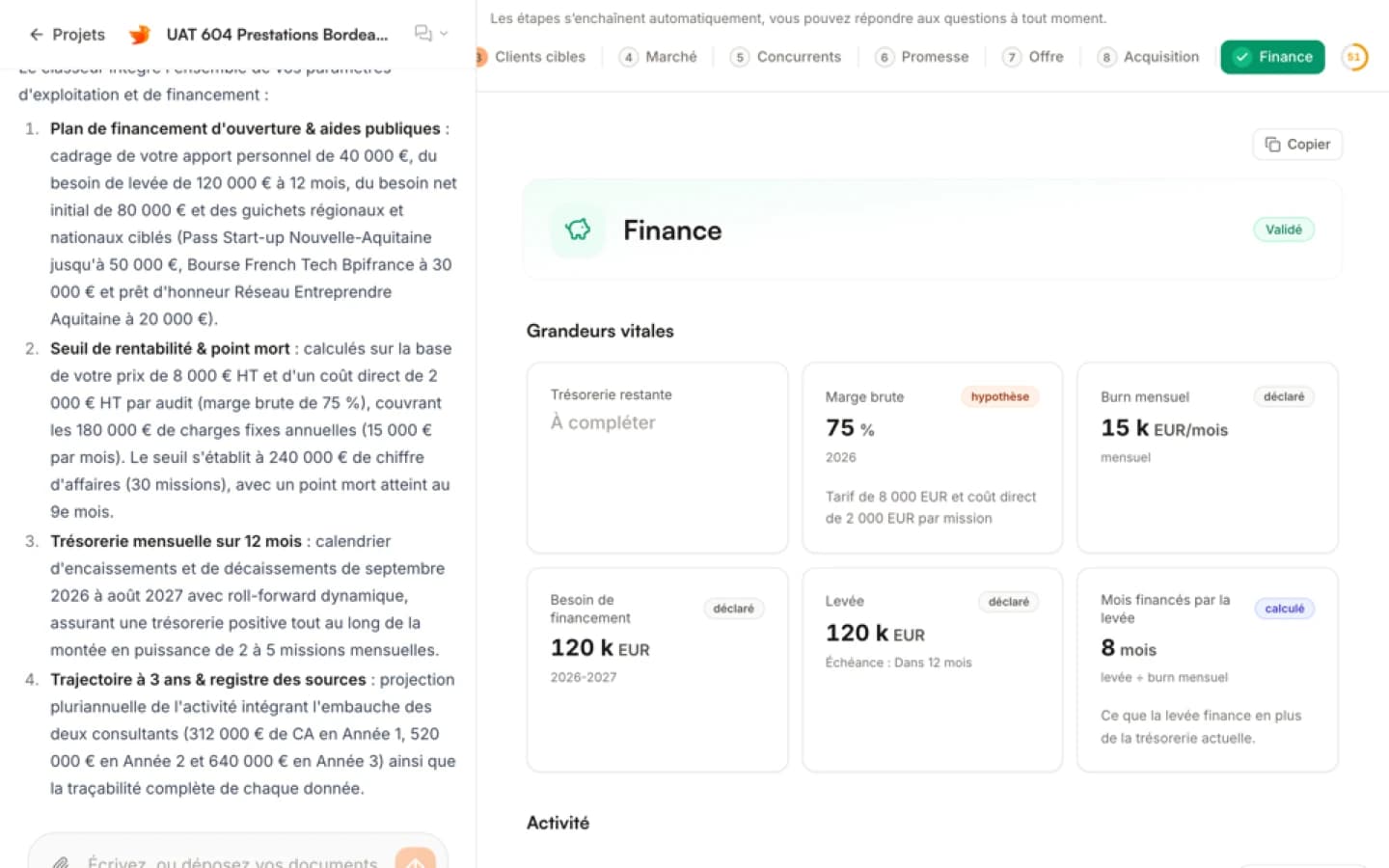
For a bootstrapped founder, this unified approach makes it possible to connect assumptions, evidence, funding needs, and the action plan in one single context. The capability also organises finance, traction, legal, and investor materials in a Data Room connected to the file, which is accessible via the Ember Fund Your Growth Page. This structured environment allows early stage founders to build a comprehensive Business Plan to fund and develop the project, ensuring they remain investment-ready for non-dilutive capital or future strategic partnerships while maintaining their independence.
To place this decision in context, the Knowledge guides for finance brings together deeper guidance on the same field.
Problem
Early stage founders who choose to bootstrap face a unique structural paradox. While they deliberately avoid the dilutive venture capital path to maintain operational control, they still require structured capital to fuel their expansion. Traditional financial planning frameworks are almost exclusively designed for high growth startups aiming for institutional investment. For instance, standard industry guides, such as the startup development phases outlined by Hectelion, typically map a linear journey from pre seed rounds to an initial public offering (IPO). This venture-backed roadmap is poorly suited for a business that must fund its operations through customer revenue and strategic, non-dilutive capital.
Without the cushion of venture capital, a bootstrapped founder must treat every growth decision as a high stakes trade-off. Securing alternative funding, whether through bank loans, government grants, or revenue-based financing, requires a rigorous business plan and a clear financial strategy. As detailed in the startup funding guide by Stripe, aligning your capital acquisition strategy with your specific business stage is critical to avoiding premature scaling or unsustainable debt.
The core challenge for these entrepreneurs is the lack of specialized resources. Most early stage teams do not have a dedicated chief financial officer (CFO) to model complex cash flow scenarios or to stress-test their business assumptions. Founders are forced to spend dozens of hours compiling financial data, organizing legal documents, and guessing which funding options are actually viable for their specific constraints. This administrative burden distracts from product development and customer acquisition, leaving the business vulnerable to cash flow gaps and misaligned growth strategies.
Prerequisites
Before an early stage founder can fully leverage the Fund Your Growth capability within Ember, certain foundational elements must be established. Bootstrapping is not merely about avoiding external funding, it is a deliberate operational model that requires specific inputs to generate actionable strategic outputs.
First, the founder must have a clear view of their current development phase. Whether the startup is in the initial pre-seed validation stage or transitioning toward early commercialization, as detailed in the startup phase framework by Hectelion, knowing where the business stands is crucial. Fund Your Growth uses this developmental context to compare and structure funding scenarios that are realistic for the project's specific stage and geography.
Second, the founder needs to gather their existing operational and financial materials. While bootstrapped companies do not need the exhaustive documentation required for institutional venture capital rounds, they still need a centralized repository of truth. Ember helps organize these finance, traction, legal, and investor materials in a Data Room connected directly to the project file, as outlined on the Ember Fund Your Growth page. Having initial customer contracts, basic financial statements, or early traction metrics ready allows the document analysis feature to identify gaps and connect relevant evidence to future funding decisions.
Finally, there must be a strategic commitment to exploring diverse capital pathways. According to the capital-raising insights shared by Stripe, young enterprises have multiple avenues to secure capital beyond traditional equity dilution. For a bootstrapped Software as a Service (SaaS) founder, this means being prepared to evaluate non-dilutive options such as revenue-based financing, government grants, or bank debt. Fund Your Growth relies on this willingness to look beyond venture capital to build a tailored funding strategy that preserves equity while fueling growth.
To explore this point further, What B2B SME Leaders Should Prioritize in 2026 Ember Guide? details a step directly related to this decision.
Workflow
The workflow of utilizing the Fund Your Growth capability within Ember is designed to turn raw operational data into a defensible, non-dilutive capital strategy. For an early stage founder, this process bypasses the traditional, equity-heavy fundraising narrative to focus entirely on sustainable, self-funded expansion.
The journey begins with context aggregation. The founder uploads existing operational documents, financial statements, and customer contracts. Through document analysis, Ember reads these materials to connect real-world evidence directly to potential funding decisions. This step ensures that the strategic foundation is built on actual traction rather than speculative projections.
Once the initial context is established, the system generates tailored funding scenarios. Rather than presenting a generic list of venture capital options, Ember structures scenarios that align with the constraints of a bootstrapped business model. This involves evaluating revenue-based financing, non-dilutive government grants, or strategic bank debt, mapping these options against the development phases outlined by Hectelion.
Next, the living graph feature maps the entire business model to identify structural vulnerabilities. If a founder's growth plan relies on aggressive customer acquisition but lacks the corresponding working capital, the system highlights this gap. These identified weaknesses are immediately converted into a prioritized action plan, giving the founder clear steps to de-risk the business before seeking alternative capital.
To make these strategies actionable, Ember organizes all finance, traction, legal, and investor materials in a secure Data Room connected directly to the project file, a feature detailed on the Ember Fund Your Growth page. This centralized repository ensures that when the founder is ready to apply for non-dilutive funding or present their metrics to alternative lenders, all supporting evidence is structured, validated, and ready to be defended.
Finally, the validated business plan and Ideal Customer Profile (ICP) context can be bridged to other operational modules. This transition allows the founder to move from financial planning to active customer acquisition, ensuring that the capital strategy directly fuels the daily sales engine.
Expected result
When early stage bootstrapped founders complete the Fund Your Growth workflow, the primary expected result is a highly structured, defensible Business Plan designed to fund and develop the project on their own terms. Instead of chasing dilutive equity, founders receive a clear roadmap of non-dilutive capital options and strategic milestones. This allows them to navigate the early stages of business development without prematurely entering the venture capital cycle, aligning with the funding stages described by Stripe.
Another concrete outcome is the creation of an organized Data Room. This feature automatically structures and centralizes the startup's financial, traction, legal, and investor materials, keeping them directly connected to the main project file. For a bootstrapped business, having these documents audit-ready is essential when applying for bank loans, government grants, or revenue-based financing. It ensures that the operational proof of the business is always visible and verifiable, which is critical for companies progressing through the early growth phases outlined by Hectelion.
Finally, the validated Business Plan does not remain a static document. Because Ember operates as an integrated Artificial Intelligence (AI) team for entrepreneurship, the strategic context, Ideal Customer Profile (ICP), and offer details established during this process can be instantly reused by other capabilities. For instance, this context feeds directly into Lead Intelligence to prepare targeted sales missions, turning high-level financial planning into immediate, outbound commercial action. This transition helps founders bridge the gap between long-term strategic planning and daily revenue generation.
This approach also connects with Before choosing Fund Your Growth, check this evidence, which clarifies the next choice.
Example Ember mission
To illustrate how this works in practice, consider a hypothetical scenario involving an early stage founder of a Business-to-Business (B2B) Software as a Service (SaaS) startup. Having reached initial product market fit through self-funding, the founder wants to accelerate hiring and marketing without diluting their equity. Instead of navigating the complex venture capital ecosystem, they run a strategic mission using the Fund Your Growth capability in Ember.
First, the founder uploads their existing financial spreadsheets, customer billing history, and growth projections. The platform reads these project documents and connects relevant evidence to funding decisions, ensuring that every strategic recommendation is grounded in actual performance data. Rather than presenting a generic list of financing options, Ember replaces a generic list of options with a funding path coherent with the project, focusing on non-dilutive capital sources that respect the operational model of bootstrapping as outlined by PayPro Global.
During this analysis, the system makes available proof, assumptions, and remaining validation gaps visible. For instance, if the founder projects a rapid increase in customer acquisition but lacks the historical conversion data to prove it, Ember highlights this discrepancy. It then turns gaps in the file into prioritised next actions, giving the founder a clear checklist of metrics to validate before approaching non-dilutive lenders. Finally, to ensure the startup is fully prepared for underwriting, the platform organises finance, traction, legal, and investor materials in a Data Room connected to the file, as detailed on the Ember Fund Your Growth page. This structured preparation allows the bootstrapped founder to structure their funding file while keeping control of their equity.
Limits and non-fit
While the Fund Your Growth capability provides early stage bootstrapped founders with a structured path to build a Business Plan to fund and develop the project, it is not a universal solution for every business scenario. Understanding where the tool does not fit prevents misaligned expectations and ensures founders use the right tool for their specific operational stage.
First, Fund Your Growth is not designed for founders seeking automated, high-volume outbound sales execution. If your primary objective is to build a massive contact list and run automated email sequences without deep contextual filtering, established platforms like Apollo are highly effective.Ember does not replace these high-volume outbound engines. Instead, its Lead Intelligence capability focuses on contextual prioritization, reusing the Business Plan, Ideal Customer Profile (ICP), and strategy to identify high-value conversations.
Second, Ember does not offer automatic synchronization with every Customer Relationship Management (CRM) platform. Founders looking for a tool that silently and automatically syncs all CRM data in the background will see this as a limitation.
Third, the capability is not a shortcut for projects lacking basic operational data or proof of concept. While the tool organizes finance, traction, legal, and investor materials in a Data Room connected to the file, as detailed on the Ember Fund Your Growth page, it cannot invent traction where none exists. For founders in the absolute earliest ideation phase who have no metrics, customer feedback, or financial assumptions, the structured exercises of traditional startup guides, such as those provided by Stripe or the growth phase frameworks outlined by Hectelion, may be more appropriate initial reading.
Finally, access to the Fund Your Growth capability is enabled progressively depending on the account, meaning some advanced features may not be immediately active upon registration. It is also critical to note that Ember does not guarantee that funding will be obtained. The tool provides the strategic structure and helps organize the necessary materials, but the ultimate success of securing non-dilutive capital or revenue-based financing remains dependent on the intrinsic strength of the business and the founder's execution. For Software as a Service (SaaS) companies committed to pure bootstrapping, as discussed by PayPro Global, the tool serves as a strategic guide rather than an automated funding guarantee.
In practice, Which Funding Strategy Fits a B2B Founder With Revenue but? completes this framework with another angle on the same topic.
When to use it
For an early stage founder, knowing exactly when to transition from pure organic growth to external capital is a critical turning point. The Fund Your Growth capability within Ember is designed for specific moments in a bootstrapped company's lifecycle when intuition must be backed by a structured, defensible strategy.
The first key scenario occurs when a founder needs to transition from organic cash flow to structured non-dilutive funding. While bootstrapping allows for maximum equity control, as explained by PayPro Global, it can sometimes limit the speed of product development or market entry. When a Software as a Service (SaaS) founder identifies a clear market window but lacks the immediate cash to hire key engineers or scale marketing, Fund Your Growth helps build a structured Business Plan. This plan maps out alternative funding options, such as revenue-based financing or local innovation grants, allowing the business to accelerate without giving up equity.
The second scenario is when preparing a professional application for non-dilutive capital providers. Unlike traditional Venture Capital (VC) firms that might prioritize high-risk market capture, non-dilutive lenders, banks, and public institutions demand strict financial discipline and clear proof of traction. According to insights on capital acquisition from Stripe, presenting a well-structured case is essential for securing these funds. Founders can use the Fund Your Growth capability to organize their finance, traction, legal, and investor materials in a secure Data Room connected directly to their strategic file, as detailed on the Ember Fund Your Growth page. This ensures that all supporting evidence is instantly accessible and aligned with the funding request.
The third scenario involves long-term strategic planning and scenario modeling. As a bootstrapped startup matures through different growth phases, potentially looking toward future milestones like an Initial Public Offering (IPO) as discussed by Hectelion, the founder must constantly weigh the cost of capital against dilution. Fund Your Growth allows founders to compare different funding scenarios side by side, analyzing how different choices impact their control, runway, and execution timeline. This helps entrepreneurs make proactive decisions rather than reacting under financial pressure.
Next step
For an early stage founder navigating the transition from pure bootstrapping to structured growth, the immediate priority is to turn raw business data into a defensible strategy. The most practical next step is to consolidate your current operating context, including your traction metrics, financial assumptions, and legal documents, to identify what is missing before you present your case to external partners.
By using Ember and its Fund Your Growth capability, you can centralize these scattered elements. The platform automatically organizes your finance, traction, legal, and investor materials into a secure Data Room connected directly to your project file. This process does not just store your documents, it actively analyzes your business model to highlight critical blind spots.
Instead of guessing what an investor or a non-dilutive funding provider will ask, you can let the system turn the identified gaps in your file into prioritized next actions. This allows you to systematically build a robust Business Plan to fund and develop your project on your own terms. By taking this step today, you shift from reactive management to executing a clear, structured roadmap that protects your equity while securing the capital your business needs to scale.
Before deciding, Can You Build a Trusted Financial Model Without a CFO? helps connect this method with adjacent priorities.
Sources
To ensure a reliable and objective framework for bootstrapped founders evaluating their growth and funding options, this article relies on verified industry insights and structured methodologies.
The foundational concepts of self-funding and organic growth are grounded in the PayPro Global guide on Software as a Service (SaaS) bootstrapping, which outlines the core principles, advantages, and challenges of building a business without initial venture capital. When transitioning from bootstrapping to external funding, the strategic pathways and capital requirements are informed by the Stripe startup capital guide, which details how early-stage companies can raise capital across different development stages. Additionally, the progression from early-stage growth to mature corporate structures is mapped using the Hectelion analysis on startup development phases, which provides a clear framework for navigating the journey from pre-seed to an Initial Public Offering (IPO).
These sources complement the capabilities of Ember, particularly the Fund Your Growth capability, which helps founders structure their business plan and organize critical materials in a dedicated Data Room connected directly to their project file as detailed on the Ember Fund Your Growth page.
Sources
FAQ
Mini audit
Test your Business Plan
Identify strengths, missing proof and the next priority.