
Context and ICP
Early-stage founders preparing to raise capital often face a common trap: they focus on visual slide design before securing the underlying business logic. According to startup strategy insights from Silicon Valley Bank, building a compelling pitch deck requires a clear understanding of the business model, milestones, and funding requirements. Without a rigorous foundation, even the most beautiful slides fail to convince investors. This is where the strategic alignment between a founder's business plan and their pitch deck becomes critical.
To move decisions forward, a presentation must help the audience understand, believe, and act, as outlined in the Ember guide on pitch deck conviction. For an early-stage founder, the primary use case of the Fund Your Growth capability in Ember is to establish this strategic substance. Instead of treating the pitch deck as an isolated design exercise, founders can use Fund Your Growth to build a Business Plan to fund and develop the project. This module connects assumptions, evidence, funding needs, and the action plan in one context, ensuring that every claim made on a slide is backed by a coherent, defensible strategy.
By structuring funding options from project context, founders can avoid presenting generic financial projections. They can analyze historical examples, such as the curated list of more than 35 startup presentations hosted by Slidebean, to understand how successful companies structured their early narratives. With Ember, which acts as an artificial intelligence (AI) team for entrepreneurship, founders can organize finance, traction, legal, and investor materials in a Data Room connected directly to their file. This ensures that when an investor asks for the data behind a slide, the proof is already structured and accessible, transforming the pitch preparation from a superficial design task into a robust fundraising strategy.
To place this decision in context, the Knowledge guides for finance brings together deeper guidance on the same field.
Problem
Early-stage founders frequently make the mistake of treating pitch deck preparation as a graphic design exercise rather than a strategic alignment process. They spend valuable time polishing slides using standard presentation software, which is perfectly adequate for basic layouts but entirely disconnected from the operational reality of the business. This disconnect creates a fundamental vulnerability when presenting to investors. If the financial projections, growth assumptions, and funding requirements do not form a cohesive, defensible strategy, the pitch falls apart under basic questioning.
While studying successful pitch deck examples from over 35 startups compiled by Slidebean can provide visual inspiration, it does not solve the underlying challenge of structural integrity. Founders need to ensure that their business plan, milestones, and capital requirements are fully validated before they even begin drafting their slides. Without a structured foundation to organize their financial, traction, and legal materials, they risk pitching a narrative that lacks substance and fails to secure the necessary capital.
Prerequisites
To prepare an investor-ready pitch deck, early stage founders must first establish a rock-solid business foundation. The primary prerequisite for any persuasive presentation is a coherent business plan and a clear funding strategy. Without these elements, slides remain superficial. This is where the Fund Your Growth capability in Ember becomes essential. Instead of jumping straight into visual design, founders need to structure their core assumptions, financial projections, and strategic milestones.
According to historical pitch deck examples analyzed by Slidebean covering more than 35 startups, the most successful fundraising rounds are built on clear operational metrics and structured business models rather than flashy graphics. By using Fund Your Growth, founders can build a Business Plan to fund and develop the project, ensuring that every claim made on a slide is backed by rigorous planning.
Another critical prerequisite is the organization of supporting documentation. Investors do not just look at the slides; they perform due diligence on the underlying data. The Fund Your Growth capability addresses this by organizing finance, traction, legal, and investor materials in a Data Room connected to the file. This ensures that when founders transition to Creation to generate and edit their presentation, or use Speaking practice to record, replay, and rehearse their pitch, they have a single, unified source of truth.
Furthermore, establishing an Ideal Customer Profile (ICP) and defining the target market are crucial steps before launching any fundraising or sales initiative. This structured context can later be reused by other capabilities like Lead Intelligence to prepare sales missions and monitor market signals, creating a continuous loop between fundraising strategy and operational execution.
To explore this point further, Building and Funding Your Project Without the Wrong Strategy details a step directly related to this decision.
Workflow
The workflow begins by using the Fund Your Growth capability to build a Business Plan to fund and develop the project. Instead of jumping straight into slide design, the founder uses this stage to align their financial assumptions, traction metrics, and operational milestones. This step ensures that the narrative is built on a foundation of strategic truth rather than superficial assumptions.
As the business plan takes shape, Fund Your Growth organizes finance, traction, legal, and investor materials in a Data Room connected to the file. This ensures that every claim made in the pitch deck is backed by verifiable evidence, which is critical when moving from initial interest to due diligence.
Once the core strategy is validated within the shared workspace context, the founder can transition to Creation to build the actual presentation. According to resources on presenting projects to make audiences understand, believe, and act, which can be explored on the Ember knowledge base, a pitch deck must be grounded in real substance. Rather than starting from a blank page or copying generic templates, the presentation is generated directly from the structured business plan context.
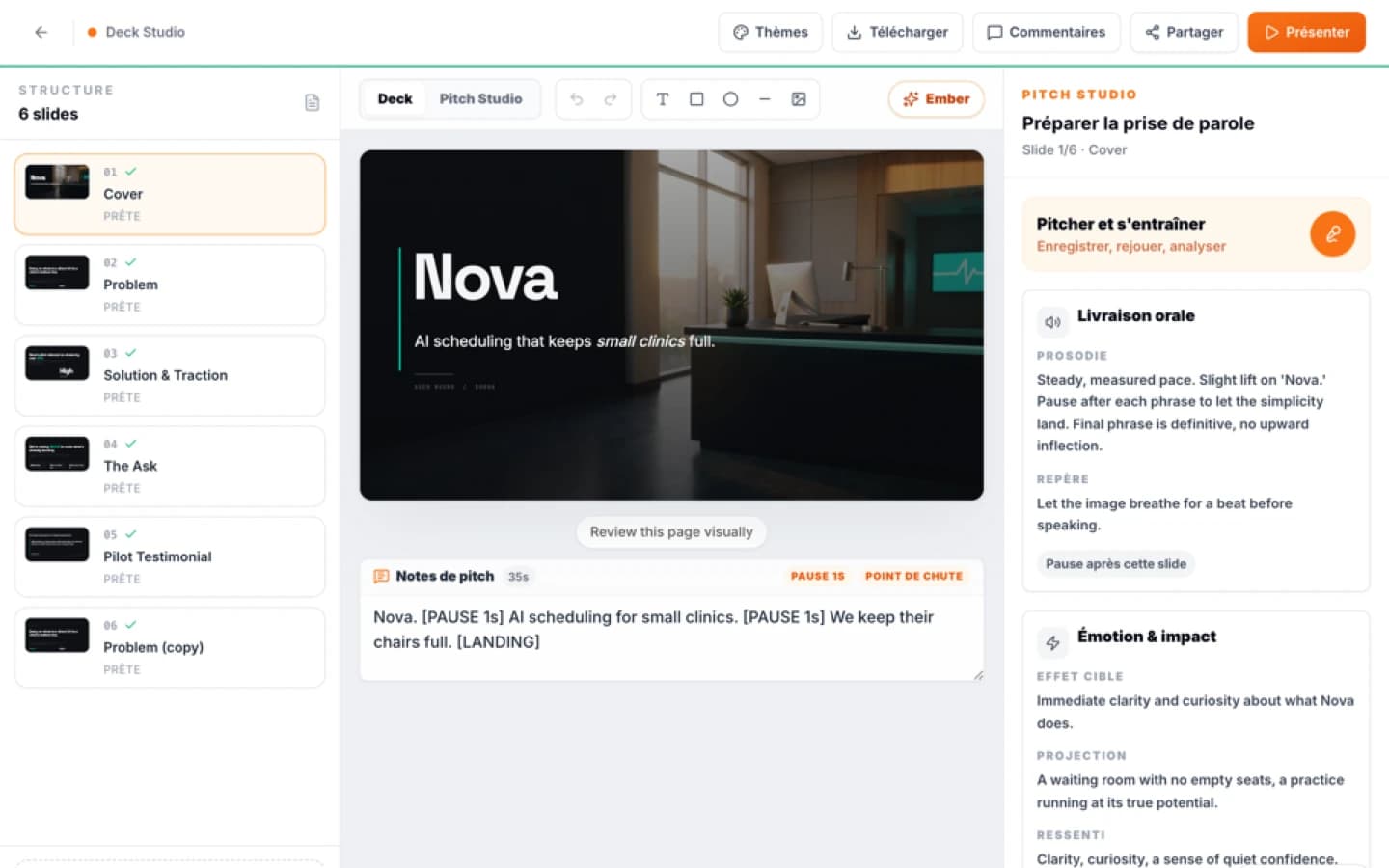
After generation, Ember lets users edit the generated presentation in Creation to fine-tune the narrative flow. Founders can also look at historical examples of successful presentations, such as those analyzed in the collection of over 35 startup pitch decks compiled by Slidebean, to understand how top-tier companies structured their early narratives. To prepare for live investor meetings, Ember lets users record, replay, and rehearse the presentation in Speaking practice, analyzing delivery and structure before pitching. This integrated workflow ensures that the final presentation is not just visually polished, but strategically defensible from the first slide to the final appendix.
Expected result
By completing this strategic preparation with the Fund Your Growth capability, early stage founders achieve a level of readiness that goes far beyond visual polish. The immediate expected result is a pitch deck built on verified business logic rather than hopeful projections. Instead of presenting a generic list of funding options, the founder presents a highly coherent funding path tailored to their specific project constraints and milestones.
Another critical outcome is the automatic organization of supporting evidence. The system organizes finance, traction, legal, and investor materials in a Data Room connected to the file. This means that when an investor expresses interest, the founder does not scramble to compile spreadsheets. The underlying proof is already structured and accessible, matching the narrative presented in the slides. This aligns with the core philosophy detailed in Ember's guide on persuasive presentations, which emphasizes presenting a project to make audiences understand, believe, and act.
While traditional design platforms are good enough for basic slide layouts, as shown by Slidebean's pitch deck examples, they lack this deep connection to the underlying business data. With Ember, the validated context from the business plan flows naturally into the presentation phase. Once the strategic foundation is set, the founder can edit the generated presentation in Creation and even record, replay, and rehearse the presentation in Speaking practice to perfect their delivery. The final result is a complete fundraising package where the pitch deck, the financial model, and the supporting documents tell a single, unified story.
This approach also connects with How to Build and Fund a Project Without Choosing the Wrong?, which clarifies the next choice.
Example Ember mission
To illustrate how this works in practice, consider a hypothetical scenario where an early stage founder is preparing a pitch deck to secure their first major round of funding. The founder begins by uploading their initial financial models, market assumptions, and early customer feedback into the workspace.
The Fund Your Growth capability immediately reads these project documents and connects the relevant evidence directly to the funding decisions, as detailed in the Ember Fund Your Growth documentation. Rather than leaving the founder to navigate a generic list of options, the system structures a coherent funding path tailored to the specific stage and constraints of the business. It maps out the available proof and makes any remaining validation gaps visible, turning those gaps into prioritised next actions.
While studying successful historical examples, such as the pitch decks of more than 35 startups analyzed by Slidebean, can provide excellent structural inspiration, the actual substance of the presentation must be airtight. By using Ember, the founder can organize their finance, traction, legal, and investor materials in a dedicated Data Room connected directly to the file, as detailed on the Ember Fund Your Growth page. This ensures that when the founder transitions to building their slides, the narrative is backed by a living graph of verified business logic. This thorough preparation helps the founder present their project in a way that truly makes investors understand, believe, and act, which is the ultimate goal of any persuasive presentation, as highlighted in the Ember guide on pitch decks.
Limits and non-fit
While the Fund Your Growth capability provides a structured foundation for early stage founders, it is important to understand its boundaries and where it is not the right fit.
First, Fund Your Growth is designed to build the strategic substance of your business plan, not to handle the aesthetic layout of your slides. Founders looking purely for visual polish or quick slide templates without doing the underlying strategic work will find that this capability is not a shortcut for superficial design. The actual creation and editing of presentations happen in Creation, and the product bridges that connect your validated business plan context to your slides only activate once that required strategic context is fully validated.
Second, the tool does not replace the founder's judgment. The entrepreneur must approve, reject, or edit proposals before they enter the file. It is an interactive experience that relies on your active participation to refine assumptions and verify evidence.
Third, using this capability does not guarantee that funding will be obtained. While it helps you organize your finance, traction, legal, and investor materials in a Data Room connected to the file, the final investment decision always rests with the investors.
Additionally, access to the Fund Your Growth capability is enabled progressively depending on the account, meaning some advanced features may not be immediately available to all users from day one. Finally, for founders who already have a fully validated, investor-ready business plan and only need to rehearse their oral presentation, using the strategic structuring modules of Fund Your Growth would be redundant. In those cases, moving directly to Speaking practice is a more appropriate path.
In practice, How should a founder read a term sheet before signing? completes this framework with another angle on the same topic.
When to use it
Early stage founders should use the Fund Your Growth capability of Ember at three specific moments during their fundraising preparation.
First, use it before writing a single slide to establish the strategic foundation of the business. While traditional presentation software or generic templates are perfectly adequate for basic slide layouts, they cannot help you validate your underlying business model. Fund Your Growth allows you to build a Business Plan to fund and develop the project by connecting your assumptions, traction metrics, and operational milestones in a single context. This ensures your narrative is grounded in business reality before you begin designing. For guidance on structuring these initial slides, founders can consult the Silicon Valley Bank guide on creating a pitch deck.
Second, use it when you need to define your funding strategy and evaluate different capital paths. Instead of presenting a generic funding request, you can use Ember to structure funding options and compare scenarios tailored to your specific stage, geography, and operational constraints. This preparation helps you answer tough investor questions about how you plan to allocate capital. To see how successful startups have historically presented their financial milestones, you can explore historical references such as the Slidebean pitch deck examples.
Third, use it when preparing for the due diligence phase that follows the initial pitch. A compelling presentation only opens the door, but securing capital requires verifiable proof. You should use Fund Your Growth to organize your finance, traction, legal, and investor materials in a Data Room connected directly to your strategic file. This ensures that every claim made on your slides is backed by structured evidence, helping you move from an initial conversation to a closed deal. This transition from a visual pitch to a defensible strategy is critical to make investors understand, believe, and act, as detailed in the Ember guide on pitch deck impact.
Next step
To move your fundraising preparation forward, the immediate priority is to transition from raw ideas to a structured, defensible file. A successful fundraising process requires more than just an appealing presentation. It demands a narrative that makes investors understand, believe, and act, a methodology detailed in Ember's guide on presenting your project with impact.
To begin structuring your narrative, you can study historical benchmarks, such as the pitch deck examples of more than 35 great startups compiled by Slidebean, or review the fundamental requirements of early stage fundraising outlined in Silicon Valley Bank's guide on creating a pitch deck for investors.
Once you have gathered your initial assumptions, the next practical step is to centralize your strategic foundation. By using the Fund Your Growth capability within Ember, you can build a comprehensive Business Plan to fund and develop your project. This capability automatically analyzes your uploaded materials, turns remaining gaps in your file into prioritised next actions, and organises your finance, traction, legal, and investor documents in a secure Data Room connected directly to your file. Instead of managing scattered spreadsheets and draft slides, you can establish a single, coherent source of truth that is ready to be transformed into a high conviction presentation.
Before deciding, Essential financial documents for a Series A data room helps connect this method with adjacent priorities.
Sources
To ensure the strategic insights provided in this article are grounded in industry standards and proven methodologies, we analyzed foundational resources on startup fundraising and presentation design.
Silicon Valley Bank (SVB) provides guidance on how early-stage founders can build essential fundraising skills and structure their presentations for investors, as detailed in their guide on How to create a pitch deck for investors. To understand how successful companies have historically structured their narratives, founders can study real-world references such as the collection of Exemples de Pitch Deck de plus de 35 startups géniales curated by Slidebean. For founders looking to align their presentation with a strategic foundation, Ember outlines a clear methodology to make investors understand, believe, and act in the resource Pitch deck: make investors understand, believe and act, with Ember.
Sources
FAQ
Mini audit
Test your Business Plan
Identify strengths, missing proof and the next priority.