
Symptom or signal
For many early-stage founders, preparing a pitch deck reveals a deeper question: how to build and fund the project without picking the wrong strategy. The first symptom is often a slide deck that seems disconnected from the financial reality of the company. Founders commonly start from generic templates, such as the slide structure described in the CCI Aix-Marseille-Provence pitch deck guide, to organise their presentation. That guide sets out a classic sequence: cover, problem, solution, market, product, business model, traction, competition, team and financing, in ten to fifteen slides. It helps organise the visual flow, but it does not by itself align the business model with a workable funding roadmap.
The real signal of a weak strategy is a deck that cannot articulate a coherent financial path. To raise capital, a presentation has to do more than look professional. It must help the audience understand the opportunity, believe the assumptions and act on the decision, a principle discussed in Ember's guide on making an audience understand, believe and act. When a founder cannot explain how the funding need matches the milestones, there is a risk of presenting the wrong instruments to the wrong investors.
A quick check: on the financing slide, can you state the amount you are seeking, what it will be used for, and which milestones it reaches? If the answer changes depending on who asks, the plan behind the deck is not yet settled.
Another sign is that the numbers on the slides have never been checked against a written plan. The founder has typed them from memory or from an old spreadsheet, and nobody, including the founder, can say quickly which assumption each number rests on. When the deck is the only place where the figures live, any question about them becomes a risk.
Read your own deck with one question in mind: which slide would I be unable to defend with a document? That slide is where the plan needs work.
To place this decision in context, the Knowledge guides for finance bring together deeper guidance on the same field.
What changed
The pitch deck and the business plan are often treated as two separate documents: one to tell a story, the other for compliance. The separation sometimes creates a gap, where the story told to investors did not match the operational and financial reality of the company.
The CCI guide keeps the documents distinct and explains why. The business plan is an exhaustive, multi-page document, useful for loans and grants. The pitch deck is a short presentation for a meeting, and the elevator pitch is a spoken statement of thirty to ninety seconds. Each has its own job, but the numbers and claims must be the same in all three.
What matters is coherence. An audience that reads a deck expects the figures on the business-model and financing slides to hold up when it asks for the underlying plan. The tools have moved in the same direction: in Ember, the context that feeds Creation includes a Fund Your Growth file when one is linked. The composer shows what is reused, namely the name of the file, the number of validated building blocks and a marker for each block. A block that is only proposed is not carried over, and a validated block with no filled field produces no invented line.
The consequence for a founder is simple: build the plan first, then the deck from the plan, rather than two documents that drift apart.
The reader matters too. Investors, lenders and grant officers each look for different things: an investor tests the size of the opportunity and the team, a lender tests the ability to repay, a grant officer tests eligibility conditions. One deck cannot serve all three unchanged, which is another reason to keep a common plan and adapt the presentation to each reader.
The practical consequence is a habit: whenever a number changes in the plan, update it everywhere the same day, in the deck, in any summary and in any file already shared.
Facts and sources
Three groups of facts support this guide.
The CCI Aix-Marseille-Provence guide, opened and read for this version, describes the pitch deck as a visual presentation of ten to fifteen slides meant to convince investors, juries or partners, and to illustrate the founder's speech without replacing it. It cites the 10-20-30 rule attributed to Guy Kawasaki (ten slides, twenty minutes, thirty-point font), lists the ten essential slides, and distinguishes a deck presented live (strong visuals, little text) from a deck sent by email (self-explanatory). It also lists frequent mistakes: too much text, denying the existence of competitors, unrealistic hockey-stick projections, a missing or buried team slide, vague use of funds and inconsistent design.
Ember's own guide states that narrative structure should come before visual design and that the presentation should help the audience understand, believe and act.
The description of Fund Your Growth comes from the product: nine building blocks (project, why, ideal customer, market, competitors, promise, offer, acquisition, finance), targeted questions, human validation of each proposal, a plan of action, and a Data Room that opens linked to the file. The module is available progressively depending on the account, and it does not guarantee financing.
None of these sources measures how often a coherent plan leads to funding, and this guide does not claim any such figure. The facts it relies on are descriptive: what a deck usually contains, what mistakes are frequent, and what the product does. Where a number is given, such as the ten to fifteen slides, it is attributed to the guide that states it.
Why the common explanation is incomplete
The usual explanation is that a good deck needs a good template: follow the standard sequence, keep text short, respect the ten-slide discipline. That advice is sound and the CCI guide explains it well. It is incomplete because a template gives the container, not the content.
A template tells you that slide six is the business model and that it should show price, margins, customer acquisition cost, lifetime value and recurring revenue. It cannot tell you whether those numbers are right for your company, how they relate to your hiring plan, or what they imply for the amount you should raise. Those answers come from work that happens outside the deck.
The same is true for the financing slide. The guide asks for the amount and the use of funds, but choosing whether to seek equity, a loan or a grant depends on the stage, the country and the constraints of the project. A deck that is formally perfect can still present an instrument that does not suit the project.
There is also a timing issue. Templates are usually followed at the end of the process, when the story is already told, whereas the plan questions come first. A founder who starts from the template fills slides with what is known and leaves blanks where the plan is missing; a founder who starts from the plan knows in advance which slides are strong and which are thin.
None of this makes templates useless. They remain a good way to check that no essential slide is missing once the content exists.
The real problem
The real problem is a lack of alignment between three things: the story, the numbers and the funding instrument.
The story is what the deck tells. The numbers are what the business plan holds: assumptions, projections, milestones. The instrument is the way the project will be financed: equity from investors, a loan, a grant or the founders' own resources. When one of the three changes, the other two must follow. A founder who revises the growth assumption but leaves the funding amount untouched creates an inconsistency that a careful investor will find.
The frequent mistakes listed in the CCI guide are often symptoms of this misalignment. Unrealistic projections come from numbers not tied to evidence. Vague use of funds comes from a plan that has no milestones. A denied competitor comes from a story built before the market analysis. Fixing the slide does not fix the cause, which sits upstream in the plan.
The same logic applies to the audience. A story that works for a friendly first conversation may collapse under a request for the plan. If the plan already exists and matches the deck, the request becomes an opportunity instead of a risk.
A useful discipline is to write, for each slide, the source of the main claim: a document, a conversation, a calculation or an assumption. Slides with no source are the ones to fix first.
Seen this way, the deck is a view of the plan, and the plan is the thing to maintain.
How the mechanism works
The sequence that holds the three elements together has five steps.
One, define the objective. In Fund Your Growth the founder chooses a goal that becomes a file: test my idea, raise funds, loan or grant, business plan, or bootstrap, and states the country of the project.
Two, build and validate the plan. The agent reads the project documents, asks only the questions still useful, and works through the nine blocks. The finance block reuses answers from the others, with visible and editable assumptions, and funding scenarios adapted to the stage, geography and constraints. The founder approves, rejects or edits each proposal before it enters the file.
Three, produce the deck from the plan. In Creation, the founder chooses a format, a document language and possibly a template. The workflow proposes three templates with a preview, asks the questions that are useful and asks for confirmation before creating. The deck is one of eight formats, and it is the only one that can be exported to PDF and PowerPoint.
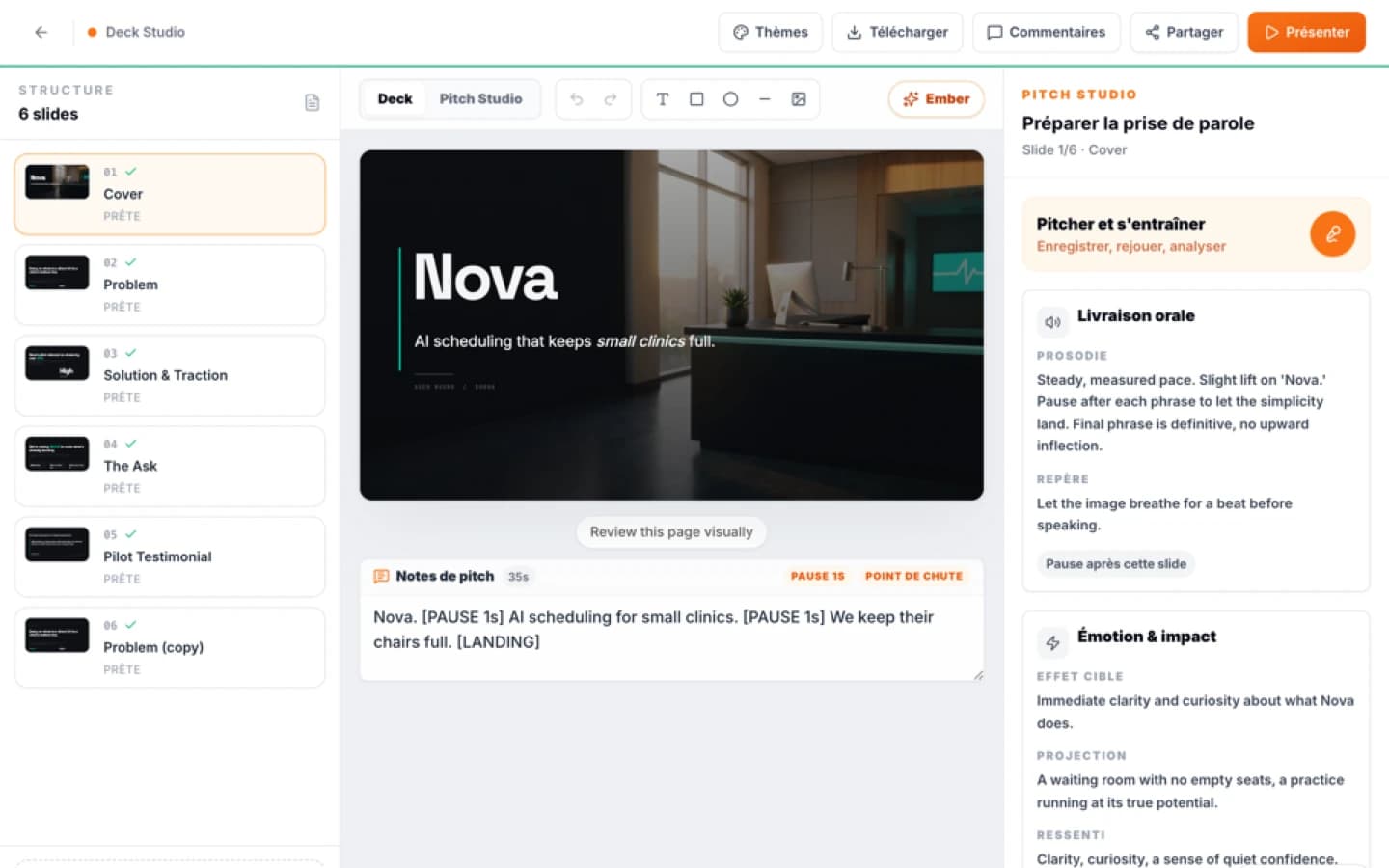
Four, refine the deck page by page or zone by zone in the editor.
Five, practise. Speaking practice, reserved to decks, lets the founder record and replay a presentation and receive an analysis of rhythm, clarity, impact and structure. It does not promise any result.
Two details keep the sequence honest. First, questions are asked only when still useful, and skipping the framing questions in Creation simply launches the generation with the answers available. Second, a request made in a Second Brain conversation is never generated on missing information, so an incomplete brief is flagged instead of being filled with invented content.
After the deck is generated, texts are fitted to their zones and may be shortened once by the model, and remaining overflows are reported. A fitting warning is not proof of a flawless page, so read each page before sending.
Concrete examples
Example 1, the financing slide. A founder writes on the last slide that she is raising a round to grow. An investor asks what the round covers. In the plan, the finance block shows the amount, the use of funds and the milestones. She updates the slide from the plan, and the answer is the same on paper and in the room.
Example 2, the wrong instrument. A founder with little traction prepares an equity deck for investors. The plan, built by objective and country, shows that a loan or a grant may match the current stage better. He keeps the equity path for later and prepares a shorter file for the first instrument. As always, aids must be checked against the conditions of the issuing body, and amounts not established stay marked to be confirmed.
Example 3, the live deck and the sent deck. The CCI guide distinguishes a deck presented live from a deck sent by email. The same plan can produce both: a visual deck with little text for the room, and a more explanatory version for the inbox. The numbers stay identical.
These examples illustrate the reasoning; they are not accounts of real cases.
Example 4, the plan review. Before sending the deck, the founder reads the plan as a lender would: is each number tied to an assumption, is each assumption marked proven, declared or assumed, and does the funding amount follow from the milestones? Two assumptions turn out to be declared without proof. She adds them to the list of items to validate, and rewrites one slide to say plainly that the figure is an estimate.
In each of these examples the founder ends with a document that says what is known, what is estimated and what remains to be validated. That is the real deliverable, more than the slides themselves.
A last variation: a founder who is only starting to explore financing writes the one-page plan and stops there, without producing a deck. That is a valid outcome if the plan shows that the project is not ready for investors yet.
When to use this diagnosis
Use this approach when you are preparing a deck for a financing conversation and the plan behind it is not written, or when the deck and the plan have been produced by different people or at different times.
It suits founders who must choose among several instruments and want to compare them for their stage and country, and teams who need a single file that several people can read.
It also helps when a first meeting has raised questions about the numbers, since these are the questions the deck cannot answer alone. In that case, going back to the plan is more productive than redesigning slides.
If you decide to use a tool, keep the human steps: read each proposal, correct it with what you know from your customers, and date the versions.
It is also a good moment to use it when a deadline forces a choice between instruments, for example a grant call with a closing date. Working from the plan tells you quickly whether the project meets the conditions and what is still missing, so you can decide whether to apply or to wait.
Teams with several founders benefit most, because a shared plan prevents each person from carrying a slightly different version of the numbers.
When not to use it
This approach is too heavy for a quick internal presentation or a routine update where nobody will challenge the numbers. A simple design tool is enough.
It is also premature if the project is not yet defined enough to state a customer and an offer. In that case, talk to customers first.
It does not replace legal, tax or accounting advice: questions on equity structure, grant conditions or loan terms are to be validated with the relevant professional and with the issuing body.
Finally, no tool guarantees financing. Fund Your Growth prepares a file and Creation prepares a deck; the decision belongs to the investor or the lender. Fund Your Growth is also available progressively depending on the account, so check what is enabled on yours.
If your deck is meant for a sales audience or a customer rather than a funder, the reasoning changes: the plan is less relevant, and the narrative of the customer's problem matters more.
It is also unnecessary if you already have a plan that has been reviewed by an accountant or an adviser and your deck simply needs a visual refresh.
Next step
Choose one concrete action. Write on one page the amount you seek, the use of funds and the three milestones they reach. Then check that the business-model slide of your deck uses the same numbers.
If the plan is not written, start with the objective and the country, then list your assumptions and mark each as proven, declared or assumed. When the plan holds, produce the deck from it and rehearse aloud.
If you want a structure to hold the plan, Fund Your Growth links hypotheses, evidence, funding needs and the action plan in one context. The related article on key evidence before choosing Fund Your Growth can help you decide what to check first.
Set a date to review the alignment again, for instance after each significant customer conversation or before each meeting. A plan and a deck that were aligned last month can drift as soon as new information arrives, and the review takes little time when it is done regularly.
Then send the deck, and keep the plan ready to open if it is requested.
Sources and methodology
This guide draws on two sources opened and read for this version: the CCI Aix-Marseille-Provence pitch deck guide and Ember's guide on making an audience understand, believe and act. The slide structure, the 10-20-30 rule and the list of frequent mistakes come from the CCI guide; the principle of narrative before design comes from the Ember guide. The description of Fund Your Growth and Creation comes from the documented behaviour of the products. The examples and the five-step sequence are editorial suggestions, not measured results. Product availability can change.
Sources
FAQ
Mini audit
Test your Business Plan
Identify strengths, missing proof and the next priority.