
Claim to verify
A founder who wants to validate a market before choosing a funding path has one claim to check first: that a real market exists and is willing to pay. Having a good idea is not evidence. The question this guide answers is narrower and more practical: what should you be able to show, and what should you check, before choosing a structured approach such as Ember's Fund Your Growth?
The answer depends on the stage. Hectelion's publication on startup development phases describes the early stage as an exploration phase, where the startup identifies a problem and tests whether a solution is feasible, and where the business model is not yet stable. The seed phase that follows is a validation phase, where the product meets the market and first sales, active users or partnerships appear as tangible signals. So the claim to verify at the very beginning is whether your assumptions about the customer's problem match reality.
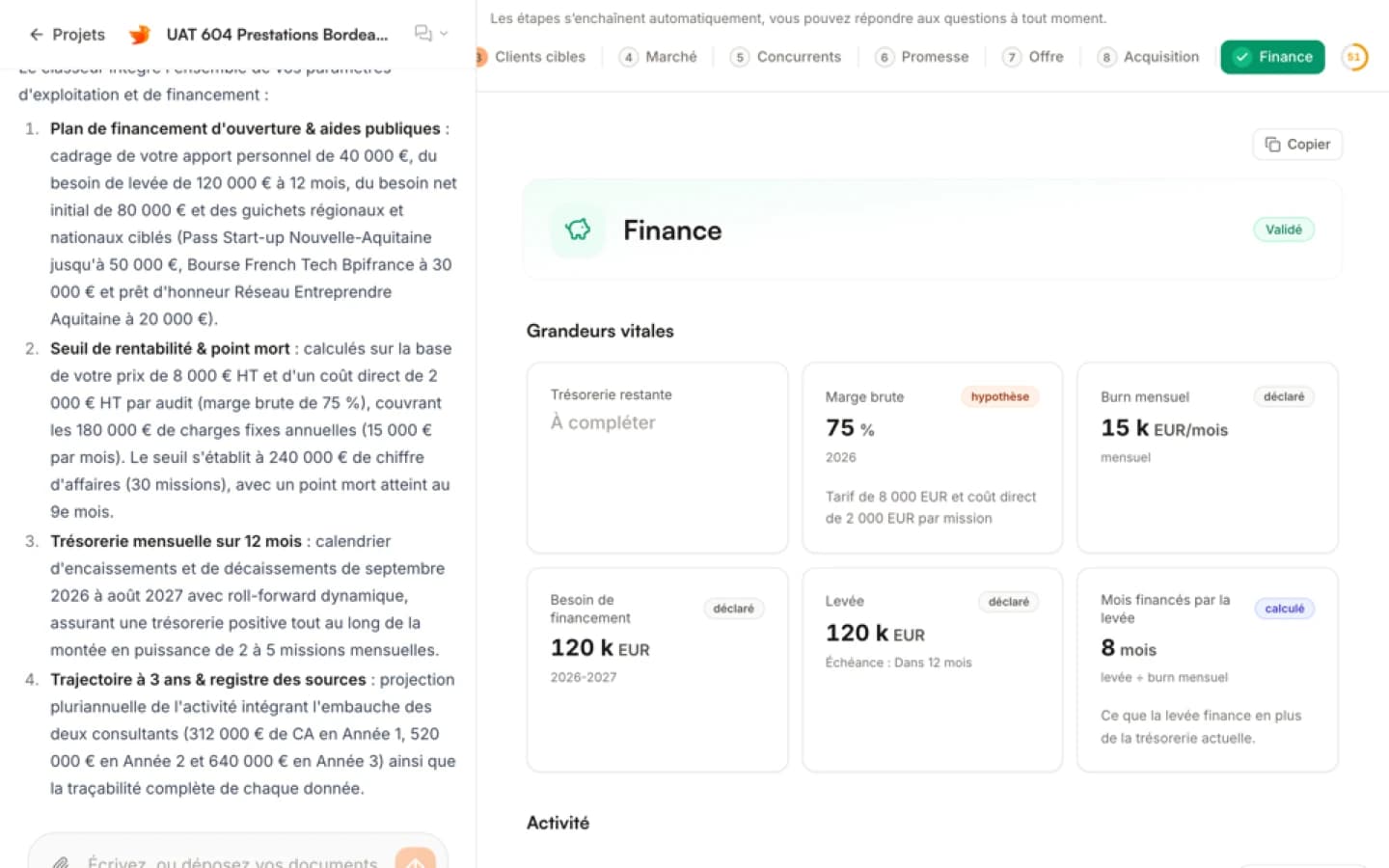
Fund Your Growth is designed for this work. It guides a founder through nine building blocks of a project and connects hypotheses, evidence, funding needs and the action plan in one context. It makes visible which proofs exist, which assumptions remain and which gaps still need validation, so that you know what to test before presenting to investors. The founder approves, rejects or edits each proposal before it enters the file, and the module does not guarantee financing.
The stakes are practical. A founder who commits to a funding path on the strength of enthusiasm alone risks building a plan that the first serious reader can take apart. A founder who starts from a clear statement of what is proven can choose a path, and change it, on real grounds.
A simple test: can you state, in three sentences, the problem, the customer and the evidence you hold? If not, the first work is to clarify these, before any question of funding.
To place this decision in context, the Knowledge guides for finance bring together deeper guidance on the same field.
Methodology
A useful method has three steps, and each maps to something you can do with or without a tool.
Step one is to separate assumptions from proof. Write down every statement your plan relies on: who has the problem, how often, what they use today, what they would pay. Mark each one as proven (you have a document, a customer conversation or data), declared (you say so, without a source), or assumed. Fund Your Growth uses a similar distinction: it separates proofs by level (document, reference, web, declared, hypothesis), so a hypothesis is never presented as traction.
Step two is to structure the evidence for outside scrutiny. Gather early traction signals, financial projections, legal documents and investor materials so that every claim in the plan can be backed by an accessible document. In Ember, once the last decision is made, the Data Room opens linked to the file with seven folders: file, identity, market, commercial, finance, legal and documents.
Step three is to keep editorial control. A founder should read and decide on each proposal rather than accept an automatic draft. In Fund Your Growth every proposal is approved, rejected or edited by the founder before it is integrated, and questions are asked only when still useful. This human review is what keeps the plan aligned with what you have actually learned from customers.
In practice, run the three steps in one sitting for a first version. Then revisit them after each round of customer conversations. Each pass should move at least one assumption to proven, or remove it from the plan. A plan whose assumptions never change is probably not being tested. Keep the dated version of each pass, so you can show how your understanding evolved.
For instance, an assumption such as "small agencies lose time on invoicing" becomes proven only when you can point to conversations in which agencies described it, with dates and, ideally, the words they used. Until then it stays a hypothesis, and the plan should say so.
Evidence
Before choosing a structured funding approach, check several layers of evidence.
Problem evidence: interviews or conversations that show the problem exists and matters to the customer you have in mind. Quote what people said, with dates, rather than summarising your impressions.
Demand evidence: early signals that people would pay, such as a letter of intent, a pilot, a waitlist or first revenue. Hectelion's description of the seed phase points to first sales, active users or partnerships as the tangible signals. The level required rises with the stage, and funding rounds express economic phases without alone defining maturity.
Market evidence: a defined first market, with an explanation of who pays first, why now and what they replace. It should come from sources you can name and date.
Financial evidence: figures that are declared, estimated or confirmed, kept apart. Fund Your Growth keeps this separation, and it does not assign amounts that a source does not give: an aid whose amount is not established stays marked "to be confirmed".
For basic tracking, a spreadsheet or shared documents are enough to list early feedback. A structured tool becomes useful when several people must read the same file, when the evidence must be presented to investors, or when funding options depend on the country and stage of the project.
Keep in mind who will read the evidence. A customer quote is stronger when it names the role and the situation, with the date. A number is stronger when its origin is stated. A document is stronger when it can be opened in the meeting. The aim is not to accumulate items but to make each important claim checkable in a few seconds by someone who does not know your company.
When evidence is missing, say so plainly and describe how you will obtain it and by when. An honest gap with a plan is easier for a reader to accept than a claim with no support.
Prefer a few strong pieces of evidence to a long list of weak ones. Three dated conversations with named roles are worth more than twenty vague impressions, and they are easier to keep up to date.
Demonstration and examples
Consider a founder who has spoken to twelve potential customers and believes there is a market. Before choosing a funding path, the founder lists what is actually proven. Six conversations were recorded with notes and dates. Two customers said they would pilot, one in writing. Nobody has paid yet. The founder therefore has problem evidence and early demand signals, but no revenue.
In Fund Your Growth, this picture would translate into a project with a chosen objective (for example test my idea, raise funds, loan or grant, business plan, or bootstrap), a country, and blocks whose evidence levels differ: some documented, some declared, some hypotheses. The finance block reuses answers from the other blocks, with visible, editable assumptions. The plan then links decisions to actions and to items still to be validated, such as a third pilot or a quote confirming a price.
This example is an illustration of how to reason, not a report of an observed customer case. The point is that the founder leaves with a written statement of what is proven and what is not, and that this statement, not the enthusiasm, guides the funding conversation.
Now suppose that the third pilot fails. The file shows immediately which claim depended on it and which decisions are affected: the price assumption, the acquisition plan or the funding need. The founder revises the block, the finance block picks up the change, and the plan lists a new item to validate. The value of the structure is not that it prevents the failure, but that it makes its consequences visible early.
You can reproduce this exercise with any tool, including a spreadsheet. What matters is the discipline of writing down the status of each claim and of revisiting it when new information arrives.
Observed results
There are no measured results to report for this guide. Neither the sources opened for this version nor the product documentation provide statistics on how much evidence changes funding outcomes, and none is claimed here.
What can be observed is more modest and checkable. In a project prepared with Fund Your Growth, you can see for each block which evidence exists and at what level. You can see which proposals were approved, rejected or edited. You can see which points remain open, and you can export or store deliverables and pieces in the Data Room with version history.
These observations describe the state of your file, not the response of investors. A well-prepared file shortens the time spent looking for documents and makes contradictions visible sooner, but it does not guarantee financing, and the decision always belongs to a third party.
If you want to measure the effect of your own preparation, track things that are yours to observe: the number of claims in your plan that have a dated proof, the number of assumptions still open, and the time it takes to answer a request for a document. These are modest indicators, but they show whether the file is becoming more solid from one week to the next.
Limitations
Several limits should be kept in view when choosing.
Access: Fund Your Growth is available progressively depending on the account and enabled rights. It is not open to everyone, and it is not available in the mobile applications, where only Second Brain is present.
Coverage of aids: the database of public aids is partial, with references in France, Germany and at European level. It is not exhaustive, and web leads remain to be verified even when a source is unreachable.
Scope: a structured file is not an accounting certification, an investor decision or a guarantee of funds. The finance block does not allocate the use of funds beyond what the founder declares.
Stage: the phases described by Hectelion are a framework, not a rule. A company does not become mature by raising a round, and evaluation methods should follow the actual stage rather than the funding sequence.
Another limit is time. Structuring a file takes effort, and for a very early project the effort may exceed the value. If you are still deciding what to build, a page of notes and a list of customer conversations may be all you need for now.
Decision criteria
To decide whether a structured approach suits you now, ask five questions.
Do you have at least problem evidence and one early demand signal? If not, spend the next weeks on customer conversations rather than on a funding file.
Do you know which objective you are pursuing: testing an idea, raising funds, obtaining a loan or grant, or writing a business plan? The path and the documents differ for each.
Will several people, or outside readers such as investors, need to read the same file? If yes, a shared structure saves time.
Do you need to compare funding options that depend on country and stage? If yes, a database with sources and verification status helps, provided you check each lead.
Are you able to review and decide on each proposal yourself? A tool that proposes and asks you to approve only helps if you take the time to read.
If you answer yes to most of these questions, a structured approach is likely to save time. If you answer no to the first, work on evidence first. In both cases, decide on a date to review your answers, because the right choice changes as the evidence grows.
What remains unproven
Several things remain unproven, and it is better to say so.
It is not proven that a more structured file leads to more funding. No source opened for this guide measures that.
It is not proven that evidence requirements are the same across countries, sectors or investors. The Hectelion phases are a general framework and vary in practice.
It is not proven that every aid listed in a database applies to your case: each one needs to be checked against the eligibility conditions of the issuing body.
Finally, product behaviour described here is the documented behaviour of Fund Your Growth and has not been tested by this guide on your account. Check on your own account what is enabled before relying on a given function.
Sources and updates
This guide draws on Hectelion's publication on the development phases of a startup, opened and read for this version, and on the documented behaviour of Ember's Fund Your Growth. The Hectelion framework lists early stage, seed, Series A, Series B, scale-up, Series C and IPO, with their usual financing sources and characteristics; the guide only uses the first two phases and the note that funding rounds do not alone define maturity. The example and the decision questions are editorial suggestions. Product conditions can change: check the current state of your account.
Sources
FAQ
Fund Your Growth
Connect strategy, proof and funding
Turn project assumptions into defensible decisions and next actions.