
Claim to verify
A B2B founder who sells the first contracts personally eventually faces the same question: are today's wins enough to support a funding plan? Before choosing a tool to structure that plan, you need to check what actually proves demand, what is still only a conviction, and what the tool can or cannot do for you. This article is published by Ember, which makes Fund Your Growth, so read it as the view of the publisher, not as an independent test.
The claim to examine is simple: "to fund my project, I just need a good tool." It is wrong in both directions. No tool replaces paying customers, documented conversations and numbers you can explain. But a suitable tool can stop you from mixing what is proven with what is assumed. That second role is the one to test.
A practitioner, Patrick Trümpi, sums up a useful difference in a LinkedIn post. In his words, founders can sell things that do not exist yet, and buyers who talk to founders are not expecting a finished product, whereas buyers who talk to salespeople expect a product that works and has shown impact with other companies. He adds that the transition from founder-led sales to sales-led sales is the most difficult a startup will face. That is not a statistic: it is field experience and should be read as such.
For a funding plan, this has a concrete meaning. An investor, a bank or a public body will not only read your wins. They will try to work out which ones do not depend on you. You should therefore arrive with a file that clearly separates three categories: what you have documented, what you have declared without a supporting document, and what you assume.
Fund Your Growth is built around that separation. The product guides the founder through nine building blocks of the project and connects assumptions, evidence, funding needs and the action plan in one context. It is opened progressively depending on the account, so check that your access is enabled before building a schedule around it.
To place this decision in context, the Knowledge finance guides collect the deeper analyses of the same field.
Methodology
To decide whether Fund Your Growth suits you, apply a four-step method that you can follow without even opening the product. The idea is not to choose from a feature list, but from the real state of your evidence.
Step one: write down the objective. The product starts from an objective the founder chooses, which becomes a case: test an idea, raise funds, look for a loan or grant, build a Business Plan, or move forward without raising, by bootstrapping. These objectives do not call for the same evidence. A loan application will look at your ability to repay, while a raise will look at traction and market. If you do not know which one is yours, that is already a result of the exercise.
Step two: inventory your documents. List what you could show a third party tomorrow: signed contracts, quotes, written exchanges with customers, invoices, presentations, sales tracking data. For each document, note who produced it and when. A document you wrote yourself does not weigh like a contract signed by a customer.
Step three: classify each statement in your project by level of evidence. The product itself distinguishes several levels: what comes from a document, what comes from the Web, what is simply declared and what remains an assumption. Doing this classification by hand, on a sheet of paper, already gives you a first diagnosis: how many statements rest on a document, how many on your word.
Step four: test on a small scope. Open a case with a single objective and the documents you have, then look at what the product draws from them. The agents' first turn of work is not billed, which lets you see what Ember understands of your project before spending credits. Then review each proposal: you approve, reject or edit before it enters the case.
What to observe during this test comes down to a few questions. Are the questions the agent asks useful, or do they ask again for what you already supplied? Are the financial assumptions visible and editable? Do weak points surface first, or are they buried? If the answers are positive, the product serves your decision. If not, you have lost little time and you know why.
Finally, plan a review date. A tool decision is revisited when your situation changes: new objective, new country, new documents. Write down that date and the person who will hold it, so that a provisional choice does not become permanent through neglect.
Evidence
What can be established today about Fund Your Growth, and with what degree of certainty? We separate here what comes from a publicly readable source from what describes the intended behaviour of the product.
What the public product page says. The presentation page describes an approach in five strands: clarify your values and long-term motivation, define a precise Ideal Customer Profile, structure your market logic, model financial logic and align acquisition with your economics. It also states: "In 15 minutes, you don't 'finish' your plan. You structure it correctly." In other words, the promise is to structure, not to finish, and not to guarantee an outcome. This is commercial copy: it gives the direction, not proof that it works.
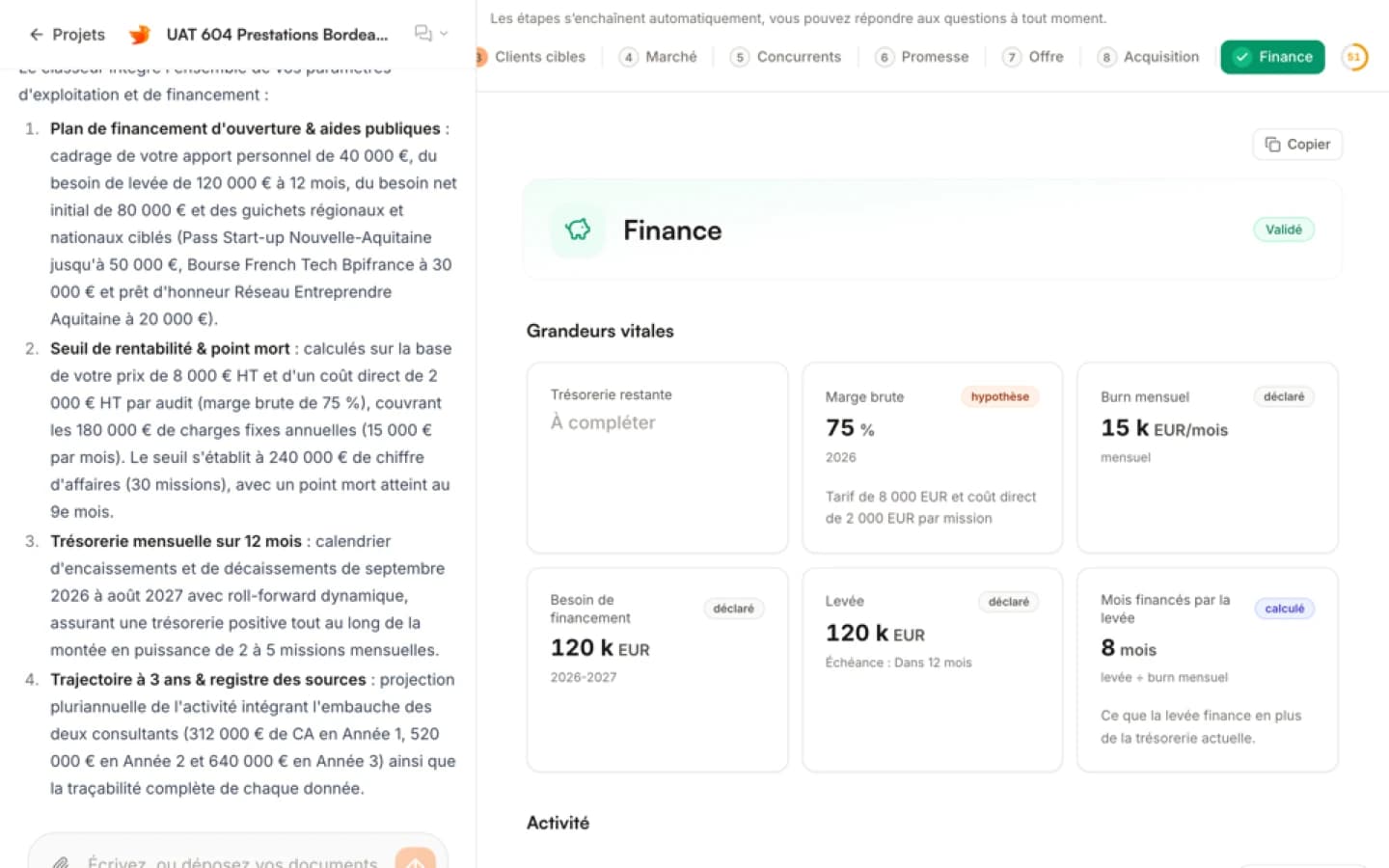
What the product's behaviour involves. The case follows nine building blocks: project, why, ideal customer, market, competitors, promise, offer, acquisition and finance. Each keeps its own versions, evidence and status. The agent asks only the questions that are still useful, and the finance block reuses the answers from the other blocks while keeping assumptions visible and editable. The founder validates each proposal before it is added. These are behaviours described by the product, not results measured with customers: we do not claim here that they improved a raise or a loan.
What the product refuses to do. It guarantees neither funding nor a third party's decision. It does not split the use of funds beyond what you declare. Recurring revenue figures you declare are kept with their caveats, and an assumption is never presented as traction. These limits protect you: a tool promising the opposite should worry you.
What you can check yourself. Open a case on a real project, with your real documents, and check three points. Are unreadable documents flagged with their reason, instead of being silently ignored? Are the evidence categories clear on screen? Does each deliverable have a version history that you can read and restore?
What is not evidence. The user count of a neighbouring software, the revenue of a competing vendor or the size of a market says nothing about the quality of your file. We therefore cite no figure of that kind: none was verified for this article, and none would help your decision.
To go further, How Fund Your Growth works for early-stage founders details a step directly related to this decision.
Demonstration and examples
Here are three illustrative situations. They are examples built for this article, not customer cases: no company and no figure in them is real.
First example: the founder of planning software for architecture firms. She signed her first contracts after meetings she led alone. Her objective is a loan to hire a first salesperson. Before any tool, she inventories her documents: signed contracts, exchanges with two customers, one presentation. She notices that her loan application rests mostly on declarations. Opening a case with the "loan or grant" objective helps her here to see which statements remain without a document, and to decide what to gather before meeting a banker.
Second example: two cofounders hesitating between raising funds and moving forward without a raise. The product offers an entry for those who want to bootstrap, next to the "raise funds" entry. They open two cases, one per objective, and compare the questions the agent asks them. What they gain is not a ready-made answer: they see that a raise demands a market narrative they have not yet written, whereas the path without a raise mostly requires a realistic cash plan.
Third example: a founder preparing meetings with investors. Once the context is validated, the Project and Finance views can offer a bridge to the fundraising mission assistant in Lead Intelligence. That assistant presents investor profiles as people to contact, never as funds already secured. Project and finance facts are prefilled there, uncertain fields stay empty, and no search starts before the founder has reviewed and confirmed.
What these examples show: the product first serves to lay a case out flat, spot its gaps and prepare what follows. It replaces neither the search for customers nor the negotiation with a funder.
The typical flow of a case, as the product describes it, reads as follows. You create the case by choosing the objective and the country of the project, with France and the United States available directly. Project files are read separately: if one fails, the others continue, and if none is readable, no AI work starts and the reason for each unavailable file stays displayed. The blocks fill in with your validations. The action plan then connects decisions to items to validate. After the last decision, the Data Room opens, linked to the case, without generating a document.
One last practical marker: the documents produced are editable, and the product keeps their versions. You can read an earlier version, restore it, rename a document or delete it while revoking its shares. For a founder preparing a case over several weeks, this traceability avoids lost content and misunderstandings between partners.
Observed results
This section does not report customer results: we have none we could honestly cite on this subject. It describes what you can observe yourself after a first trial, and how to interpret it.
What you should see at the end of a first case. First, a status of the blocks: which are validated, which are partial, which have no document. Then, weak points that surface first in a graph linking the blocks. Finally, gaps turned into prioritised next actions. If you only get a fluent text that reassures you, with no gap flagged, the result is suspect.
What these observations let you conclude. Three results are realistic after a serious trial.
- Spot validation gaps: the available evidence, the assumptions and what remains to be validated are made visible, which leaves you time to address weaknesses before talking to a funder.
- Store documents: the Data Room sorts your documents into seven folders: case, identity, market, commercial, finance, legal and documents. You know what exists and what is missing.
- Keep control: the founder approves, rejects or edits each proposal. What you read in the final case is therefore what you accepted.
What these observations do not let you conclude. A well-structured case is neither an accounting certification, nor an investor's decision, nor a guarantee of obtaining funds. Declared, estimated and confirmed figures remain separate: do not mix them by presenting an assumption as traction.
One particular case deserves attention: public funding. The product suggests useful bodies with their source, their verification status and an "amount to confirm" when the amount is not established. It therefore does not write an amount that the source does not give. Coverage remains partial: references in France, including Nouvelle-Aquitaine, Île-de-France and the Bordeaux area, in Germany including Berlin, and at European level. If your region is not listed, leads found on the Web remain to be verified with the body itself.
How to score your trial. Take three simple criteria and give each a mark from one to five: clarity of what is proven, usefulness of the questions asked, ease of correcting a proposal. Write the mark with one sentence of justification. Repeat the same assessment after bringing new documents: if the case progresses, the tool follows your work. If it does not move, the problem may lie with the documents, not the tool.
This approach also benefits from being read alongside How to turn founder conversations into measurable B2B pipeline, which sheds light on the next choice.
Limitations
No structuring tool suits everyone, and Fund Your Growth has limits you should know before committing to it.
Progressive access. The product is available depending on the account and the enabled rights. Check that you have access before organising teamwork around it, and do not rely on a feature you have not seen on your account. It is also not available in the iPhone and Android apps, where only the Second Brain is accessible; you use it on a computer or in a browser.
No guarantee of funding. Ember does not guarantee that you will obtain funding. The success of a raise or a loan depends on market conditions, on the relationship with funders and on the strength of your company. The product prepares a defensible case, it does not decide in place of the funder.
A result that depends on your documents. The system is only as good as what you give it. If your sales data is messy or unverified, it makes the gaps visible instead of hiding them. For a team that prefers a flattering presentation to a frank diagnosis, a classic document template may feel less demanding. That is a legitimate choice, but it is not the same approach.
Mandatory human control. You must approve, reject or edit proposals before they are added. The tool therefore does not run on autopilot, and it does not make a final strategic decision without you.
Conditional bridges. The links to Creation and Lead Intelligence only activate once the required context is validated. In practice, you cannot skip the structuring phase to go straight to the presentation or to investor prospecting.
Partial coverage of public funding. The reference list is not exhaustive, as noted above. Some related functions, such as opening a document in the Second Brain, storing it in the Data Room or exporting it to Google Drive and OneDrive, are available only under certain connection conditions. Without an active storage connection, the destination is disabled, and a revoked authorisation requires a reconnection.
A case is not an audit. The Data Room is a filing linked to the case, not an automatic due diligence. An investor will run their own checks, and it is normal for them to ask questions the case did not anticipate.
Finally, our position as publisher is a limit in itself: this article is written by the team that publishes the product. We have therefore avoided any market or competitor figure we could not verify, and we invite you to compare our description with what you see on your own account.
Decision criteria
Here are the criteria that, in our view, should settle your choice. They apply to Fund Your Growth as to any approach for structuring a plan.
First criterion: the repeatability of your first sales. During the founder-led sales phase, the first contracts often come from your network or from very manual effort. Patrick Trümpi stresses on LinkedIn that buyers behave differently with a founder and with a salesperson. If you do not yet know which sales someone else could repeat, your priority is to understand that, and a funding plan can wait. A solid ideal customer profile comes before a funding request.
Second criterion: your ability to face your gaps. The product puts forward what remains to be validated. If you still have no documented sales data, no written customer feedback and no pipeline indicators, you will draw little value from it, and you will first have to collect those elements. You have to accept that the tool shows you what is missing.
Third criterion: your funding objective. A loan search, a raise from investors and a grant request do not expect the same evidence. The product starts from your objective and adapts scenarios to the stage, geography and constraints of the project. If your need is simple and already covered by a document template you master, an extra tool may bring nothing.
Fourth criterion: your country. France and the United States are offered directly when creating the case, other countries go through a list. For public funding, current coverage mostly concerns France, Germany and Europe.
Fifth criterion: your need for prospecting volume. If your immediate priority is simply to feed a flow of contacts, that is not the subject of Fund Your Growth. The Ember module that handles it is Lead Intelligence, which works in waves of 200 contacts and works from 10, 100 or 1,000 contacts, with no minimum threshold. The two products complement each other, but they answer different questions.
Sixth criterion: the time you are willing to spend. Plan a bounded first trial, with an end date, an owner and a simple criterion to decide whether to continue or stop.
A rule to settle it: if you tick at least half of these criteria without hesitation, the trial makes sense. Otherwise, work on your evidence first.
In practice, Fund Your Growth use cases for founder operations complements this framework with another angle on the same subject.
What remains unproven
This article deliberately contains a section on what we do not know. It is the part founders most readily skip, and the one that matters most.
We have no measurement of the product's effect. No public data shows, to date, that using Fund Your Growth increases the probability of obtaining funding, shortens the time to prepare a case or improves the quality of exchanges with investors. The behaviour described in this article comes from what the product is designed to do, not from an evaluation carried out with users.
We also do not know whether your case suits it. A founder's case with five customers close to their network is not in the same situation as a team with an established sales cycle. The product can structure both, but what you get out of it depends on your documents and your objective.
The repeatability of your sales also remains an open question as long as no other salesperson has reproduced your results. Patrick Trümpi writes on LinkedIn that the transition from founder to team is the most difficult for a startup. No case structuring replaces that test. A tool can help you word the hypothesis "a salesperson converting as well as I do", it cannot demonstrate it.
Nor can we guarantee the accuracy of every public funding suggested. The product shows its verification status and leaves an amount "to confirm" when it is not established. Before building a cash plan on a grant, confirm its existence, amount and conditions with the body itself.
Another unknown: comparison with other approaches. We have not compared Fund Your Growth with human coaching, an accountant or a simple spreadsheet. Those solutions have their strengths, notably an outside view that no tool provides. Do not read our silence as superiority.
Finally, the functions described here evolve. Access, the geographic coverage of grants and storage connections may change. What we describe is valid at the update date of this article, and it is better to recheck on your account.
The right way to handle these unknowns is to write them down. For each one, note a hypothesis, how to test it, a deadline and an owner. That is precisely the kind of sorting you expect from a tool: better to apply it first to your choice of tool.
Before deciding, Problems that block your project funding and automation helps connect this method to neighbouring priorities.
Sources and updates
This article is published by Ember, which makes Fund Your Growth. It rests on three types of sources, which we distinguish so that you know what to verify.
Sources opened for this rewrite. The Fund Your Growth presentation page, read on 29 September 2026, for the public wording of the promise and the five strands of work it announces. The LinkedIn post by Patrick Trümpi, read on the same date, for the differences between founder-led and team-led sales. It is a personal field account, not a study, and we attribute no figure to it.
Product description. The journeys, evidence levels, Data Room, bridges and limits described here are those of the product as Ember's product documentation describes them. They describe the intended behaviour, not a check carried out on your account. Since the product is opened progressively, what you see may differ.
What we do not cite. No revenue, market share or usage figure of another vendor appears here: we did not open a primary source that would let us verify them, and they would not help your decision.
What we did not do. We ran no survey of users and did not compare the product with other solutions. We give no price: for the cost of use, see Ember's pricing page.
Updates. This article was rewritten on 29 September 2026. It will be reviewed when access to the product, the coverage of public funding or the Data Room functions change notably. If you notice a gap between this text and what you see in your account, the product is what counts.
For neighbouring subjects, the finance guides in Ember's knowledge base collect other analyses, notably common cap table mistakes in seed due diligence.
Finally, an invitation: before choosing a tool, write on one page your three strongest pieces of evidence and your three most fragile assumptions. If this short exercise takes you more than an hour, your case needs work before any tool. It is also the best way to judge honestly what Fund Your Growth can, or cannot, do for you.
Sources
FAQ
Fund Your Growth
Connect strategy, proof and funding
Turn project assumptions into defensible decisions and next actions.