
Definition
For a Business-to-Business (B2B) founder who already has revenue but lacks an established investor network, the optimal funding strategy is revenue-backed growth combined with non-dilutive financing. This strategy, often referred to as revenue-based financing or customer-funded scaling, uses existing sales traction to secure capital without giving up equity or relying on warm introductions to venture capitalists.
Traditional venture capital fundraising typically depends heavily on warm introductions and extensive investor networks, as detailed in fundraising guides by Carta. When those networks do not exist, founders can leverage their balance sheet and customer contracts as collateral. This shift from equity to debt or revenue-share models allows early-stage companies to fund operations directly from their own commercial success.
Even major market players that eventually raise massive venture rounds often build their initial momentum on strong sales foundations. While they had raised approximately 250 million dollars in total funding by August 2023, as announced by Apollo, early-stage founders without that network must first focus on the underlying unit economics that make such scale possible.
Choosing the right path requires analyzing the business's specific constraints rather than following a generic checklist. Founders must structure their business plan and compare different funding scenarios based on their actual project stage, geography, and cash flow constraints to find a sustainable way forward.
To place this decision in context, the Knowledge guides for finance brings together deeper guidance on the same field.
Prerequisites
secure capital without giving up equity. To successfully execute this approach, early stage founders must meet several critical prerequisites before approaching alternative lenders or non-dilutive funding platforms.
First, founders must establish predictable cash flow and high revenue quality. Unlike early stage Venture Capital (VC) where pre-revenue startups can sometimes raise funds based on a pitch deck alone, as discussed in guides on LinkedIn, revenue-backed financing requires actual, verifiable traction. Lenders and non-dilutive platforms evaluate the quality of your customer contracts, payment history, and churn rates to determine borrowing capacity.
Second, the business requires a defensible business plan and an organized financial model. Because you lack a warm investor network to advocate for your character, your business data must do the talking. Having a structured business plan that outlines your unit economics, customer acquisition costs, and growth projections is essential. This is detailed in resources like the Carta Startup Funding Guide which emphasize the importance of structured financial preparation.
Third, you must align your funding search with your specific business stage, geographic constraints, and actual capital needs, rather than pursuing a generic list of venture capital options.
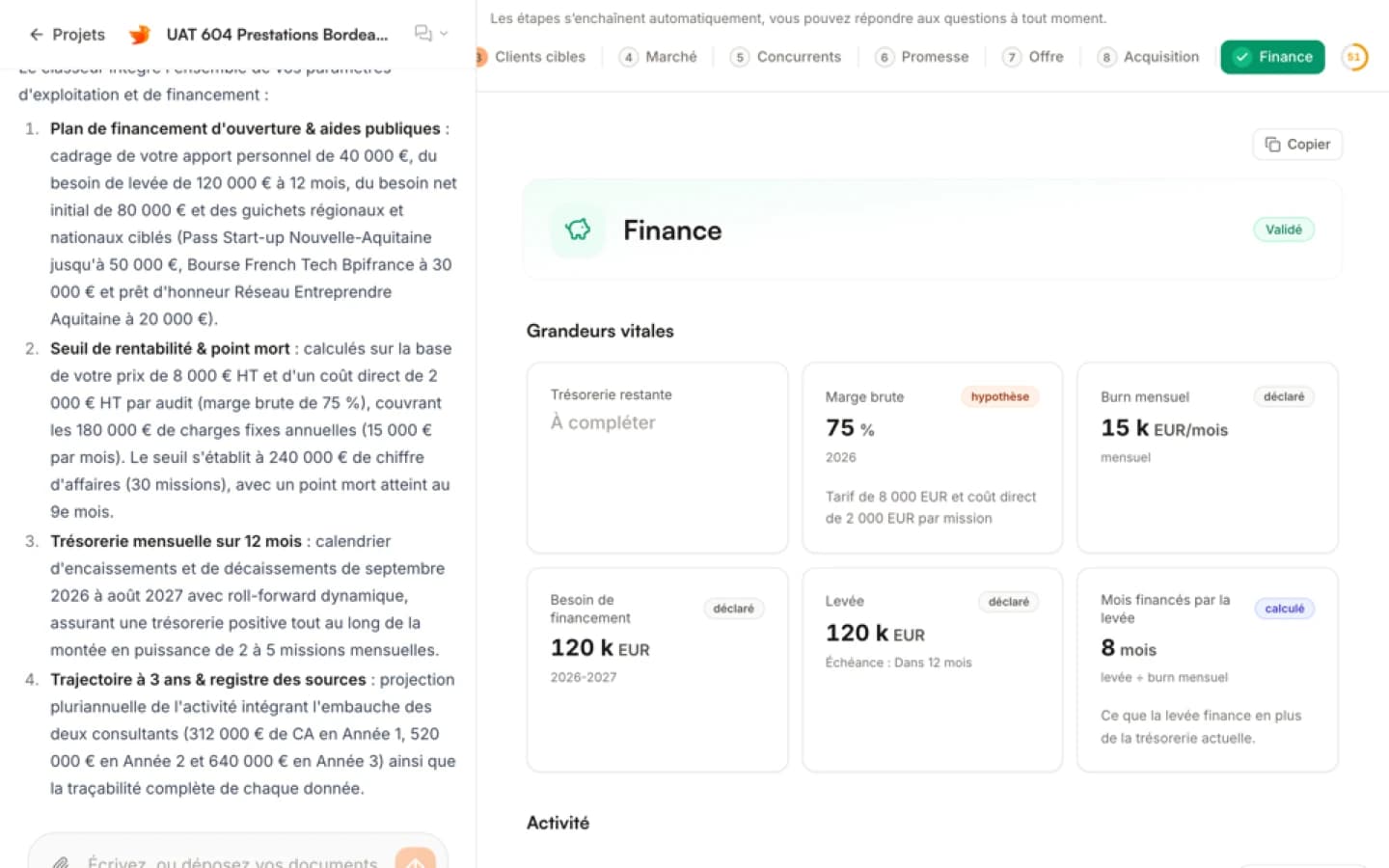
To help founders navigate these requirements, Ember offers the Fund Your Growth capability. It reads project documents and connects relevant evidence to funding decisions, ensuring your existing traction is presented accurately. Instead of leaving you to navigate a generic list of options, it structures funding options from your unique project context. This allows you to compare and structure funding scenarios for your specific project stage, geography, and constraints, replacing guesswork with a coherent funding path.
Steps
The first phase of executing a revenue-backed funding strategy requires a rigorous audit of your financial metrics. Because you lack a warm investor network, your balance sheet and customer metrics must speak for themselves. You must calculate your Annual Recurring Revenue (ARR) and Monthly Recurring Revenue (MRR) with absolute precision, alongside your Customer Acquisition Cost (CAC) and customer Lifetime Value (LTV). Lenders and revenue-based financing platforms will scrutinize these metrics to determine your borrowing capacity. Resources like the Carta guide on startup fundraising Carta can help you understand how clean equity and financial structures prepare a company for external capital.
The next phase involves packaging your financial data into a transparent, accessible format. Since you cannot rely on personal introductions to build trust, your data room must be flawless. This means organizing your historical bank statements, billing platform data, and customer contracts. You must demonstrate that your revenue is not just present, but recurring and diversified across multiple clients. For practical insights on how small businesses can prepare their operations for scaling, the Small Business Expo startup funding guide Small Business Expo outlines the essential preparations needed to secure non-dilutive capital.
Following this preparation, you must evaluate and select the specific non-dilutive financing vehicles that align with your cash flow cycle. This could include revenue-based loans, where repayments flex based on your monthly sales, or accounts receivable factoring if you work with large enterprise clients who pay on longer terms. Understanding how to transition from early traction to structured funding is a critical step for founders who do not have deep venture connections, a challenge often discussed in professional circles regarding startup fundraising strategies Dhruv Nath on LinkedIn.
Finally, you must connect these funding options to a concrete, risk-adjusted growth plan. Instead of guessing which path to take, you can leverage Ember and its Fund Your Growth capability. This capability structures funding options from project context and replaces a generic list of options with a funding path coherent with your specific business model Ember. It reads project documents and connects relevant evidence to funding decisions, ensuring that your existing revenue traction is presented in the best possible light to potential capital providers Ember. By grounding your funding strategy in real data, you can confidently plan your next steps and secure the capital needed to scale without giving up equity.
To explore this point further, How to Build a 12-Month Cash Runway That Investors Trust? details a step directly related to this decision.
Worked example
Consider a hypothetical scenario involving a Business-to-Business (B2B) software company that has reached a stable run rate of recurring revenue but operates entirely outside traditional technology hubs, leaving the founders without an established network of venture capital investors. In this hypothetical situation, the leadership team needs capital to hire additional engineering talent to support their expanding customer base but wants to avoid spending months pitching to unresponsive angel investors.
Instead of relying on cold outreach or generic advice, the founders can use Ember to evaluate their options. By utilizing the Fund Your Growth capability, the team can upload their existing financial statements, customer contracts, and growth projections. Ember reads project documents and connects relevant evidence to funding decisions, ensuring that the company's actual traction is the foundation of its strategy.
Rather than presenting a generic list of venture capital firms, the platform structures funding options from project context. For this specific business, Ember compares and structures funding scenarios for the project stage, geography, and constraints, highlighting that a non-dilutive revenue-based financing model is far more viable than traditional equity financing. This replaces a generic list of options with a funding path coherent with the project, allowing the founders to secure capital based on their proven cash flow.
By mapping out this structured path, the founders can confidently approach alternative lenders with a clear, defensible business plan. They avoid the distraction of chasing mismatched equity investors and instead leverage their strongest asset, which is their existing customer revenue.
Common mistakes
Early stage founders who possess solid revenue but lack a warm investor network frequently fall into predictable traps when seeking capital. The first common error is the cold outreach trap for Venture Capital (VC). Founders often spend months sending unsolicited pitch decks to institutional venture capital firms, hoping that their revenue traction will overcome the lack of a personal introduction. However, as outlined in fundraising guides by Carta, navigating the fundraising landscape requires a deep understanding of how different capital providers operate. For a revenue-generating Business-to-Business (B2B) startup, relying solely on cold equity pitches is highly inefficient when alternative, non-dilutive options are much more accessible.
Another frequent mistake is treating all funding options as identical. Founders often review generic lists of financing sources and choose whatever is most popular, rather than what is most coherent for their specific situation. This lack of strategic alignment can lead to unnecessary equity dilution or the adoption of restrictive debt covenants that do not match the company's cash flow patterns.
Additionally, founders often fail to present a cohesive, evidence-backed financial case. When you do not have a warm network to establish trust, your financial data and business plan must do the heavy lifting. Presenting messy spreadsheets or generic templates instead of a structured, verifiable plan will quickly turn off alternative lenders who rely heavily on data-driven underwriting.
To avoid these strategic missteps, founders can leverage the Fund Your Growth capability within Ember. This system helps entrepreneurs move past generic options by replacing standard lists with a funding path coherent with the project, as explained on the Ember Fund Your Growth page. By reading project documents and connecting relevant evidence to funding decisions, Ember structures funding options directly from your specific project context. This allows you to compare and structure funding scenarios based on your actual stage, geography, and operational constraints, ensuring you pursue a strategy you can successfully defend.
This approach also connects with How to Build a 12-Month Cash Forecast for Investor Scrutiny?, which clarifies the next choice.
Tools
To execute a revenue-backed or alternative funding strategy without an established investor network, founders must deploy a highly targeted software stack. This toolkit serves two primary purposes: first, to maximize the customer revenue that forms the foundation of your funding eligibility, and second, to organize your financial data so that alternative lenders can evaluate your business objectively.
For equity management and understanding the operational steps of raising capital, platforms like Carta provide the necessary infrastructure to manage cap tables and maintain compliance, as outlined on Carta. These traditional platforms are highly effective for tracking equity ownership and compliance once you have secured capital, but they do not assist in identifying which non-dilutive funding pathways match your specific revenue profile.
If your immediate priority is to boost customer-funded growth to qualify for larger revenue-based loans, sales intelligence platforms can help accelerate outbound pipeline generation. While such tools are powerful for driving the top-of-funnel sales that feed your cash flow, they do not help you translate that raw commercial traction into a structured, defensible funding application.
This is where general business tools and static databases fall short. A Business-to-Business (B2B) founder with proven revenue but no investor network needs a system that can synthesize financial metrics into a coherent narrative. Ember bridges this gap through its Fund Your Growth capability. Instead of forcing you to navigate a generic list of financing options, Ember reads project documents and connects relevant evidence to funding decisions. By analyzing your unique business context, it structures funding options from project context and replaces a generic list of options with a funding path coherent with the project. This ensures that your revenue metrics, customer retention, and growth plans are automatically aligned into a strategy that alternative lenders can immediately validate.
When to use this method
This revenue-backed funding strategy is most effective when your Business-to-Business (B2B) startup has transitioned past the initial search for product-market fit and possesses a predictable stream of customer receipts. For early-stage founders who lack a warm investor network, this approach turns your balance sheet into your strongest advocate.
You should deploy this method when your customer acquisition cost is stable and you want to avoid the equity dilution associated with traditional Venture Capital (VC). While pre-revenue startups face steep hurdles when trying to attract external capital, as discussed by Prof Dhruv Nath on LinkedIn, having active customer revenue changes the dynamic entirely. It allows you to bypass the need for warm introductions and secure non-dilutive capital based on your historical billing data.
This method is also ideal when your business model does not require massive upfront capital to build infrastructure. However, if your goal is sustainable scaling rather than hyper-growth fueled by heavy dilution, alternative funding fits perfectly.
Instead of guessing which path to take, early-stage founders can use Ember to evaluate their options. The Fund Your Growth capability helps you build the Business Plan, choose a funding strategy, and plan the next steps based on your actual revenue data rather than hypothetical investor connections.
In practice, A 12-Month Investor Update Cadence for Early-Stage Founders completes this framework with another angle on the same topic.
When not to use it
While revenue-backed funding is highly effective for Business-to-Business (B2B) founders with existing traction, it is not a universal solution. There are specific scenarios where this strategy will fail to yield results, and continuing down this path can waste valuable operational time.
First, this method is entirely unsuitable for pre-revenue startups. If your business has not yet generated consistent customer sales, you cannot leverage your balance sheet or future receipts. In these early stages, founders must look toward equity financing, grants, or angel investors, as discussed by experts on LinkedIn.
Second, if your business operates in a winner-take-all market that requires massive upfront capital to build a proprietary network effect, alternative funding is rarely sufficient.
Third, if your B2B startup operates with very low gross margins, revenue-based financing can severely restrict your cash flow. Because repayment is tied directly to a percentage of your monthly revenues, thin margins leave very little capital to cover ongoing operational costs.
For founders who already possess a strong, warm network of venture capital investors and are pursuing a traditional equity round, standard equity management platforms like Carta are often perfectly adequate for structuring dilution and managing cap tables.
When you are uncertain whether your current financial metrics and growth trajectory align with alternative financing, Ember can help clarify your path. Through the Fund Your Growth capability, Ember reads your project documents and connects relevant evidence to funding decisions. The platform structures funding options from your project context and compares and structures funding scenarios for your project stage, geography, and constraints. This replaces a generic list of options with a funding path coherent with the project, ensuring you do not commit to a capital strategy that compromises your operational cash flow.
Action plan
To transition from a revenue-generating Business-to-Business (B2B) startup to a funded enterprise without a warm investor network, founders must execute a systematic, step-by-step plan. This approach shifts the focus from chasing elusive introductions to leveraging your balance sheet and customer traction as your primary leverage.
First, audit your revenue and metrics to establish a clear baseline. To qualify for revenue-backed funding or non-dilutive capital, you must demonstrate highly predictable customer receipts. The market values this predictability above almost all else. While an early-stage startup operates at a different scale, the core lesson is identical: clean, verifiable revenue data is your strongest asset when you lack personal connections to investors.
Second, map your funding scenarios directly to your business plan. Instead of pursuing generic venture capital, align your capital requirements with your actual growth trajectory. You need to compare non-dilutive options, revenue-based financing, or strategic debt against your current operational constraints. To navigate this, Ember provides the Fund Your Growth capability. It helps founders structure their business plan, choose a funding strategy, and plan the next steps. By connecting decisions to an action plan and items to validate, it ensures your strategy is grounded in your actual business context rather than generic templates.
Third, accelerate your customer acquisition to expand your funding eligibility. Because your capacity to secure revenue-backed funding is directly tied to your top-line performance, growing your customer base is the most effective way to unlock more capital. Rather than wasting time on broad, untargeted outreach, focus on high-intent opportunities. Ember supports this growth through Lead Intelligence. This capability reuses your business plan, Ideal Customer Profile (ICP), and offer to prepare a targeted sales mission. It provides a clear next action, identifying who to contact, why now, which channel to use, and which angle to take, allowing you to build the predictable revenue stream that funding partners require.
Finally, package your growth materials for funding partners. Once your revenue is growing and your strategy is clear, organize your financial metrics, customer contracts, and growth plans into a structured format. This structured preparation ensures that when you do engage with potential funding partners, your business speaks for itself, turning your lack of an investor network into a minor detail easily overcome by your undeniable operational traction.
Before deciding, How to set a B2B price when you have no benchmark? helps connect this method with adjacent priorities.
Put the funding choice to the test
Check the company’s current runway, required milestone and the terms of each available source before approaching funders.
Sources and methodology
The analysis of funding strategies for Business-to-Business (B2B) founders who possess revenue but lack a warm investor network is built on a systematic evaluation of non-dilutive and traction-based financing options. To ensure the relevance of these recommendations, we synthesized operational frameworks from established equity and compliance platforms, specifically leveraging the fundraising guidelines outlined by Carta. This is combined with practical growth methodologies for scaling small enterprises, as detailed by The Small Business Expo.
To address the specific challenges of early-stage founders navigating the funding ecosystem without pre-existing investor relationships, we incorporated real-world practitioner insights, such as the strategic fundraising perspectives shared on LinkedIn.
This methodology is designed to help founders move away from generic funding templates. Instead of relying on static advice, entrepreneurs can leverage Ember and its Fund Your Growth capability. This system reads project documents, connects relevant evidence to funding decisions, and structures tailored funding options directly from the unique context of the business.
Sources
FAQ
Mini audit
Test your Business Plan
Identify strengths, missing proof and the next priority.