
Definition
In 2026, a successful Business-to-Business (B2B) startup storytelling strategy requires a fundamental shift in how founders present their vision. When the market is saturated with Artificial Intelligence (AI) generated sameness, what makes an investor say yes to a pitch is not a polished, generic template, but a narrative that feels unmistakably human and logically airtight. To understand this, founders must first distinguish their materials. As noted by Tosea.ai, a pitch deck is entirely different from a board deck. While a board deck reports to directors who already own a piece of the company and have seen the numbers, a pitch deck must sell a compelling story to investors who do not yet have skin in the game. To capture this audience, founders must design their narrative around how venture capitalists actually consume information. According to research by Outcrowd, investors do not read pitch decks in the linear, slide-by-slide order that founders use to build them. Instead of moving methodically from problem to solution, market, and team, investors are driven by doubt. They scan the deck for the business model, jump directly to the traction slide, check the product and team, and evaluate the ask. If the underlying logic does not become clear immediately, the deck quietly loses their attention. Therefore, the slide order that keeps investors engaged is one that addresses these doubts head-on while breaking through the sea of automated noise. A powerful way to establish credibility in 2026 is to align the deck structure with the broader market shift toward human-centric communication. As highlighted in a LinkedIn testimony from Katie Street, modern buyers and investors increasingly reward brands and leaders who show up authentically and feel human. For an early-stage founder, this means structuring the deck around a slide order that earns that human connection. It begins with a problem slide deeply grounded in a real, named buyer, rather than an abstract market pain point. This is immediately followed by a mechanism slide that clearly explains how the product delivers its unique value, stripping away superficial design in favor of structural clarity. To help founders build a presentation that moves decisions forward rather than just looking pretty, Ember offers a dedicated module called Creation. Instead of forcing founders to rely on static layouts, Ember Creation suggests three templates with previews, asks useful questions, and asks for confirmation before creating. The system generates slides directly from the selected structure and project context, ensuring the narrative remains grounded in real business data. Because the creation process is resilient, the platform keeps generating slides even after a connection loss or tab closure, resuming progress automatically when the user returns. Once the draft is ready, founders can edit the generated presentation directly in Creation to fine-tune their message. Creation describes structured speaker notes per slide and contextual objection practice; verify any further capability in the current application. By focusing on deep reasoning and authentic structure, founders can deliver a pitch that drives a decision.
To place this decision in context, the Knowledge guides for marketing brings together deeper guidance on the same field.
Why this category exists
The category of structured, human-first startup storytelling exists because venture capitalists are increasingly fatigued by the flood of identical, automated presentations. In the Business-to-Business (B2B) sector, when every founder uses the same generic Artificial Intelligence (AI) templates, the resulting slides lack the unique strategic depth required to secure funding. To stand out, early-stage founders must understand what makes an investor say yes to a pitch. It is not superficial visual polish, but a clear, logical narrative that helps an investor understand the business model, traction, and team before they lose interest, as detailed in the design analysis by Outcrowd.
To achieve this, founders must design a slide order that holds attention by directly addressing investor skepticism. Traditional presentation software is perfectly adequate for basic visual layouts, but it often leads to a predictable, rigid sequence that fails to engage. A slide order that keeps investors engaged begins with a problem slide grounded in a named buyer, followed by a clear mechanism slide, and a traction slide that addresses doubts directly. This human-centric approach aligns with a broader market shift where buyers and partners reward brands that show up authentically against automated noise, as highlighted in discussions on LinkedIn.
Furthermore, founders must distinguish between different presentation types to ensure their message lands correctly. A pitch deck sells a story to investors who do not yet own a piece of the company, whereas a board deck reports to directors who already do, as explained in the presentation guide by Tosea. Mixing these formats results in dense, compliance-heavy slides that fail to drive a decision during an initial fundraising meeting.
This critical need for substance over generic design is why Ember developed Creation. Instead of producing superficial layouts, the platform suggests three templates with previews, asks useful questions, and generates slides from the selected structure and context, ensuring the final presentation remains fully editable and grounded in the actual business strategy.
How it works
To understand what makes an investor say yes to a pitch, founders must first recognize that venture capitalists do not read a pitch deck the way creators build them. While founders typically construct their narrative slide by slide in a linear progression, experienced investors move by doubt. They actively scan the deck for the business model, jump straight to the traction slide, and scrutinize the team and the product. If the underlying business logic does not become clear immediately, the presentation quietly loses their interest. In a market saturated with automated content, a successful investor pitch must focus on a slide order that holds attention by resolving investor doubts systematically rather than relying on decorative elements.
According to research on pitch deck design by Outcrowd, a strong deck has one job, which is to help an investor understand the business before they lose interest. This requires moving away from generic templates and superficial decoration. Furthermore, a pitch deck serves a completely different purpose than a board deck. As noted by Tosea, a board deck reports to directors who already own a piece of the company and have skin in the game, whereas a pitch deck must sell a compelling story to investors who do not yet own a piece of the company.
To stand out against Artificial Intelligence (AI) generated sameness, the narrative for founders must feel distinctly human. As highlighted by industry insights shared on LinkedIn, modern Business-to-Business (B2B) buyers and investors reward brands that show up authentically and feel human. This human-first startup storytelling is achieved by structuring a problem slide that is grounded in a real, named buyer, followed by a mechanism slide that clearly explains how the solution works. When presenting a deck for a non-technical audience, this clear explanation of the core mechanism prevents the narrative from getting lost in technical jargon.
This is where a structured, reasoning-first workflow becomes essential. While traditional presentation tools are good enough for basic slide formatting, they often fail to help founders build a pitch that drives a decision. Ember addresses this challenge through Creation, which works directly on the reasoning, the audience journey, structure, design, and impact of the presentation.
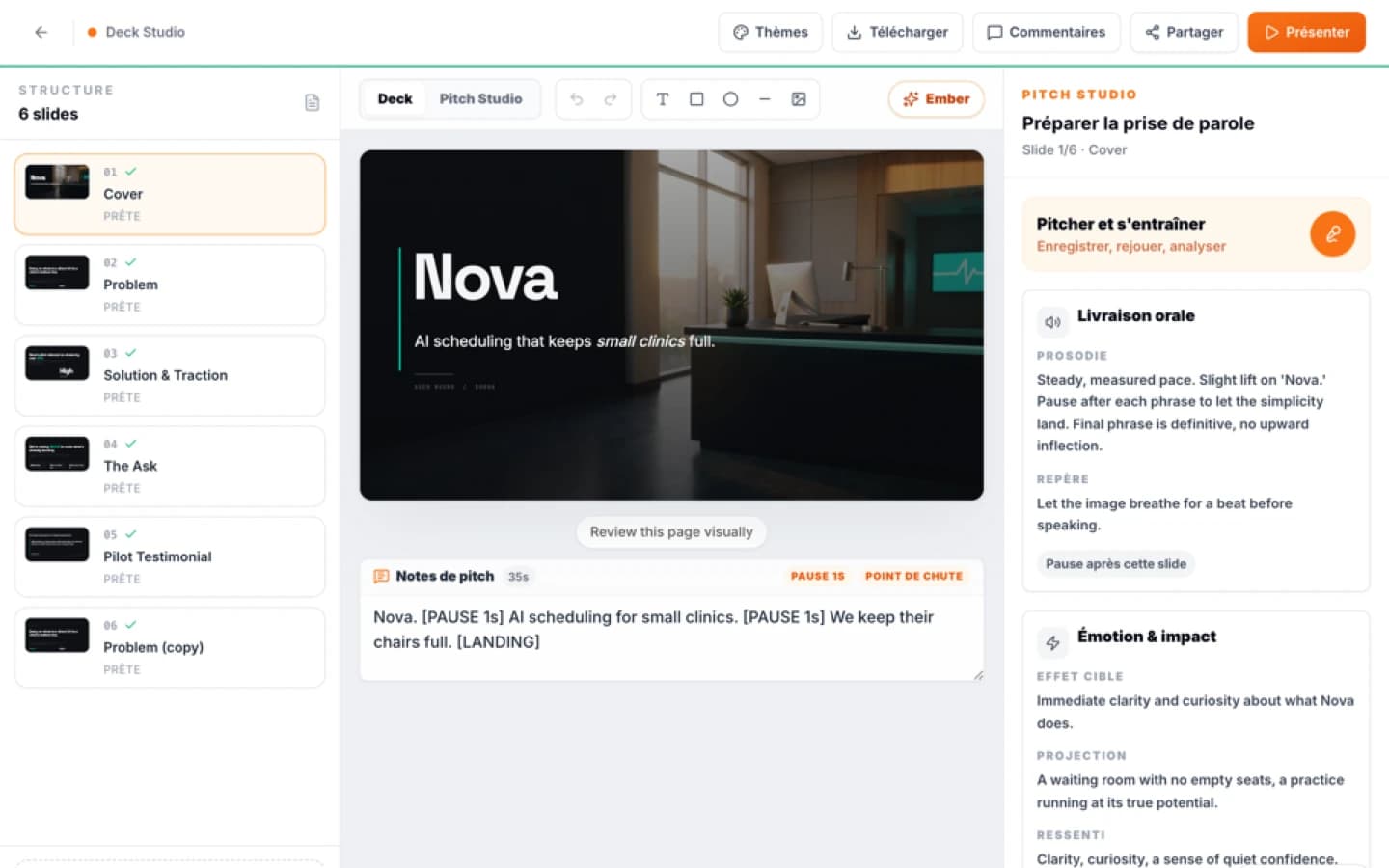
The process begins when the platform suggests three templates with previews and asks targeted, useful questions about the business context. It then asks for confirmation before creating, so nothing is generated without your approval. Instead of just applying visual polish, Creation generates slides from the selected structure and context, ensuring that the narrative arc remains grounded in the actual business model. The generation process is highly resilient; the system keeps generating after a connection loss or tab closure, and then resumes progress automatically when the user returns.
Once the initial draft is ready, founders can edit the generated presentation directly in Creation to refine the messaging. The system then analyses rhythm, clarity, impact, and structure in the recorded take, helping the founder deliver a confident, human presentation that cuts through the noise.
To explore this point further, Proof Asset B2B Founders Need Before First Sales Meeting details a step directly related to this decision.
Difference from the classic approach
The classic approach to building a pitch deck for a Business-to-Business (B2B) startup relies on a rigid, linear template: problem, solution, market, product, traction, team, and ask. Founders often spend weeks polishing the visual design of these slides, assuming that investors will review them in the exact order they were created. However, this linear assumption ignores how venture capitalists actually evaluate opportunities. What makes an investor say yes to a pitch is not a highly decorated, generic template, but a narrative that addresses their specific doubts before they lose interest.
According to design experts at Outcrowd, investors do not read pitch decks the way founders build them; instead, they move by doubt, scanning for the business model, jumping straight to the traction slide, and then checking the product, team, and ask. In 2026, according to Outcrowd, a strong pitch deck has the sole job of helping an investor understand the business before they lose interest.
Another critical difference lies in confusing a pitch deck with a board deck. As detailed in a 2026 guide by Tosea, a pitch deck sells a story to investors who do not yet own a piece of the company, while a board deck reports to directors who already do. Founders who use a reporting-heavy, board-style structure for their initial investor pitch fail to build the necessary narrative momentum. Classic presentation tools and standard templates are perfectly adequate when presenting to internal stakeholders who already understand your operational context, but they fall short when you need to capture the attention of skeptical external partners.
To stand out against a sea of automated, identical presentations, founders must ask themselves: what slide order keeps investors engaged? The answer lies in earning a human connection. Insights shared on LinkedIn in 2026 indicate that modern buyers and investors are actively rewarding brands that feel human and reject generic, Artificial Intelligence (AI) generated noise.
To achieve this, the slide order must be restructured. Instead of presenting abstract market statistics, founders should start with a problem slide grounded in a named, real-world buyer. This should be immediately followed by a mechanism slide that demonstrates exactly how the product works, rather than hiding behind vague marketing claims. By grounding the narrative in concrete human experiences and clear mechanics, early-stage founders can break through the skepticism of Artificial Intelligence (AI) generated sameness and drive a decisive, positive response from investors.
Concrete example
To understand what makes an investor say yes to a pitch, early stage founders must structure their startup storytelling around how investors actually consume information. Unlike a board deck, which reports to directors who already own a piece of the company and have seen last quarter's numbers, a pitch deck sells a story to investors who do not yet own a piece of the company, as outlined in the Tosea.ai Board Deck Guide. Because investors do not read pitch decks linearly, founders must design a narrative arc that addresses doubt immediately. According to research by Outcrowd.io, investors move by doubt, scanning for the business model, jumping to the traction slide, and checking the product, team, and ask. In 2026, a strong pitch deck has one job, which is to help an investor understand the business before they lose interest. To combat the fatigue of Artificial Intelligence (AI) generated sameness, the slide order that keeps investors engaged must feel authentic and human. As highlighted by Business-to-Business (B2B) marketing expert Katie Street on LinkedIn, buyers and investors increasingly reward brands that feel human against automated noise. Founders can achieve this by building a deck around a specific slide order that earns that human feeling. This begins with a problem slide grounded in a named, real world buyer, followed by a mechanism slide that explains exactly how the solution works, rather than relying on generic high level claims. This structure ensures a pitch that drives a decision, keeping the narrative grounded in reality even when presenting a deck for a non-technical audience. To help founders build this level of conviction, Ember offers a dedicated presentation tool called Creation. Instead of relying on rigid layouts, Creation suggests three templates with previews, asks useful questions, and asks for confirmation before creating, as detailed on the Ember Creation Page. The platform generates slides from the selected structure and context, ensuring the narrative remains cohesive and grounded in the startup's unique data. The generation process is highly resilient, meaning it keeps generating after a connection loss or tab closure, then resumes progress when the user returns. Once the draft is ready, founders can edit the generated presentation directly in Creation to refine the messaging. The system analyses rhythm, clarity, impact, and structure in a recorded take, helping founders deliver a polished, human first presentation that stands out in a crowded market.
This approach also connects with How B2B Sales Teams Build a Narrative That Earns Attention?, which clarifies the next choice.
Limits
While a structured, context-driven approach solves the problem of generic slide design, early stage founders must recognize the boundaries of automated tools and structured frameworks. If a startup has a highly unusual business model that defies standard industry categories, or if the founder has the budget to hire a high-end, specialized design agency for weeks of custom creative direction, traditional manual design remains a highly effective option. Manual creation in classic presentation software is often good enough when the narrative does not need to scale or when a dedicated internal design team is already on retainer.
Furthermore, no software can replace the raw preparation required to deliver a pitch that drives a decision. What makes an investor say yes to a pitch is not merely a beautiful document, but the founder's ability to defend their assumptions under pressure. A slide order that holds attention only works if the presenter can speak to the underlying business reality. Investors do not read pitch decks the way founders build them, as they scan for the business model and jump directly to the traction slide to validate claims, according to insights on modern pitch deck design from Outcrowd. If the logic is weak, even the most logical narrative arc will fail.
To address these gaps, technology must allow for continuous human refinement rather than offering a single, unchangeable output. For instance, Ember addresses this by ensuring that the entrepreneur remains in full control. The platform generates slides from the selected structure and context, but crucially lets users edit the generated presentation in Creation. This avoids the trap of rigid, uneditable templates. This ensures that the final pitch is grounded in human conviction rather than automated sameness.
When to use it
This structured, human-first approach to startup storytelling is most critical when early-stage founders face an audience of highly skeptical venture capitalists who have developed a strong resistance to templated, artificial presentations. When preparing an investor pitch, founders often wonder what makes an investor say yes to a pitch. The answer lies in moving away from superficial visual polish and focusing instead on a narrative arc that directly addresses investor skepticism.
According to industry analysis on pitch deck design published in May 2026, investors do not read decks linearly; instead, they scan for the business model and jump straight to the traction slide to resolve their doubts Outcrowd Pitch Deck Design. This methodology is distinct from preparing a board deck, which, as outlined in a 2026 guide, is designed to report to directors who already own a piece of the company and have seen the previous quarter's numbers Tosea.ai Board Deck Guide. For an investor pitch, you need a pitch that drives a decision from people who do not yet have skin in your game.
This framework is especially valuable when presenting a deck for a non-technical audience, where complex product features must be translated into clear business value. To answer what slide order keeps investors engaged, founders should structure their deck around a slide order that holds attention: starting with a problem slide grounded in a named, real-world buyer, followed by a clear mechanism slide, and supported by a strong traction slide. This human-centric approach is essential in 2026, a period where buyers and investors increasingly reward brands that feel human against the backdrop of generic, automated Artificial Intelligence (AI) noise, as discussed in professional insights on LinkedIn LinkedIn B2B Marketing Shift.
When you need to build this level of conviction, Ember's Creation guides you by suggesting three templates with previews, asking useful questions, and asking for confirmation before creating Ember Creation. Instead of leaving you with static, unchangeable slides, Ember generates slides from the selected structure and context, and lets you edit the generated presentation directly in Creation Ember Creation. This ensures your final pitch feels entirely human, authentic, and prepared to stand up to rigorous investor scrutiny.
In practice, Creation Use Cases for Bootstrapped Founders by Ember completes this framework with another angle on the same topic.
When not to use it
This structured approach to startup storytelling is not a universal solution for every corporate presentation. When founders ask what makes an investor say yes to a pitch, they often focus on narrative flow, but this narrative arc is entirely inappropriate if your audience consists of existing board members. According to the Tosea 2026 board deck guide, a board deck reports to directors who already own a piece of the company, whereas a pitch deck sells a story to prospective investors who do not. If your stakeholders already have skin in the game, have reviewed your previous quarterly numbers, and expect you to measure your current performance against past commitments, you should not use a pitch deck. Forcing busy board members to sit through a high-level problem slide or a generic market overview will frustrate them, as they require a structured board book focused on concrete operational decisions, cash runway, and hiring updates.
Similarly, you should avoid relying on standard pitch templates if your startup has a highly unusual business model that defies standard industry categories. As outlined in the Outcrowd 2026 pitch deck design analysis, investors do not read decks slide by slide, but instead scan them quickly to resolve specific doubts about the business model and traction. If you are trying to determine what slide order keeps investors engaged when your business model is highly unconventional, a rigid template might obscure your unique mechanics. While platforms like Ember allow you to edit the generated presentation in Creation to inject your specific context, a highly complex or non-standard business model will still require significant manual refinement and human oversight to ensure that a non-technical audience can grasp the core innovation without getting lost in generic slides.
Honest relationship to Ember
If your goal is simply to fill out a standard template for a routine internal update, or if you have the budget to hire a premium design agency for a fully bespoke manual creation, traditional options are perfectly adequate. However, when early stage founders need a pitch that drives a decision, relying on generic templates often leads to the very sameness that modern investors reject.
This is where the Ember approach diverges. Through Creation, the process does not start with superficial visual polish. Instead, it starts from your actual project context and data rather than a generic template, ensuring your unique narrative remains intact. When you begin, the system suggests three templates with previews, asks useful questions, and asks for confirmation before creating, as detailed on the Ember Creation page.
Rather than forcing you into a rigid layout, Ember generates slides from the selected structure and context. The generation process is highly resilient. It keeps generating after a connection loss or tab closure, then resumes progress when the user returns. Once the draft is ready, you are never locked into an automated output. Ember lets users edit the generated presentation in Creation, keeping you in complete control of the final narrative.
To help you prepare for the actual room, you can also transition from design to delivery. By focusing on how the presentation builds understanding and moves a decision forward, you can confidently address the core question of what slide order keeps investors engaged, ensuring your business logic is clear, defensible, and entirely your own.
Before deciding, Gamma vs Ember Lead Intelligence for B2B Founder Sales helps connect this method with adjacent priorities.
Product scope
Creation can help prepare audience-specific slides and structured speaker notes. The founder remains responsible for customer evidence, financial figures and every claim made to an investor.
Sources and methodology
This analysis is built on a rigorous review of contemporary investment standards, design methodologies, and market signals regarding how investors interact with startup presentations. The primary frameworks for structuring narrative arcs and keeping investors engaged are derived from the design principles outlined in the guide to Pitch Deck Design in 2026 by Outcrowd, which highlights how modern venture capitalists scan decks for logical clarity. The critical distinction between raising capital and reporting to active directors is sourced from the Board Deck Structure Guide for Founders and Chief Executive Officers by Tosea.ai. Finally, the broader shift toward human-centric messaging in Business-to-Business (B2B) environments, which counters the rise of generic Artificial Intelligence (AI) content, is anchored in real-world practitioner testimonies, such as the market observations shared by Katie Street on LinkedIn.
Sources
- The 2026 LinkedIn/webinar signal is that buyers reward brands that 'feel human' against AI-generated noise. Build the article around the slide order that earns that feeling: a problem slide grounded in a named buyer, a mechanism slide that
- Board Deck (Board Book) Structure Guide for Founders & CEOs (2026)
- Pitch Deck Design in 2026: How to Make Investors Understand Your ...
FAQ
Mini audit
Test your Pitch Deck
Get an initial diagnosis of substance, form and impact.