
When sales teams present an investor pitch deck to prospective enterprise buyers, the meeting almost always derails. Pitch decks are engineered to sell equity, category dominance, and long-term enterprise value to venture capitalists. Sales decks exist to convince a budget holder that your solution resolves an active operational bottleneck faster, cheaper, or with less risk than doing nothing.
Confusing these two audiences produces collateral that confuses buyers. B2B decision-makers do not care about your total addressable market (TAM), your multi-year hiring plan, or your cap table. Their concerns center on their specific blockers, implementation speed, and the measurable return on investment (ROI) they must defend before an internal buying committee. Adapting your slide structure requires dropping the investor-centric vision in favor of a buyer-centric narrative arc.
The Core Divide Between Investor and Buyer Psychology
The distinction between convincing investors and convincing enterprise customers rests on their respective perception of risk and profitability.
Understanding what drives an investor to say yes to a pitch helps measure the gap with a buying process: investors weigh upside potential against market risk, looking for vast markets, strong barriers to entry and hypergrowth trajectories capable of paying back an equity stake. Because their portfolio model anticipates most startups will underperform, they favor asymmetric gains over operational predictability.
Enterprise buyers respond to diametrically opposed incentives. A commercial decision-maker does not seek portfolio-scale asymmetric returns; they protect their team against disruption, vendor failure and budget waste. Leaving investor-centric messaging in a commercial deck scatters their attention onto questions that are not theirs. The buyer simply wants to know which problem you solve, why they should trust you and which concrete steps follow contract signature.
To place this decision in context, the Knowledge guides for marketing bring together deeper guidance on the same field.
| Dimension | Sales deck for buyers | Pitch deck for investors |
|---|---|---|
| Target audience | Enterprise buyers and procurement teams | Venture capital investors and business angels |
| Core objective | Demonstrate operational ROI and sign the contract | Demonstrate enterprise value and raise funds |
| Primary narrative | From operational friction to measurable outcome | Market opportunity and category leadership |
| Validation metric | Customer case studies and adoption speed | Revenue trajectory and unit economics |
| Presentation context | Interactive discovery calls and demos | Formal pitch presentations and send-ahead materials |
What Slide Order Keeps Buyers Engaged?
While the slide order that holds investor attention foregrounds market opportunity then financial traction, a sales presentation follows a rigorous operational diagnostic. The commercial deck moves from current situation to friction, then to resolution, proof and execution.
1. The operational summary
Open the presentation with the buyer's main challenge and your solution phrased in plain language. State who you serve, the operational constraint resolved and the major commercial outcome achieved. Avoid starting with company history, executive bios or founding anecdotes. Buyers evaluate their own deadlines before examining your track record.
2. The current-friction diagnostic
Dedicate part of the presentation to illustrating the buyer's operational reality. This section should make the invisible costs of the status quo explicit, whether wasted hours, missed service-level agreements or lost revenue. Personalize this diagnostic using the precise elements gathered during prior discovery interactions rather than relying on industry generalities.
3. Solution fit and outcome framing
Introduce your solution as the direct answer to the identified difficulties. Do not turn this part into an exhaustive catalog of technical features. Structure capabilities around the job to be done: detail how specific functions eliminate manual work, automate verifications or secure compliance. Highlight tangible business outcomes rather than software architecture.
4. Quantified proof and customer references
Build institutional credibility on verifiable proof. Anchor proof in documented customer outcomes. Include recognized logos, but always tie them to concrete transformations by highlighting how a similar organization overcame the obstacle your prospect faces today.
5. Deployment, integration and governance
An enterprise buyer evaluates implementation risk before committing. Plan a dedicated section explaining integration timelines, required internal resources, technical prerequisites and security measures. Lowering this risk level reassures procurement and technical teams that adoption will not paralyze ongoing operations.
6. Value creation and pricing
Tie your pricing model directly to the value produced. Rather than presenting an isolated pricing grid, weigh the annual contract cost against the operational savings or revenue gains established during the diagnostic. Display your offer tiers, the included support and the estimated delay before first returns clearly.
7. A clear, immediate action
Close with an explicit next step specifying responsibilities, scope and schedule. A crisp, simple next step, such as a bounded pilot or a technical architecture review, preserves momentum.
To explore this point further, How to Structure a Commercial Teaching Pitch Deck details a step directly related to this decision.
Eliminating Investor Slides That Stall Commercial Deals
Adapting a slide set for commercial exchanges requires pruning investor content without hesitation. Leaving fundraising messages inside a sales deck creates dispersion and plants doubt in the buyer's mind.
Remove the total addressable market slide
Enterprise decision-makers do not care whether your global market weighs billions. Displaying a TAM calculation signals to the buyer that they represent a simple statistical line in a global financial projection. Replace market sizing with an account-level diagnostic showing the immediate cost or direct gain for the prospect.
Limit founder biographies to operational expertise alone
Pitch decks dedicate significant space to founder backgrounds, past exits and academic credentials to reassure about team execution capacity. Commercial buyers simply need to know your customer support, pre-sales engineers and account management teams will back them daily. Reduce team presentations to relevant operational and business expertise, or move them to an appendix.
Replace valuation trajectories with operational milestones
Forecasts displaying annual recurring revenue targets or geographic expansion projects belong in a boardroom, not a commercial proposal. Customers do not want to subsidize your expansion plan: they want to know how your product works today. Replace growth milestones with software stability indicators, customer satisfaction scores and the planned feature evolutions that will smooth the buyer's work.
This approach also connects with How to Design the Closing Commitment Slide, which clarifies the next choice.
Structuring the Deck for Internal Stakeholder Circulation
In enterprise sales, your primary contact rarely signs alone. The presentation shared during a meeting is frequently downloaded and forwarded internally to finance directors, legal counsel and team leads who never attended your live exchange.
To pass this stage, every slide must carry an explicit title that conveys the main argument autonomously. If an executive only skims slide titles, their sequence must compose a fluid synthesis: the problem, the operational impact, the validated solution, the deployment plan and the expected commercial benefit.
Keep supporting text concise and remove vague claims. When you detail a customer's results, document the baseline conditions and evaluation parameters so a financial analyst reviewing the document independently judges the business case fully credible.
In practice, Prezi AI: Pricing Analysis and Presentation Creation completes this framework with another angle on the same topic.
Crafting Focused Sales Presentations with Ember
Moving from investor logic to a commercial narrative designed to convert requires rigorous structure and constant visual coherence. Rather than using generic templates modeled on fundraising frameworks, sales teams can rely on dedicated storytelling tools.
With Creation, Ember's visual module, teams can design and edit eight visual formats, including commercial decks, one-pagers and business model canvases, drawing on real project data and context rather than a preset canvas. The tool analyzes the substance and structures the narrative path before production, letting the visual facilitate decision-making while keeping every element editable to the team's choices.
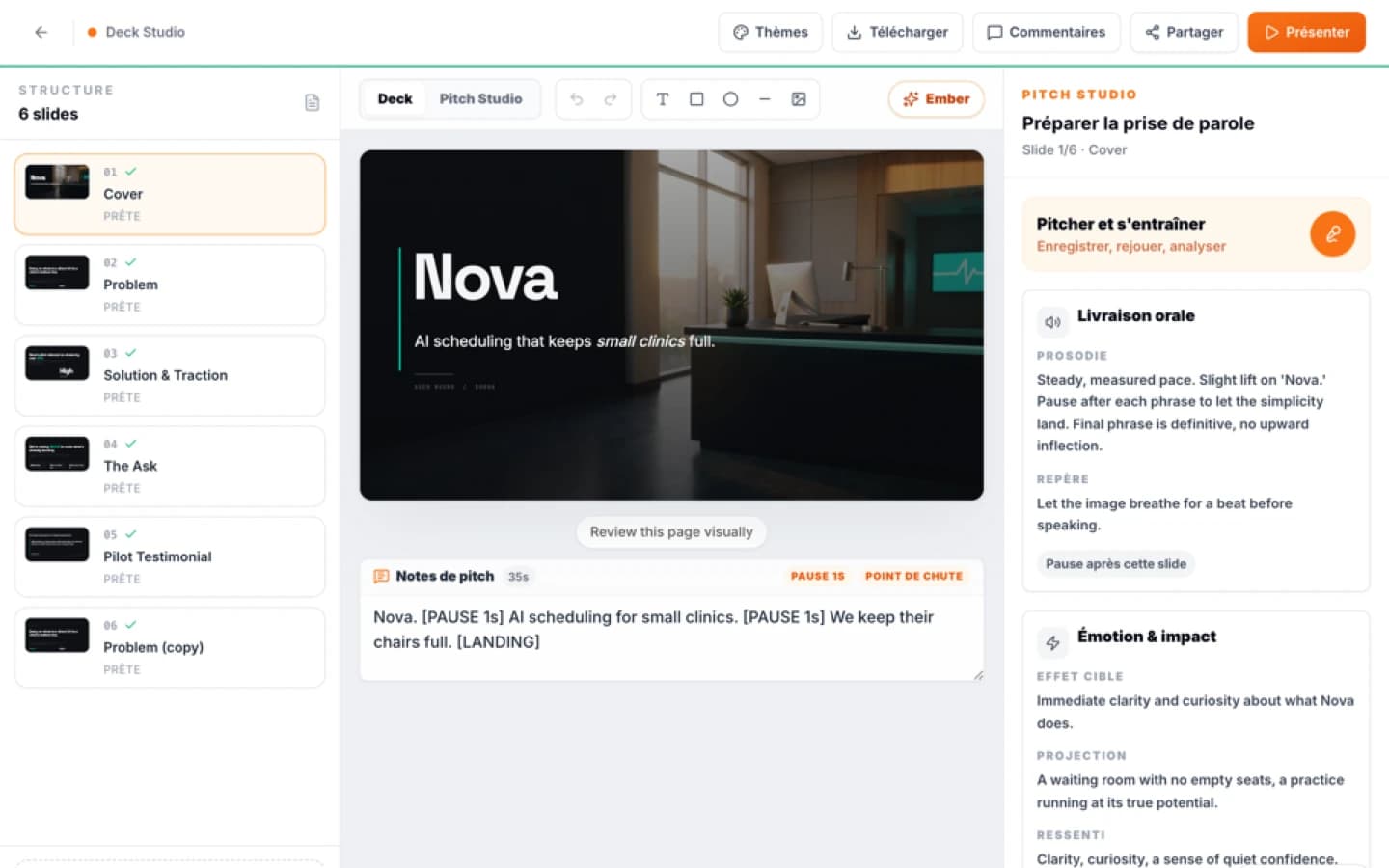
To perfect delivery before strategic buyer meetings, commercial teams can also record, replay and rehearse their deck in Speaking practice within Creation, which analyzes the rhythm, clarity, impact and structure of recorded takes. Completed presentations export as PowerPoint (.pptx) or PDF, making it easy to share a support suited to live demonstrations as well as asynchronous reviews inside the enterprise.
Before deciding, How to Build a Credible Sales ROI Slide for B2B Pitches helps connect this method with adjacent priorities.
Sources
FAQ
Mini audit
Test your Pitch Deck
Get an initial diagnosis of substance, form and impact.