
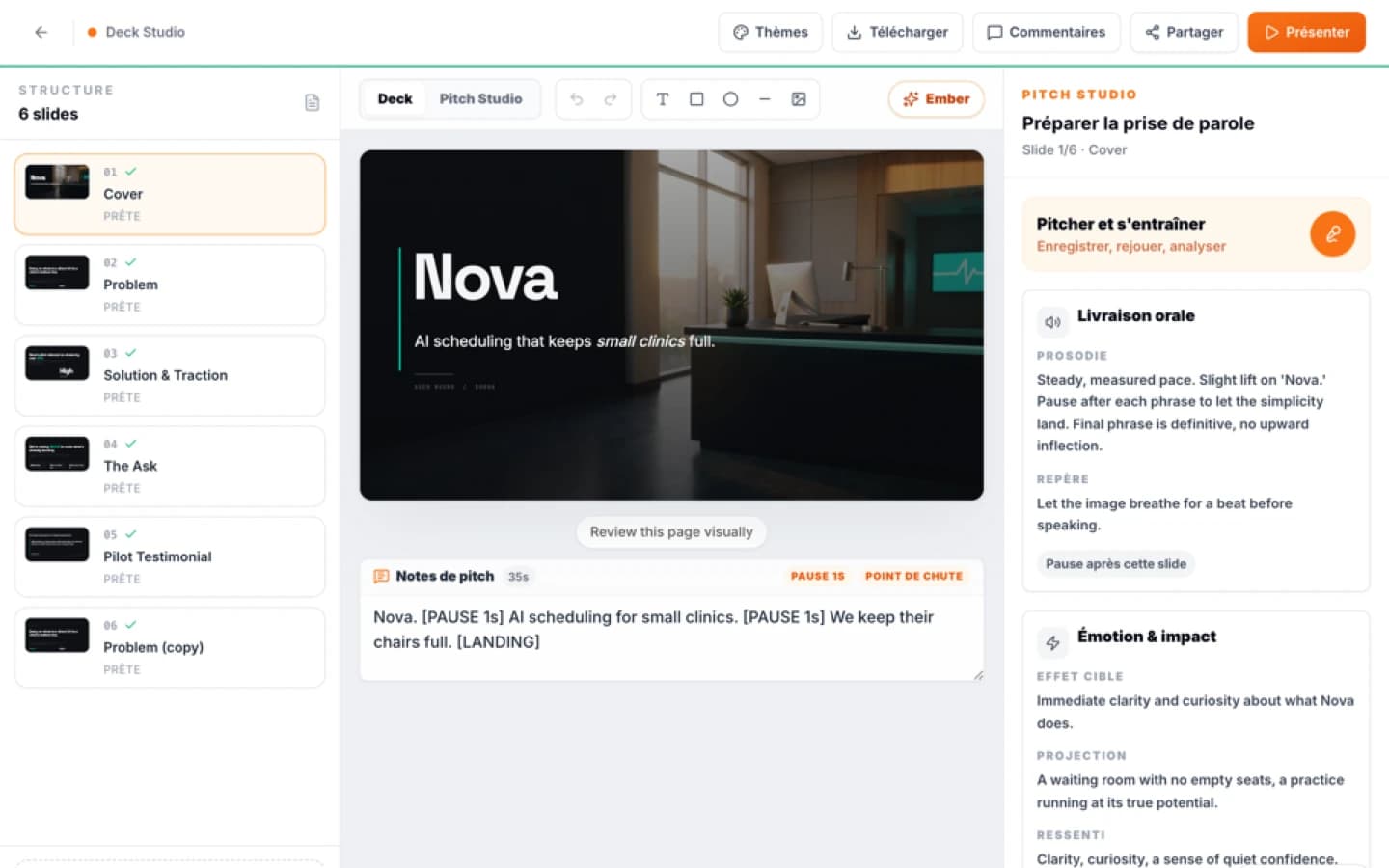
The trap: building the deck before the test
Many founders open a presentation tool to "clarify their ideas". The deck looks good but tells an untested story. The right order is the reverse: name the riskiest hypothesis, test it at the lowest cost, then produce the material that shows the result. If you already have customer feedback to organize, read Validating product-market fit through customer feedback. For Creation use cases on this topic, see Creation use cases for validating your market.
Finding the riskiest hypothesis
Strategyzer, in its article How to test your idea: start with the most critical hypotheses, read on September 29, 2026, suggests turning the idea into a value proposition, then asking which hypotheses must be true for it to work. They fall into three risks:
- Desirability: will customers want it?
- Feasibility: can I build and execute it?
- Viability: can I earn more than it costs?
A useful question to choose: which one, if wrong, makes the other two pointless? For a B2B founder with no customer, it is often desirability: does someone in a specific company have a problem painful enough to act?
The smallest credible test
The same article cites simple tests: interviews with customers and stakeholders, or a landing page to see whether people click, sign up or buy an offer that does not exist yet. The idea is to keep the hypothesis at the center of the experiment, without getting lost in building the test.
Example for a B2B offer: write a half-page promise, send it to 20 people in the exact target, and count how many reply, ask for a meeting or put down a deposit. Write down before the test what would count as success.
What counts as evidence
In Is your hypothesis really validated?, Strategyzer separates what people say from what they do. An interview reveals opinions: weak evidence. An observable action, such as a purchase or a deposit, is much stronger. The article cites a car maker's deposit campaign that collected 325,000 deposits in one week, rather than email addresses. It adds that customers who know they are in a test behave differently. And it says that "validated" is a matter of judgment: ask your team what evidence was collected and how confident they are.
| Need | Gamma | Creation (Ember) |
|---|---|---|
| Share a test result quickly | Presentations, documents or web pages; slides adapt to content | Deck, one-pager or business model canvas, from your brief and files |
| Structure hypotheses and evidence | Up to you in the layout | The business model canvas and one-pager are Creation formats; estimable unknowns can become explicitly marked hypotheses |
| Shared limit | Does not test the hypothesis | Does not test the hypothesis; does not replace your interviews or sales |
After the test: what to produce
- The test confirms the hypothesis: present the result (what you did, what people did, which success criterion you had set). A deck is then useful to raise money or recruit.
- The test disproves it: the right output is a decision note (change target, promise or offer), not a deck.
- The test is ambiguous: note what evidence is missing and run a stronger test, for example moving from an interview to a deposit request.
In every case, visibly separate observed results from untested hypotheses: that is what a skeptical investor or customer will read. Creation can mark hypotheses as such when information is missing; you must never present a hypothesis as a result.
Sources
FAQ
Mini audit
Test your Pitch Deck
Get an initial diagnosis of substance, form and impact.