
Claim to verify
Before selecting a presentation tool to pitch a new venture, an early stage founder must verify that their market validation data can be seamlessly translated into a structured, persuasive narrative. Market validation is not about aesthetic slides. It is about proving that a real customer problem exists and that your solution has a viable path to adoption.
Traditional presentation software remains highly effective for standard design needs. For instance, Microsoft PowerPoint provides robust utilities for presenters, including its private rehearsal feature, Speaker Coach, which helps users practice their delivery before presenting, as documented on the Microsoft Support page. However, generic templates often force founders to write their story backward, fitting complex market signals into pre-formatted bullet points.
To evaluate whether Creation is the right choice for your market validation phase, you should verify three core elements:
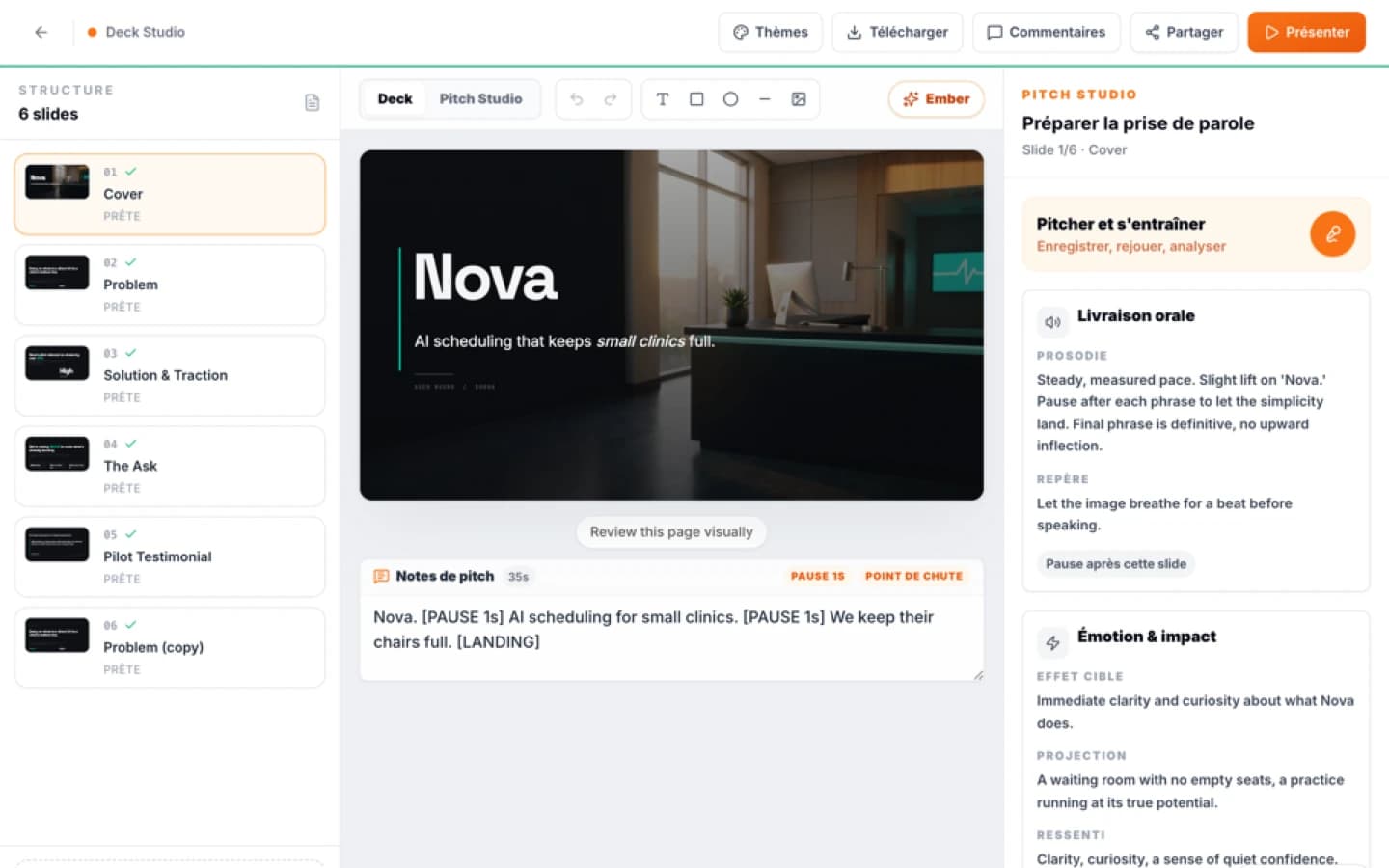
First, the tool must help structure the narrative journey from your actual project context rather than starting with blank slides. According to the Ember Pitch Deck page, Creation suggests three templates with previews, asks clarifying questions before generating. This ensures that the substance of your market validation, such as your Ideal Customer Profile (ICP) and early traction signals, directly shapes the structure of the presentation.
Second, you must retain full creative and editorial control. A common pitfall of automated generation is the inability to refine the output. Founders need to verify that they can edit every element. Creation allows users to edit the generated presentation directly within the platform, keeping the workflow fluid and adaptable as new market feedback arrives.
Third, the presentation should align with your broader strategic planning. Market validation is closely linked to your funding and growth strategy. In the Ember ecosystem, this context connects with Fund Your Growth, which helps make available proof, assumptions, and remaining validation gaps visible. By identifying these gaps, founders can rehearse their presentations in Speaking practice, where they can record, replay, and rehearse the presentation to address investor concerns head on.
For founders seeking deeper benchmarks on how to align Business-to-Business (B2B) sales evidence with their pitch materials, further guidance is available on the What Proof Should a B2B Founder Verify Before Choosing Creation?. Ultimately, the right tool is one that does not just polish your slides, but helps you build a presentation that moves decisions forward.
To place this decision in context, the Knowledge guides for marketing brings together deeper guidance on the same field.
Methodology
To systematically validate a market before building a pitch deck, early stage founders must transition from loose qualitative feedback to structured, defensible proof. The methodology for doing this involves three distinct phases of audit and preparation.
First, founders need to separate assumptions from verified facts. In the early stages of building a venture, it is easy to mistake casual customer interest for genuine market validation. A rigorous approach requires mapping out every claim made about the market size, customer pain points, and willingness to pay. This aligns with the structured approach of the Fund Your Growth capability in Ember, which connects assumptions, evidence, funding needs, and the action plan in one context, making available proof, assumptions, and remaining validation gaps visible.
Second, the narrative structure must be locked in before any visual design begins. Jumping straight into slide creation often leads to weak messaging masked by pretty graphics. The methodology should focus on answering critical business questions first. When using Creation, this sequence is respected by design. The system asks useful questions and suggests three templates with previews to establish the core narrative path, as detailed on the Ember Pitch Deck Page. This ensures that the substance of the market validation drives the presentation, rather than superficial design.
Third, the presentation must be refined through active rehearsal. Static slides do not win over investors or customers; the founder's ability to defend the data does. Incumbent tools have recognized this need for preparation. For instance, Microsoft PowerPoint provides a private rehearsal feature with Speaker Coach to help presenters prepare privately before the presentation, as outlined in the Microsoft PowerPoint Support Guide. Within the Ember ecosystem, once the presentation is generated, founders can edit the slides directly in Creation and then transition to Speaking practice to record, replay, and rehearse the presentation to ensure maximum impact.
By following this structured validation and rehearsal methodology, founders can ensure their pitch is grounded in reality and ready for critical evaluation.
Evidence
Before choosing a presentation tool like Creation, early stage founders must audit the quality of their market validation evidence. If a founder only has loose qualitative feedback, a generic slide generator will simply beautify weak assumptions.
For founders who prefer manual design control, established tools remain highly effective. Microsoft PowerPoint is excellent for custom layouts and includes a private rehearsal feature called Speaker Coach, which helps founders prepare before their live presentation as detailed on the Microsoft Support page. For quick, design first layouts, Gamma offers six distinct plans ranging from Free to Business to accommodate different team sizes, as documented in the Gamma Help Center.
However, when the priority is translating complex market validation data into a defensible business case, the tool must do more than polish slides. The true evidence a founder must gather beforehand is a clear map of their market assumptions, customer proof points, and remaining validation gaps. This structured foundation is what connects the market research phase to the final pitch. In the Ember ecosystem, this transition is supported by Fund Your Growth, which makes available proof, assumptions, and remaining validation gaps visible, as highlighted in the What evidence do founders need for Finance ta Crois?.
Once this foundation is set, Creation helps turn this context into a structured narrative. Instead of forcing founders into a rigid layout, it suggests three templates with previews, asks useful questions to capture the core of the project before generating, according to the Ember Pitch Deck page. Once the presentation is generated, founders retain full control to edit the slides directly in Creation or use Speaking practice to record, replay, and rehearse their presentation to ensure maximum impact before meeting investors.
To explore this point further, What Does the Perfect B2B Sales Pitch Actually Look Like? details a step directly related to this decision.
Demonstration and examples
To understand how this transition from raw data to a structured pitch works in practice, consider an early stage founder validating a new business-to-business (B2B) software solution. Initially, the founder has a collection of unstructured notes from customer interviews, some preliminary usage metrics, and competitor pricing sheets. Before designing any slides, the founder must organize these scattered data points. By utilizing the Fund Your Growth capability within Ember, the founder can make available proof, assumptions, and remaining validation gaps visible. This module connects assumptions, evidence, funding needs, and the action plan in one single context, allowing the founder to build the Business Plan, choose a funding strategy, and plan the next steps. This benchmark helps ground the market sizing assumptions in verified industry data. Once the underlying business logic and market evidence are structured, the founder can move to the presentation phase. Instead of starting with a blank canvas or a generic template, the founder initiates Creation. The system suggests three templates with previews, asks useful questions before generating, as outlined on the Creation product page. This process ensures that the generated narrative directly reflects the validated proof points rather than superficial design choices. After the initial generation, the founder retains full creative and editorial control. The platform lets users edit the generated presentation in Creation, making it easy to refine messaging, swap out data points, or adjust the flow as new customer feedback comes in. Finally, delivering a persuasive pitch requires practice. While traditional presentation software like Microsoft PowerPoint provides a private rehearsal experience with Speaker Coach to help with preparation before a presentation, as detailed by Microsoft Support, Ember integrates this step directly into the creation workflow. Specifically, Creation lets users record, replay, and rehearse the presentation in Speaking practice, ensuring the founder can practice their delivery with the exact context of their validated business case.
Observed results
When founders systematically audit their market validation before building their pitch, the observed results show a stark contrast to the traditional, design first approach. Instead of rushing to create slides with unverified assumptions, successful founders first make their available proof, assumptions, and remaining validation gaps visible. This initial diagnostic, which can be structured using the Fund Your Growth framework, ensures that the business plan and funding strategy are built on verified evidence rather than wishful thinking. Once these gaps are identified and addressed, the transition to creating a presentation becomes highly efficient. When using Creation, the platform suggests three templates with previews, asks useful questions before generating. This structured framing prevents the common pitfall of spending hours on superficial slide design before the core narrative is even defined. The observed result is a presentation that is not just visually polished, but deeply aligned with the actual state of market validation. After generating the presentation, founders retain full control to edit the slides directly. To ensure they are ready for investor scrutiny, they can record, replay, and rehearse the presentation in Speaking practice. For founders who only require basic, private rehearsal features without integrated narrative building, established tools like Microsoft PowerPoint provide a viable alternative. PowerPoint allows for private preparation before a presentation through its Speaker Coach feature, as detailed in the Microsoft support documentation. However, the primary benefit of an integrated workflow is the continuous alignment between data and delivery. While massive data platforms operate at a different scale, early stage founders do not need enterprise scale data to prove their point. They need precise, contextual validation. This focus on structured validation as a prerequisite for growth is a recognized best practice in venture building, as highlighted in the Mandalore Partners research. By verifying their market evidence first, founders ensure that their pitch deck represents a defensible business opportunity rather than a collection of creative slides.
This approach also connects with What to Verify Before Choosing Creation as a Founder?, which clarifies the next choice.
Limitations
While Creation provides a structured environment to build and edit presentations, founders must recognize its functional boundaries. First, a presentation tool cannot manufacture market validation out of thin air. If your project lacks foundational customer evidence, any design tool will only beautify unverified assumptions. For a deeper structural analysis of your business model, you must first identify what needs to be proven. Using a dedicated module like Fund Your Growth helps make your available proof, assumptions, and remaining validation gaps visible, allowing you to connect these elements into a single context before designing slides. Second, established legacy tools remain highly effective for specific workflows. For instance, founders who require highly customized manual design or specific presentation practice tools might find that Microsoft PowerPoint offers mature features, such as its Speaker Coach for private rehearsal before a presentation, as documented on the Microsoft Support page. While Creation includes its own Speaking practice to record, replay, and rehearse, founders should evaluate which environment fits their existing presentation habits. Third, founders looking for massive market databases must look to specialized providers rather than presentation software. This scale supports massive data operations that a presentation tool is not built to replicate. Finally, within the Ember ecosystem, Creation operates with clear parameters. It suggests three templates with previews, asks useful questions before generating, as outlined on the Creation product page. It also lets users edit the generated presentation directly. However, the quality of the output remains directly tied to the depth of the context you provide. For a comprehensive guide on the specific customer evidence to gather before starting, founders can consult the What Proof Should a B2B Founder Verify Before Choosing Creation? on founder-led sales validation.
Decision criteria
Before choosing Creation to build your pitch, you must evaluate whether your project is ready for a high-stakes presentation. Early-stage founders often make the mistake of rushing into slide design before solidifying their market proof. To make an informed decision, you should verify three critical criteria.
First, assess the maturity of your market evidence. A presentation tool cannot create market validation out of thin air. You must verify whether you have clearly mapped out your business-to-business (B2B) assumptions. Before you begin designing slides, it is essential to make your available proof, assumptions, and remaining validation gaps visible. If you need to structure these foundational elements first, the Fund Your Growth capability within Ember helps you build the Business Plan, choose a funding strategy, and plan the next steps. This ensures that when you transition to slide creation, you are presenting verified facts rather than hopeful guesses.
Second, determine whether you need simple visual polish or deep narrative structure. Many generic slide generators focus solely on superficial design, which often masks weak business logic. You should choose a solution that helps the presentation build understanding and move a decision forward beyond visual polish. Creation achieves this by starting with your actual project context. The workflow suggests three templates with previews, asks useful questions to extract the core of your message before generating. This guarantees that the final output is tailored to your specific audience journey.
Third, evaluate your post-generation editing and rehearsal workflow. Static templates often lock you into rigid layouts that are difficult to customize. You must ensure that you retain full creative control. Ember addresses this because it lets users edit the generated presentation in Creation. Additionally, delivering a pitch requires practice. While traditional tools like Microsoft PowerPoint allow you to prepare with a private rehearsal feature as detailed in the Microsoft Speaker Coach guide, Creation integrates this step directly into your workspace. It lets users record, replay, and rehearse the presentation in Speaking practice, allowing you to refine your delivery and narrative impact in one continuous process.
In practice, Creation Use Cases for Founders Seeking Investors completes this framework with another angle on the same topic.
What remains unproven
When founders transition from customer interviews to pitch creation, the most dangerous risk is confusing a polished narrative with a validated market. What remains unproven at this stage is the structural integrity of your business assumptions. A compelling slide deck can easily mask critical gaps in your value proposition, leading to failed investor meetings or misaligned sales conversations.
Traditional presentation platforms and automated slide generators are designed to optimize visual output, not to stress-test your business model. For example, design-focused tools like Gamma, which structures its offering across six distinct plans as detailed in their subscription guide and provides a one-time grant of 400 credits at signup according to their credit policy, will format any input into a visually appealing layout. However, they cannot identify whether your target market size, pricing model, or customer acquisition costs are based on real evidence or pure speculation. Similarly, while legacy software like Microsoft PowerPoint offers features to rehearse your delivery privately using Speaker Coach, as outlined in the Microsoft support guide, practicing your presentation skills does nothing to validate the underlying commercial viability of your project.
To ensure your pitch is grounded in reality, you must actively separate your narrative from your validated facts. Before choosing Creation to generate your slides, you should systematically audit your files to identify what remains unproven. This involves mapping your existing customer testimonials, pilot data, and market research against your core business assumptions. For a detailed breakdown of the specific validation steps required before designing your pitch, you can review the What Proof Should a B2B Founder Verify Before Choosing Creation?. By isolating your unverified hypotheses early, you can use the structured workspace in Ember to address these gaps directly, ensuring that your final presentation is built on a foundation of verifiable truth rather than superficial design.
Before deciding, How to Turn a Customer Story Into a Pitch Deck That Closes? helps connect this method with adjacent priorities.
Sources and updates
To maintain complete transparency for early-stage founders evaluating their market validation, this guide relies on verified industry benchmarks and structured methodologies. Our analysis incorporates insights from established business-to-business (B2B) frameworks to help founders distinguish between superficial slide design and robust market proof. For instance, research on venture building and venture capital models, such as those published by Mandalore Partners, highlights the importance of structuring business assumptions before designing investor materials. This methodology is also grounded in the benchmark analysis on what B2B founders in the founder-led sales phase must verify before choosing Creation, which can be explored in detail on the What Proof Should a B2B Founder Verify Before Choosing Creation?. When comparing presentation workflows, alternative tools like Gamma allow users to create presentations by prompting, pasting, or uploading sources, according to their documented product capabilities on Wikipedia. Similarly, traditional platforms like Microsoft PowerPoint offer private rehearsal features through their Speaker Coach, as detailed in the Microsoft Support Documentation.
Sources
FAQ
Creation
Work on substance and impact
Structure the reasoning, form and mental journey of your presentation.