
Claim to verify
For an early stage founder preparing a pre-seed round, the pitch deck is the primary tool to secure initial capital. According to insights from global Venture Capital (VC) firm Antler, building a winning pre-seed pitch deck requires a clear narrative structure that proves market understanding. Before committing to an Artificial Intelligence (AI) presentation builder like Creation, founders must verify specific claims regarding control, transparency, and rehearsal capabilities.
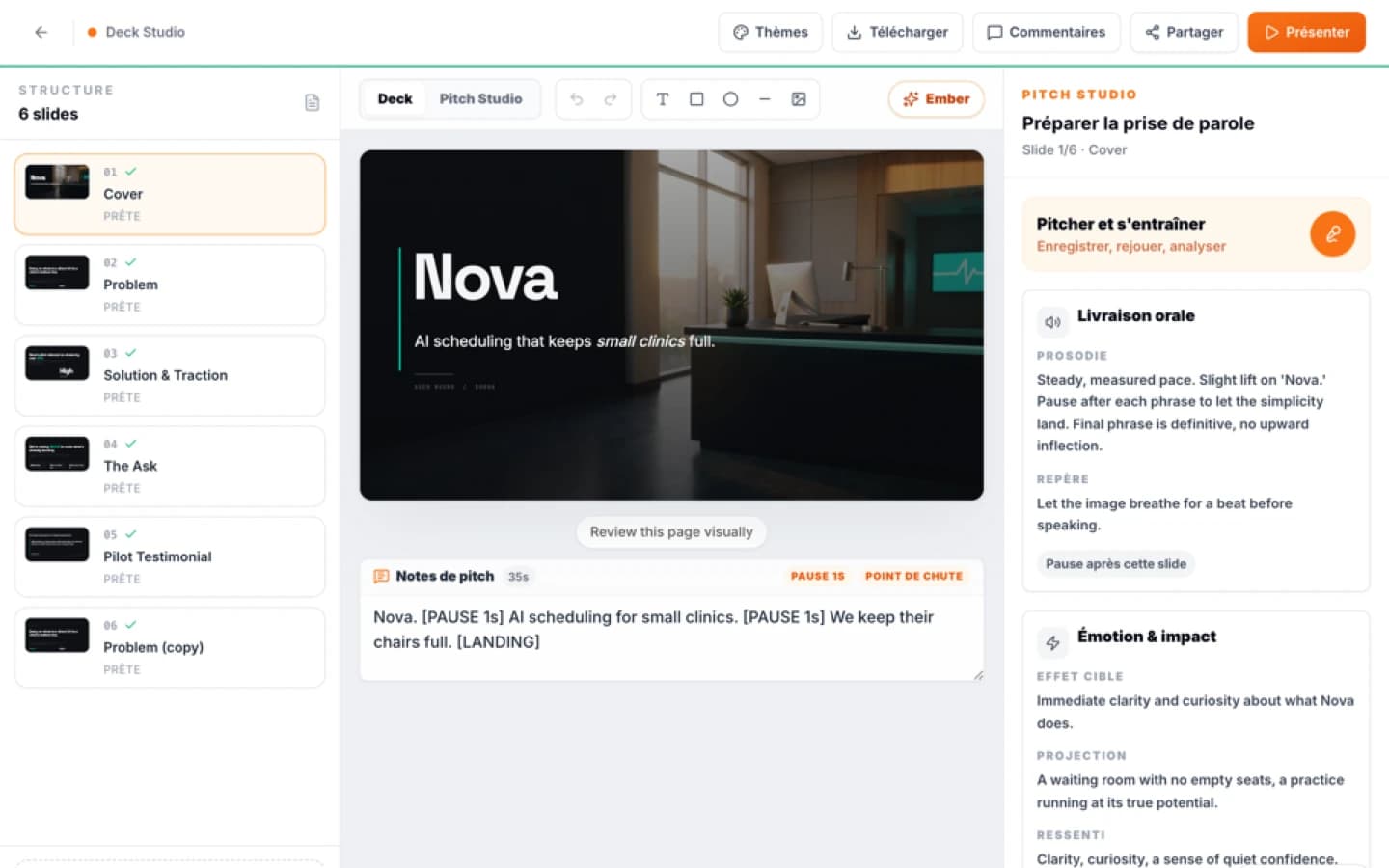
First, founders should verify whether the tool allows full editing capabilities or merely generates static slides. Many generic generators lock users into rigid layouts. In contrast, verified product capabilities show that Ember lets users edit the generated presentation directly within Creation, keeping the founder in complete control of the final narrative. This capability is outlined on the Ember Creation product page.
Second, process transparency is critical for early stage startups. Founders must know what a tool will do before it does it. Creation addresses this by suggesting three templates with previews, asking clarifying questions and asking for confirmation before creating, as detailed on the Ember Creation page.
Finally, a pitch deck is only as good as its delivery. Traditional presentation software is often sufficient for basic preparation. For instance, Microsoft PowerPoint provides a helpful private rehearsal experience through its Speaker Coach feature, allowing presenters to practice before their live session, as documented by Microsoft PowerPoint Support. However, founders looking for an integrated workflow should verify if their creation tool supports active delivery practice. Creation integrates this directly by letting users record, replay, and rehearse their presentation in Speaking practice, which is also verified on the Ember Creation page.
To place this decision in context, the Knowledge guides for marketing brings together deeper guidance on the same field.
Methodology
Evaluating a pitch deck creation tool requires a systematic methodology that goes beyond superficial aesthetics. For an early stage founder, the priority is to ensure the tool respects the strategic weight of a pre-seed round.
First, founders must verify how the tool handles narrative creation. A winning deck cannot rely on generic layouts. It must start with reasoning. A rigorous methodology checks whether the platform analyses the substance and structures the narrative path before producing slides. This ensures that the core business logic is sound before any visual elements are rendered.
Second, the evaluation must look at the onboarding and framing process. A professional tool should not demand immediate payment or commitment without context. Instead, it should guide the founder through an interactive discovery phase. For example, the system should suggest three templates with previews, ask useful questions, as outlined on the Ember Creation page. This transparent framing ensures that the final output aligns with the founder's specific goals.
Third, editability and control are non-negotiable. Founders must avoid tools that lock them into rigid, unchangeable formats. The methodology should confirm that the platform lets users edit the generated presentation directly within the workspace, keeping the creator in complete control of the final narrative.
Fourth, the transition from slide creation to oral delivery must be seamless. While traditional presentation software like Microsoft PowerPoint provides a private preparation experience through its Speaker Coach feature, as detailed by Microsoft Support, modern platforms must offer integrated rehearsal capabilities. Founders should verify if the tool lets users record, replay, and rehearse the presentation in a dedicated environment like Speaking practice to build confidence before meeting investors.
Finally, the pitch deck must remain perfectly aligned with the startup's underlying business model. A standalone design tool cannot achieve this. The ideal methodology evaluates how well the deck builder connects with broader strategic modules, such as Fund Your Growth. This integration connects assumptions, evidence, funding needs, and the action plan in one unified context. It makes available proof, assumptions, and remaining validation gaps visible, while ensuring the entrepreneur can approve, reject, or edit proposals before they enter the official file. This holistic approach guarantees that the pitch deck is not just a beautiful presentation, but a true reflection of a fundable business strategy.
Evidence
To make a well-informed decision, early-stage founders must weigh the evidence of how different tools handle both the creation and the delivery of their pitch.
For general presentation design and rapid slide generation, existing market tools are often highly effective. For instance, Gamma is a strong option for teams needing a quick, visually polished draft. According to Gamma's subscription documentation, they offer six plans across individual and team tiers including Free, Plus, Pro, Ultra, Teams, and Business. If a founder only needs a quick, one-off draft, Gamma's free plan provides 400 credits at signup with no refresh, as detailed in Gamma's credit help center. For ongoing needs, their paid plans refill credits monthly and allow a rollover of up to double the plan size, offering monthly Artificial Intelligence (AI) credits such as 1,000 for Plus, 4,000 for Pro, and 20,000 for Ultra according to Gamma's upgrade guide.
Similarly, for practicing the spoken delivery of a presentation, Microsoft PowerPoint remains a highly capable incumbent. It provides a private rehearsal experience before the presentation through its Speaker Coach feature, as documented by Microsoft Support.
However, pre-seed founders require more than just aesthetic templates or generic slide layouts. They need a tool that anchors the pitch in strategic substance and aligns the narrative with their actual business model. This is where the evidence for Ember and its Creation capability becomes critical.
Instead of forcing founders into a rigid template, the workflow in Creation suggests three templates with previews, asks useful questions and asks for confirmation before creating, as outlined on the Ember Creation page. This ensures the initial framing is tailored to the project's unique context. Once the presentation is generated, the platform lets users edit the generated presentation directly in Creation, as detailed on the Ember Creation page, giving founders complete control over the final messaging. Finally, to ensure the verbal pitch matches the quality of the slides, the platform lets users record, replay, and rehearse the presentation in Speaking practice, as explained on the Ember Creation page. By combining strategic framing, full editability, and integrated rehearsal, founders can build a presentation designed to move investor decisions forward.
To explore this point further, Creation Use Cases for Founders Launching a New Offer details a step directly related to this decision.
Demonstration and examples
To understand how this works in practice, consider an early-stage founder preparing for a pre-seed round. Instead of staring at a blank canvas or forcing their ideas into a rigid visual template, the founder needs a workflow that prioritizes strategic substance.
The process begins with narrative construction. According to the Antler guide on pre-seed pitch decks, a successful pre-seed pitch requires a highly clear narrative structure. To address this, Creation analyzes the substance and structures the narrative path before producing slides. This ensures that the core business logic, market opportunity, and problem statement are aligned before any design choices are made.
When starting the generation, the platform suggests three templates with previews, asks useful questions and asks for confirmation before creating, as outlined on the Ember Creation page. Once the initial slides are generated, the founder retains full creative agency. Rather than receiving a static file, Ember lets users edit the generated presentation in Creation, making it easy to refine copy, adjust layouts, and update data points.
For delivery and practice, founders have several viable paths. Traditional tools like Microsoft PowerPoint are excellent for general preparation, offering a dedicated Speaker Coach feature for private rehearsal before a presentation, as detailed by Microsoft Support. To provide an integrated experience, Ember also lets users record, replay, and rehearse the presentation in Speaking practice, keeping the rehearsal process directly connected to the generated slides.
Ultimately, a pitch deck is only as strong as the business model behind it. This is where the integration with other workspace capabilities becomes critical. Through the Fund Your Growth capability, founders can build the Business Plan, choose a funding strategy, and plan the next steps. This module connects assumptions, evidence, funding needs, and the action plan in one context, making available proof, assumptions, and remaining validation gaps visible. Throughout this process, the entrepreneur can approve, reject, or edit proposals before they enter the file, ensuring that the final pitch deck perfectly reflects a validated, defensible business strategy.
Observed results
Evaluating the observable outcomes of a pitch deck tool requires looking at how it bridges the gap between raw business ideas and investor-ready presentations. For an early-stage founder, the first verifiable result is how the tool handles narrative flow. Rather than jumping straight to visual design, Ember analyses the substance and structures the narrative path before producing slides, ensuring the core business logic remains front and center. This methodical approach aligns with the strategic structuring advice shared by global Venture Capital (VC) firms like Antler, where a clear and logical narrative is deemed essential for pre-seed fundraising success.
The second observable result lies in the transparency of the creation process itself. When starting a project, the platform suggests three templates with previews, asks useful questions and asks for confirmation before creating, as outlined on the Ember Creation page. This ensures founders are not locked into a blind workflow and can preview the direction of their deck before creation starts. Once the slides are generated, the tool lets users edit the generated presentation in Creation, providing a fully interactive editor to refine copy, adjust layouts, and update data points without needing to export the file to external software.
Finally, the preparation does not end with a polished file. Founders must also evaluate how a tool supports their actual verbal delivery. Traditional software has long recognized this need, with Microsoft PowerPoint offering a private rehearsal experience through its Speaker Coach to help presenters practice before a live audience, as documented on the Microsoft Support portal. To address this critical phase of fundraising, Ember integrates this step directly into the creation workflow, letting users record, replay, and rehearse the presentation in Speaking practice. This allows pre-seed founders to test their verbal pacing and slide transitions in one continuous environment, turning a static slide deck into a fully rehearsed, high-impact pitch.
This approach also connects with Build trust before a B2B sales call, which clarifies the next choice.
Limitations
Every artificial intelligence (AI) tool has boundaries that early stage founders must understand before committing their time. While Creation provides an orchestrated workflow to turn project context into an editable presentation, it is not a substitute for the founder's personal conviction and deep understanding of the business.
Incumbent tools remain highly effective for founders who prefer complete manual design control from scratch. For example, Microsoft PowerPoint is a mature industry standard that offers specialized features like a private rehearsal helper to practice before presenting, as documented in the Microsoft PowerPoint Speaker Coach guide. Founders who already have a finalized, pixel-perfect deck and only need manual formatting may find these traditional desktop applications more than sufficient for their needs.
Furthermore, Creation is designed to work on the substance and narrative path of a pitch, not just superficial slide design. This means the quality of the generated presentation depends heavily on the context the founder provides. During the setup, the tool suggests three templates with previews, asks useful questions, then asks for confirmation before creating, as detailed on the Ember Creation page. If a founder lacks clear assumptions, proof, or a structured business model, the tool cannot invent these core strategic elements.
Finally, while the platform lets users edit the generated presentation directly and rehearse their delivery in Speaking practice, as shown on the Ember Creation page, the final defense of the project always rests with the human entrepreneur. A structured narrative path is a powerful tool to move decisions forward, but it is the founder who must ultimately stand in front of investors to secure the round.
Decision criteria
When evaluating whether to adopt a presentation platform at the pre-seed stage, early stage founders must look beyond basic design automation. The right tool should serve as a strategic partner that prepares the business for rigorous investor scrutiny. Founders should evaluate several key criteria to ensure their chosen solution aligns with the demands of raising capital.
First, the tool must prioritize narrative depth over superficial aesthetics. At the pre-seed phase, investors are buying into the founder's vision and the clarity of their thesis. A startup should verify if the platform helps the presentation build understanding and move a decision forward beyond visual polish, as detailed in the Ember Creation documentation. This focus on substance is essential because, as global venture capital (VC) firm Antler highlights in their guide on building winning pre-seed pitch decks, a compelling narrative structure is what ultimately secures early stage interest.
Second, founders need absolute creative control and transparency during the creation process. Rigid templates that lock content into unalterable formats can ruin a pitch. Founders should confirm that the software lets users edit the generated presentation directly, which is a core feature of Creation. Transparency in the workflow is equally important. The platform should guide the user step by step, which is why Creation suggests three templates with previews, asks useful questions and asks for confirmation before creating, so founders retain full decision-making power.
Third, the transition from slide creation to oral delivery must be seamless. A pitch deck is only as effective as the founder's ability to present it. While established tools like Microsoft PowerPoint provide a private rehearsal experience through their Speaker Coach feature, as documented by Microsoft Support, modern platforms should offer integrated rehearsal workflows. Founders should verify if they can easily practice their delivery, a need met by Creation, which lets users record, replay, and rehearse the presentation in Speaking practice.
Finally, the presentation must remain grounded in the startup's actual business model. A pitch deck created in a vacuum often falls apart during due diligence. Founders should look for a system that connects assumptions, evidence, funding needs, and the action plan in one unified context. This is the exact mechanism behind the Fund Your Growth capability in Ember, which makes available proof, assumptions, and remaining validation gaps visible. By ensuring the deck is backed by a coherent strategic foundation, founders can step into investor meetings with a defensible business case.
In practice, What Does the Perfect B2B Sales Pitch Actually Look Like? completes this framework with another angle on the same topic.
What remains unproven
For an early stage founder preparing a pre-seed round, certain critical elements of the fundraising process remain unproven by software alone. While platforms can structure information, they cannot validate the underlying business assumptions. According to the guide on building a winning pre-seed pitch deck by Antler (Antler), founders must still do the heavy lifting of proving problem-solution fit, market size, and team chemistry.
The limits of automated generation become clear when looking at credit-based design tools. For example, Gamma offers six plans across individual and team tiers, specifically Free, Plus, Pro, Ultra, Teams, and Business (Gamma). While Gamma provides a one-time credit grant of 400 credits at signup with no refresh (Gamma) and allows paid users to purchase top-ups of 1,500 credits for $6 (Gamma), having thousands of design credits does not prove that your slides will convince a venture capital (VC) investor. Paid plans on Gamma refill monthly with rollover up to double the plan size (Gamma), but this mechanical cycle remains disconnected from the actual strategic milestones a startup must hit.
Similarly, the ability to rehearse a presentation does not guarantee real-world performance. Microsoft PowerPoint allows for a private rehearsal before the presentation using its Speaker Coach feature (Microsoft). In a similar way, Ember lets users record, replay, and rehearse the presentation in Speaking practice (Ember). However, even if Creation suggests three templates with previews, asks useful questions (Ember) before letting users edit the generated presentation (Ember), the ultimate test is human. The founder must still step into the room and defend their vision. The software prepares the structure, but the conviction remains entirely unproven until the founder delivers the pitch.
Before deciding, What to Verify Before Choosing Creation as a Founder? helps connect this method with adjacent priorities.
Sources and updates
Early stage founders preparing a pre-seed round must rely on verified methodologies and clear benchmarks to build their fundraising materials. Industry standards, such as the guide on building a winning pre-seed pitch deck published by Antler, emphasize that structuring a compelling narrative is far more critical than superficial design. When evaluating tools to support this process, founders often compare different approaches to presentation creation. For instance, platforms like Gamma allow users to create presentations by prompting, pasting, or uploading sources, as documented on Wikipedia. Meanwhile, traditional software like Microsoft PowerPoint provides a private rehearsal feature called Speaker Coach to help presenters prepare before their actual delivery, according to the Microsoft Support documentation. To address these needs in an integrated manner, Creation combines narrative structuring with interactive editing and rehearsal capabilities. As detailed on the Ember product page, the platform suggests templates with previews, asks useful questions. It also lets users edit the generated presentation directly in Creation and rehearse their delivery in Speaking practice, allowing them to record, replay, and practice their pitch.
Sources
FAQ
Creation
Work on substance and impact
Structure the reasoning, form and mental journey of your presentation.