
Context and ICP
Launching a new offer is a critical milestone for early-stage founders. At this stage, the primary challenge is not just aesthetic polish, but narrative clarity. Founders must synthesize market signals, customer pain points, and product capabilities into a cohesive story that convinces early adopters, partners, or investors. Traditional presentation design often forces founders into rigid, generic templates that fail to reflect the unique nuances of a new market entry. This is where a dedicated, narrative-first tool becomes essential.
For early-stage founders, the journey of defining a new offer requires a tool that understands the underlying business substance. Instead of starting from a blank canvas or a superficial layout, founders need to ground their presentations in actual project data and strategic assumptions. As detailed on the Ember Creation page, the platform starts directly from project context and data rather than a generic template. This ensures that the resulting slides are aligned with the founder's strategic vision from the very beginning.
This context-driven approach contrasts with traditional alternatives. For instance, some platforms focus primarily on importing pre-existing materials, such as the PowerPoint text import feature used by Prezi AI to build new presentations, as described in the Prezi AI FAQ. However, when launching a completely new offer, founders rarely have polished, pre-existing slide text. They require an interactive framing process. To address this, Creation suggests three templates with previews, asks useful questions to clarify the offer, allowing founders to structure their thoughts before any slides are generated. By analyzing the substance and structuring the narrative path first, the system generates slides that are ready to be edited and refined directly by the user.
To place this decision in context, the Knowledge guides for marketing brings together deeper guidance on the same field.
Problem
When launching a new offer, early-stage founders face a critical challenge that goes far beyond visual aesthetics. They must translate a complex, newly formed business idea into a compelling narrative that immediately resonates with early adopters and partners. Traditional presentation tools are highly effective for specific scenarios. For instance, Google Slides provides a reliable template library designed to help teams start planning and pitching quickly (Google Workspace Blog). Similarly, design-first platforms like Canva (Canva Pricing), are excellent when the story is already set and the primary goal is rapid visual customization. For presentations requiring a non-linear format, Prezi offers a zoomable open canvas that helps map out complex ideas spatially (Prezi Product).
However, these tools assume the founder already knows exactly what to say. When introducing a brand-new product or service to the market, the narrative is rarely settled. Founders often get trapped in a cycle of superficial editing, adjusting layouts and colors instead of refining their core message. Even automated assistants often miss the mark by focusing solely on reformatting existing text, such as Prezi AI importing PowerPoint text to build a new deck (Prezi AI FAQ). This focus on form over substance results in presentations that look professional but fail to articulate a clear value proposition, leaving the audience confused about the actual problem being solved. For an early-stage founder, a beautiful slide deck that lacks a logical narrative path is a missed opportunity to validate their new offer.
Prerequisites
Before launching a new offer, early stage founders must gather their core business assumptions. Unlike traditional design tools that focus purely on visual layouts, Creation builds presentations from the underlying substance of the project. For instance, while Google Slides provides templates to help users start designing faster as detailed on the Google Workspace Blog, and Prezi offers an open, zoomable canvas to structure presentations as shown on the Prezi Product Page, these platforms still require you to bring a pre-structured narrative. Even Prezi AI focuses on importing existing PowerPoint text to build a new presentation, according to the Prezi AI FAQ. While design-centric platforms like Canva offer individual subscriptions as shown on the Canva Pricing Page, they leave the burden of narrative creation entirely on the founder.
To get the most out of Creation, you do not need a finished slide layout, but you do need a few essential inputs. First, you need a clear definition of your Ideal Customer Profile (ICP). Next, you need a raw outline of your new offer, including the specific problem it solves and how it works. Finally, you should have a clear goal for the presentation, whether that is securing a pilot customer or presenting to early stage investors. When you begin, the platform suggests three templates with previews and asks useful questions to frame the narrative, as outlined on the Ember Creation page.
This approach shifts the founder's preparation from visual formatting to strategic thinking. Instead of spending hours adjusting text boxes, the prerequisite is simply knowing your business model and your audience. If you already have your project context documented in Ember, such as within the Second Brain or Fund Your Growth modules, Creation can reuse this existing information directly, ensuring your presentation remains completely aligned with your overall business strategy.
To explore this point further, What Does the Perfect B2B Sales Pitch Actually Look Like? details a step directly related to this decision.
Workflow
The workflow in Creation is designed to transform raw business assumptions into a structured presentation that validates a new offer. It moves systematically from strategic framing to narrative design, editing, and rehearsal.
First, the founder initiates the process by defining the core parameters of the new offer. Unlike generic design tools, Creation begins with strategic alignment. The platform suggests three templates with previews, asks useful questions to capture the unique value proposition Ember Creation page. This ensures that the foundation of the deck is built on business substance rather than empty visual placeholders.
Second, the platform structures the narrative path. Traditional presentation tools often force founders to start with blank slides or purely visual templates. For example, Google Slides provides templates to help users start designing faster Google Workspace Blog, but it leaves the narrative structure entirely to the user. Similarly, Prezi offers a zoomable open canvas to structure presentations Prezi Product and allows importing text from PowerPoint presentations to build new slides Prezi AI FAQ. In contrast, Creation analyzes the underlying substance of your project first, building a logical flow that guides the audience from the initial problem to the proposed solution before any visual elements are rendered.
Third, the generation process begins. The orchestrated Artificial Intelligence (AI) workflow translates the validated narrative structure into fully designed slides. Because founders often work on the move, the generation is resilient, meaning it continues in the background even if there is a temporary connection loss or if the browser tab is closed. Once the slides are ready, the founder remains in complete control. Creation lets users edit the generated presentation directly Ember Creation page. Founders can modify layouts, refine copy, or request changes using natural language instructions, avoiding the tedious manual adjustments typical of complex design suites. For comparison, while dedicated design platforms like Canva offer a free tier and paid plans Canva Pricing, they still require the founder to manually manage the design alignment and layout rules.
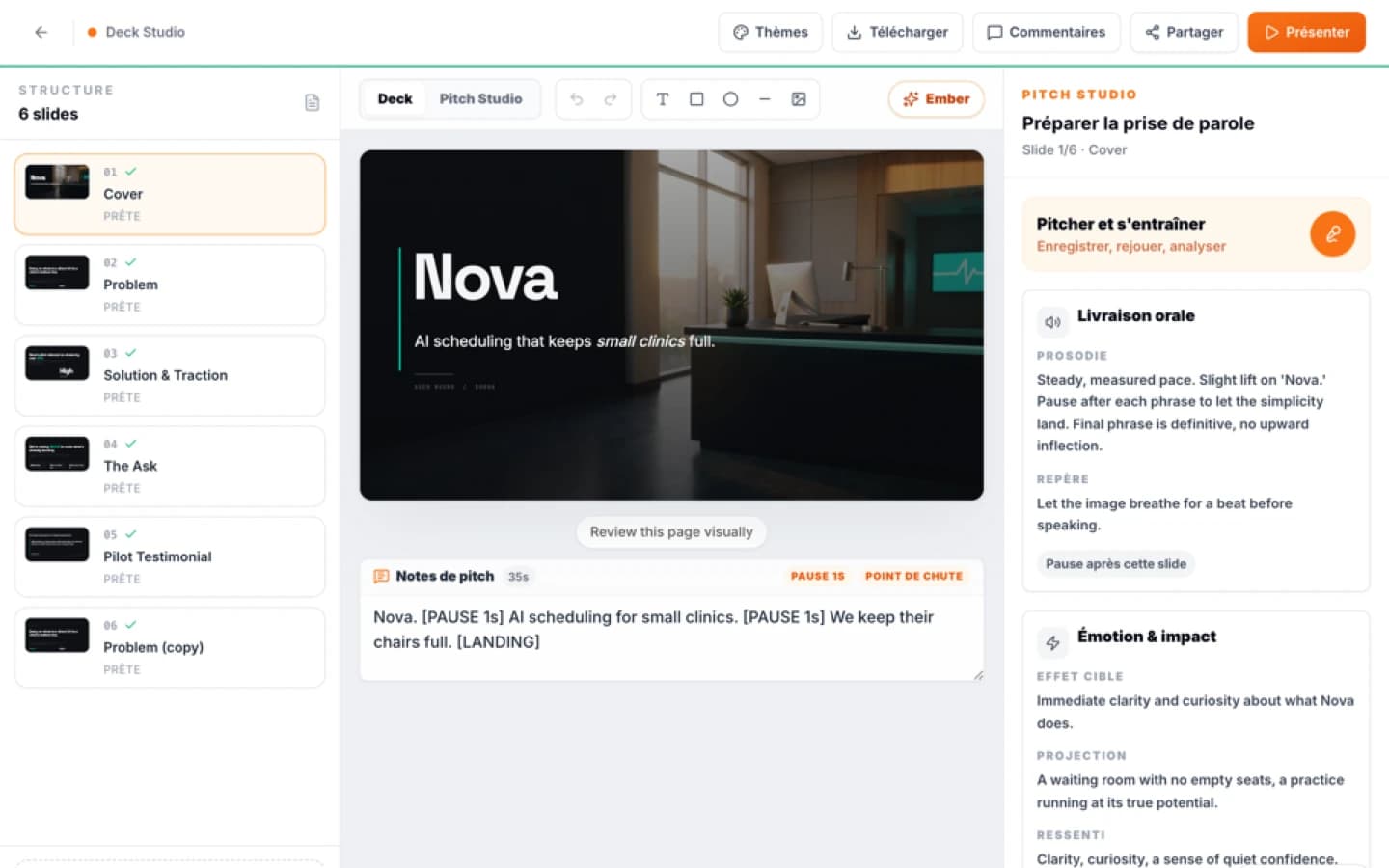
Finally, the workflow extends to delivery preparation. Once the slides are finalized, they can be exported to Portable Document Format (PDF) or PowerPoint. To ensure the pitch is delivered with maximum impact, Creation lets users record, replay, and rehearse the presentation in Speaking practice Ember Creation page. This integrated environment analyzes the recorded take for rhythm, clarity, and structure, helping founders refine their verbal delivery before they present their new offer to early adopters or partners.
Expected result
By completing this structured workflow in Creation, early stage founders achieve a presentation that is fundamentally aligned with the strategic reality of their new offer. Instead of a generic template filled with placeholder text, the expected result is a highly tailored, persuasive narrative path that connects customer pain points directly to the new product capabilities. The presentation serves as a strategic tool designed to move decisions forward, helping partners and early adopters understand the precise value of the launch.
Once the initial generation is complete, founders do not receive a static, unchangeable file. The expected outcome includes a fully interactive workspace where users can edit the generated presentation directly in Creation, as outlined on the Ember Creation page. This ensures that as early market feedback arrives, the founder can easily adjust the messaging, refine the value proposition, and update slides without needing to rebuild the entire presentation from scratch.
Beyond the physical slides, the final result of this process is a founder who is fully prepared to deliver the pitch. By allowing users to record, replay, and rehearse the presentation in Speaking practice, as detailed on the Ember Creation page, the platform helps founders build vocal confidence, test their narrative flow, and perfect their timing. This ensures that the transition from a digital deck to a live client conversation is seamless and impactful.
While specialized tools are highly effective for specific design needs, they serve different purposes. Google Slides remains an excellent option for teams looking for quick planning templates, as described on the Google Workspace Blog. Similarly, Prezi provides a unique zoomable open canvas to structure presentations visually, as detailed on the Prezi Product Page. For founders who only require pure graphic design, Canva offers paid Pro and Business plans, as listed on the Canva Pricing Page. However, when launching a new offer, the primary challenge is not just visual layout but strategic coherence. Creation bridges this gap by ensuring that the underlying business logic is fully integrated into every slide.
This approach also connects with What to Verify Before Choosing Creation as a Founder?, which clarifies the next choice.
Example Ember mission
To illustrate how this works in practice, consider an early stage founder preparing to launch a new business to business software offering. Instead of starting with a blank canvas or copying a generic layout, the founder initiates a structured mission within Ember to align their team and secure early customers.
The process begins with strategic framing. The platform guides the founder through clarifying their target audience, value proposition, and Ideal Customer Profile (ICP). During this initial setup, Creation suggests three templates with previews, asks useful questions to capture the strategic substance of the new offer, as detailed on the Ember Creation page. This ensures the presentation is grounded in actual business logic rather than superficial design choices.
Once the narrative structure is generated, the founder can easily refine the messaging. Ember lets users edit the generated presentation in Creation, keeping every element fully customizable. This approach differs from alternative presentation platforms. For example, Prezi Artificial Intelligence (AI) allows users to import the text of PowerPoint slides to construct a new presentation, as described in the Prezi AI FAQ. Ember, by contrast, generates the narrative path directly from the founder's validated business assumptions.
After polishing the slides, the founder can transition to delivery. To ensure the pitch resonates with early adopters, the platform lets users record, replay, and rehearse the presentation in Speaking practice, a capability highlighted on the Ember Creation page. This complete workflow transforms the launch of a new offer from a stressful design chore into a structured, repeatable exercise in strategic alignment.
Limits and non-fit
While Creation is highly effective for structuring a strategic narrative for a new offer, it is not the right fit for every scenario. Early stage founders should consider alternative tools when their primary objective lies outside of deep narrative alignment.
If your immediate need is a quick, standard template to begin writing slides without any guided narrative structuring, traditional tools are often sufficient. For example, Google Slides provides a template library covering planning and pitching to help users start faster, as detailed on the Google Workspace Blog.
For founders who require highly visual, design-centric layouts or quick marketing assets rather than a structured business narrative, dedicated graphic design platforms are a better match. Canva offers accessible design options with a free tier and paid plans, as shown on the Canva Pricing Page.
If the presentation demands a non-linear, highly dynamic visual flow, other specialized tools are more appropriate. Prezi provides an open and zoomable canvas to structure presentations, which can be explored on the Prezi Product Page. Additionally, Prezi AI supports importing text from existing PowerPoint slides to build new presentations, as outlined in the Prezi AI FAQ.
Furthermore, if your primary goal is high-volume outbound sales prospecting rather than crafting a persuasive presentation for a new offer, you will need a dedicated sales engagement platform. Tools like Apollo focus on providing a massive contact database and sequence automation rather than narrative development.
Finally, Creation requires active strategic input. The workflow begins by suggesting three templates with previews and asking useful questions to establish the project context, as described on the Ember Creation page. If a founder is looking for a purely automated generator that requires no strategic thinking or context input, Creation will not align with their workflow.
In practice, Creation Use Cases for Founders Seeking Investors completes this framework with another angle on the same topic.
When to use it
For early stage founders launching a new offer, the primary challenge is not just making slides look professional, but ensuring the underlying business logic is persuasive enough to secure early customers or investor buy in. Creation is designed specifically for these critical market entry moments, helping founders translate their strategic vision into a structured narrative.
You should use Creation when your launch requires a deep, cohesive narrative rather than a generic layout. When initiating a presentation, the system suggests three templates with previews and asks useful questions to align the slides with your specific business goals, as detailed on the Ember Creation page. This structured approach ensures that your value proposition, target audience, and business model are tightly integrated.
This workflow is highly resilient for busy founders. If you experience a connection loss or close your browser tab during the creation process, the platform keeps generating the presentation in the background and resumes progress immediately when you return. Once the initial draft is ready, you can edit the generated presentation directly within Creation to refine the messaging. To prepare for high stakes meetings, you can also record, replay, and rehearse your presentation in Speaking practice, ensuring your verbal delivery matches the quality of your slides.
There are, however, scenarios where alternative tools are more suitable. If your goal is simply to start quickly with a standard layout for internal notes, Google Slides provides basic templates to help users start faster, as documented in the Google Slides Blog. If you already have a completed PowerPoint presentation and want to import its text to build a new layout, Prezi supports importing PowerPoint text to construct a new presentation, as explained in the Prezi AI FAQ. For design centric projects that do not require deep strategic structuring, Canva offers paid plans, as shown on the Canva Pricing Page.
When the success of a new offer depends on clear strategic positioning and earning the trust of early adopters, Creation provides the narrative structure needed to move those critical decisions forward.
Next step
To take the next step in launching your new offer, the immediate priority is translating your business strategy into a clear, persuasive narrative. Founders often face a choice between focusing purely on visual design or deeply structuring their business logic. If your goal is simply to find quick templates to start faster, Google Slides offers a straightforward, accessible option as outlined in the Google Workspace Blog. Similarly, if you want to present your ideas on an open, zoomable canvas, Prezi provides a flexible spatial layout as detailed on the Prezi Product Page. For teams focused primarily on visual assets and graphic design, traditional tools like Canva offer individual Pro plans, as shown on the Canva Pricing Page.
However, when launching a new business-to-business (B2B) offer, the challenge is building deep conviction rather than just polishing slides. The most effective next step is to ground your presentation in your actual project context. By using Creation within Ember, you can answer targeted questions that clarify your value proposition. The platform suggests three templates with previews and asks useful questions, as documented on the Ember Creation page.
Once your presentation is generated, you retain full control to edit the slides directly in Creation. To ensure your delivery matches the strength of your message, you can then record, replay, and rehearse your presentation in Speaking practice, a feature detailed on the Ember Creation page. This structured approach ensures that when you finally present to early customers or investors, your narrative is fully aligned with the strategic reality of your new offer.
Before deciding, How to Turn a Customer Story Into a Pitch Deck That Closes? helps connect this method with adjacent priorities.
Sources
To ground our analysis of presentation tools and founder strategies, we rely on official documentation and public benchmarks. For instance, founders looking for rapid, template-driven designs often evaluate standard platforms like Google Slides, which focuses on templates to help users start faster as detailed in the Google Workspace Blog. For collaborative design, Canva offers a free plan and paid plans, as documented on the Canva Pricing Page.
Other modern alternatives focus on automated generation from existing assets. Gamma allows users to create presentations from a prompt, pasted text, or uploaded files, according to its Wikipedia page. Similarly, Prezi Artificial Intelligence (AI) supports importing the text of PowerPoint slides to build new presentations, as explained in the Prezi AI FAQ. For community-driven pitch analysis, organizations like Front Row Ventures host events such as Pitch Deck Teardown, which can be seen on Instagram.
When founders transition from generic templates to structured, high-stakes narratives for launching new offers, specialized resources are required. The strategic framework for using Creation during market entry decisions is outlined in the Use Creation for Market Entry Decisions as a Founder. Finally, the specific capabilities of Creation, including how it suggests three templates with previews, asks useful questions, and allows users to edit and rehearse presentations, are detailed on the Ember Creation page.
Sources
FAQ
Mini audit
Test your Pitch Deck
Get an initial diagnosis of substance, form and impact.