
Context and ICP
Launching a first product requires early stage founders to translate abstract ideas into concrete, persuasive narratives. At this critical phase, the ideal customer profile (ICP) is often still being refined, and the founder must pitch to diverse audiences, from early adopters to potential pre seed investors. Instead of relying on generic templates that fail to capture the unique value of a new product, founders need a structured way to build presentations grounded in their actual project data.
This is where Creation becomes essential. By starting directly from the project context and data rather than a generic template, it allows founders to build highly tailored narratives. According to the documented Creation Use Cases for Founders Seeking First Clients, presenting a clear, structured value proposition is key to securing early market validation. Similarly, as detailed in the Creation Use Cases for Early-Stage Founders in Traction, maintaining narrative consistency across different decks is vital as the startup begins to scale.
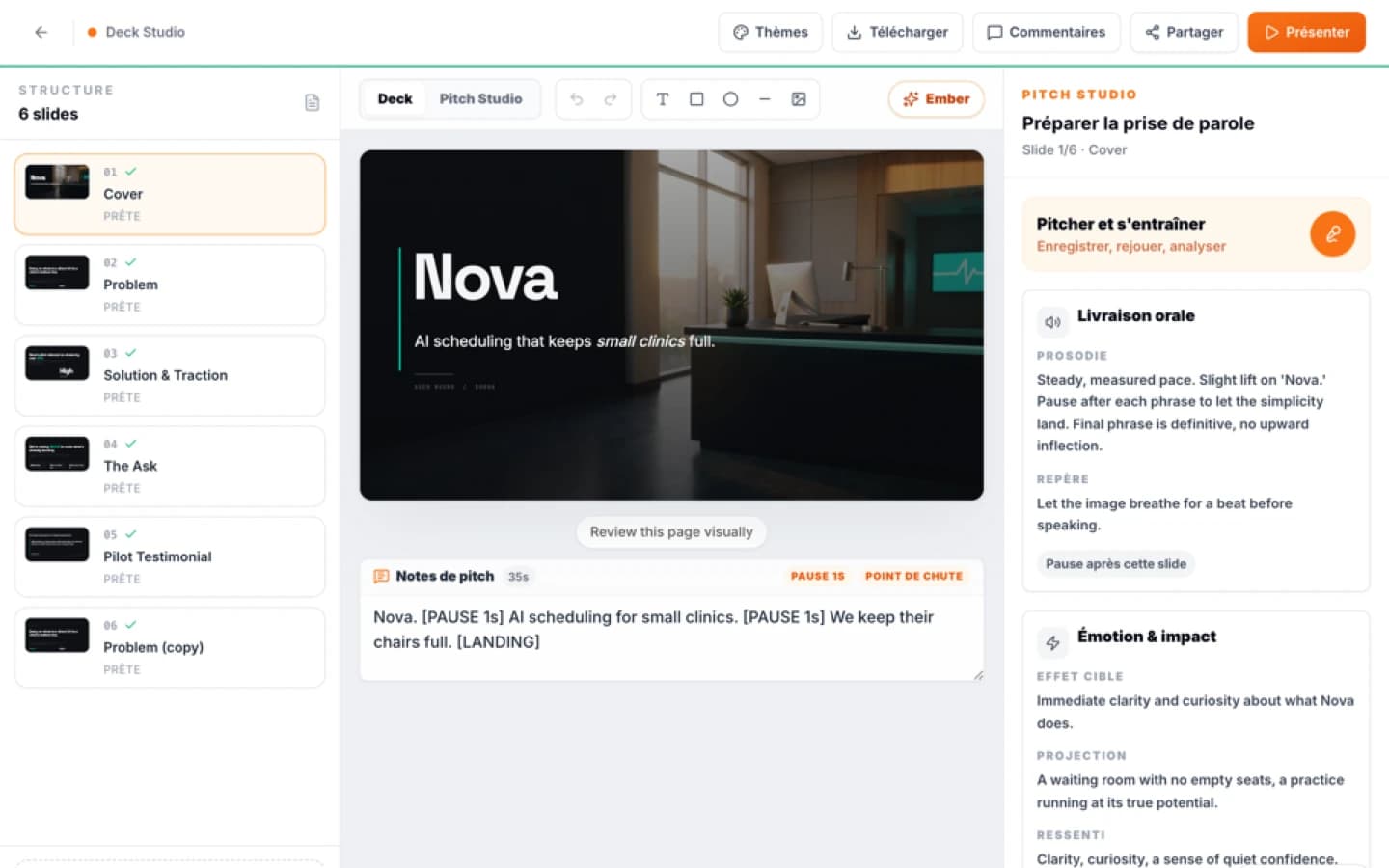
The workflow in Creation is designed to respect the founder's time and budget. The platform suggests three templates with previews, asks useful questions to capture the core of the project, as outlined in the Ember product documentation. Once the structure is defined, it generates slides from the selected structure and context, ensuring that the final presentation is both visually polished and strategically sound. Founders can then edit the generated presentation directly in Creation or even record, replay, and rehearse their delivery in Speaking practice to ensure maximum impact before their first live meetings.
To place this decision in context, the Knowledge guides for marketing brings together deeper guidance on the same field.
Problem
When launching a first product, early stage founders must constantly pitch to different audiences, including pre seed investors, beta testers, and potential design partners. The core challenge at this stage is not just making slides look clean, but translating a complex, evolving product vision into a structured, persuasive narrative.
Most founders default to traditional presentation software. While platforms like Google Slides provide basic templates to help users start faster (Google Workspace Blog), and Prezi offers an open, zoomable canvas to help structure ideas (Prezi Product Page), these tools assume the story is already fully formed. They do not help the founder figure out what to say or how to align the pitch with their target Ideal Customer Profile (ICP).
As a result, founders often find themselves trapped in design loops. They might use general design platforms, which offer accessible entry points including free tiers and individual pro plans (Canva Pricing), but these tools focus on visual layout rather than strategic positioning. This creates a dangerous disconnect. A founder might spend hours polishing a layout, only to realize the underlying message does not address the specific pain points of Creation Use Cases for Founders Seeking First Clients or proving early market Creation Use Cases for Early-Stage Founders in Traction. The real problem is not a lack of design templates, but the absence of a structured, context-driven narrative path that turns a raw product concept into a compelling business case.
Prerequisites
Before generating slides with Creation, an early stage founder must gather a few essential elements. The primary prerequisite is not a polished design file, but a clear grasp of the project substance, including the target audience, the core problem, and the unique value proposition.
For founders who already have a finalized script and simply need a quick visual layout, traditional presentation software is often entirely sufficient. For instance, Google Slides provides a robust library of templates to help teams start faster, as highlighted on the Google Workspace Blog. Similarly, if the goal is to present highly visual, non-linear concepts, Prezi offers an open and zoomable canvas to structure the presentation, as detailed on the Prezi Product Page. For teams focused on quick graphic design templates, Canva offers accessible options, including a free tier and paid plans, according to the Canva Pricing Page.
However, when a founder is launching their first product, their main challenge is translating raw ideas into a structured narrative that convinces pre seed investors or early adopters. To prepare for this, the founder should gather their raw notes, technical specifications, or early feedback. This unstructured material serves as the foundation.
Once these raw elements are ready, Creation helps structure the narrative path before producing any slides. The tool suggests three templates with previews and asks useful questions, ensuring the founder remains in control of the direction, as explained on the Ember Creation Page. After generation, the founder can edit the presentation directly in the visual editor or use Speaking practice to record, replay, and rehearse their delivery, as detailed on the Ember Creation Page. This structured preparation is particularly valuable whether the founder is focusing on securing early traction, as discussed in the Creation Use Cases for Early-Stage Founders in Traction, or searching for their very first design partners, as outlined in the Creation Use Cases for Founders Seeking First Clients.
To explore this point further, Creation vs Gamma: Which Tool Builds Your Visibility? details a step directly related to this decision.
Workflow
The journey of turning a raw product vision into a structured presentation follows a deliberate, step-by-step workflow within Ember Creation. This process prioritizes narrative substance over superficial design, helping founders align their messaging before they ever show a slide to an early adopter or investor.
First, the founder initiates the creation process. The platform suggests three templates with previews and asks targeted questions to capture the core value proposition of the new product. This initial framing ensures that the generation is grounded in the specific goals of the launch rather than a generic outline.
Second, the system analyzes the substance of the project and structures the narrative path before producing any slides. This step is crucial for early stage founders who must explain complex technical concepts simply. By focusing on the logical flow first, the presentation is built to guide the audience through a clear problem, solution, and market opportunity.
Third, the slides are generated based on the selected structure and validated project context. The generation process is highly resilient. If a founder experiences a network interruption or closes their browser tab, the background generation continues uninterrupted and resumes progress immediately upon their return.
Fourth, once the initial draft is ready, the founder can edit the generated presentation directly in the visual editor. Instead of manually moving elements or wrestling with formatting, the founder can request specific changes in natural language while staying in complete control of the final layout. This allows for rapid iteration as the product positioning evolves.
Fifth, the workflow extends to delivery and practice. Founders can export their finished presentation to Microsoft PowerPoint or Portable Document Format (PDF). To prepare for live meetings, they can also record, replay, and rehearse their delivery in Speaking practice. This environment analyzes the rhythm, clarity, impact, and structure of the recorded take, giving the founder actionable feedback before they speak to external stakeholders.
While traditional tools like Google Slides provide templates to start faster, as highlighted on the Google Workspace Blog, they require the founder to write and structure all content manually. Similarly, Prezi offers an open, zoomable canvas to structure presentations, as described on the Prezi Product Page, which is highly effective for non-linear visual storytelling. However, for founders launching their first product, the structured, context-driven workflow of Creation ensures that the underlying business logic is sound and ready to be defended. This structured approach is particularly valuable when transitioning from initial concepts to securing early traction, as detailed in the guide on Creation Use Cases for Founders Seeking First Clients.
Expected result
The expected result of using Creation is a presentation that does not just look professional but actively drives business decisions. For an early stage founder launching a first product, this means moving away from generic slide decks and toward highly tailored narratives. Whether the goal is securing early traction or signing the very first customers, the resulting deck directly connects the product's technical capabilities to the specific pain points of the target audience.
Traditional presentation tools remain highly effective for standard use cases. For example, Google Slides provides a reliable, collaborative environment with templates designed to help teams start faster, as detailed in their official workspace updates. For founders who prefer non-linear, highly visual storytelling, Prezi offers an open, zoomable canvas that is excellent for mapping out complex, interconnected ideas, as shown on the Prezi product overview. However, these platforms require the founder to manually translate their business strategy into slide copy, which often leads to a disconnect between the product vision and the final pitch.
By contrast, the output of Ember Creation is grounded in the founder's actual project context. The expected result is a clear, persuasive narrative path that prepares the founder to face different audiences. Founders can expect to walk away with a presentation that is fully editable, allowing them to make real-time adjustments as their product positioning evolves.
This structured approach is particularly valuable when transitioning from initial product development to market entry. As documented in the Creation Use Cases for Founders Seeking First Clients, the primary outcome is a presentation that clearly articulates the value proposition to early adopters. For startups moving into their next growth phase, the Creation Use Cases for Early-Stage Founders in Traction demonstrate how the tool helps align product metrics with investor expectations.
Ultimately, the final result is not just a static file, but a launchpad for active communication. Once the presentation is generated, founders can leverage Speaking practice to record, replay, and rehearse their pitch, ensuring their delivery is as sharp as their slides.
This approach also connects with Use Creation to Pitch Business Angels: A Structured Guide, which clarifies the next choice.
Example Ember mission
To illustrate how this works in practice, consider a founder preparing a presentation to secure their first design partners and early customers. The journey begins within the Ember workspace, where the founder establishes their core project context, including their target Ideal Customer Profile (ICP) and value proposition.
When initiating a presentation mission, Creation guides the founder through a structured framing process. The platform suggests three templates with previews, asks clarifying questions about the target audience, as detailed on the Ember Creation page.
Instead of relying on generic layouts, the orchestrated Artificial Intelligence (AI) workflow analyzes the substance of the project to build a tailored narrative path. This ensures the resulting slides do more than look clean. They actively help the presentation build understanding and move a business decision forward beyond simple visual polish, which is a core benefit highlighted on the Ember Creation page.
Once the initial draft is generated, the founder retains complete creative control. Ember lets users edit the generated presentation directly in Creation, allowing for real-time adjustments to the copy, structure, and layout, as explained on the Ember Creation page. This flexibility is particularly valuable for founders who need to adapt their messaging rapidly based on early feedback.
After refining the slides, the founder can transition to delivery preparation. Ember lets users record, replay, and rehearse the presentation in Speaking practice, as documented on the Ember Creation page. This rehearsal environment helps the founder practice their delivery, analyze their rhythm, and build the necessary confidence to present to external stakeholders.
This structured mission workflow directly addresses the most common scenarios faced by early-stage teams. Whether a founder is actively seeking their first clients, as explored in the Creation Use Cases for Founders Seeking First Clients, or focusing on scaling their initial user base, as detailed in the Creation Use Cases for Early-Stage Founders in Traction, the integration of context, generation, and rehearsal ensures the final presentation is fully aligned with their business goals.
Limits and non-fit
While Creation is built to align a presentation with the core substance of a business, it is not the ideal tool for every scenario. Founders who require absolute, pixel-perfect manual control over every vector, shape, and custom animation will find traditional design tools more suitable. For instance, those who need a highly collaborative, template-driven graphic design environment might prefer Canva, which offers a free tier and paid plans, as shown on the Canva pricing page. Similarly, for founders who simply want basic, quick-start layouts without deep narrative reasoning or artificial intelligence guidance, Google Slides provides templates to help users start more quickly, as detailed in the Google Slides blog.
Other specialized presentation formats also have clear use cases where Creation is not the primary choice. If a founder needs to deliver a highly spatial, non-linear pitch that relies on zooming in and out of a single map, Prezi offers an open and zoomable canvas to structure the presentation, as outlined on the Prezi product page. These tools are excellent when the primary goal is rapid visual variety or spatial storytelling rather than building a structured, context-grounded business case.
Within the Ember ecosystem, Creation also has specific boundaries. It is designed to work from project context, meaning its strength lies in translating business logic, target audiences, and strategic evidence into a cohesive narrative. If a founder has no structured project context or is unwilling to engage with the narrative-framing questions, the tool cannot perform at its best. Furthermore, the integration between modules is deliberate. The bridges that allow Creation to reuse context from other capabilities, such as Fund Your Growth or Lead Intelligence, are limited and only activate once the required project context has been validated by the user. For founders seeking a purely automated, one-click slide generator that operates without human review or business context, this structured approach may feel too rigorous.
In practice, How Small B2B Sales Teams Tell Customer Stories Without Fud? completes this framework with another angle on the same topic.
When to use it
For an early stage founder launching a first product, time is the most scarce asset. Designing slides from scratch often distracts from the core mission of refining the product and talking to users. Creation is built for specific moments in this early journey where narrative structure and business context must align perfectly.
The first critical scenario is when a founder needs to secure their very first clients and design partners. At this stage, the presentation cannot be a generic sales pitch. It must clearly articulate the problem, the proposed solution, and the collaborative value of being an early adopter. Founders can explore how to structure these early commercial pitches by reading about Creation Use Cases for Founders Seeking First Clients.
The second scenario occurs when the product has launched and the founder needs to demonstrate early market feedback to secure initial funding or join an accelerator. This requires translating early usage, user feedback, and qualitative signals into a compelling growth narrative. For a deeper look at this transition, founders can review the Creation Use Cases for Early-Stage Founders in Traction.
Finally, Creation is highly effective when preparing for high-stakes meetings where verbal delivery is just as important as the visual support. Once the presentation is generated, founders can record, replay, and rehearse their presentation in Speaking practice. This allows them to test their narrative flow, refine their verbal delivery, and build confidence before presenting to external stakeholders.
While specialized design platforms or traditional tools are highly capable, they serve different needs. For instance, Google Slides is an excellent, highly accessible option if a founder simply needs basic templates to start faster. If a team requires an extensive, multi-user creative suite with thousands of manual design assets, they might choose Canva, which offers paid Pro and Business plans, as shown on the Canva pricing page.
For a founder launching a first product, the value of Creation lies in its integration with the broader business context. The tool suggests three templates with previews and asks useful questions. Because early stage founders often work on the move, the platform is designed to be highly resilient: it keeps generating after a connection loss or tab closure, and resumes progress when the user returns. Once the structure is built, it lets users edit the generated presentation in Creation directly, ensuring that the final output remains fully under the founder's control.
Next step
For an early stage founder launching a first product, the immediate priority is translating raw product vision into a structured, persuasive narrative. The most effective next step is to move away from blank slides and begin structuring your core message.
You can start by defining your target Ideal Customer Profile (ICP) and the primary value proposition of your Minimum Viable Product (MVP). Once this context is clear, you can initiate the creation process within Ember. The platform will suggest three templates with previews and ask clarifying questions to align the presentation with your specific goals, as detailed on the Ember Creation page.
Rather than focusing on superficial design, the workflow first analyzes your business substance to build a coherent narrative path. After the slides are generated, you remain in complete control. You can edit the presentation directly in the visual editor or request specific adjustments using natural language. To ensure you are fully prepared for your first meetings, you can also record, replay, and rehearse your delivery in Speaking practice, which provides automated voice analysis on your rhythm and clarity. By focusing on the substance of your message first, you build a presentation designed to secure your very first customers.
Before deciding, Best Gamma Alternative for Founder Keynotes and Conferences helps connect this method with adjacent priorities.
Sources
To ensure complete transparency and help early stage founders make informed decisions, this article relies on verified product documentation, customer case studies, and public market benchmarks. The primary use cases and customer stories analyzed for this guide are documented in the Creation Use Cases for Early-Stage Founders in Traction and the Creation Use Cases for Founders Seeking First Clients. The core capabilities of Creation, including its structured narrative generation and pitch rehearsal features, are detailed on the Ember Creation Page. For alternative design and presentation frameworks, we reference the following public sources: * Google Slides template capabilities are detailed in the Google Workspace Blog. * Gamma features are outlined on the Gamma Wikipedia Page. * Canva pricing options, including the free tier and paid plans, are published on the Canva Pricing Page.
Sources
FAQ
Mini audit
Test your Pitch Deck
Get an initial diagnosis of substance, form and impact.