
Symptom or signal
For an early-stage founder, preparing a pitch deck is only half the battle. While studying resources like the collection of pitch deck examples from over 35 startups on Slidebean can help structure your narrative, the real challenge lies in execution. A compelling presentation is useless if you do not know who to contact, why now, and which message will resonate. Founders often fall into the trap of building a beautiful deck without a clear strategy for reaching the right investors, partners, or early customers. To solve this, many teams turn to broad database providers. For instance, Apollo offers large contact databases, a Chrome extension and a sequencing platform, for founders focused on speed and immediate outbound volume (Apollo). However, raw volume often leads to high noise levels, and even their unlimited plans remain subject to a Fair Use Policy as outlined on the Apollo pricing page. For an early-stage company, blasting a generic message to thousands of cold contacts is rarely effective. Instead of chasing volume, founders need to prioritize the conversations that deserve attention now. This is where Lead Intelligence helps by reducing noise and focusing your limited time on high-potential opportunities. By analyzing your specific project context, the system helps you know who to contact, why now, and which action to take. It provides a clear next action, defining the best channel and the exact angle to use. When you have a usable targeting context, the first prioritized leads can appear in about 30 minutes, allowing you to transition immediately from designing your deck in Creation to executing a highly targeted outreach strategy.
To place this decision in context, the Knowledge guides for marketing bring together deeper guidance on the same field.
What changed
A compelling presentation is only as good as the audience it reaches. Traditionally, founders seeking to identify and contact potential partners, investors, or early customers had to rely on massive, volume-first databases. For teams focused on sheer volume, platforms like Apollo are highly effective. Apollo provides immediate access to a vast database of contacts and automated sequences. While this high-volume approach works well for established sales teams, early-stage founders often find themselves overwhelmed by the sheer noise of cold outreach. When you are preparing a pitch deck, you cannot afford to blast thousands of generic messages. You need to identify the precise individuals who are receptive to your message right now. This is where the paradigm has shifted. Instead of starting with database filtering, modern founders use context-driven intelligence. Ember Lead Intelligence changes the equation by focusing on relevance over raw volume. Rather than managing complex credit systems or parsing massive lists, Lead Intelligence helps you know who to contact, why now, and which action to take. By reusing your project context, including your Ideal Customer Profile (ICP) and business strategy, it delivers a clear next action that details who to contact, why now, which channel to use, and which angle to take. This ensures that every conversation you start is backed by a clear, strategic reason, turning your pitch deck from a static document into an active tool for growth.
Facts and sources
For a founder looking for immediate volume, a platform like Apollo may fit. However, founders must note that even unlimited plans on such platforms are subject to a Fair Use Policy that limits credits, as shown on the Apollo pricing page. Rather than managing raw volume and credit limits, founders can use Ember to focus on high-intent opportunities. The Lead Intelligence capability finds accounts based on the mission Ideal Customer Profile (ICP) and real-time signals, then verifies useful sources. This allows founders to know who to contact, why now, and which action to take. Instead of sending generic sequences, Lead Intelligence provides a clear next action that specifies the contact, the timing, the channel, and the precise angle to use, focusing attention on the opportunities that deserve action now. Once these conversations are identified, founders can align their messaging with their pitch materials: Ember lets users edit the generated presentation in Creation, then record, replay and rehearse it with Speaking practice. For founders who are also working on their funding, Fund Your Growth replaces a generic list of options with a funding path coherent with the project, and the entrepreneur can approve, reject or edit proposals before they enter the file.
To explore this point further, How Lead Intelligence Helps Founders Structure Their Pitch Deck Outreach details a step directly related to this decision.
Why the common explanation is incomplete
The common explanation for outbound success suggests that fundraising or customer acquisition is purely a numbers game. Under this assumption, a founder only needs to build a solid presentation and blast it to a massive list of potential contacts. This volume-first strategy is fundamentally incomplete for early-stage founders who have limited time and cannot afford to burn their market reputation with generic spam. Relying on raw data alone ignores the critical need for timing and relevance. For example, platforms like Apollo are highly effective for teams focused on sheer volume. However, even their unlimited plans are subject to boundaries under a fair use policy, as outlined on the Apollo Pricing Page. More importantly, massive lists create immense noise, leaving founders with no clear indication of who is actually receptive to their message at any given moment. While studying pitch deck examples from more than 35 startups on Slidebean can help you refine your core story, it cannot tell you who to contact, why now, and which action to take. A beautiful deck sent to the wrong person at the wrong time will still end up ignored. Success requires shifting from raw volume to contextual relevance. This is why a more precise approach is necessary. With Lead Intelligence from Ember, founders can bypass the noise and focus entirely on the opportunities that deserve action today. By leveraging your specific project context, Lead Intelligence reduces noise and helps you prioritise the conversations that deserve attention now. Instead of waiting days to parse through spreadsheets, the first prioritised leads can appear in about 30 minutes once you provide usable targeting context. This ensures you always know who to contact, why now, which channel to use, and exactly which angle to take to make a meaningful connection.
The real problem
The real problem for early-stage founders is not just designing a slide deck. While studying successful pitch deck examples, such as those from over 35 startups documented by Slidebean, provides a solid starting point, it does not solve the critical question of distribution. Founders frequently struggle to identify exactly who to contact, why a conversation is relevant right now, and what specific message will resonate. When founders rely on massive databases to blast their newly minted decks, they run into a noise problem. Platforms built for sheer volume, like Apollo are powerful for broad outbound campaigns. However, even their unlimited email plans are subject to a fair use policy, as detailed on the Apollo pricing page. For an early-stage founder, a generic, high-volume blast often dilutes the message and wastes valuable market attention. The actual challenge is translating the strategic context of a business plan into highly targeted conversations. Instead of navigating a generic list of contacts, founders need to prioritize the conversations that deserve attention now. This requires a system that reduces noise by focusing attention on opportunities that deserve action now. By aligning the core narrative of the presentation with real-time market signals, founders can determine the clear next action, including who to contact, why now, which channel, and which angle to use. With a usable targeting context, this prioritization does not have to take days. In fact, the first prioritized leads can appear in about 30 minutes, allowing founders to move from a finished presentation straight into high-conviction outreach.
This approach also connects with How to Prioritize Your Customers with Lead Intelligence: A Structured Guide, which clarifies the next choice.
How the mechanism works
The transition from a raw pitch deck to an active, targeted campaign requires a unified mechanism that connects strategy, presentation, and intelligence. Instead of treating these as isolated tasks, Ember orchestrates them through a continuous flow of shared context.
The process begins with defining a coherent strategy. Through Fund Your Growth, the mechanism replaces a generic list of options with a funding path coherent with the project. The entrepreneur remains in complete control throughout this stage, as they can approve, reject, or edit proposals before they enter the file. This ensures that the underlying business assumptions are validated and aligned with the founder's actual constraints before any slides are designed.
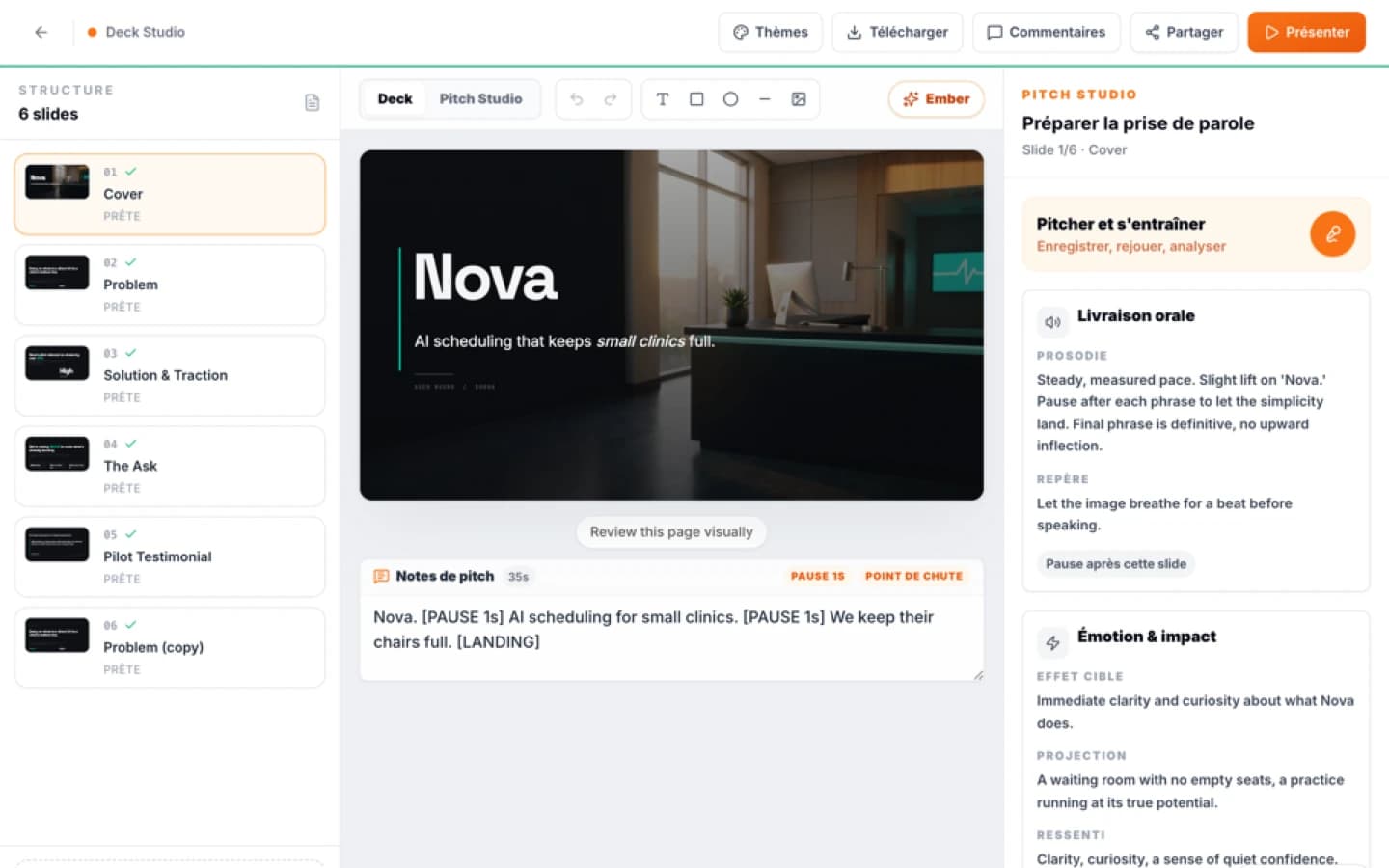
Once the strategic foundation is in place, the mechanism transitions to Creation to shape the narrative. Rather than focusing solely on superficial aesthetics, Creation works on reasoning, the audience journey, structure, design, and impact. It translates the validated business plan into a visual format. The founder can edit the generated presentation directly within Creation and use Speaking practice to record, replay, and rehearse the presentation. This preparation helps the founder get ready to defend the project when meeting potential partners or investors.
The final part of the mechanism solves the distribution problem by determining who to contact, why now, and with what message. Traditional outbound databases like Apollo offer massive lists of contacts, but they often lead to high noise levels and are subject to fair use policies as detailed on the Apollo pricing page. In contrast, Lead Intelligence reduces noise by focusing attention on opportunities that deserve action now. It analyzes signals to prioritize the conversations that deserve attention now, ensuring the founder does not waste time on cold, irrelevant leads. By understanding the specific context of both the sender and the recipient, Lead Intelligence provides a clear next action, identifying who to contact, why now, which channel, and which angle. This allows early-stage founders to move from a polished pitch deck to highly targeted conversations.
Concrete examples
To understand how this integrated approach works in practice, consider the journey of an early-stage founder preparing to raise a seed round. Instead of manually compiling lists and guessing which investors or partners to approach, the founder can systematically align their strategy, presentation, and outreach. The journey begins with defining the funding strategy. Using Fund Your Growth, the founder replaces a generic list of financing options with a funding path coherent with the specific parameters of their project. Because strategic decisions require human oversight, the entrepreneur can approve, reject, or edit proposals before they enter the official file, ensuring the foundation remains highly accurate. With the strategy validated, the founder transitions to building the narrative. Through Creation, the founder generates a structured presentation tailored to their strategic goals. Rather than dealing with static, unchangeable templates, the system lets users edit the generated presentation in Creation directly to refine the messaging. To ensure the delivery is as convincing as the slides, the founder can also record, replay, and rehearse the presentation with Speaking practice, identifying gaps in rhythm or clarity before speaking to external parties. Once the pitch deck is polished, the critical challenge shifts to distribution: identifying who to contact, why now, and with what message. Many founders default to high-volume outbound platforms. For example, Apollo is highly popular among sales leaders and speed-oriented founders because it offers a massive contact database and automated sequences. However, founders using these platforms must navigate specific constraints, such as the fact that unlimited email credit plans remain subject to a fair use policy, as documented on the Apollo pricing page. Instead of blasting generic messages to a massive list, the founder uses Lead Intelligence to prioritize the conversations that deserve attention now. This capability reduces noise by focusing attention on opportunities that deserve action now, ensuring the founder does not waste time on cold or irrelevant leads. It allows the founder to know exactly who to contact, why now, and which action to take. By analyzing the project context, Lead Intelligence provides a clear next action that details who to contact, why now, which channel to use, and which angle to take. With usable targeting context in place, the first prioritized leads can appear in about 30 minutes, turning a static pitch deck into an active, highly targeted outreach campaign.
When to use this diagnosis
An early stage founder preparing a pitch deck reaches a critical inflection point when the focus shifts from internal strategy to external execution. This diagnostic approach is most valuable when you need to transition from a static presentation to active, highly targeted conversations without wasting resources on uncoordinated outreach.
For founders who prioritize immediate volume and rapid outbound activity, established platforms like Apollo are often a suitable starting point. These platforms provide a massive contact database and a browser extension to generate immediate activity. However, this volume first approach introduces specific tradeoffs. Additionally, unlimited email plans on these platforms remain subject to a Fair Use Policy with credit limits as detailed by Apollo Pricing.
This diagnosis becomes essential when you want to avoid the noise of untargeted volume. Instead of blasting a generic list of options, early stage founders need to align their outreach with the precise narrative developed in their pitch deck. Using Lead Intelligence allows you to know who to contact, why now, and which action to take. By analyzing the deep context of your project, Lead Intelligence provides a clear next action, detailing who to contact, why now, which channel to use, and which angle to take. This ensures that your first outreach is built on strategy and relevance rather than sheer volume.
In practice, Building a B2B account list without an existing network completes this framework with another angle on the same topic.
When not to use it
This context-driven approach is not a universal solution for every outreach scenario. Understanding when to rely on alternative methods prevents early-stage founders from misallocating their time and capital. First, if your primary goal is high-volume, unsegmented outbound blasting rather than relationship-driven fundraising or strategic sales, a pure database provider is a more suitable choice. For instance, platforms like Apollo cater directly to teams requiring immediate mass volume, offering a vast contact database, a browser extension, and instant sequence automation. However, founders seeking sheer volume should remain aware that even unlimited plans on such platforms are governed by fair use policies, as outlined on the Apollo Pricing page. If you do not need deep context to prioritize your conversations, legacy database tools are sufficient. Ember publishes Lead Intelligence: test each tool on your own case. Second, this approach is ineffective if you do not yet have a defined business foundation or are unwilling to participate in the strategic process. While Lead Intelligence can surface prioritized leads in about 30 minutes once a usable targeting context is established, it relies entirely on the underlying substance of your project. If you lack a clear Ideal Customer Profile (ICP) or a coherent strategy, generating outreach angles will only amplify weak assumptions. Furthermore, Ember is designed to keep the entrepreneur in control. For example, within Fund Your Growth, the entrepreneur must approve, reject, or edit proposals before they enter the file, just as Creation requires active human refinement to shape the final narrative. If you are looking for a fully autonomous tool to run campaigns with zero human oversight or review, this methodology will not align with your workflow.
Next step
To move from a finalized pitch deck to active conversations, early stage founders must shift their focus toward precise execution. Instead of relying on broad, unsegmented databases, the next step is to identify the specific individuals who have a strategic reason to engage with your project right now.
While high volume platforms like Apollo are useful for rapid outbound activity, their unlimited plans remain subject to a fair use policy as shown on the Apollo Pricing page. For founders seeking highly targeted, relationship driven conversations, a context first approach is a better fit.
This is where Ember helps bridge the gap between your pitch deck and your outreach strategy. By using Lead Intelligence, you can easily determine who to contact, why now, and which action to take. The system analyzes your project context to propose the next action and channel that fit each specific lead situation. Rather than sending generic messages, you receive a clear next action that outlines who to contact, why now, which channel to use, and which angle to take.
Simultaneously, you can align this outreach with your broader financial roadmap. Through Fund Your Growth, you can turn any remaining gaps in your file into prioritized next actions and replace generic funding lists with a coherent funding path tailored to your project. This ensures that every conversation you start is backed by a solid, defensible strategy.
Before deciding, Signals that reveal which prospect deserves contact next helps connect this method with adjacent priorities.
Sources
- Slidebean, "Pitch Deck Exemple: Plus de 35 Meilleurs Exemples de Pitchs de Startups à Succès", consulted on September 28, 2026: slidebean.com.
- Apollo, pricing page (Fair Use Policy of unlimited plans) and homepage, consulted on September 28, 2026: apollo.io/pricing and apollo.io.
- Functions of Lead Intelligence, Creation and Fund Your Growth: product description by Ember, its publisher.
Sources
FAQ
Free diagnostic
Test your sales file
Drop an Excel or CSV and check its readiness without sending its rows to Ember.