
Symptom or signal
Modern business-to-business (B2B) buyers are drowning in outreach. A typical decision-maker now receives a large number of pitches every week, creating an environment where standard sales templates are archived without being read. The root of this saturation lies in the widespread adoption of volume-centric outbound platforms. For example, the sales intelligence platform Apollo highlights access to 240 million contacts and 30 million companies on its website. While this scale suggests that automated sequencing is highly efficient for generating outbound activity, it also means that buyers are bombarded with more generic, automated emails than ever before.
When every sales team has access to the same contact databases and automated workflows, the traditional playbook of sending hundreds of generic emails fails. According to real-world sales practitioner feedback shared on Reddit, the emails that actually secure replies are short, highly conversational, and completely devoid of typical sales jargon. Instead of pitching a long list of features, successful reps focus on a single, undeniable friction point that the buyer is experiencing right now.
To stand out in a crowded inbox, sales teams must transition from generic templates to highly contextualized messages. As outlined in the cold email guide by Overloop, writing a successful cold email requires a structured, step-by-step approach that prioritizes relevance and human connection over raw volume.
The practitioner feedback cited here comes from public discussions in the sales community and from a cold email guide published by Overloop: it illustrates observed practice rather than a quantified study.
To place this decision in context, the Knowledge guides for marketing bring together deeper guidance on the same field.
What changed
The landscape of outbound sales has undergone a fundamental shift. For years, the prevailing playbook was built on sheer scale. Platforms like Apollo made outbound activity highly efficient: Apollo highlights access to 240 million contacts and 30 million companies (Apollo). For sales teams with a highly defined ideal customer profile (ICP) who need to run broad, multi-channel campaigns across email, phone, and social, these traditional databases and sequencing tools remain incredibly effective.
However, this ease of delivery has created an unintended consequence. When any sales team can easily connect multiple mailboxes or leverage unlimited email credits, which are still governed by a fair use policy as outlined on the Apollo Pricing page, the volume of cold outreach explodes. Buyers are no longer just selective; they are actively defensive. The standard approach of exporting a list, where each contact exported outside Apollo consumes an export credit according to the Apollo Pricing page, and running them through a generic sequence no longer works.
Even when teams adopt modern data enrichment platforms like Clay, the temptation is often to use that data to send highly personalized spam at scale. But as sales professionals discuss in community testimonies on Reddit, business-to-business (B2B) buyers have developed an acute radar for automated personalization. They can instantly spot when a line about their university or their latest company news has been dynamically inserted by a machine.
According to the outbound strategies detailed in the Overloop Blog, writing a successful cold email in this saturated environment requires moving away from pure volume. The gatekeepers are no longer just spam filters; they are the buyers themselves, who delete templated pitches in seconds. What changed is that relevance has replaced personalization. To stand out, sales teams must shift their focus from finding more contacts to identifying the exact moments when a prospect actually needs their help.
Facts and sources
This guide draws on two main sources: a cold email guide and a discussion among practitioners. These sources combine structured industry frameworks with direct practitioner feedback. Tactical advice on structuring messages is drawn from the 2026 Cold Email Guide by Overloop, which outlines step-by-step methods to write cold emails that get replies. To balance this with real-world execution, we analyzed peer-to-peer discussions on top-performing outbound templates shared directly by sales professionals on Reddit. Finally, to understand the broader market shift toward volume-driven sales engagement platforms, we look at Apollo, whose site highlights access to 240 million contacts and 30 million companies (Apollo).
To explore this point further, How Lead Intelligence Helps Founders Structure Their Pitch Deck Outreach details a step directly related to this decision.
Why the common explanation is incomplete
The standard advice given to sales teams is straightforward: write shorter copy, use a catchy subject line, and insert a dynamic placeholder for the recipient's company name. Traditional step-by-step tutorials, such as the outbound guides published by Overloop, outline these foundational mechanics of structuring an outreach message. However, this common explanation is incomplete because it treats personalization as a cosmetic task rather than a strategic alignment. When every sales representative uses the same automated templates to insert a prospect's job title, the resulting emails still look entirely automated to a busy decision-maker.
This superficial approach fails to address the structural shift in how outbound platforms operate. Platforms designed for scale have made sending high volumes of messages incredibly easy. For instance, Apollo highlights access to 240 million contacts and 30 million companies (Apollo). This offer reflects a market that has optimized for outbound activity and sheer outreach volume. When the cost of sending another thousand emails approaches zero, buyers are flooded with messages that technically meet the basic criteria of personalization but completely lack genuine business relevance.
Real-world feedback from practitioners confirms that generic templates no longer work. On professional forums like Reddit, sales professionals openly discuss how their top-performing cold emails rely on deep, peer-to-peer relevance and acute timing rather than superficial template hacks. A busy buyer can instantly spot a message that was generated by a bulk sequence, even if it mentions their college or their latest corporate blog post. The missing link in the common explanation is context. To get a reply, an email must prove that the sender understands the specific operational challenges of the target account and has a timely, logical reason for reaching out right now.
The real problem
The real problem is not that cold email is dead, but that the technology used to scale it has stripped away its most critical element: genuine relevance. When sales teams rely on massive databases to export thousands of contacts, they inevitably treat every prospect as a static entry on a spreadsheet. A typical Business-to-Business (B2B) buyer receives a large number of cold pitches every week, creating a wall of noise that standard templates cannot penetrate. Buyers can instantly spot an automated sequence, even when it includes basic personalization tokens like the recipient's first name or company name.
This template-driven automation creates a fundamental misalignment. The sender is focused on outbound activity metrics, while the recipient is looking for actual solutions to immediate operational challenges. According to practitioner testimonies shared on Reddit, the cold emails that consistently earn replies are those that abandon the high-volume pitch entirely. Instead, successful sales professionals focus on highly specific, timely observations that prove they understand the prospect's current situation before they ever ask for a meeting.
When every competitor has access to the same contact databases, the only remaining competitive advantage is timing and context. Sending a well-crafted message to a prospect who has no current need is just as ineffective as sending a generic message. Sales teams do not need more contacts, they need to know who to contact, why now, and what specific angle will resonate.
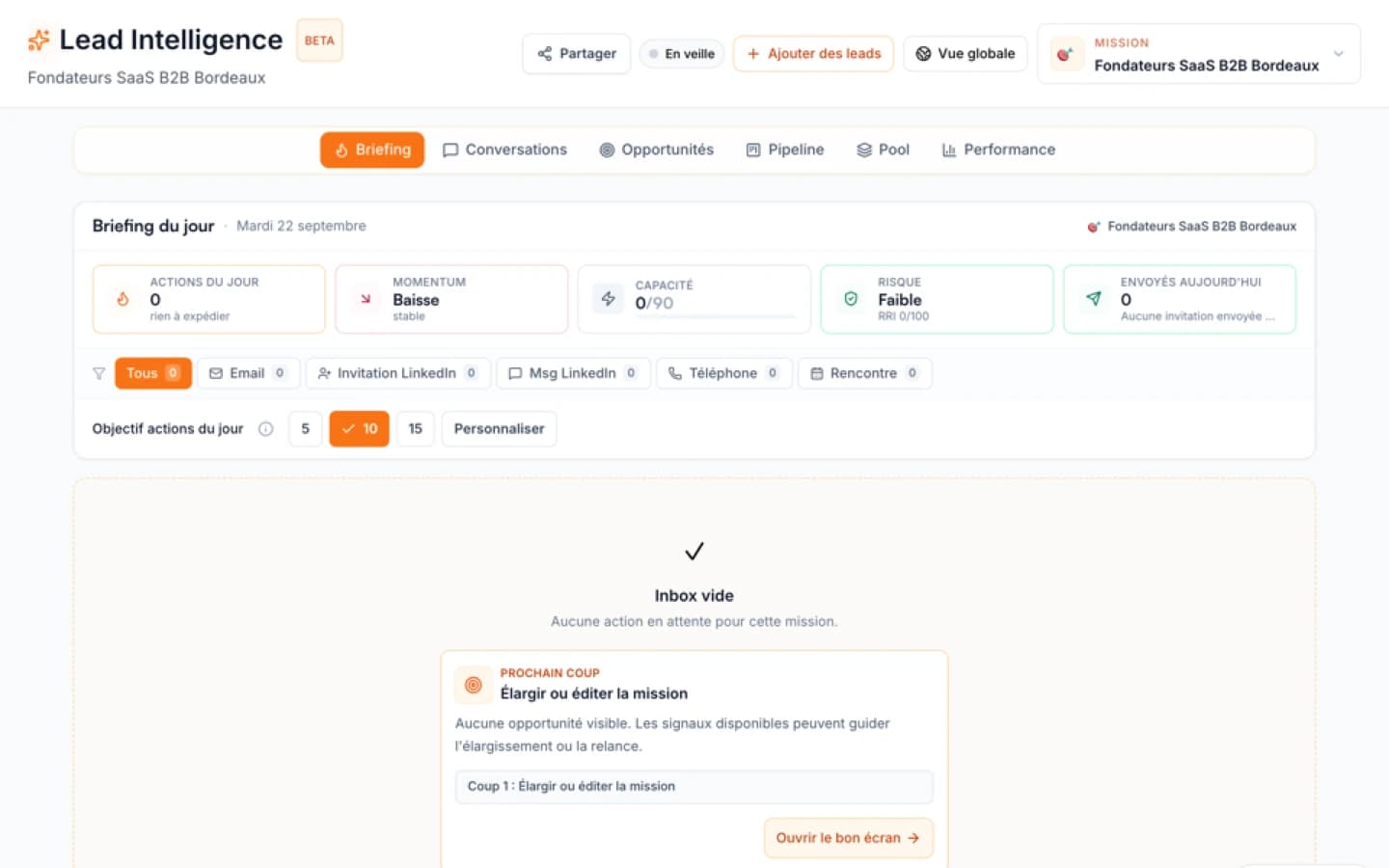
This is the exact challenge that Ember solves with Lead Intelligence. By analyzing the available project context and monitoring real-time signals across companies and people, Lead Intelligence helps sales teams prioritize the conversations that actually deserve attention today. Rather than forcing teams to manage noisy, unsegmented lists, it provides a clear next action based on opportunity readiness, ensuring that every outbound email is backed by a genuine reason to reach out.
This approach also connects with How to Prioritize Your Customers with Lead Intelligence: A Structured Guide, which clarifies the next choice.
How the mechanism works
The actual mechanism of a high-performing cold email relies on three interconnected pillars: signal detection, contextual prioritization, and actionable next steps. First, sales teams must move away from static list building. Instead of targeting a broad, inactive list of accounts, the mechanism begins by monitoring active signals. These signals include leadership changes, hiring patterns, or shifts in company strategy. According to practitioner feedback on Reddit, the cold emails that consistently secure replies do not pitch a product immediately. Instead, they focus on a highly specific, undeniable observation about the prospect's current business situation. Second, the email must connect these external signals directly to the sender's core value proposition. This is where generic databases fall short. While platforms like Apollo make outbound activity highly efficient, they encourage a volume-first approach. The true mechanism of reply-getting emails requires filtering out the noise to focus only on opportunities that are ready for a conversation. This aligns with modern outbound methodologies, such as those detailed by Overloop, which emphasize that successful cold outreach relies on precise timing and clear relevance rather than generic templates. Third, the message itself must propose a low-friction, highly logical next step. Rather than asking for a thirty-minute meeting, the email should offer a specific piece of value or ask a simple, open-ended question about how they are handling the observed signal. This is precisely how Ember's Lead Intelligence transforms the prospecting workflow for sales teams. Instead of forcing teams to manually research hundreds of accounts, Lead Intelligence automatically identifies accounts based on the target Ideal Customer Profile (ICP) and active signals, then prioritizes them based on opportunity readiness. It provides sales teams with a clear next action: who to contact, why now, which channel to use, and what specific angle to take. Because Lead Intelligence is built to work independently of contact volume, it is equally effective whether a sales team starts with 10, 100 or 1,000 contacts, with no minimum contact threshold required to generate value. Once the targeting context is configured, the first prioritized leads can appear in about 30 minutes, allowing sales teams to act on fresh signals immediately.
Concrete examples
When a buyer receives dozens of pitches every week, the difference between a generic template and a highly contextual message is immediately obvious. To illustrate this contrast, consider two hypothetical examples that demonstrate how the structure of an email dictates its response rate. The first example represents the traditional, volume-oriented approach. This style of outreach is common among sales teams using legacy databases to scale their outbound activity. For context, Apollo highlights access to 240 million contacts and 30 million companies (Apollo). While this scale shows that high-volume platforms are widespread, the resulting emails often feel mechanical to the recipient because they rely on static data. A hypothetical example of a low-relevance email looks like this: Subject: Quick question for [First Name] Hi [First Name], I saw you are the [Title] at [Company]. We help Business-to-Business (B2B) companies scale their pipeline. Do you have 15 minutes on Thursday for a quick demo? This email fails because it contains no genuine relevance. It relies entirely on basic merge tags that any recipient can spot instantly, offering no specific reason why the conversation should happen now. According to practitioner feedback shared on Reddit, the top-performing cold emails completely abandon this generic formula. Instead, they focus on a highly specific, observable change or challenge within the prospect's organization. Even established outbound resources, such as the guides published by Overloop, emphasize that success depends on aligning your message with the recipient's current reality rather than forcing a generic pitch. A hypothetical example of a high-relevance email looks like this: Subject: Localizing security compliance for your Berlin expansion Hi [First Name], I noticed your team recently expanded its engineering presence in Berlin but has not updated its localized European security compliance documentation yet. When scaling across borders, keeping up with regional regulations often delays product releases. We put together a short framework on how similar engineering teams handle this transition. Would you be open to seeing if this applies to your current roadmap? This second email succeeds because it is built on a real signal, the Berlin expansion, and addresses a logical consequence of that signal, compliance bottlenecks. It offers immediate value instead of demanding a meeting. For sales teams, manually researching these signals for every prospect is incredibly time-consuming. Ember addresses this challenge directly through Lead Intelligence. By reusing your Ideal Customer Profile (ICP), offer, and strategy, Lead Intelligence prepares a targeted sales mission that reduces noise and focuses attention on opportunities that deserve action now. The platform finds and prioritizes contacts itself, whether your team starts with 10, 100, or 1,000 contacts, with no minimum contact threshold. Instead of sending generic templates, sales teams receive a clear next action, including who to contact, why now, which channel to use, and the exact angle to take.
In practice, Building a B2B account list without an existing network completes this framework with another angle on the same topic.
When to use this diagnosis
This diagnosis is critical for Business-to-Business (B2B) sales teams when traditional outbound metrics begin to decay. When open rates drop, click-through rates vanish, and the sales pipeline becomes a graveyard of unanswered templates, it is a clear sign that the current approach has run its course. Often, teams respond to declining reply rates by simply increasing the volume of their campaigns, but this action only accelerates domain burnout and alienates potential buyers who are already fatigued by generic pitches.
This evaluation is especially urgent when sales teams find themselves trapped in a credit-based volume loop. Many legacy databases charge per export or per contact enrichment, turning every prospecting action into a metered decision where wasted exports and bounced emails compound the overall cost. For instance, while a platform like Apollo facilitates large-scale outbound activity, sales teams must recognize when this volume-first model begins to yield diminishing returns for their specific market. If your team is spending more time managing credits and cleaning up bounced emails than having meaningful conversations, a strategic shift is required.
Another key trigger for this diagnosis is when a team wants to target high-value accounts but lacks the necessary context to do so convincingly. If your Ideal Customer Profile (ICP) consists of busy decision-makers who receive dozens of pitches every week, a generic sequence will be ignored. To stand out, you need to know not just who to contact, but why now and with which specific angle.
This is where Ember can help. Through Lead Intelligence, sales teams can move away from the noise of raw volume and focus on opportunities that deserve immediate action. Lead Intelligence prioritizes contacts based on real-time signals and project context, whether the team starts with a small list of ten contacts or a larger list of one thousand contacts, with no minimum contact threshold required to begin. By analyzing these opportunities, teams can determine the exact next action, the most effective channel, and the precise angle to use, ensuring that every cold email feels like a natural, highly relevant continuation of a real business conversation.
When not to use it
A highly contextual, signal-driven approach to cold outreach is not a universal solution for every sales team. If your business operates in a market with a massive number of potential accounts, low average contract values, and a highly standardized offering, spending time researching deep context for every single lead is counterproductive. In these situations, speed and sheer volume are far more important than deep personalization.
For teams that need to generate immediate outbound activity across multiple channels simultaneously, a classic sales engagement platform is often the more practical choice. For example, Apollo combines a large Business-to-Business (B2B) contact database, email sequences, call dialing, and a browser extension for social prospecting into a single interface. This broad channel coverage is highly effective for teams that want to execute high-volume outreach from one central tool. Apollo highlights access to 240 million contacts and 30 million companies (Apollo).
If your sales leaders or founders are focused on rapid execution and already know their target audience perfectly, a database-driven sequencing tool allows them to start sending pitches on day one. Relying on a massive database makes sense when a low reply rate is acceptable because the cost of a missed opportunity is negligible. However, if your target market is small, your deal sizes are large, and you cannot afford to burn through your limited list of accounts with generic templates, then shifting away from volume toward context-first prioritization becomes essential.
Before deciding, Signals that reveal which prospect deserves contact next helps connect this method with adjacent priorities.
Next step
To move away from the noise of generic outbound sequences, sales teams must shift their focus from raw volume to contextual prioritization. The next step is to build a workflow where every email is backed by a real trigger, a clear reason for contacting that specific buyer, and a highly relevant angle.
According to practitioner feedback on Reddit, the most successful cold emails avoid generic templates and focus on highly specific, low-friction questions. Similarly, a step-by-step tutorial on Overloop emphasizes that writing a successful cold email requires a structured approach that prioritizes relevance over raw volume.
For sales teams that already know their ideal customer profile cold and need immediate outbound volume, classic sales engagement platforms like Apollo are highly effective. However, when buyers are overwhelmed with pitches, relying solely on volume can dilute your brand and damage your domain reputation.
To solve this, sales teams can use Ember to transition from generic outreach to signal-driven conversations. Through its Lead Intelligence capability, Ember reuses your strategic context to prepare a targeted sales mission. Instead of forcing you to manually research prospects, Lead Intelligence finds accounts based on your Ideal Customer Profile (ICP) and active market signals, verifying the most useful sources to ensure accuracy.
Once the mission is active, Lead Intelligence prioritizes the conversations that deserve attention now. It classifies accounts into explained opportunities, showing you exactly who to watch, who to act on, and who to set aside. For every high-priority opportunity, it proposes the next action and channel that fit the lead situation, allowing your team to write emails that feel personal, timely, and impossible to ignore. Because the system operates independently of volume, you can start with a small, highly targeted list and see the first prioritized leads appear quickly after setup, helping your team focus on the conversations that actually move decisions forward.
To move from analysis to action, Lead Intelligence presents the corresponding Ember workflow.
Sources and methodology
To establish a reliable framework for Business-to-Business (B2B) sales teams navigating crowded inboxes, this analysis synthesizes practitioner insights and platform benchmarks. These documents include tactical guides such as Overloop's cold email guide and practitioner testimonies from Reddit sales community discussions.
To contrast highly personalized, signal-driven outreach with traditional mass-outreach models, we examined market leaders in the sales engagement space. The information on Apollo (access to 240 million contacts and 30 million companies, and a Chrome extension that lets you add prospects to a list or a sequence) comes from its official website and the page of its extension, consulted on 28 September 2026. While these high-volume systems are highly efficient for broad market coverage, they also contribute to the noise that modern buyers actively filter out, reinforcing the need for sales teams to prioritize relevance and timing over sheer output.
Sources
FAQ
Free diagnostic
Test your sales file
Drop an Excel or CSV and check its readiness without sending its rows to Ember.