
Definition
For a small Business-to-Business (B2B) sales team in 2026, measuring outbound does not mean drowning the analysis in complex indicators. The approach focuses on the minimum viable set of measures: opens, replies and meetings, because they are the only reliable data available without a sophisticated Customer Relationship Management (CRM) system or multi-touch attribution. Rather than multiplying arbitrary numbers, the team can identify the situations that convert by connecting executed actions, replies, meetings and outcomes. Ember supports this transition by connecting these elements to reveal the specific contexts where a follow-up works or a contact becomes relevant, helping the founder qualify first prospects without a dedicated team.
To place this decision in context, the Knowledge guides for sales brings together deeper guidance on the same field.
Prerequisites
Small Business-to-Business (B2B) sales teams measuring cold outreach in 2026 must shift their focus from raw activity metrics to high-intent conversion signals. Most traditional outbound measurement advice assumes a dedicated Revenue Operations (RevOps) function, complex multi-touch attribution, and a Customer Relationship Management (CRM) system with a complete data history. For a small team, these resources are rarely available. Instead of getting lost in complex tracking, small teams need a minimum viable measurement set that directly drives daily sales decisions. When evaluating basic metrics like email opens, replies, and meetings, it is easy to fall into the volume trap. High-volume database platforms like Apollo, which advertises access to 240M contacts and 30M companies (source), encourage teams to focus on sending more emails. However, their model runs on credits: Apollo states that an export credit is consumed whenever a contact is exported outside Apollo (source). This volume-first approach is increasingly ineffective because modern B2B prospecting has shifted toward precision systems built on Ideal Customer Profile (ICP) clarity and clean data.
Steps
In 2026, outbound sales for startups must adapt to a landscape where buyers are harder to reach and traditional high-volume playbooks no longer yield the same results. For small Business-to-Business (B2B) sales teams, the initial step in measuring cold outreach is refining the Ideal Customer Profile (ICP). When building a prospect list from scratch, early-stage founders often ask: who should an early-stage founder contact first? The answer lies in identifying high-intent accounts that match your exact ICP, rather than blasting thousands of unverified contacts.
To explore this point further, How do solo B2B founders actually get their first 10 customers without an existing list? details a step directly related to this decision.
Worked example
To understand how a small Business-to-Business (B2B) sales team can measure cold outreach effectively, consider a practical scenario of a startup building a prospect list from scratch. When resources are constrained, an early-stage founder often asks: who should an early-stage founder contact first? The answer lies in targeting high-intent profiles within a tightly defined Ideal Customer Profile (ICP) rather than pursuing broad, unsegmented lists. Furthermore, when considering how does a founder qualify B2B leads without a sales team, the focus must shift from sheer activity volume to precise lead qualification. Traditional high-volume platforms like Apollo rely on a vast contact database (source). However, their model runs on credits: an export credit is consumed whenever a contact is exported outside Apollo (source). For a lean team, measuring outbound sales for startups requires a much simpler, outcome-oriented framework.
In 2026, outbound sales for startups must adapt to a landscape where buyers are harder to reach and traditional high-volume playbooks no longer yield the same results. Instead of relying on complex Revenue Operations (RevOps) setups, a small team can focus on a minimum viable measurement set. According to SalesHive, 45% of B2B companies say generating enough leads is their biggest challenge. For a small team, it is better to focus on the few metrics that actually drive decisions. When your available metrics are limited to opens, replies, and meetings, these data points must be interpreted as signals of market resonance rather than mere activity counters. An open rate tells you if your subject line matches the recipient's daily priorities, while a reply rate indicates whether your value proposition addresses a real pain point. Ultimately, the meeting booked rate serves as the ultimate validator of your lead scoring, sales pipeline health, and b2b prospecting efforts, showing you how to qualify b2b leads early without getting lost in vanity metrics.
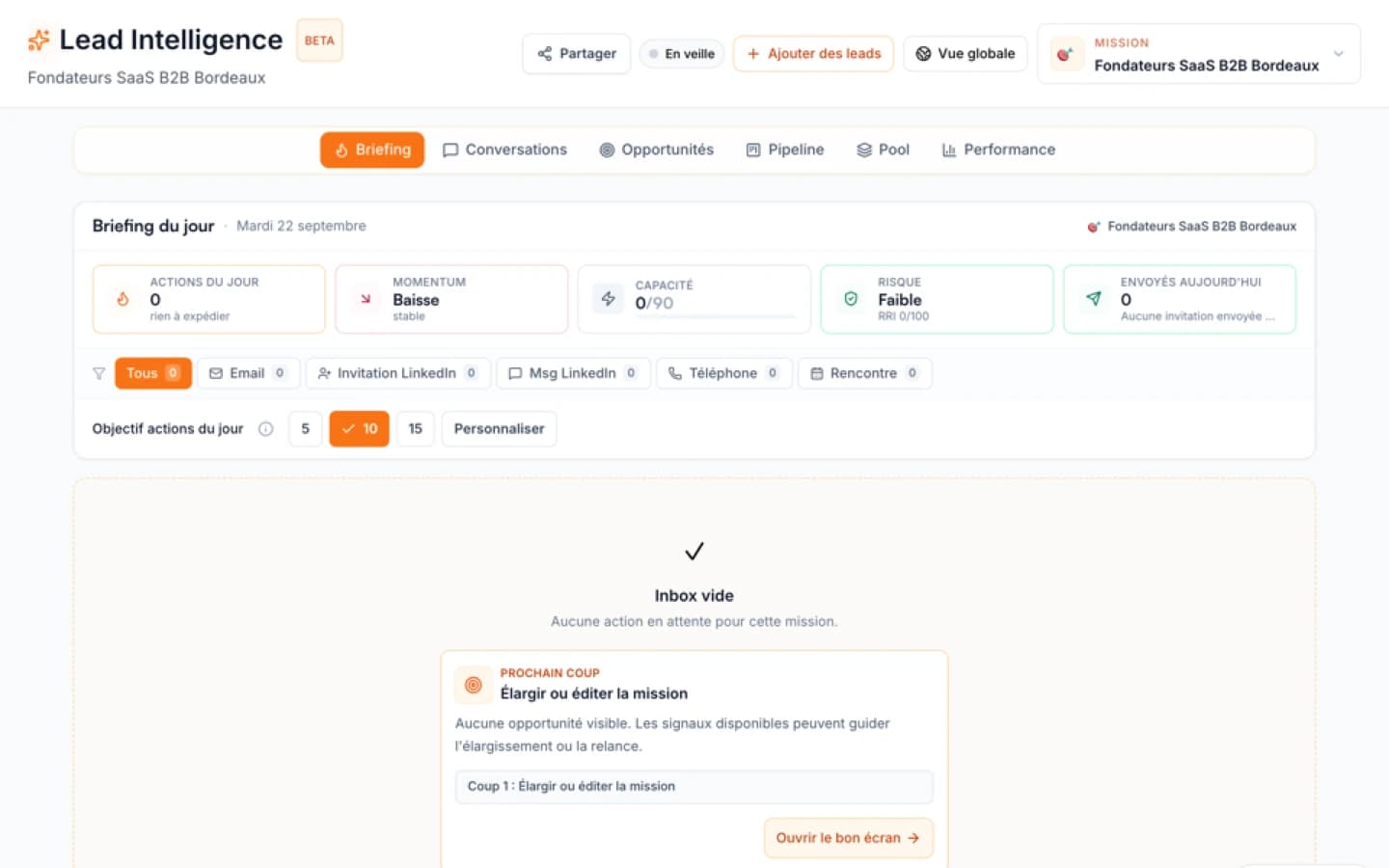
Ember supports this transition by helping small teams focus on high-yield conversations rather than raw volume. Through its Lead Intelligence capability, Ember connects executed actions, replies, meetings and outcomes to identify situations that convert. This allows a small team or a founder to focus on high-yield conversations without needing a dedicated Sales Development Representative (SDR) team, with prospecting efforts grounded in real, actionable context.
Common mistakes
Small Business-to-Business (B2B) sales teams operating in 2026 often fall into predictable traps when their measurement toolkit is limited to basic metrics like opens, replies, and meetings. The first critical error is optimizing for raw activity volume over message precision. Many small teams rely on massive databases to scale their outreach. For example, Apollo advertises a database of 240M contacts (source). However, when a small team adopts this high-volume mindset, they often run into severe budget inefficiencies. This model runs on credits: Apollo states that an export credit is consumed whenever a contact is exported outside Apollo (source). For a small team with limited resources, treating outbound as a numbers game quickly drains budgets without proving product-market fit. Another common mistake is failing to distinguish between positive and negative replies. When a team only tracks raw reply rates, they treat a request to unsubscribe with the same weight as an active inquiry. This lack of nuance makes it impossible to understand which segments are actually converting. This issue is particularly acute for early-stage companies. When considering how does a founder qualify B2B leads without a sales team, the answer is never to copy the high-volume sequencing of a large Sales Development Representative (SDR) department. Instead, the founder must look for deep engagement signals rather than superficial email opens, which are increasingly unreliable.
This approach also connects with What does a realistic 30-day B2B outbound pipeline look like for a small team with no brand and no list: and which activities actually produce meetings?, which clarifies the next choice.
Tools
To build a functional measurement framework with limited metrics, a small Business-to-Business (B2B) sales team must choose tools that align with their operational capacity. According to SalesHive, 45% of B2B companies say generating enough leads is their biggest challenge. However, chasing volume without context often leads to cluttered Customer Relationship Management (CRM) systems and wasted effort. For small teams, the goal of B2B prospecting is not simply to send more emails, but to identify which conversations actually drive pipeline value.
For teams running structured, high-volume outbound sales, legacy platforms like Apollo are highly effective. Apollo advertises access to 240M contacts and 30M companies (source). It combines a massive contact database with sequence automation and cold outreach tools in a single platform. This breadth of channel coverage is genuinely useful for teams that have the resources to manage large-scale campaigns. However, the tradeoff is that its model runs on credits: an export credit is consumed whenever a contact is exported outside Apollo (source), which can compound costs as a team scales. For a small team, this volume-first approach can quickly become expensive and noisy.
Other specialized tools focus on data enrichment and workflow flexibility. Clay, for example, allows teams to build highly customized prospect lists by pulling data from multiple sources and integrating directly with sales engagement platforms such as Salesloft, Outreach, Instantly, Smartlead.ai, and HubSpot Sequencer (source).
When to use this method
This lightweight measurement method is specifically designed for early-stage companies and lean commercial setups where complex tracking infrastructure is absent. Most traditional outbound measurement advice assumes a dedicated marketing operations function, multi-touch attribution, and a Customer Relationship Management (CRM) system with a complete data history, which is rarely the reality for a small team. When a startup lacks these resources, attempting to track dozens of micro-metrics only introduces noise and administrative overhead. Instead, focusing on a minimum viable measurement set of opens, replies, and meetings allows a small team to maintain momentum without getting bogged down in complex analytics.
This approach is highly relevant when building a prospect list from scratch. For instance, a common challenge is understanding how a founder qualifies Business-to-Business (B2B) leads without a sales team. When operating solo or with a tiny team, a founder cannot rely on automated lead scoring or enterprise-grade databases to perform deep lead qualification. Instead, they must use direct, observable feedback from cold outreach to validate their market assumptions. When deciding who to contact first as a founder, the priority must be a small, highly targeted segment of the Ideal Customer Profile (ICP) rather than a massive, unsegmented list. This ensures that the limited metrics available, such as reply rates, actually reflect product-market fit rather than database noise.
Additionally, this method is essential when the sales pipeline is still in its infancy and the team does not have a dedicated Sales Development Representative (SDR) to manage complex multi-channel sequences. According to Salesmotion, the outbound playbook that worked in 2022 is dead because buyers are harder to reach and inboxes are increasingly crowded. In this challenging environment, a small team must avoid over-complicating their tracking. When the primary goal of B2B prospecting is simply to start conversations, measuring whether an email was opened, whether a prospect replied, and whether a meeting was booked provides sufficient signal to iterate on the messaging and targeting.
To make this work, teams can leverage modern tools that simplify the process. For example, Lead Intelligence by Ember helps small teams prioritize their conversations by connecting executed actions, replies, meetings, and outcomes to identify situations that convert, as detailed on the Ember Lead Intelligence page. This allows lean teams to focus on the opportunities that deserve immediate action without needing a complex RevOps setup.
In practice, Which reference data helps a pre-seed startup founder decide who to contact, why now, and with what message? completes this framework with another angle on the same topic.
When not to use it
This lightweight measurement framework is not suitable for every stage of growth. If your organization is running a highly structured, high-volume prospecting model, tracking only opens, replies, and meetings will leave critical blind spots. Most outbound measurement advice assumes a marketing operations function, multi-touch attribution and a CRM with a complete history. For a small team, this minimal data set may be enough, but as soon as you move to paced, large-scale prospecting, you need a solution that connects executed actions, replies, meetings and outcomes to identify the situations that convert. This is where Ember's Lead Intelligence comes in, turning raw signals into decisions for B2B sales teams.
Action plan
To execute outbound sales for startups successfully with limited resources, a small team must implement a highly structured action plan. This plan focuses on maximizing the value of basic metrics like opens, replies, and meetings to optimize the Business-to-Business (B2B) sales pipeline.
First, establish a clear target list before launching any cold outreach. When building a prospect list from scratch, the initial temptation is to gather as many contacts as possible. However, to answer the critical question of who should an early-stage founder contact first, the strategy must be highly selective. An early-stage founder should contact high-fit accounts first, specifically targeting decision-makers who match a tightly defined Ideal Customer Profile (ICP) and exhibit active buying signals. Focusing on these high-probability accounts prevents wasted effort and ensures that early b2b prospecting conversations yield meaningful feedback.
Second, streamline your lead qualification process. A common question for early-stage companies is how does a founder qualify B2B leads without a sales team? The answer lies in setting up a basic lead scoring system based on firmographic fit and immediate relevance before any emails are sent. By qualifying leads early, a founder acting as a solo Sales Development Representative (SDR) can focus limited energy on contacts that have a genuine need, keeping the active sales pipeline clean and manageable.
Third, map your available metrics to specific operational decisions. Since the team only tracks opens, replies, and meetings, treat each metric as a diagnostic signal. Use the open rate to evaluate subject line relevance and deliverability. Use the reply rate to measure the strength of your value proposition. Finally, use the meeting-booked rate to assess the ultimate alignment of your offer. If a campaign has high open rates but zero replies, the copy or the targeting is off. If replies are high but meetings are low, the call to action or the offer itself needs refinement.
Fourth, manage your data stack with cost-efficiency in mind. While large platforms like Apollo offer broad coverage, their model runs on export credits (source), which can quickly become expensive for small teams. Similarly, specialized tools can introduce integration challenges. For example, CRM integrations are available from the Growth plan and are not included in the Free or Launch plans, according to the Clay pricing page consulted on 28 September 2026. For a small team, manually tracking these three core metrics in a simple spreadsheet or a basic CRM is often sufficient to maintain momentum without incurring high software costs.
Finally, leverage intelligent systems to automate the heavy lifting of context preparation. Rather than relying on manual research, teams can use Ember and its Lead Intelligence capability. Lead Intelligence reuses the Ember Business Plan, ICP, offer, and strategy to prepare a sales mission. By connecting executed actions, replies, meetings, and outcomes, it helps identify the exact situations that convert. This allows a lean team to continuously refine their outbound strategy based on real performance, turning limited metrics into clear, actionable growth decisions.
Before deciding, Which signals should alert a traction-stage startup founder? helps connect this method with adjacent priorities.
Sources and methodology
To establish a realistic framework for measuring outbound in small sales teams, this article relies on public sources consulted on 28 September 2026: SalesHive for the main challenge of B2B companies, Salesmotion for the changing outbound context, and the official pages of Apollo (home, pricing) and Clay (home, pricing, integrations). Ember is the publisher of Lead Intelligence and of this article, so the comparison is not neutral.
Sources
- Most outbound measurement advice assumes a marketing ops function, multi-touch attribution, and a CRM with full history. This piece focuses on the minimum viable measurement set for a small team: which 4-6 metrics actually drive decisions,
- Outbound Sales Strategy: 7 Plays That Actually Work in 2026
- Outbound Sales: 50+ Questions Answered for B2B Teams
FAQ
Free diagnostic
Test your sales file
Drop an Excel or CSV and check its readiness without sending its rows to Ember.