
Context and ICP
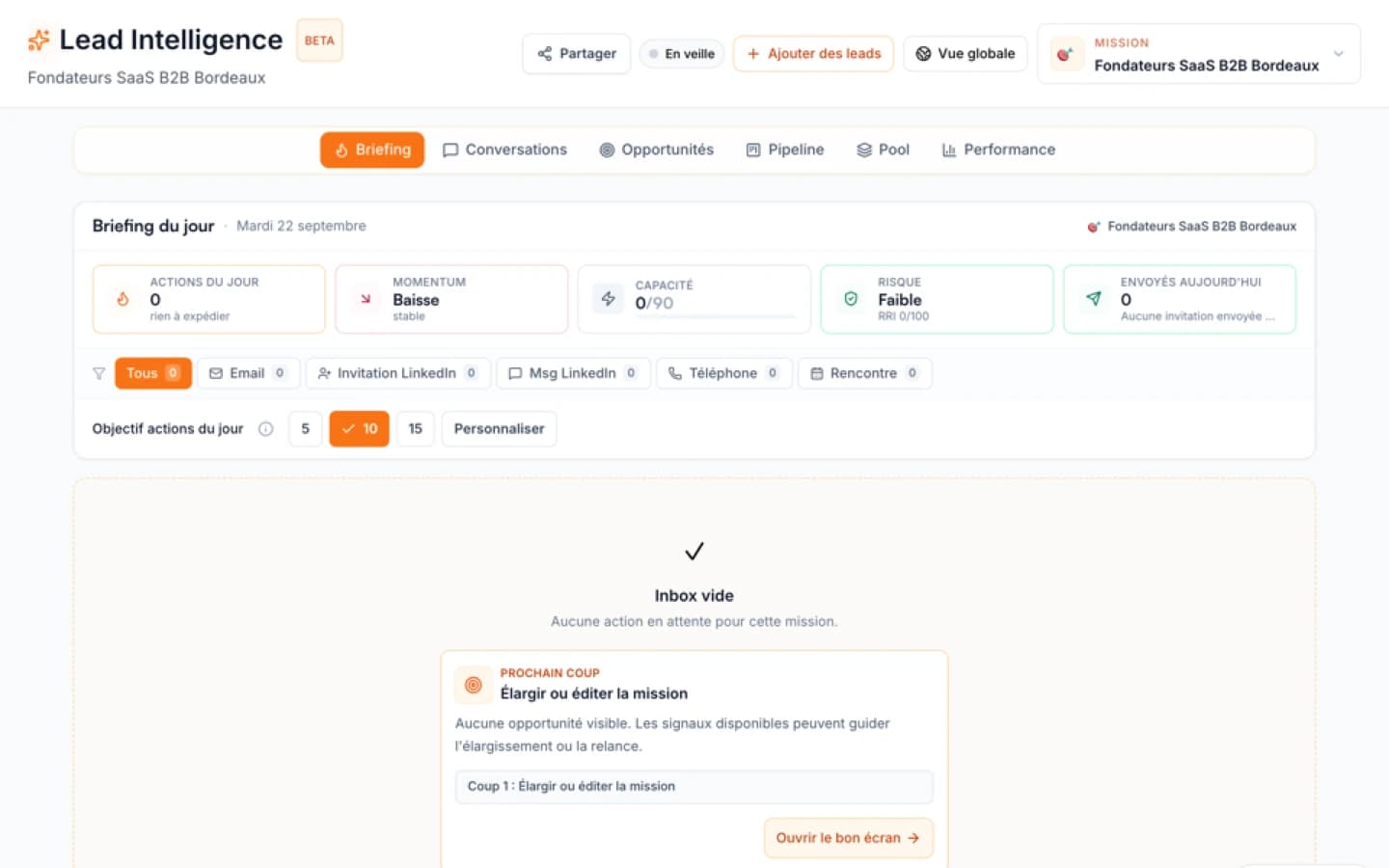
Treating fundraising as a highly targeted outbound campaign allows founders to apply rigorous qualification to their investor pipeline. This is where Lead Intelligence changes the dynamic of early-stage fundraising. Instead of relying on static, outdated lists of wealthy individuals, founders can use Lead Intelligence to run precise discovery missions. A fundraising mission can start from a Fund Your Growth file, then search for individual investors by investment thesis after founder confirmation. One of the primary challenges for an early-stage founder is the starting point. Lead Intelligence is highly flexible, finding and prioritizing the contacts itself whether the founder starts with 10, 100 or 1,000 contacts, with no minimum contact threshold (Lead Intelligence Product Page). Furthermore, the platform does not just look at basic demographic data. It understands context and human relationships, detecting changes across people and companies to adjust priorities. By monitoring signals about people and companies to keep context current, it helps founders identify when a business angel might be most receptive, perhaps after a recent exit, a shift in their investment thesis, or a public industry statement. This makes the priority of each contact explainable from context, signals, and opportunity readiness (Lead Intelligence Product Page), giving founders a clear, logical reason to reach out to one specific investor over another on any given day. This strategic approach to identifying business angels integrates naturally with other creative workflows. For instance, once the right investors are prioritized, founders can utilize Creation to build a presentation tailored to the expectations of those specific business angels, as outlined in the Use Creation to Pitch Business Angels: A Structured Guide. By combining precise lead discovery with structured narrative design, early-stage founders can navigate their seed rounds with maximum efficiency and clarity.
To place this decision in context, the Knowledge guides for sales brings together deeper guidance on the same field.
Problem
Early-stage founders seeking business angels often treat fundraising as a numbers game, duplicating the high-volume outbound tactics of traditional sales departments. They scrape massive, generic lists of potential investors, only to face silent rejections. Traditional sales intelligence platforms are built for scale rather than strategic precision. Similarly, data enrichment tools like Clay offer features such as an official Sales Navigator datapoint integration, but they require founders to build complex data pipelines themselves. These platforms assume the user already has a massive database and a dedicated sales team to run campaigns. For a founder, the real challenge is finding the exact intersection of an investor's past investments, current interests, and active thesis. When starting with a small pool of potential allies, traditional tools fall short because they often demand high volume to show value. An early-stage founder needs a system that can prioritize and extract deep context whether they start with 10 or 100 contacts, with no minimum contact threshold, as detailed on the Ember Lead Intelligence page. Without this contextual intelligence, founders spend more time managing spreadsheets than building relationships with the angels who could actually fund their growth.
Prerequisites
Before you can leverage intelligent search to identify and prioritize business angels, you must establish a clear strategic foundation. Fundraising is not a process that begins with a raw list of names.
Prepare the company stage, sector, funding need and the investor theses to check. If the account has access to Fund Your Growth, its file can be the starting point. The founder then confirms the fundraising mission before Lead Intelligence researches and prioritises people.
However, for an early-stage founder seeking business angels, starting with massive, uncalibrated lists often results in low response rates and wasted time.
The true prerequisite is a validated strategic context. Once your business plan and investor criteria are defined, you do not need a massive database to begin. Lead Intelligence finds and prioritizes the contacts itself whether the team starts with 10, 100, or 1,000 contacts, with no minimum contact threshold, as detailed on the Ember Lead Intelligence Page.
To explore this point further, Use Lead Intelligence to research suitable investors details a step directly related to this decision.
Workflow
To execute this targeted fundraising strategy, early stage founders can follow a structured workflow that turns raw investor interest into active conversations. The process begins by aligning your strategic foundation with your outreach mission. Instead of starting from scratch, Ember allows you to leverage your existing strategic assets. Lead Intelligence directly reuses the Fund Your Growth file, company stage, sector and investor thesis to prepare a fundraising mission after founder confirmation, as documented on the Ember Lead Intelligence Product Page.
Once the mission parameters are set, the next phase is sourcing and discovery. Similarly, for teams requiring deeply customized data enrichment workflows, Clay provides powerful tools, including an official LinkedIn Sales Navigator datapoint integration for lead discovery and connection insights, as detailed on the Clay Integrations Page.
However, early stage fundraising demands a more intimate approach. Rather than forcing you to build massive databases, Lead Intelligence finds and prioritizes the contacts itself whether the team starts with 10, 100 or 1,000 contacts, with no minimum contact threshold, according to the Ember Lead Intelligence Product Page. This flexibility allows founders to focus on a small, highly curated list of investors to review without the overhead of enterprise sales tools.
After identifying your target investors, the workflow shifts to contextual prioritization and personalized engagement. Rather than sending generic, automated sequences that business angels routinely ignore, the platform proposes the next action and channel that fit the lead situation, as explained on the Ember Lead Intelligence Product Page.
Finally, once an angel investor expresses interest, you must be prepared to present your project with absolute clarity. This is where your outreach workflow connects directly with your presentation materials. With your funding file, you can prepare a clear narrative for interested investors. Founders can use Creation to structure and refine their pitch deck specifically for business angels, ensuring that the substance of their business plan is reflected in every slide, as outlined in the guide on Use Creation to Pitch Business Angels: A Structured Guide.
Outcome to check
The outcome to check is a list of people whose published thesis, stage and geography may fit the company. Each entry retains its source and date. The founder checks that the person still invests in the field before making contact. Lead Intelligence can help organise leads after the funding file is confirmed. Its ranking guarantees no reply, meeting or funding.
Example Ember mission
To illustrate how this works in practice, consider an early stage founder who has just finalized their business plan and is ready to identify investors to review. Instead of manually searching through online directories or buying outdated databases, the founder launches a targeted prospecting mission within Ember. The setup begins by importing the strategic foundation already built in the workspace. As detailed on the Ember Lead Intelligence page, the platform reuses the Fund Your Growth file, company stage, sector and investor thesis to prepare the fundraising mission. Once the mission is configured, Lead Intelligence begins its discovery process. The system researches individual investors by investment thesis after the founder confirms the mission, then verifies useful sources to document available evidence. This is particularly valuable for identifying business angels who may not advertise their investment activity openly but exhibit clear signals, such as recent exits, board appointments, or active discussions in specific sectors. A major advantage for early stage founders is that the process does not require a massive pre-existing network. According to the Ember Lead Intelligence documentation, the system finds and prioritizes the contacts itself whether the team starts with 10, 100 or 1,000 contacts, meaning there is no minimum contact threshold required to generate value. As the mission progresses, the platform proposes explained priorities for the founder to review before contacting anyone. Rather than just delivering a list of names, the system proposes the next action and channel that fit the lead situation, as explained on the Ember Lead Intelligence page. For example, if a business angel has recently posted about sustainable technology, the system might suggest reaching out with an angle that highlights the startup's environmental impact metrics. Finally, the founder can easily track the tangible outcomes of their outreach. After the mission, the platform shows the contacts analysed, signals detected and priority actions actually recorded.
Limits and non-fit
While Lead Intelligence is highly effective for context-driven investor discovery, it is not a universal solution for every outreach strategy. Similarly, if you require highly customized data enrichment workflows with official LinkedIn Sales Navigator access, Clay provides a dedicated integration for lead discovery and connection insights. It is built to prioritize high-conviction relationships based on your specific project context. According to the Ember Lead Intelligence page, the system finds and prioritizes contacts whether you start with 10, 100 or 1,000 contacts, meaning there is no minimum contact threshold required to begin. Additionally, finding the right business angels is only one step in the fundraising process. Lead Intelligence helps you identify who to contact and why, but it does not design your presentation or draft your financial plan. For those needs, founders must rely on other specialized tools. To build a compelling presentation that moves investor decisions forward, you can read the guide on how to Use Creation to Pitch Business Angels: A Structured Guide or review Creation Use Cases for Founders Seeking Investors.
In practice, What Lead Intelligence can do in automated prospecting completes this framework with another angle on the same topic.
When to use it
A possible time to begin is when the founder knows the funding need and the criteria of the investors sought. Once you have structured your business plan and funding strategy, you need an outreach approach that respects this context. Lead Intelligence directly reuses your Fund Your Growth file and investor criteria to prepare a fundraising mission after your confirmation, as detailed on the Ember Lead Intelligence page. Another key use case is when you want to avoid the noise of massive, unvetted databases. Traditional outbound tools often require large lists to show any utility, but early-stage fundraising relies on relationship-building. Lead Intelligence finds and prioritizes the contacts itself, whether your team starts with 10 or 100 contacts, with no minimum contact threshold, as documented on the Ember product specifications page. This makes it ideal when you have a shortlist of potential local investors or want to discover a small, highly qualified group of angels who match your industry. You should also use this capability when you need to move from discovery to execution without guessing the best approach. Once potential business angels are identified, Lead Intelligence proposes the next action and channel that fit the lead situation, which is a core feature of the Ember platform. This helps founders determine whether to reach out via a mutual connection, a tailored email, or a specific professional network. For other scenarios, alternative tools might be more appropriate. Similarly, if you require an official LinkedIn Sales Navigator data point integration to build complex, customized lead discovery workflows, Clay provides excellent capabilities for data enrichment. However, for early-stage founders seeking business angels, Lead Intelligence bridges the gap between strategic planning and direct investor engagement without requiring complex configurations.
Next step
The transition from planning to active outreach is the moment where many fundraising campaigns lose momentum. To maintain traction, the immediate next step is to bridge your strategic foundation with active investor discovery. If you have already built your business plan and selected a funding strategy using Fund Your Growth, you can reuse that work if your account has access to a fundraising mission. Lead Intelligence directly reuses your funding file and investor criteria to prepare a targeted investor search mission after your confirmation. Whether your initial list of potential investors contains 10 or 100 contacts, Lead Intelligence finds and prioritizes the contacts itself with no minimum contact threshold, as outlined on the Ember Lead Intelligence page. This allows you to bypass generic databases and focus entirely on high-value relationships. By initiating this mission, you receive a clear next action that details who to contact, why the opportunity is timely, and which channel and angle to use. You can begin by importing your existing draft list or letting the platform discover new targets that match your exact criteria.
Before deciding, Lead Intelligence for an independent founder helps connect this method with adjacent priorities.
Checked sources
- Y Combinator seed fundraising guide: advice on investor research.
- Fund Your Growth: public product overview.
- Lead Intelligence: public product overview.
Sources
FAQ
Free diagnostic
Test your sales file
Drop an Excel or CSV and check its readiness without sending its rows to Ember.