
Context and ICP
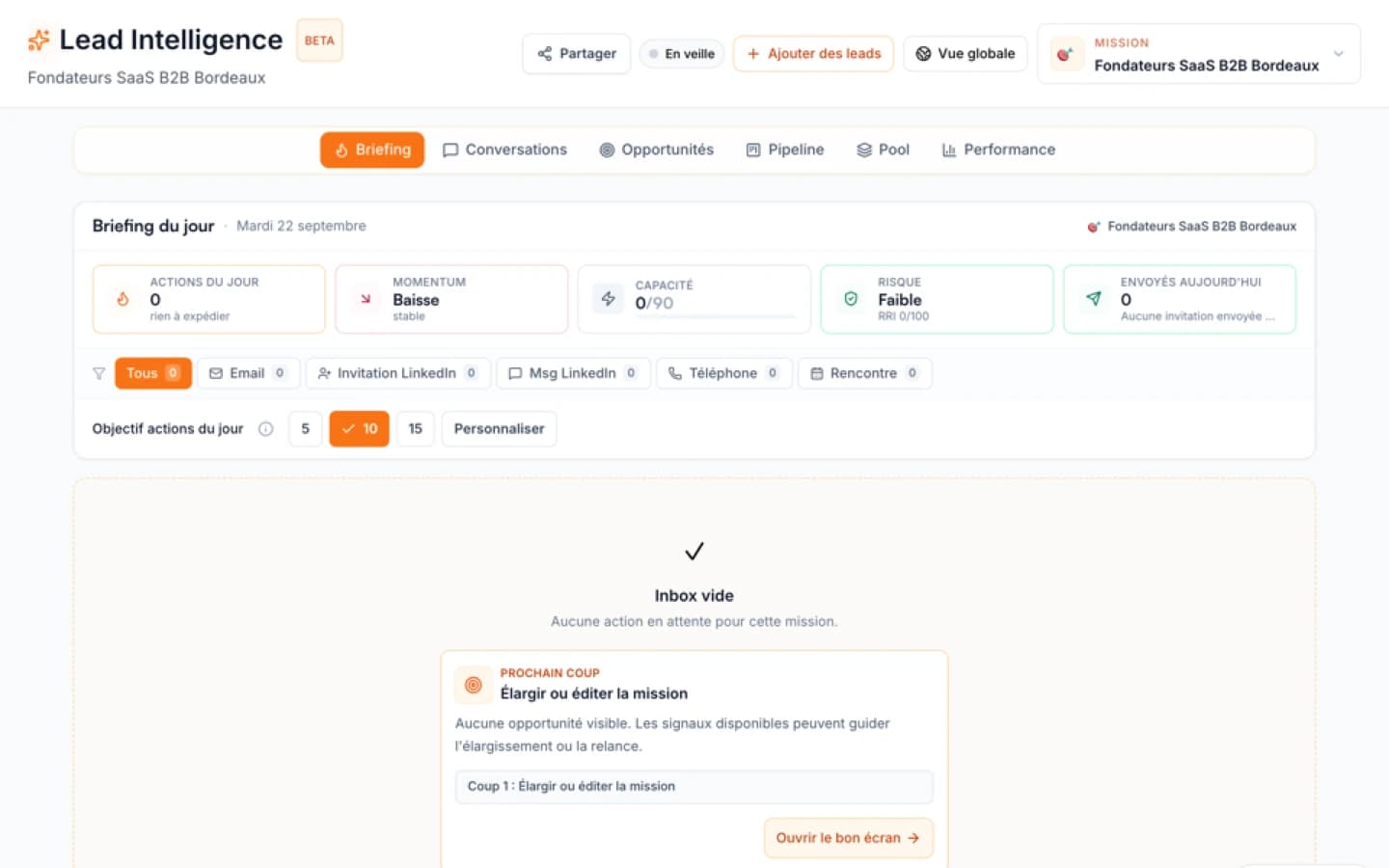
For an ambitious solo entrepreneur or an early stage founder, time is the single most constrained resource. Building a product, managing operations, and handling administrative tasks leave very little room for manual sales prospecting. Some outbound methods require tool setup and contact-list filtering before a relevant account is found. This workload can make regular prospecting hard for one person. An ambitious solo founder needs a way to identify high value opportunities without getting lost in the noise of generic contact lists. This is where Lead Intelligence by Ember changes the dynamic for individual creators. Instead of requiring a massive database to start, the system finds and prioritizes the contacts itself whether the team starts with 10, 100 or 1,000 contacts, with no minimum contact threshold. This flexibility allows solo entrepreneurs to run focused campaigns based on their Ideal Customer Profile (ICP). In a solo setup, waiting days for data enrichment or list building stalls momentum. With a usable targeting context in place, the first prioritized leads can appear in about 30 minutes. By monitoring recent signals about people and companies, the platform keeps the context current and makes the priority of each opportunity explainable. The founder receives contacts, explained priorities and proposed next actions, then checks whether the timing and angle suit each account.
To place this decision in context, the Knowledge guides for sales brings together deeper guidance on the same field.
Problem
For an ambitious solo entrepreneur, the primary bottleneck is not the lack of potential leads, but the overwhelming noise of modern sales prospecting. Traditional outbound sales platforms are built for larger, structured teams. Apollo presents a connected sales system spanning data, intelligence and execution on its official site. Similarly, Clay provides powerful data enrichment workflows, including a Sales Navigator data point for lead discovery and connection insights, as documented on Clay.
While these platforms are suited for dedicated sales representatives who spend their entire day inside a Customer Relationship Management (CRM) system, they introduce significant operational overhead for a single founder. Setting up multi-step enrichment databases, cleaning raw lists, and writing complex prompt templates can require manual work. A solo founder cannot afford to act as a full-time database administrator. When time is the most constrained resource, the challenge is finding a way to identify high-value opportunities and prioritize outreach without needing a massive database or a complex engineering setup.
Prerequisites
Before launching any outbound sales campaign, an early stage founder must establish a clear business direction. Traditional sales setups often require complex, pre-configured databases. Apollo describes a workspace for prospecting, contacts and execution on its official site. For a solo entrepreneur, however, the primary prerequisite is simply a clear definition of their target audience and core offer. This strategy can be structured in a Business Plan with Ember Fund Your Growth if your account has access. This context lets the founder compare the planned outreach with the business goals. The second prerequisite is an initial set of contacts or a target profile, though the scale required is vastly different from traditional enterprise tools. While some data enrichment platforms like Clay rely on specific integrations, such as the Sales Navigator data point for lead discovery and connection insights described on Clay Integrations, Ember takes a highly flexible approach. An ambitious founder does not need a massive database to begin. In fact, Ember Lead Intelligence finds and prioritizes the contacts itself whether the team starts with 10, 100 or 1,000 contacts, with no minimum contact threshold. This allows solo entrepreneurs to initiate highly targeted campaigns without spending weeks building massive prospect lists. Finally, the founder must be prepared to execute the recommended outreach. Because time is limited, the system is designed to minimize manual decision-making. Once the initial context is set, the platform analyzes the available information and proposes the next action and channel that fit the lead situation, in the mission. The only remaining prerequisite is the founder's readiness to review these tailored recommendations and initiate the conversations that actually move the business forward.
To explore this point further, Lead Intelligence Use Cases for B2B SME Leaders: A Decision details a step directly related to this decision.
Workflow
For an ambitious solo entrepreneur, a sales workflow must be lean, direct, and highly automated. In Ember, a founder can start a sales mission from project context without first building a dedicated prospecting team. The founder can start a targeted prospecting mission from an existing business strategy.
The workflow begins by leveraging the central context of the project. Because Ember acts as an Artificial Intelligence (AI) team for entrepreneurship, the Business Plan, ICP, offer and strategy already established, such as defining the Ideal Customer Profile (ICP) or structuring a business plan, is reused in the sales mission. The founder reviews the reused targeting criteria before launching research.
Once the mission parameters are set, the discovery phase runs autonomously. Some prospecting methods use large contact lists, but Ember adapts to the founder's immediate scale. The system finds and prioritizes the contacts itself whether the team starts with 10, 100, or 1,000 contacts, with no minimum contact threshold. This flexibility is crucial for early-stage founders who need to test niche markets or validate assumptions with a small, highly curated group of prospects before scaling.
After identifying the right prospects, the workflow shifts from raw data collection to strategic execution. Rather than exporting a static spreadsheet of email addresses, the system analyzes company signals and individual profiles to propose a contact time. It then proposes the next action and channel that fit the lead situation, as outlined on the Lead Intelligence product page. The founder receives an explained priority and a proposed next action, then checks them before contacting anyone.
Outcome to check
A useful outcome for a solo founder is a short account list with the observed fact, its source and a question for each account. Lead Intelligence can help order the research. The founder checks the signal date and records the actual reply. If early contacts do not recognise the proposed problem, the target profile changes. An explained priority makes daily work easier; it promises neither meetings nor contracts.
Example Ember mission
To illustrate how this works in practice, consider an early stage founder launching a new Business to Business (B2B) software service. Instead of manually scraping directories or purchasing outdated email lists, the entrepreneur initiates a targeted sales mission within Ember.
The process begins because Lead Intelligence reuses the Ember Fund Your Growth, Ideal Customer Profile (ICP), offer, and strategy already established in the workspace to prepare the sales mission, in the mission. This context helps prepare the sales mission from the project information already available.
Once the parameters are set, Lead Intelligence finds accounts from the mission ICP and signals, then verifies useful sources to document the findings, in the mission. For a solo founder, scale is often a barrier in traditional tools. However, Lead Intelligence finds and prioritizes the contacts itself whether the team starts with 10, 100 or 1,000 contacts, with no minimum contact threshold. This flexibility lets the founder test a focused campaign with few contacts; engagement quality remains to be measured.
As the mission progresses, the system does not just dump raw data into a spreadsheet. It actively proposes the next action and channel that fit the specific lead situation. The founder reviews the proposed action and channel, then decides whether to contact the person or wait for another signal.
Finally, the mission provides immediate transparency. After the mission, Ember shows the contacts analyzed, signals detected, and priority actions actually recorded. This makes the first value actually produced by the mission visible, giving the ambitious solo entrepreneur a clear, auditable view of their market reach and immediate next steps.
Limits and non-fit
While Lead Intelligence is suited for focused, high-conviction outreach, it is not a universal solution for every sales model. Understanding its boundaries helps early-stage founders select the right tool for their specific operational stage.
Apollo describes data, sales management and execution functions that may serve a different need Apollo. Similarly, if your prospecting workflow relies on highly customized data enrichment pipelines, such as using a Sales Navigator data point for lead discovery and connection insights, Clay offers this integration Clay.
Ember is built for relevance rather than raw volume. Lead Intelligence finds and prioritises contacts without a minimum threshold. For mass email campaigns, check sending and sequence-management features separately. A team that mainly needs high-volume sending should compare that need with each tool’s available functions.
There are also technical boundaries to consider. Ember does not automatically synchronise every Customer Relationship Management (CRM) system. If the business needs several existing systems synchronised, check the available integrations before choosing.
In practice, Lead Intelligence Use Cases for Sales Directors: A Decision Guide completes this framework with another angle on the same topic.
When to use it
For an early stage founder, the transition from planning to execution is a critical bottleneck. Once you have structured your Business Plan to fund and develop your project, the immediate challenge is finding real market traction. This can be a moment to try Lead Intelligence. Instead of waiting for a large marketing budget or a dedicated sales team, a solo founder can initiate a targeted sales mission. This approach is particularly valuable when you need to validate your Ideal Customer Profile (ICP) with real market feedback, allowing you to reuse your existing strategy and business context to launch outreach campaigns without starting from scratch.
Some outbound sales methods use large contact volumes. However, an ambitious solo entrepreneur rarely has the luxury of managing thousands of cold leads. Lead Intelligence is designed for scenarios where quality and context matter more than raw volume. The system finds and prioritizes the contacts itself whether the founder starts with 10, 100, or 1,000 contacts, with no minimum contact threshold. This can make it useful for niche Business to Business (B2B) offerings where you need to identify and contact a highly specific group of decision makers.
Solo founders must wear every hat, from product development to customer support. You do not have the time to configure complex, multi step data pipelines. Clay describes a LinkedIn Sales Navigator integration (source). Evaluate its setup effort for your own use. Similarly, unified sales platforms like Apollo are built to streamline pipeline management and closing for modern, multi person sales and marketing teams (Apollo). When you are operating alone, you need a solution that bypasses this administrative overhead. Lead Intelligence can fit this need because it automatically proposes the next action and channel that fit the lead situation (Ember Lead Intelligence), which may leave more time for the actual conversation.
Another key use case is when you need to stay highly responsive to market movements without spending hours monitoring social media or news feeds. Lead Intelligence understands context and human relationships, detecting changes across people and companies to update the available context. This is crucial for solo founders who need to time their outreach perfectly, such as when a target company receives new funding or a key decision maker changes roles. By examining opportunities with active signals, you can decide where to spend your time.
Next step
For an ambitious solo entrepreneur or early stage founder, the path forward requires moving from strategic planning to direct market engagement without losing momentum. One possible next step is to initiate a focused prospecting mission. You do not need a massive database or a dedicated sales team to begin. You can launch a targeted search regardless of your starting point. The system finds and prioritizes contacts itself whether you begin with 10 or 100 contacts, operating with no minimum contact threshold. This flexibility allows you to test your value proposition on a micro scale before expanding your outreach. Instead of guessing who to reach out to or sending generic bulk emails, the platform provides a clear next action, identifying who to contact, why now, which channel to use, and which angle to take. By analyzing signals and company context, it proposes the next action and channel that fit the lead situation. As an AI team for entrepreneurship, Ember helps you understand a changing context, choose your next priority, and take action. You can start by defining your Ideal Customer Profile (ICP) in your workspace and letting the system identify your first high-priority opportunities today.
Before deciding, Lead Intelligence Use Cases for Account Executives helps connect this method with adjacent priorities.
Sources and checks
- Lead Intelligence: public product overview.
- Apollo: the publisher’s product description.
- Clay Sales Navigator: the publisher’s integration description.
Sources
FAQ
Free diagnostic
Test your sales file
Drop an Excel or CSV and check its readiness without sending its rows to Ember.