
Definition
Activating a B2B buying group means helping several people reach one internal decision. It does not mean sending a separate pitch to every title. This method starts after the account is qualified, a credible participant is engaged and the relevant roles are sufficiently known. If those conditions are missing, return to qualification and role discovery first.
The operating artifact is a consensus file that can travel without the sales rep. It states the shared problem, the evidence already accepted, the impact on each role, open risks, the decision path and one common next action. Each contact receives only the question that belongs to their role, but every answer returns to the same file. The rep therefore maintains one case rather than several competing narratives.
Gartner reported on 7 May 2025 that 74% of the 632 B2B buyers surveyed in August and September 2024 observed unhealthy conflict in their buying teams source. Gartner also reported that teams reaching consensus were 2.5 times more likely to describe the deal as high quality, and that content relevant to the buying group supported consensus more than content tailored only to an individual source.
The implication for a one-person sales function is practical. Buyer alignment is the scarce resource. Message volume is not a substitute for it.
Prerequisites
Begin only when five conditions are present:
- The account matches the offer and has a current problem worth examining.
- One credible participant is willing to check the case and explain the internal decision path.
- The seller knows enough about users, finance, technical review and final approval to route questions responsibly. A complete organisation chart is not required.
- The seller has source-dated evidence for the problem and can label assumptions honestly.
- There is one decision to request, such as validating a problem statement, approving a bounded review or rejecting the opportunity.
Use the Defensible B2B Lead Qualification Framework for Small Sales before activation. It prevents a polished file from disguising an account that was never qualified.
The 2025 6sense Buyer Experience Report is vendor research, not a universal benchmark. In its nearly 4,000 survey responses, 79% of buyers reported that they, not the vendor, initiated the first buyer-seller interaction, and 94% said their team could rank vendors by preference before speaking with sellers source. These findings support preparing an internally shareable case early, but they do not prove that this method will win a deal.
Treat those figures as context, not as a target. The rep still needs permission, a relevant problem and a credible internal participant. Early preparation does not justify early pressure.
Steps
First, draft the consensus file. Keep it short enough to review in one sitting. Open with the shared operational problem, not the product. Attach the evidence and its date. Separate observed facts, the buyer's statements, the seller's interpretation and unresolved assumptions. Add a simple role-impact table with four columns: role, concern to resolve, evidence needed and current answer. End with one proposed action, one owner and one date.
Second, ask the credible participant to co-author it. Do not ask this person to forward a sales deck blindly. Ask them to correct the problem statement, remove language that will create resistance and identify which unanswered question blocks an internal discussion. Their job is not to sell on the rep's behalf. Their job is to make the file usable inside the organisation.
Third, sequence questions by role. A user can validate the current workflow and adoption constraint. A financial reviewer can test the cost logic and the cost of leaving the problem unresolved. A technical or security reviewer can identify integration, access and risk requirements. Procurement or legal can explain the process and mandatory terms. The final approver can confirm whether the proposed decision is the right next commitment. Send the smallest useful excerpt, link back to the same file and ask one precise question.
The 6sense buying-group role report distinguishes champions, influencers, financial ratifiers and ultimate decision makers, while noting that one person may hold more than one role source.
Roles are therefore routing rules, not message templates. If one person holds several roles, combine the questions. If two people share one role, ask them to resolve the same issue together rather than creating two versions of the case.
Fourth, consolidate every objection in the shared file. Record the objection, its owner, the evidence needed, the answer and whether the issue remains open. Do not answer a finance objection in one email and a security objection in another private thread without updating the common record. A single source of truth reduces contradictory promises and lets the credible participant see what changed.
Fifth, request one common action. Examples include a short internal review of the file, approval of a bounded technical check or a decision to stop. The call to action must be identical across role messages. Do not ask one person to book a demo, another to send data and a third to approve a purchase during the same cycle.
Log the agreed action and unresolved questions in the Structure a Weekly Outbound Review for Small B2B Sales Teams. Follow up only when there is new evidence, a due decision or a relevant change. Repeating the same reminder is not activation.
Worked example
Consider a solo rep selling workflow software to a mid-sized services company. An operations lead has confirmed that handoffs between client delivery and finance are inconsistent. The relevant internal participants are an operations sponsor, a daily user, a finance reviewer and a security reviewer. This is an illustrative case, not a reported customer result.
The rep creates one file. Its first page describes the current handoff, links to the sponsor's examples and marks the volume assumption as unverified. The role table shows that the user must validate the workflow, finance must define an acceptable cost comparison and security must list data-access constraints. The proposed common action is a short review in which the group accepts, corrects or rejects the problem statement.
The sponsor receives a co-author request. The user receives only the workflow extract and one question about the failure point. Finance receives the cost assumptions and a request to correct them. Security receives the proposed data path and a request for non-negotiable constraints. Every response is added to the same file. Nobody receives a different promise.
When finance rejects an assumption, the rep updates the file instead of defending the original number. When security asks for a narrower data path, that condition becomes visible to the sponsor and user. The review is held only after the open questions are precise. The outcome may be a bounded evaluation, a request for more evidence or a stop. All three are useful because the buying group made one explicit decision.
If the account cannot yet support this example, revisit the Build a B2B Lead Scoring Model in 2026 Without an Analyst rather than manufacturing urgency.
Common mistakes
Contacting everyone at once. Parallel outreach creates more conversations for one rep to manage and may expose inconsistent claims. Sequence the unresolved questions instead.
Creating a custom deck for each role. Personalise the entry point and question, not the underlying evidence. A finance version and a security version that disagree will weaken the internal case.
Turning the champion into a courier. A credible participant should improve the file and decision path. They should not be asked to distribute material they cannot defend.
Using several calls to action. A demo, data request, trial and contract discussion in one cycle force the group to choose the process before it agrees on the problem.
Treating silence as consensus. No objection is not approval. Record explicit agreement, correction or refusal for the common action.
Following up without change. A reminder should carry new evidence, a resolved objection or a due decision. Otherwise, pause and preserve the relationship.
The B2B Sales Team Guide to Lead Generation Contracts 2026 is relevant when a supplier will help with research or outreach. Supplier diligence does not remove the need for buyer consent and message control.
Tools
The minimum stack is deliberately small:
- one shareable document with version history and clear permissions;
- one role-impact table inside that document;
- one objection and evidence register;
- one task list for owners and dates;
- one account record linking the current file, next action and stop reason.
Avoid adding a separate automation tool for every role. The process works when evidence, objections and the common action remain visible in one place. A customer relationship management system can hold the record, but it should not become a second narrative.
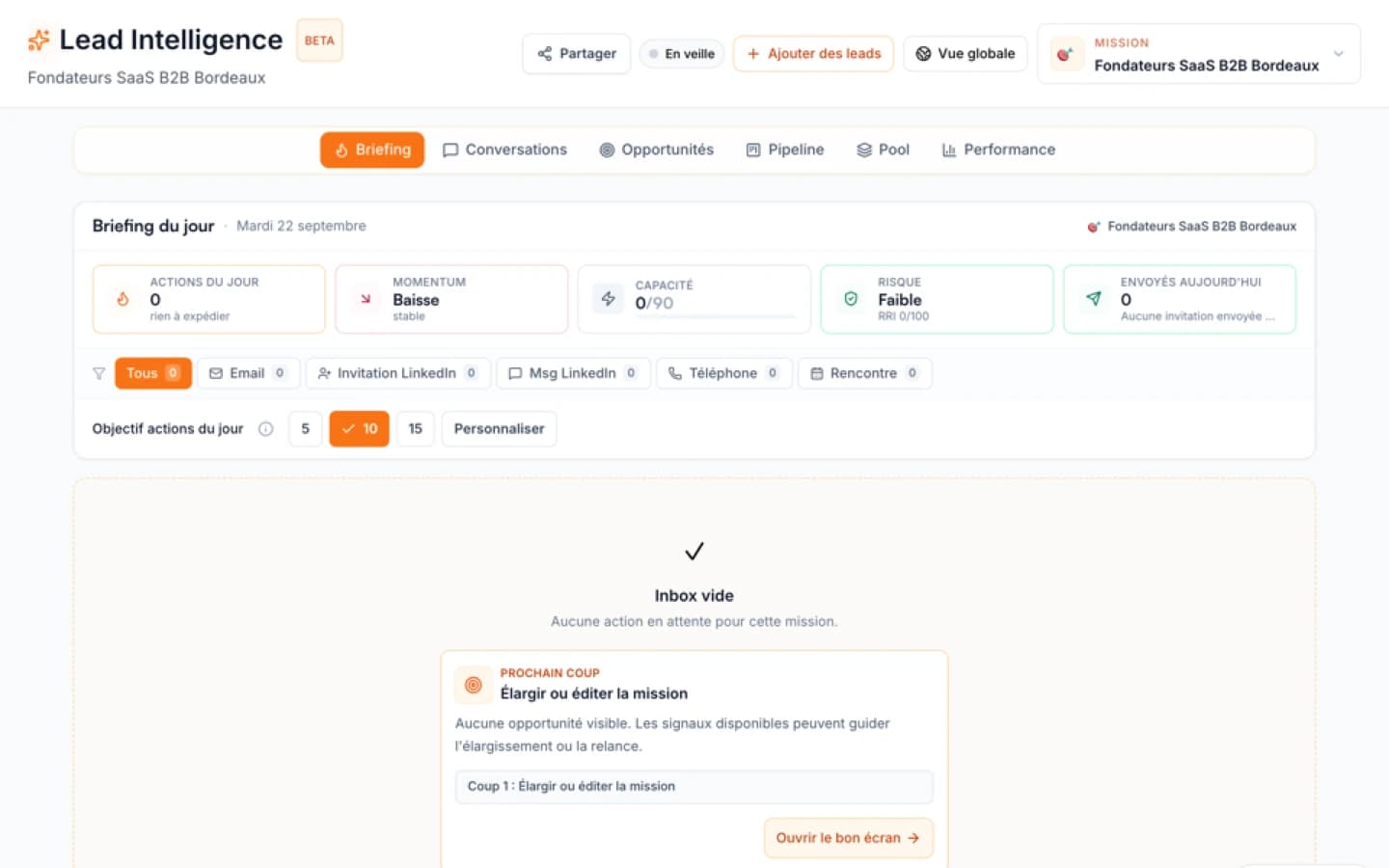
Lead Intelligence prioritises opportunities from the available context.
Lead Intelligence monitors signals about people and companies to keep context current.
Lead Intelligence proposes the next action and channel that fit the lead situation.
These capabilities can help the rep choose which role-specific question deserves attention. They do not write the buyer's consensus, send messages without review or guarantee agreement. The rep and buying group remain responsible for the file, the outreach and the decision.
When to use this method
Use this method when the purchase involves several functions, the problem is already credible and one internal participant is willing to improve the case. It is especially useful when a single seller cannot maintain many parallel narratives and when the decision depends on operational, financial and technical acceptance.
It also fits an opportunity where the next obstacle is internal alignment rather than contact discovery. The seller should be able to name the decision that the group must make and the evidence that remains open. If the next step is still “find anyone who might answer”, the method is premature.
The practical test is simple: a credible participant can correct the file and name the next internal decision. A contact list alone does not satisfy that test.
When not to use it
Do not use the method for a simple purchase owned and approved by one person. Do not use it when the account is unqualified, the problem is speculative, no participant has permission to involve colleagues or the seller cannot substantiate the central claims.
Pause if a contact asks not to be approached, if internal policy prohibits sharing the proposed material or if legal, privacy or security review requires specialist advice. The consensus file is a commercial working document, not legal approval.
Do not use role sequencing to disguise automated volume. If the same generic message is sent to every title, there is no role-specific question and no common record, the process is merely a sequence with extra labels.
Action plan
Day one: qualify the account, name the one decision and draft the problem statement. Mark every assumption. Do not begin role outreach.
Day two: ask the credible participant to correct the file and decision path. Remove claims they cannot defend internally.
Day three: send the smallest relevant excerpt to each necessary role, one question per role. Keep the common action identical.
Day five: consolidate answers, owners and evidence gaps. Correct the file before any meeting. Pause roles whose question is already resolved.
Next review: hold one decision conversation or request one asynchronous sign-off. Record accept, correct, defer or stop. Each outcome must explain what happens next.
After the review, carry only unresolved evidence and the agreed action into the Structure a Weekly Outbound Review for Small B2B Sales Teams. Do not restart the whole sequence. If there is no new evidence or internal movement, stop reminders and return the account to observation.
Sources and methodology
The central consensus evidence comes from Gartner's official survey release source. Buyer-control context and role definitions come from two 6sense research reports source source. The sample, dates and vendor origin are stated so their findings are not presented as universal laws.
LeanData provides a buying-group field guide source. Highspot and the U.S. Chamber of Commerce provide current practice-oriented sales material source source. They inform implementation context, not performance promises.
The consensus file, role sequence, common-action rule, worked example and action plan are editorial recommendations. No controlled outcome test was run. Sources were reviewed on 3 August 2026.
Sources
- The Complete Guide to B2B Buying Groups
- B2B Sales: What Great Selling Looks Like in 2026
- Forward-Thinking Sales Strategies to Embrace in 2026 | CO
- Gartner Sales Survey Finds 74% of B2B Buyer Teams Demonstrate Unhealthy Conflict
- The 2025 B2B Buyer Experience Report
- Meet the B2B Buying Group
- Ember Lead Intelligence official English product page
- Page produit officielle de Lead Intelligence en français
FAQ
Free diagnostic
Test your sales file
Drop an Excel or CSV and check its readiness without sending its rows to Ember.