
Symptom or signal
Early-stage founders who have reached the traction phase face a difficult transition. To sustain growth, they must move from manual, founder-led sales to a repeatable outreach process. The common mistake at this stage is to mistake volume for progress. Founders often turn to large databases to build massive lists, hoping that sheer numbers will yield results. For example, platforms like Apollo, which has raised about $250 million and reached an Annual Recurring Revenue of $150 million according to Apollo (company history and Series D announcement), are highly popular because they offer immediate volume and automated sequences. However, this volume-first approach quickly creates a massive amount of noise. Even when using plans with unlimited email credits, which are subject to a fair use policy as outlined on the Apollo pricing page, founders find themselves drowning in administrative tasks rather than building relationships. The true signal of a successful traction phase is not the quantity of outbound messages, but the relevance of each interaction. Founders need to know who to contact, why now, and which action to take. Instead of managing noisy databases, the priority must be to identify the specific opportunities that are ready for a conversation today. Ember addresses this challenge directly through Lead Intelligence. This capability reduces noise by focusing attention on opportunities that deserve action now. It provides a clear next action by determining who to contact, why now, which channel to use, and which angle to take. Rather than waiting days for data enrichment, when you have usable targeting context, the first prioritized leads can appear in about 30 minutes, allowing you to prioritize the conversations that deserve attention now.
To place this decision in context, the Knowledge guides for founders brings together deeper guidance on the same field.
What changed
The landscape of outbound sales has undergone a fundamental shift. In the early stages of building a company, founders often look to established database giants to kickstart their sales pipeline. Platforms like Apollo are highly capable and have proven their value for teams that require immediate, massive volume. Apollo is a well-established Software as a Service (SaaS) provider with an Annual Recurring Revenue (ARR) of $150 million United States Dollars (USD) and a valuation of $1.6 billion USD in 2023 according to Apollo (company history and Series D announcement). For teams that need a large directory of contacts and immediate activity, Apollo is an excellent fit. However, this volume-first approach introduces a complex credit-management process. For instance, while Apollo offers a Free plan with 75 credits per seat per month on monthly billing, scaling up requires paid tiers like the Professional plan, which costs 99 USD per seat per month on monthly billing or 79 USD per seat per month when billed annually, as detailed on the Apollo pricing page. Under this model, every lead interaction is transactional: retrieving a verified email costs 1 credit, while obtaining a phone number costs 8 credits, and even unlimited plans remain subject to a fair use policy, according to the Apollo pricing page. For an early-stage founder in the traction phase, the challenge is no longer about acquiring thousands of uncontextualized emails. The real hurdle is answering three critical questions: who to contact, why now, and with what message. Spending hours filtering databases and managing credit balances distracts from building genuine relationships. This is where the paradigm has changed. Instead of forcing founders to act as database administrators, modern tools focus on contextual relevance. Ember addresses this shift directly through Lead Intelligence. Rather than compiling noisy, static lists, Lead Intelligence allows founders and sales teams to know who to contact, why now, and which action to take. By analyzing signals and existing project context, it delivers a clear next action that specifies who to contact, why now, which channel to use, and which angle to take. This transforms outbound sales from a numbers game into a series of timely, high-conviction conversations.
Facts and sources
To transition successfully from founder-led sales to a structured outbound process, early-stage founders must rely on verified market data and clear strategic insights. For instance, Apollo has established itself as a highly funded Software as a Service (SaaS) platform with an Annual Recurring Revenue (ARR) of $150 million dollars and a valuation of $1.6 billion dollars in 2023 according to Apollo (company history and Series D announcement). The Series D announcement from Apollo indicates that the company has raised about $250 million to fuel its aggressive growth among small and medium-sized business sales teams. While these platforms offer massive reach, founders must navigate operational constraints, such as unlimited email credits that are actually framed by a strict Fair Use Policy with specific credit limits, as outlined in the Apollo pricing terms. Understanding how these tools align with your current development stage is as critical as mastering the different funding phases for a startup, which are explained in detail in this Instagram video on startup funding.
To explore this point further, Lead Intelligence for traction-stage startup founders details a step directly related to this decision.
Why the common explanation is incomplete
The common explanation of outbound sales suggests that building a pipeline is purely a numbers game. According to this view, the formula for traction is simple: purchase access to a massive database, export thousands of contacts, and launch automated email sequences. While this volume-first approach seems logical, it is fundamentally incomplete for early-stage founders who need to establish a repeatable, high-conviction sales process. To be clear, the tools that enable this high-volume strategy are highly effective at what they do. For instance, Apollo has built an incredibly successful platform, reaching an Annual Recurring Revenue (ARR) of $150 million dollars with a valuation of $1.6 billion dollars in 2023 as reported by Apollo (company history and Series D announcement). For a sales manager or a speed-focused founder who requires immediate volume, a massive database of contacts, and sequence automation that can start producing activity on day one, such platforms are an excellent fit. However, relying solely on raw volume introduces significant friction for a scaling startup. First, even the most generous plans have operational boundaries, as unlimited email credits remain subject to a fair use policy with specific credit limits, according to the Apollo pricing terms. Second, and more importantly, flooding the market with generic messages fails to answer the three questions that actually drive conversions for early-stage companies: who to contact, why now, and with what message. When founders focus entirely on list size, they inherit a massive amount of noise. They spend valuable hours sorting through outdated profiles or managing replies from unqualified leads. For a startup in the traction phase, the goal is not to maximize the number of emails sent, but to prioritize the conversations that deserve attention now. This requires moving away from static databases and adopting a system that identifies clear signals, such as organizational changes or specific market movements, to determine the exact timing and angle for outreach. This is where a dedicated context-driven approach becomes necessary. Instead of managing a chaotic pipeline of thousands of cold contacts, tools like Lead Intelligence help founders reduce noise by focusing attention on opportunities that deserve action now. By analyzing the specific situation of each target company, it provides a clear next action, helping the team determine who to contact, why now, which channel to use, and which angle to take. This shifts the focus from raw volume to strategic relevance, ensuring that every sales conversation is built on a genuine reason to connect.
The real problem
While legacy database providers have scaled to 150 million dollars in annual recurring revenue by selling raw volume as documented by Apollo, this approach does not solve the fundamental challenge of relevance for early-stage startups. For an early-stage founder in the traction phase, the real problem is never a shortage of raw email addresses. The market is flooded with massive databases that make it easy to export thousands of profiles in a single click. However, this abundance of data quickly turns into a noise problem. When you are managing founder-led sales, you do not have the luxury of chasing cold, unverified leads or sending generic sequences that damage your domain reputation.
The true bottleneck is the absence of context. To build a repeatable sales engine, you must be able to answer three precise questions for every single prospect: who to contact, why now, and with what message. Without these answers, your outbound efforts are just shots in the dark. Legacy platforms focus on volume, but volume without timing is just spam. This is why founders often find themselves stuck in a loop of endless exporting and low reply rates.
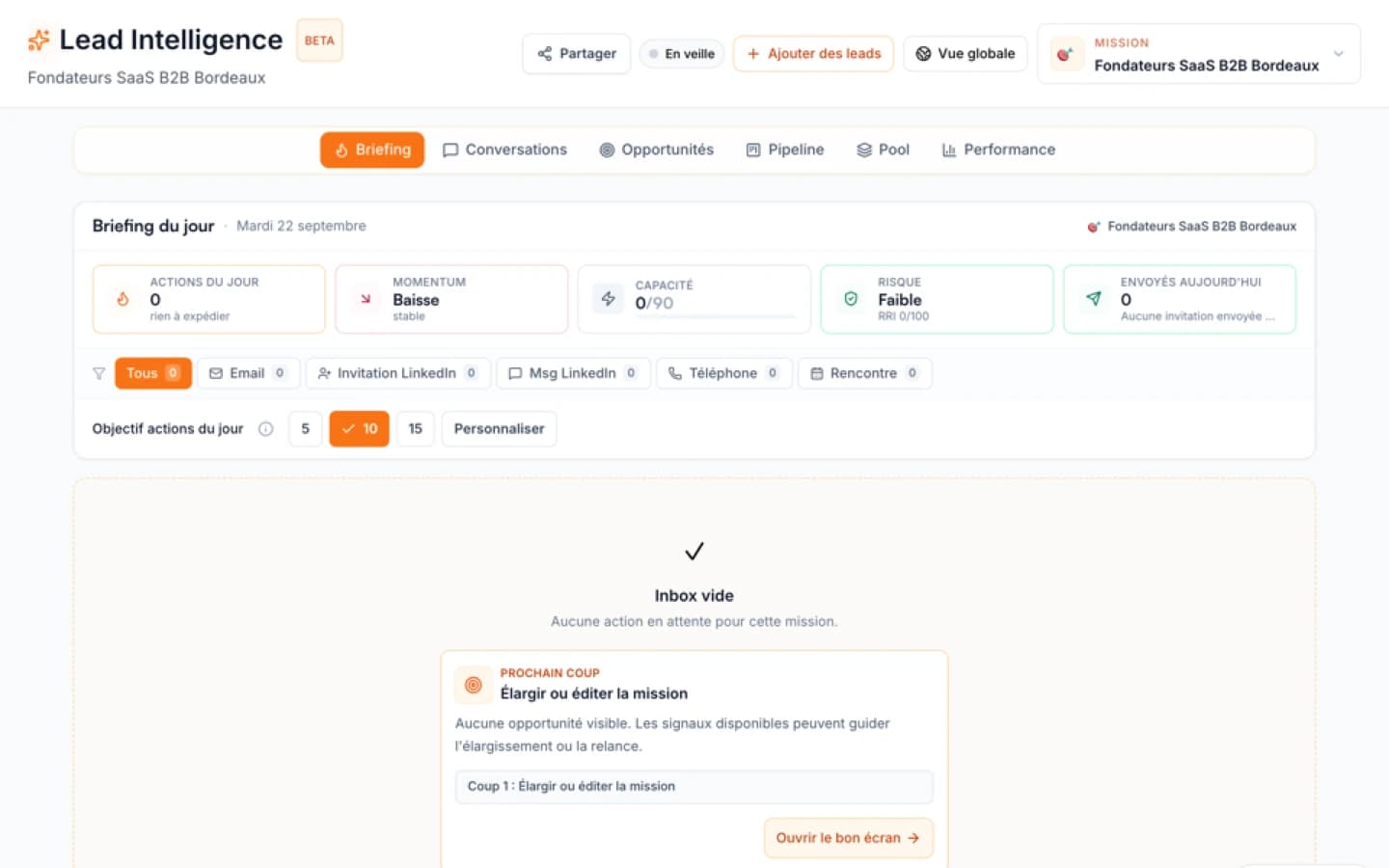
To break this cycle, founders need a system like Lead Intelligence, which reduces noise by focusing attention on opportunities that deserve action now. Instead of spending hours manually researching profiles or guessing which trigger events matter, you need to know who to contact, why now, and which action to take. By shifting from a volume-first mindset to a context-first approach, you can prioritise the conversations that deserve attention now. With a clear next action that defines who to contact, why now, which channel to use, and which angle to take, outbound sales stops being a numbers game and becomes a strategic, high-yield activity.
This approach also connects with How should a small B2B sales team qualify a lead in 2026 without a marketing team or customer relationship management (CRM)?, which clarifies the next choice.
How the mechanism works
For early-stage founders, the transition from manual, founder-led sales to structured outbound execution requires a shift from raw database scraping to context-driven engagement. Traditional platforms are highly effective when your primary goal is sheer volume. For example, Apollo has built a massive market presence, reaching an Annual Recurring Revenue (ARR) of $150 million dollars and a valuation of $1.6 billion dollars in 2023 as documented by Apollo (company history and Series D announcement). This scale allows them to offer extensive contact databases, though their unlimited plans remain subject to a Fair Use Policy that restricts email credits as detailed on the Apollo Pricing page. While massive databases excel at providing raw contact lists, they often introduce significant noise for a startup in its traction phase. Ember takes a different approach through Lead Intelligence, which reduces noise by focusing attention on opportunities that deserve action now. Instead of treating prospecting as an isolated database search, the mechanism connects your strategic foundation directly to your daily sales activity. The process begins by reusing the strategic context already established in your workspace, such as your Ideal Customer Profile (ICP), your core offer, and your business plan. By anchoring the search in this pre-validated strategy, the system avoids generic targeting. It discovers accounts based on specific ICP criteria and real-time market signals, verifying useful sources to ensure accuracy. Once the accounts are identified, the mechanism prioritizes the conversations that deserve attention now. It analyzes the gathered data to classify opportunities into clear, explained categories, showing you which accounts to watch, which to act on immediately, and which to set aside for later. This contextual prioritization ensures that you do not waste time on cold accounts that are not ready to buy. Ultimately, this workflow translates complex market signals into a clear next action. It enables founders and sales teams to know who to contact, why now, and which action to take. By defining the exact person, the channel and the angle that fit each prospect’s situation, the mechanism proposes the next action and the channel that fit the lead situation.
Concrete examples
To understand how this works in practice, consider an early-stage founder who has just launched a new Business-to-Business (B2B) software solution. In the traction phase, the temptation is often to buy access to a massive database and send thousands of automated emails. For a founder whose primary goal is sheer volume, established platforms are highly effective. For instance, Apollo has scaled to an Annual Recurring Revenue (ARR) of $150 million dollars and achieved a valuation of $1.6 billion dollars in 2023, having raised about $250 million to fuel its growth as reported by Apollo (company history and Series D announcement). However, these massive databases are built for raw scale, and their unlimited email credit plans are ultimately bound by a Fair Use Policy with specific credit limits, as detailed on the Apollo Pricing page. For an early-stage founder, this volume-first approach often creates more noise than actual traction. Instead of chasing thousands of cold contacts, the founder needs to know who to contact, why now, and which action to take. Imagine a founder using Lead Intelligence within Ember. Instead of starting with a generic list, the founder connects their existing Ideal Customer Profile (ICP) and business plan context. When using Ember, Ember's early-stage founder cohort saw their first prioritized leads appear in about 30 minutes once a usable targeting context was established, in line with the product specifications on the Ember Lead Intelligence page. Instead of a list of thousands of unverified names, Lead Intelligence reduces noise by focusing attention on opportunities that deserve action now. For example, the system might identify a specific target company that has just hired a new decision-maker or shifted its technology stack. This signal provides the critical reason for why to reach out at this exact moment. The founder is then presented with a clear next action: who to contact, why now, which channel to use, and which angle to take. Instead of writing a generic sales pitch, the founder can use the suggested angle to reference the prospect's specific situation. This ensures that every conversation is grounded in real context, helping the founder prioritize the conversations that deserve attention now and build meaningful traction without wasting time on low-intent volume.
In practice, Apollo vs Ember Lead Intelligence for Founder Conversion completes this framework with another angle on the same topic.
When to use this diagnosis
This diagnosis becomes essential when your outbound sales efforts produce more noise than actual customer conversations.
An incumbent platform like Apollo is highly effective when a startup needs immediate volume, a massive database of contacts, and rapid sequence automation to kickstart outbound activity. This volume-first approach has proven highly successful for larger organizations, helping Apollo scale to 150 million dollars in annual recurring revenue according to Apollo.
However, early-stage founders reach a clear turning point when credit-based pricing turns every single sales action into a metered decision. When exporting contacts, enriching records, and verifying emails each consume individual credits, the costs compound rapidly. As a small team scales, dealing with wasted exports, inaccurate data, and bounced emails quickly drains both budget and momentum, a common frustration highlighted by Factors.ai and also discussed by Coldreach.
You should use this diagnosis when you need to transition from raw database scraping to highly targeted, context-driven engagement. Instead of managing complex credit math and filtering through noisy lists, founders in the traction phase must focus their limited time on high-intent opportunities. The priority shifts from contact volume to relevance: knowing exactly who to contact, why now, and which action to take.
Ember addresses this transition directly through Lead Intelligence. By analyzing signals and company movements, Lead Intelligence helps you prioritize the conversations that deserve attention now, giving you a clear next action without requiring any minimum contact threshold to start.
When not to use it
There are specific scenarios where a context-driven approach is not the right choice for an early-stage founder. If your immediate priority is to build a massive, unsegmented pipeline through sheer volume, traditional database platforms are highly effective. For example, Apollo is an established, well-funded Software as a Service (SaaS) platform built for high-volume outbound execution. The company has raised about $250 million and reached an Annual Recurring Revenue (ARR) of $150 million dollars, with a valuation of $1.6 billion dollars in 2023 (company history and Series D announcement). For a sales manager or a speed-focused founder who needs immediate database access, Chrome extension scraping, and rapid sequence automation to generate activity on day one, such a platform is a strong fit. Even though their unlimited plans are subject to a Fair Use Policy with specific credit limits (source), they excel at delivering raw contact volume. Ember Lead Intelligence is not built for untargeted, high-volume email blasting. If your Business-to-Business (B2B) startup does not require deep personalization, or if you do not need to know who to contact, why now, and which action to take, a generic database is sufficient. Ember is designed to reduce noise by focusing attention on opportunities that deserve action now. If your sales strategy does not value contextual prioritization, or if you prefer to send automated messages without evaluating the specific angle and channel for each prospect, a traditional volume-first tool will better serve your current setup.
Before deciding, Which signals should alert a bootstrapped founder? helps connect this method with adjacent priorities.
Next step
For an early-stage founder navigating the traction phase, the critical challenge is no longer just finding names, but identifying the right moment and the right message for each prospect. While established database platforms like Apollo, which has raised about $250 million and achieved an Annual Recurring Revenue (ARR) of $150 million dollars with a valuation of $1.6 billion dollars in 2023 according to Apollo (company history and Series D announcement), are highly effective for sheer volume, they often generate more noise than actual customer conversations. To scale efficiently without wasting limited resources, the next logical step is to transition from raw list-building to context-driven prioritization. This means moving away from generic email blasts and adopting a system that helps you know who to contact, why now, and which action to take. By leveraging Lead Intelligence within Ember, founders can replace guesswork with clarity. The platform analyzes your target market and provides a clear next action, showing you who to contact, why now, which channel to use, and which angle to take, as detailed on the Ember Lead Intelligence page. Instead of static templates, it proposes the next action and channel that fit the lead situation, ensuring your outreach is always relevant and timely. This allows you to focus your energy on high-potential opportunities, turning cold data into active, high-value business conversations.
Sources and methodology
To ensure the accuracy and reliability of our analysis for early-stage founders, we rely on a structured research process that combines first-party product capabilities with verified external data. Our analysis of market incumbents is grounded in public financial and operational data. For instance, Apollo is documented as a well-funded Software as a Service (SaaS) platform that has raised about $250 million and achieved an Annual Recurring Revenue (ARR) of $150 million dollars with a valuation of $1.6 billion dollars in 2023 as reported by Apollo (company history and Series D announcement). Additionally, details regarding their unlimited email plans and credit limits are verified directly from the official Apollo Pricing Page, which outlines their Fair Use Policy. We also reference educational resources regarding startup funding phases, such as insights shared on Instagram.
Sources
FAQ
Free diagnostic
Test your sales file
Drop an Excel or CSV and check its readiness without sending its rows to Ember.