
Symptom or signal
Early stage bootstrapped founders frequently hit a wall when trying to scale their outbound sales. The core problem is not a lack of people to reach out to, but rather the difficulty of identifying who to contact, why now, and with what message. Without this clarity, founders spend valuable hours sending generic messages that fail to convert, wasting precious runway on low yield activities. Many founders turn to established market leaders for help. For instance, Apollo is a highly capable sales intelligence and engagement platform built around a massive database of business to business (B2B) contacts, email sequences, and prospecting workflows. It is an excellent choice for speed focused founders or sales managers who need immediate volume, a Chrome extension for rapid prospecting, and automated sequences that can launch outbound activity on day one. Apollo offers contact discovery and outbound sequences, as described on its official site. Yet, for a bootstrapped team, this volume first approach can quickly turn into overwhelming noise. Managing large databases requires significant manual filtering, and even unlimited plans are subject to a fair use policy that frames unlimited email credits with specific credit limits, as shown on the Apollo Pricing Page. When a founder is forced to sift through hundreds of cold profiles without clear context, they lose hours trying to figure out the right timing and angle for each lead. To break through this noise, early stage founders need a way to prioritize the conversations that deserve attention immediately. This is why Ember developed Lead Intelligence, which helps founders and sales teams prioritize opportunities using their specific project context. Instead of managing massive, unfiltered lists, Lead Intelligence reduces noise by focusing attention on opportunities that deserve action now. By aligning outreach with signals researched for the mission, it proposes the next action and channel that fit the lead situation, allowing founders to know who to contact, why now, and which action to take with the perfect angle.
To place this decision in context, the Knowledge guides for founders brings together deeper guidance on the same field.
What changed
A founder paying for prospecting tools should compare their cost with the value of the contacts actually used. Apollo offers a free plan and paid plans with different credit allowances; the current Apollo pricing page gives the applicable terms. A small team can start by defining whom it wants to reach and why, then buy or use data only where the conversation has a clear purpose.
Facts and sources
Apollo's pricing page describes its plans and credit terms. The Lead Intelligence page describes research and prioritization from a sales mission's target profile and signals. Neither tool can prove a prospect's need from a contact list alone; check the source and context before outreach.
The How to decide who to contact, why now, and what to say covers the next decision.
Why the common explanation is incomplete
The common explanation for why early stage bootstrapped founders struggle with outbound sales is that they simply lack a large enough list of contacts or are not sending enough emails. This perspective assumes that outbound prospecting is purely a numbers game. According to this logic, if a founder is not getting replies, they just need to buy a larger database, write a generic sequence, and increase their daily sending volume.
This explanation is fundamentally incomplete because it mistakes a lack of volume for a lack of relevance. For early stage startup founders, the primary barrier to outbound success is not finding people to email, but rather identifying exactly who to contact, why now, and with what message. When founders rely solely on massive databases, they end up drowning in noise. Traditional sales intelligence platforms can be effective for established sales teams, but a founder should first test whether the selected contacts have a relevant reason to talk.
The real problem
For early stage bootstrapped founders, the primary obstacle to successful outbound sales is not a lack of contacts, but the compounding noise of untargeted outreach. Traditional Business to Business (B2B) prospecting platforms are built for scale, which works well for established sales teams with dedicated resources. Apollo provides contact discovery and outbound sequences for teams that need this workflow. For organizations that need immediate volume and a massive database of contacts, such platforms are highly effective.
However, for a bootstrapped founder who must personally handle sales alongside product development and operations, this volume first approach introduces three critical problems that prevent them from knowing who to contact, why to contact them now, and what message to send.
First, raw volume creates overwhelming noise. When founders rely on massive lists, they lose the ability to personalize. They cannot easily distinguish between a cold lead and an active opportunity. This lack of prioritization leads to generic outreach that fails to convert, wasting the founder's limited time.
Second, data acquisition is restricted by hidden constraints and cost structures. Even when platforms offer seemingly unrestricted access, limitations persist. For example, unlimited email credits on Apollo remain subject to a Fair Use Policy with specific credit limits, as documented on the Apollo Pricing Page. For a bootstrapped startup, navigating these limits without a clear prioritization strategy means wasting valuable credits on low quality contacts.
Third, static databases lack timing and context. A standard contact list does not reveal the real time changes within a target company. Without active signal monitoring, a founder cannot identify the trigger events that answer the question of why now. Consequently, outreach is often poorly timed, arriving when the prospect has no active need, which ultimately damages the sender's reputation and conversion rates.
This approach also connects with Lead Intelligence for bootstrapped founders: who and why now, which clarifies the next choice.
How the mechanism works
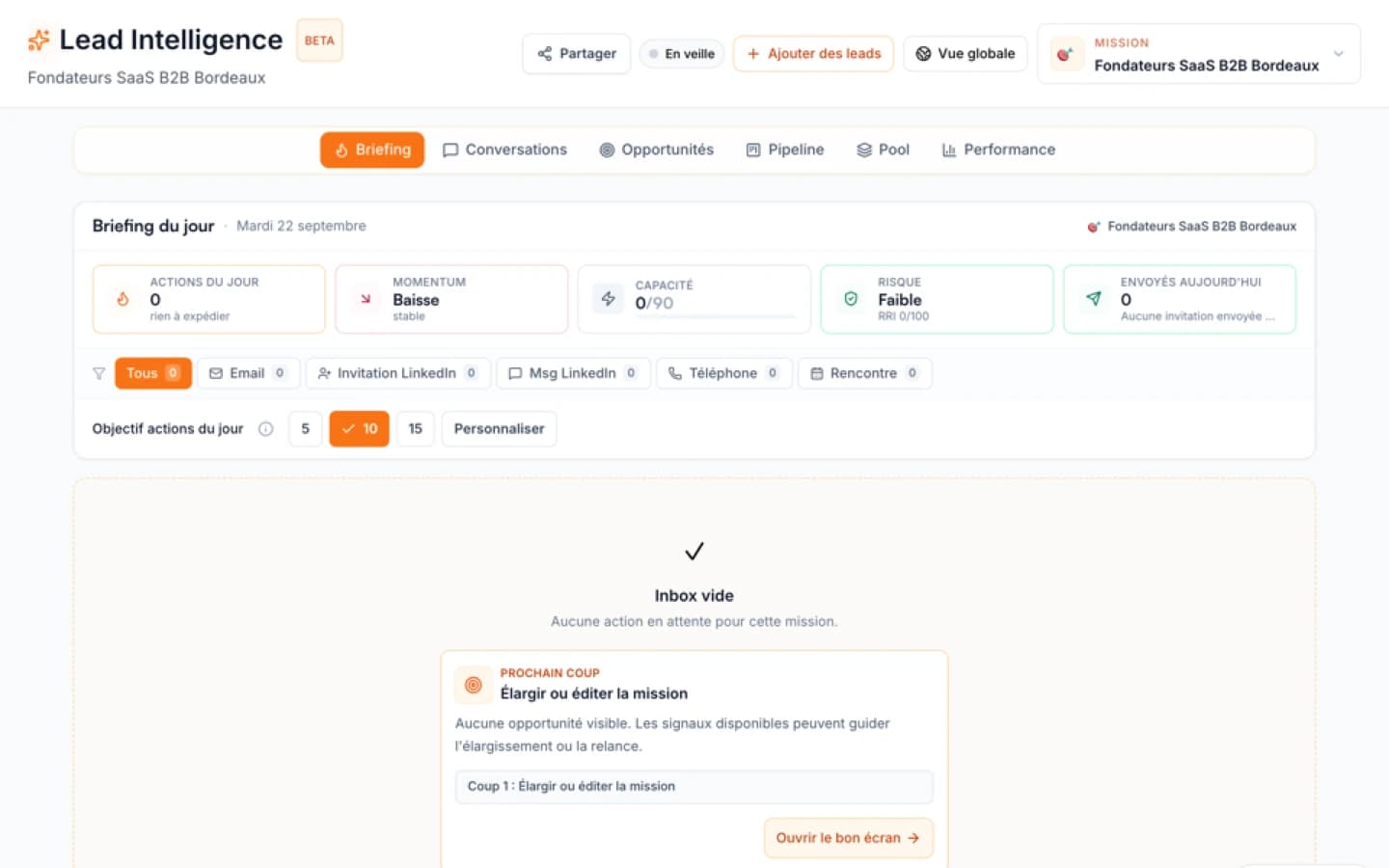
To solve the fundamental challenge of identifying high-value opportunities without wasting scarce resources, the mechanism must shift from raw volume to deep contextual relevance. Traditional platforms focus heavily on database size. For example, Apollo offers a large contact database and outbound sequences, as described on its official site. This massive scale is highly attractive to sales managers or speed-focused founders who want immediate volume, a large Business to Business (B2B) contact database, and automated email sequences. However, this volume-first approach often introduces significant noise, and even unlimited email plans remain subject to a fair use policy with email credit limits, as detailed on the Apollo pricing page. For a bootstrapped founder, managing this noise manually is a major operational bottleneck. Ember solves this problem by replacing generic list-building with Lead Intelligence, an agentic experience designed to prioritize the conversations that deserve attention now. Instead of requiring founders to sift through thousands of cold profiles, the system uses the founder's specific project context to analyze and filter opportunities. This approach reduces noise by focusing attention on opportunities that deserve action now, ensuring that early-stage founders can easily know who to contact, why now, and which action to take. The workflow operates rapidly. With usable targeting context, the first prioritized leads can appear in about 30 minutes. Once these opportunities are identified, the system does not just hand over a list of names. It proposes the next action and channel that fit the lead situation, providing a clear next action that details who to contact, why now, which channel, and which angle to use. This ensures that every outreach effort is grounded in real context rather than generic, high-volume templates.
Concrete examples
Consider a bootstrapped founder launching a new Business to Business (B2B) software service. In the early stages, the founder often falls into the trap of chasing raw volume. They might license a broad database tool like Apollo, an established contact discovery platform. While this massive data operation is highly effective for large sales departments, a solo founder quickly faces friction. For instance, even the unlimited plans on such platforms are subject to a fair use policy that limits email credits (source). More importantly, the founder is left with a list of thousands of names but no guidance on who is actually ready to buy, resulting in hours wasted on generic emails that get ignored. A different scenario unfolds when the founder focuses on opportunity readiness. Instead of exporting massive lists, the founder needs to know who to contact, why now, and which action to take. By using Lead Intelligence, the founder can avoid the noise of untargeted outreach. The system reduces noise by focusing attention on opportunities that deserve action now. With usable targeting context, the first prioritized leads can appear in about 30 minutes, meaning the founder does not have to wait days to start meaningful conversations. This approach provides a clear next action by showing exactly who to contact, why now, which channel to use, and which angle to take. The system proposes the next action and channel that fit the lead situation, allowing the founder to prioritize the conversations that deserve attention now. This ensures that every message sent is highly relevant to the recipient's current situation. Furthermore, for a bootstrapped company, sales efforts must align with overall business planning. When evaluating how to finance development, the founder can use Fund Your Growth, which replaces a generic list of options with a funding path coherent with the project. This strategic alignment ensures that the founder's commercial outreach and funding milestones work together, allowing them to build a sustainable business without wasting valuable time or capital.
In practice, How to build a B2B prospect list with zero customers and no brand completes this framework with another angle on the same topic.
When to use this diagnosis
Early-stage founders face a unique set of hurdles when trying to establish their initial go-to-market motion. According to research on overcoming common challenges for early-stage startup founders, these entrepreneurs must navigate intense pressure around funding, team building, and product development while maintaining operational resilience (Peachscore). In this high-stakes environment, wasting time and capital on inefficient outbound sales is a critical risk that can derail an otherwise promising venture.
The primary obstacle preventing a bootstrapped founder from identifying who to contact, why now, and with what message is the friction of traditional database tools. Many platforms use credits for contact data and other actions. Use this diagnosis when the time and cost of building large lists exceed the value of the conversations they produce. Review a small set of relevant contacts first.
When not to use it
For an early stage bootstrapped founder, diving straight into high volume outbound databases is often a misstep. This raw volume approach is not suitable when the founder has not yet locked in a precise Ideal Customer Profile (ICP). Without a validated targeting context, importing thousands of cold contacts simply generates overwhelming noise and risks burning the startup domain reputation before the product even finds its footing. Legacy platforms are built to support massive, broad scale operations. For example, Apollo has scaled aggressively to serve large sales teams, offering contact search and outbound sequences. However, this high volume model is not designed for the highly personalized, relationship driven outreach that early stage founders require. Even when these platforms offer unlimited plans, those plans remain subject to a strict fair use policy with specific email credit limits, as outlined on the Apollo pricing page. A bootstrapped founder should avoid these massive database exports when they do not have the internal sales resources to clean, verify, and manually follow up with hundreds of generic leads. When resources are scarce, the priority must be to reduce noise by focusing attention on opportunities that deserve action now. Instead of chasing raw volume, founders need a clear next action that tells them who to contact, why now, which channel to use, and which angle to take. If a founder cannot yet define the specific business signals that make a prospect ready to buy, launching a broad, untargeted campaign will only waste time and capital.
Before deciding, B2B prospecting list: target a job title, not a company size helps connect this method with adjacent priorities.
Next step
For an early stage bootstrapped founder, the primary obstacle to successful outreach is not a lack of contacts, but a lack of actionable context. When trying to determine who to contact, why now, and with what message, founders frequently run into structural barriers that stall their go-to-market momentum.
First, founders often default to raw volume, purchasing access to massive, static databases. However, high volume outbound tactics quickly lead to diminishing returns. Even when tools offer seemingly unrestricted access, their terms are restricted, such as the email limits governed by fair use policies outlined on the Apollo Pricing Page. This leaves the entrepreneur with thousands of cold rows but no indication of who is actually ready to buy.
Second, early stage founders operate under extreme resource constraints. As highlighted in the University of Cincinnati Guide on navigating common startup challenges, managing limited time and capital requires extreme prioritization. Without a system to filter the noise, founders waste hours crafting generic messages to accounts that have no immediate need, rather than focusing on high-intent opportunities.
To overcome these hurdles, founders must transition from generic list building to targeted, context-driven engagement. Through Lead Intelligence, Ember addresses this exact challenge by analyzing your business context to deliver a clear next action. By identifying who to contact, why now, which channel to use, and which specific angle to take, as detailed on the Lead Intelligence product page, the platform ensures your outreach is always relevant. Instead of guessing, Lead Intelligence proposes the next action and channel that fit the lead situation, allowing bootstrapped teams to execute highly personalized campaigns that convert.
Sources and methodology
This guide uses Apollo's current pricing information for the distinction between plans and credits, and the Lead Intelligence page for mission research and prioritization. Prices and allowances can change, so compare the current plan with the small number of contacts you intend to use. The worked examples are illustrative and require verification before a message is sent.
Sources
FAQ
Free diagnostic
Test your sales file
Drop an Excel or CSV and check its readiness without sending its rows to Ember.