
Symptom or signal
Many early stage founders enter the startup ecosystem believing they must sprint at an unsustainable pace to achieve rapid success. This high pressure environment often leads to premature burnout, severely shortening the professional lifespan of the entrepreneur. The constant anxiety of chasing unverified leads and managing fragmented strategies drains a founder's vital energy, making the journey feel like a race against physical and mental exhaustion.
However, the signals of actual entrepreneurial longevity paint a very different picture. True success is a marathon built on experience and strategic pacing rather than youthful exhaustion. For example, the average age of a successful startup founder is actually 45, according to the Harvard Business Review study reported by Entrepreneur. This shows that the founders who survive and thrive are those who learn to preserve their stamina.
To extend your professional lifespan as a founder, you must eliminate the daily friction that causes operational fatigue. Instead of wasting energy on manual, noisy tasks, successful leaders rely on targeted systems to protect their focus. By filtering out the noise and identifying exactly who to contact and why, you can transform a chaotic daily grind into a sustainable, long term growth strategy.
To place this decision in context, the Knowledge guides for founders brings together deeper guidance on the same field.
What changed
The traditional narrative of entrepreneurship celebrated the young, sleep-deprived founder sprinting to an early exit. This unsustainable pace often shortened the professional lifespan of entrepreneurs, leading to premature burnout before their businesses could mature. What has changed is a fundamental shift in how we view both the timeline of success and the daily execution of growth.
Data has increasingly challenged the stereotype of the teenage prodigy. The average age of a successful startup founder is actually 45, according to the Harvard Business Review study reported by Entrepreneur. This reality proves that building a viable company is a marathon that requires endurance, experience, and structured decision-making rather than frantic, unguided effort.
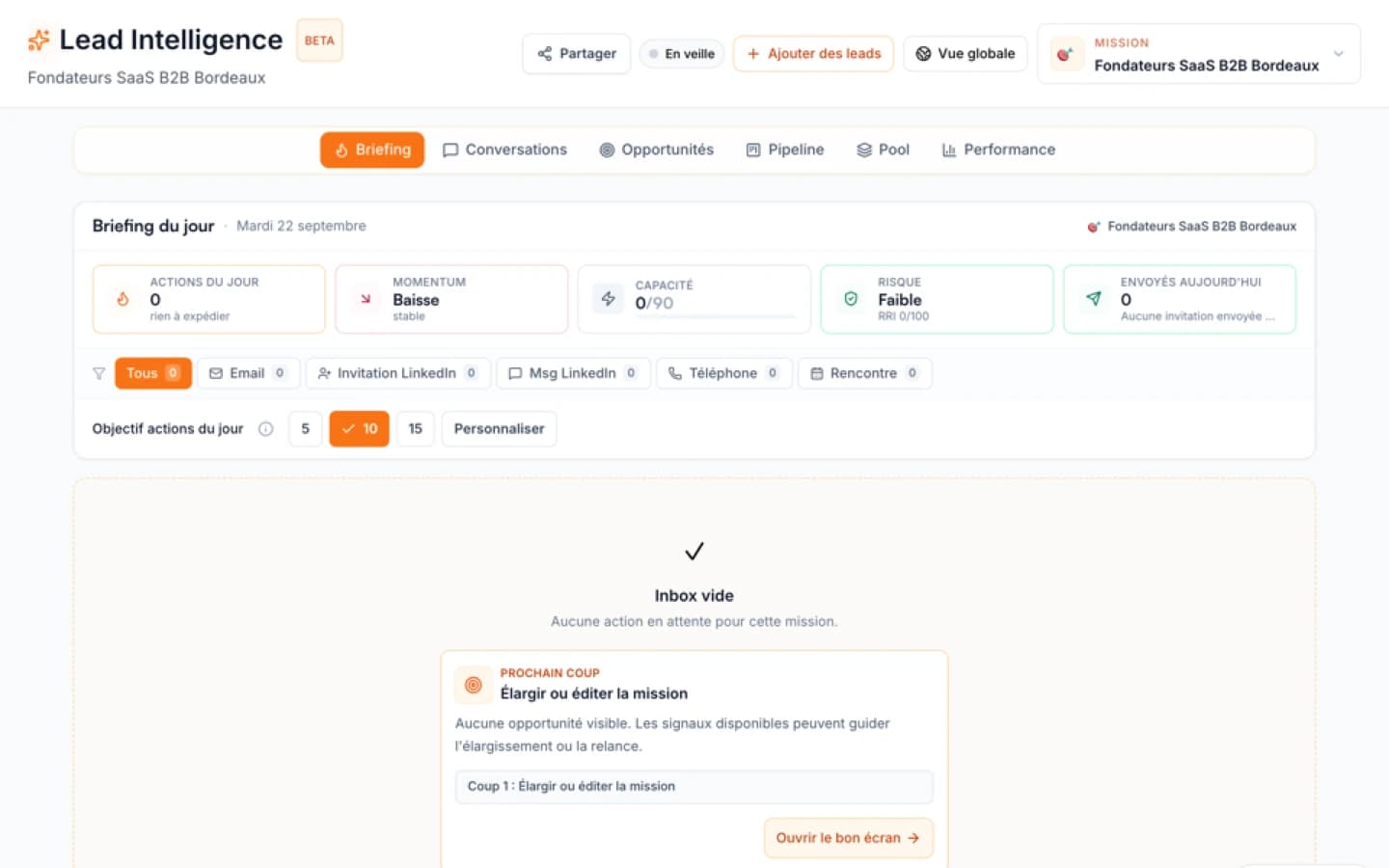
To support this longer professional life expectancy, the tools available to early-stage founders have evolved. Instead of wasting energy on manual, noisy prospecting that drains morale, modern systems allow teams to preserve their cognitive load. For instance, Lead Intelligence helps founders and sales teams prioritize opportunities with their context, reducing noise by focusing attention on opportunities that deserve action now. By providing a clear next action, including who to contact, why now, which channel, and which angle, technology helps founders transition from chaotic survival mode to structured, sustainable growth. This shift ensures that the entrepreneur's energy is spent where it matters most, extending their professional lifespan and increasing their chances of long-term success.
Facts and sources
While popular culture often celebrates the myth of the ultra-young entrepreneur sprinting toward an early exit, the reality of business longevity is quite different. Data indicates that the average age of a successful startup founder is actually 45, according to the Harvard Business Review study reported by Entrepreneur. Reaching this peak age of entrepreneurial success requires maintaining a sustainable professional lifespan and avoiding premature burnout caused by operational noise.
Many early-stage founders shorten their professional lifespan by spending valuable energy on complex data engineering. For instance, some teams turn to highly customizable platforms to manage their outbound operations. Clay describes itself as infrastructure to get data, run agentic workflows and launch go-to-market plays, with data bought from more than 200 providers (Clay). However, this approach requires significant technical bandwidth to design and maintain those workflows, which can quickly exhaust a small team.
Other founders rely on broad database providers to fuel their sales pipelines. For example, Apollo describes itself as an AI-driven go-to-market system, with 240 million contacts and 30 million companies, a parallel dialer and a Chrome extension (Apollo). Yet, this setup introduces its own stressors. Credit-based pricing makes some actions a measured decision: at Apollo, an export credit is consumed each time a contact is exported outside Apollo, according to Apollo's pricing page.
To protect their mental energy and extend their professional lifespan, founders must shift from high-volume noise to high-intent focus. Ember addresses this challenge by reducing noise and focusing attention on opportunities that deserve action immediately. Through Lead Intelligence, the platform finds accounts from the mission Ideal Customer Profile (ICP) and real-time signals, then verifies useful sources, as detailed in the Ember Lead Intelligence documentation. This allows founders and sales teams to know exactly who to contact, why now, and which action to take without wasting their vital cognitive resources on manual data orchestration.
To explore this point further, Apollo vs Ember Lead Intelligence for Founder Conversion details a step directly related to this decision.
Why the common explanation is incomplete
The standard narrative suggests that an entrepreneur's professional lifespan is determined solely by personal resilience and the ability to withstand relentless stress. This perspective is incomplete because it ignores how operational inefficiency directly drains a founder's limited cognitive and emotional reserves. Survival in the early stages is not merely a test of physical endurance, it is a challenge of resource preservation.
When founders spend their days chasing unverified leads, managing disorganized data, and guessing their next strategic move, they accelerate their own professional exhaustion. This is why the myth of the young founder sprinting to success is misleading. In reality, experience and structured decision-making are far more protective. For example, the average age of a successful startup founder is 45, according to the Harvard Business Review study reported by Entrepreneur. This maturity reflects the value of working with precision rather than relying on raw, unstructured effort.
To extend their professional life expectancy, early stage founders must transition from high-volume noise to high-intent action. Burnout is rarely caused by hard work alone. It is caused by the deep frustration of invisible progress, where hours of outreach yield no meaningful feedback. By focusing energy only on the opportunities that genuinely deserve attention, founders can preserve their stamina for the long journey of building a company.
The real problem
The true threat to an entrepreneur's professional lifespan is not the market or the product, but the sheer volume of operational noise that leads to cognitive exhaustion. For an early-stage founder, survival depends on maintaining focus, yet traditional business-to-business (B2B) sales workflows are designed to do the exact opposite. They demand high-volume outreach, forcing founders to act as database administrators rather than strategic leaders.
This volume-oriented approach, typical of traditional sales engagement platforms, encourages founders to build massive lists from large contact databases and run repetitive outreach sequences. The underlying issue is that this model relies entirely on credit consumption. This credit-based pricing transforms every single sales action into a stressful, measured decision, where exporting contacts, enriching records, and verifying emails constantly deplete resources; at Apollo, for example, an export credit is consumed each time a contact is exported outside the platform (Apollo's pricing page). Instead of building authentic relationships, founders find themselves managing spreadsheets, calculating credit costs, and chasing cold leads that have no immediate readiness to buy.
This operational drag is the real killer of early-stage startups. When founders spend their limited energy on manual data cleaning and noisy outbound campaigns, they accelerate their own burnout. To extend their professional lifespan and protect their mental stamina, entrepreneurs must transition from volume-based noise to high-context priority. Survival requires focusing strictly on opportunities that deserve action now, guided by a clear understanding of who to contact, why now, which channel to use, and what specific angle to take. By making priority explainable through real-world signals and opportunity readiness, founders can eliminate administrative waste and focus their energy where it actually converts.
This approach also connects with What to Look For When Hiring a B2B Lead Generation Agency in 2026?, which clarifies the next choice.
How the mechanism works
opposite of what is needed for long-term survival. The traditional approach to business development forces founders to act as manual data miners, spending hours filtering lists and guessing which prospects are actually ready to engage. Established platforms are highly effective for certain workflows. For example, Apollo claims 240 million contacts and 30 million companies in its database (Apollo). This scale makes it an excellent choice for larger sales teams that need a massive database and a suite of outbound channels to run high-volume campaigns. Yet, for an early-stage founder, managing these massive databases often introduces more noise than clarity, accelerating the cognitive fatigue that shortens their professional lifespan.
Ember changes this dynamic by replacing manual database management with an intelligent, context-driven process. Through Lead Intelligence, the platform reduces noise by focusing attention on opportunities that deserve action now. Instead of forcing the founder to analyze hundreds of raw profiles, the system evaluates signals and context to provide a clear next action, showing exactly who to contact, why now, which channel to use, and which angle to take. By automating the heavy lifting of discovery and prioritization, Ember allows founders to spend their limited energy on meaningful conversations rather than administrative noise, directly protecting their most valuable asset which is their operational stamina.
Concrete examples
Consider two contrasting paths an early-stage founder can take when managing business development, both of which directly impact their operational endurance and professional lifespan.
In the first scenario, a founder takes the traditional high-volume route. They spend hours manually mining databases, filtering cold lists, and guessing which prospects might have a vague interest in their offer. While large-scale platforms are highly effective for broad database coverage and running automated outbound sequences, they often flood a small team with raw data. The founder ends up chasing hundreds of cold leads, resulting in severe cognitive fatigue and premature operational burnout. This exhausting grind explains why many founders struggle to reach the maturity required for long-term success, especially considering that the average age of a successful startup founder is actually 45, according to the Harvard Business Review study reported by Entrepreneur.
In the second scenario, the founder prioritizes cognitive conservation by working with deep context. Instead of building generic lists from scratch, they reuse their validated Business Plan, Ideal Customer Profile (ICP), offer, and strategy to launch a highly targeted sales mission. By aligning outbound efforts with existing strategic context, Ember helps the founder identify exactly who to contact, why now, and which action to take. This approach reduces operational noise by focusing limited attention on the specific opportunities that deserve immediate action.
By making the priority explainable from context, real-time signals, and opportunity readiness, the founder no longer wastes energy on blind outreach. They receive a clear next action, including the most appropriate channel and communication angle for each prospect. This method also makes the actual value produced by the mission immediately visible, showing the contacts analyzed, signals detected, and priority actions recorded. Instead of burning out on administrative noise, the founder preserves their energy for high-value decisions, extending their professional lifespan and keeping their startup on a sustainable path to growth.
In practice, What Evidence Should a B2B Founder Verify Before Choosing Lead Intelligence over High-Volume Prospecting? completes this framework with another angle on the same topic.
When to use this diagnosis
This diagnostic approach is most valuable when an early-stage founder reaches a tipping point where operational noise begins to compromise strategic decision-making. Specifically, you should apply this diagnosis when your daily routine is dominated by manual list building and cold outreach rather than product development or customer conversations. When business development starts to feel like a repetitive data-entry job, it is a clear signal that your professional endurance is at risk.
Another critical moment to use this diagnosis is when you find yourself constrained by volume-centric sales tools. Traditional platforms often operate on credit-based pricing, which turns every contact export, record enrichment, and email verification into a metered financial decision. This model can penalize early-stage teams as wasted exports and bounced emails compound costs. If your team is spending more time calculating credit budgets than refining your Ideal Customer Profile (ICP), it is time to shift from a volume-first mindset to a priority-first workflow.
Finally, this diagnosis is essential when you need to establish a clear, repeatable path to market without burning out your core team. Instead of guessing which prospects might be interested, you need to know exactly who to contact, why now, and which action to take. By focusing on high-conviction opportunities that show actual readiness, you protect your cognitive capacity and extend your operational lifespan. This is precisely why Ember built Lead Intelligence, which helps founders and sales teams prioritize the conversations that deserve attention now, transforming raw market signals into actionable next steps.
When not to use it
Conversely, this highly targeted, signal-driven approach is not suitable for every business model or stage of growth. You should not focus on narrow, high-conviction prioritization if your primary commercial strategy relies on raw, undifferentiated market volume.
If your startup has already raised significant capital and is building a large, multi-tiered outbound sales department, your operational needs differ. In those environments, sales representatives often require a massive, continuous stream of cold contacts to feed automated dialers and high-volume email sequences. Traditional databases are built precisely for this type of broad-brush outbound activity. For these organizations, the operational friction of credit-based pricing is simply treated as a standard cost of doing business. However, for smaller teams, this friction is real. If your organization has the budget to absorb these costs without strategic strain, you do not need to restrict your team to highly prioritized, signal-rich opportunities.
Before deciding, How to Find Clients Quickly as an Early-Stage Founder? helps connect this method with adjacent priorities.
Next step
To protect your professional endurance and extend your operational life expectancy as a founder, you must stop treating every business challenge as a manual brute force exercise. The transition from survival to sustainable growth requires shifting your daily energy toward structured, high-leverage decisions. Ember helps understand a changing context, choose the next priority, and take action, ensuring that your limited time is spent only where it delivers the highest strategic return.
If your immediate hurdle is securing capital to extend your runway, you can use Ember to build the Business Plan, choose a funding strategy, and plan the next steps. Through the Fund Your Growth capability, the system analyzes your project documents to identify structural weaknesses, turning gaps in the file into prioritized next actions. You remain fully in control of your strategy, as the entrepreneur can approve, reject, or edit proposals before they enter the file.
If your primary bottleneck is commercial traction, continuing to guess which prospects to target will quickly exhaust your resources. Instead, Lead Intelligence provides a clear next action by identifying who to contact, why now, which channel, and which angle. This targeted approach proposes the next action and channel that fit the lead situation, allowing you to focus your energy on high-conviction conversations rather than administrative noise. For broader strategic guidance, Second Brain is available to turn your existing project context into clearer explanations and next actions, helping you navigate complex operational trade-offs without losing momentum.
Sources and methodology
To understand the factors that dictate the professional lifespan and operational endurance of early-stage founders, we analyze both demographic benchmarks and workflow efficiency models. According to the Harvard Business Review study reported by Entrepreneur, the average age of a successful startup founder is 45, for high-tech startups in the top 0.1% of growth over five years.
This maturity curve suggests that long-term survival relies on strategic resource allocation rather than brute-force execution. We contrast these findings with modern data-orchestration methodologies. For example, Clay describes itself as infrastructure to get data and run agentic workflows (Clay).
However, for smaller teams, managing these complex pipelines manually can accelerate operational burnout. Our methodology evaluates how founders can transition from manual data mining to automated prioritization. By leveraging systems like Ember, which features Lead Intelligence to find accounts from a defined Ideal Customer Profile (ICP) and verify useful sources, founders can protect their cognitive bandwidth and extend their professional lifespan.
Sources
FAQ
Free diagnostic
Test your sales file
Drop an Excel or CSV and check its readiness without sending its rows to Ember.