
Symptom or signal
You run an SME or an early-stage company, you have spotted a B2B opportunity, but you hesitate between several business models. You read lists of "models that work in 2026", you browse comparisons, yet nothing tells you whether your specific project is fundable. The signal is clear: you are searching for a decision framework, not another list.
To place this decision in context, the Knowledge guides for finance brings together deeper guidance on the same field.
What changed
In 2026, capital concentrates instead of spreading out. According to Crunchbase's annual recap as reported by Venture Capital Journal, global funding to AI-related companies reached 203 billion dollars in 2025, up 75% year over year source. At the same time, Carta data shows median seed valuations climbing (16 million dollars pre-money in Q3 2025, up 14% year over year) while the number of rounds shrinks source. The practical translation for a founder: fewer deals get funded, rounds are larger, and investors demand evidence of traction and defensibility before committing. Generic models with no differentiation (commodity e-commerce, interchangeable low-cost services) are the first ones screened out.
Facts and sources
- Crunchbase, 2025 venture recap: global funding to AI-related companies reached 203 billion dollars in 2025, up 75% year over year source. Capital is polarising: projects with no credible technology angle and no defensible niche compete for a shrinking share.
- Carta, State of Private Markets (Q3 2025): the median pre-money valuation on new seed rounds hit a record 16 million dollars, up 14% year over year, while deal volume contracted source. The bar rises for every individual deal: rounds are won on the quality of evidence, not on promises.
- Forbes: among the B2B ideas rated as having strong earning potential are applied AI consulting, vertical niche SaaS and specialised B2B marketplaces source. What these models share is an advantage that is hard to copy (expertise, data, network), not just a pricing position.
These three sources converge: what makes a B2B model fundable in 2026 is not its category (SaaS, services, marketplace) but the combination of measurable traction, a defensible advantage and a coherent case.
To explore this point further, What does a capital-efficient seed round look like in practice, and how small can the round actually be? A practical guide details a step directly related to this decision.
Why the common explanation is incomplete
Lists of "best B2B models for 2026" share a major flaw: they ignore your context. Your industry, your team, your existing traction, your financial constraints all make a generic recommendation of limited use. A model that works for a SaaS startup is not necessarily suited to an industrial SME. And the same category can hide opposite realities: two SaaS businesses can have radically different funding prospects depending on their margins, retention and acquisition costs. The common explanation gives you options, but no method to choose yours.
The real problem
The real problem is not picking a model from a list; it is building a coherent funding case that connects your assumptions, the evidence you already have, and the actions needed to close the gaps. Without that coherence, you risk presenting a fragile project to investors who have become far more selective. The question is not "which model?" but "how do I build a funding strategy I can defend?".
This approach also connects with What is the startup success rate? A practical decision guide, which clarifies the next choice.
How the mechanism works
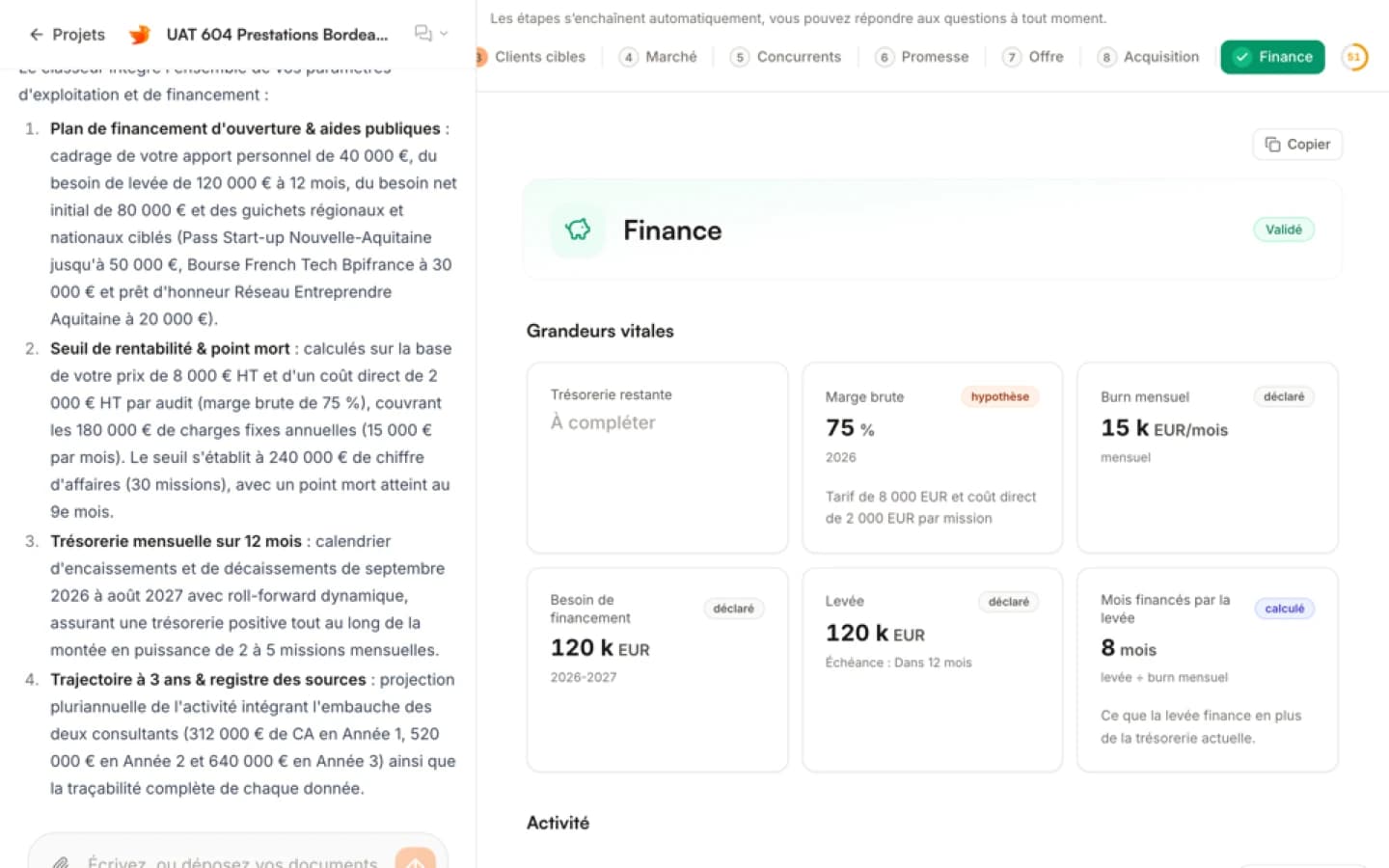
Ember's Fund Your Growth addresses this need. It does not merely list funding options. It uses your project context (business plan, financial data, documents) to identify the assumptions to validate, the evidence available, and the weak points. It then structures a coherent funding path: equity round, loan, grant, or a combination. The result is a strategy ready to be defended, with prioritised actions. Final decisions remain yours: the tool organises information and makes gaps visible, it does not replace your judgement or your advisors'.
In practice, How do you structure a B2B pitch deck so the investor or buyer makes a decision in the room, not after?: a practical guide? completes this framework with another angle on the same topic.
Concrete examples
Typical case 1: a B2B SaaS with early traction. A founder has a list of potential investors but no plan to convince them. Structuring the case reveals that retention is solid but customer acquisition cost is documented nowhere, which is exactly the evidence a seed fund will ask for. The priority is therefore not to grow the investor list, but to produce that missing proof before requesting meetings.
Typical case 2: a services SME with a subscription model. The owner hesitates between raising equity and taking a bank loan. Once the numbers are laid out (existing recurring revenue, limited funding need, no appetite for dilution), a structured comparison often surfaces non-dilutive funding (loan, grant) as the path most consistent with that stage. The value of the diagnosis is ruling out incompatible paths early, before spending months on them.
When to use this diagnosis
Use this diagnosis when you already have a B2B project, some initial traction, and you must choose a funding strategy. It is useful when you want to move past the list-of-options stage and get a coherent plan adapted to your context.
Before deciding, What is the profitability of investing in a startup? A practical decision guide helps connect this method with adjacent priorities.
When not to use it
If you are still at the pure brainstorming stage, with no context at all (numbers, team, market), a spreadsheet or a generalist guide may be enough. Ember's approach is more relevant once you have data to structure and a strategic decision to make.
Next step
If you have a B2B project and want to build a coherent funding strategy, try Fund Your Growth. It is free to start, and you will see how assumptions, evidence and actions connect into one defensible case.
Sources and methodology
This article relies on three external sources: Crunchbase's 2025 global venture recap as reported by Venture Capital Journal, Carta's State of Private Markets data (Q3 2025) on seed valuations and volumes, and a Forbes article listing high-potential B2B ideas. Every figure is attributed to its source inline. Ember product information comes from the official public product context; the examples are typical scenarios, not customer testimonials.
| Criteria | A simple list of options | Ember |
|---|---|---|
| What you get | A list of business models or funding options, with no link to your context. | Helps structure the Business Plan, funding strategy and next steps. |
| Before choosing | Check that the list reflects your stage, your numbers and your evidence. | Check that the tool connects your project's assumptions, evidence and action plan. |
Sources
FAQ
Mini audit
Test your Business Plan
Identify strengths, missing proof and the next priority.