
Symptom or signal
A stalled sequence is not one problem. It can hide a delivery issue, an audience that no longer fits, a message with no current reason to reply, poor timing, or contacts who should no longer be approached. Sending the same follow-up to every silent contact makes those cases impossible to distinguish.
Use a pause as a diagnostic boundary. Freeze the current copy and audience, preserve the response and delivery history, and remove every contact whose status already requires suppression. The useful signal is not silence alone. It is the combination of eligibility, fit, delivery status, recent context, and the exact message already received.
Explore the Knowledge guides for sales for related frameworks on qualification and pipeline review.
What changed
At the time of this review, Google's current sender guidance required authentication practices and advised senders to respect recipient choice, avoid purchased addresses, increase volume gradually, and monitor delivery signals (Gmail sender guidance). This makes a sudden replay to an old list a deliverability risk, even when the copy has changed.
The current CNIL guidance also clarifies that professional outreach has conditions. The message must relate to the person's professional activity, explain the origin and purpose of the data, and provide a simple way to object (CNIL guidance). A re-engagement plan must therefore begin with eligibility, not copywriting.
Facts and sources
The official Gmail guidance connects recipient feedback with future delivery and recommends easy opt-out, consistent sending, gradual volume changes, and monitoring of server responses, spam reports, and domain reputation (Gmail sender guidance). These are delivery safeguards, not a promise that any cadence will perform.
The CNIL states that prior consent is not systematically required for business-to-business prospecting when the message is linked to professional activity, the person is informed about the data source and purpose, and objection remains simple. It also recommends maintaining a suppression list so an objection is honored over time (CNIL guidance). This article is an operational framework, not legal advice for every country or channel.
Why the common explanation is incomplete
The usual answer is to add a new subject line, another channel, or another follow-up. That changes activity without proving why the sequence stopped. A delivery problem cannot be repaired with positioning. A wrong recipient cannot be repaired with timing. A valid objection cannot be repaired at all because the contact must remain excluded.
Open data is also insufficient by itself. An open can reflect many technical or human situations and should not be treated as purchase readiness. The diagnosis needs contact-level context and a visible reason for the next action. Without that record, the team repeats the same uncertainty with different words.
The real problem
The real problem is the absence of a decision state for each contact. A list often stores activity, but not the reason why a person remains eligible, why now is relevant, which assumption failed, or what should stop the outreach. As a result, silence becomes a generic queue rather than evidence to interpret.
Create five operational states: suppress, wrong fit, no current reason, message mismatch, and actionable signal. Each state has a different next step. Suppress means no new solicitation. Wrong fit means exit the sequence. No current reason means wait for relevant context. Message mismatch means revise one assumption. Actionable signal means prepare a reviewed approach tied to that signal.
How the mechanism works
Start with a contact-level review. Confirm the person is eligible to receive outreach and that the address or channel is still appropriate. Then check fit against the current ideal customer profile. Next, record whether a verifiable change creates a reason to speak now. Finally, compare the message already sent with that context.
Re-engage only the contacts whose state supports a new action. Change one meaningful variable so the result remains interpretable. The variable might be the recipient, the problem framed, the proof offered, the channel, or the timing, but not all of them at once. Name the owner, the review point, and the condition that returns the contact to suppression or waiting.
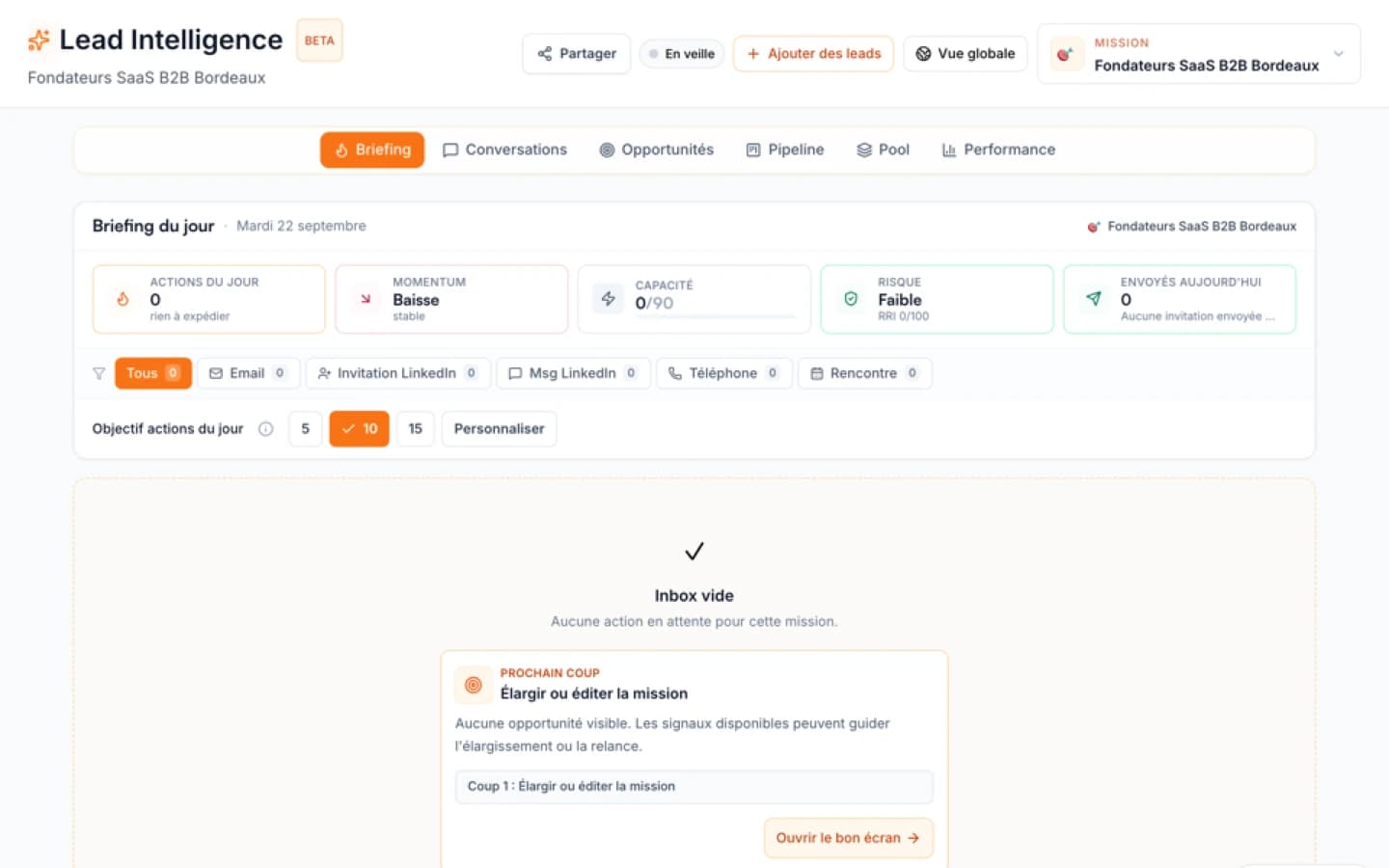
Lead Intelligence prioritises opportunities from the available context. Lead Intelligence monitors signals about people and companies to keep context current. Lead Intelligence proposes the next action and channel that fit the lead situation. These outputs support the decision about who deserves attention now. They do not remove the need to verify eligibility or approve the final outreach.
Concrete examples
These examples are illustrative and claim no measured result.
A finance leader who changed companies may still fit the target profile, but the previous message referred to the former role. The team records a context change, verifies the new remit, and drafts a fresh approach only if the new situation creates a relevant reason to talk.
A contact received the message but never showed a current business reason. The team does not add another generic follow-up. It moves the contact to waiting and defines which observable signal would justify a new review.
A prospect objected to commercial messages. The team records the objection in the suppression process and excludes the contact from every re-engagement batch. New copy, a new sender, or another channel does not override that status.
For a deeper qualification frame, read Defensible B2B Lead Qualification Framework for Small Sales.
When to use this diagnosis
Use it when a previously active outbound sequence has become silent, when the same list has received several similar messages, or when the team cannot explain why a contact should be approached now. It is also useful before moving a sequence to a new channel because it prevents channel multiplication from hiding a targeting problem.
The method works best when the team can inspect contact history, delivery outcomes, targeting criteria, and the previous copy. Structure a Weekly Outbound Review for Small B2B Sales Teams can keep those decisions visible after the first repair.
When not to use it
Do not use this diagnosis to bypass an objection, revive purchased addresses, or contact people whose professional relevance cannot be established. Do not relaunch while authentication, bounce, or reputation problems remain unresolved. Those are stop conditions, not messaging experiments.
It is also the wrong response when the offer, target, or proof has changed so much that the original sequence no longer represents the current strategy. In that case, close the old campaign and design a new qualified motion rather than labelling it re-engagement.
Next step
Build a review sheet with one row per contact and these fields: eligibility, fit, delivery status, current signal, failed assumption, proposed action, owner, and stop condition. Review the suppression state first. Then select only contacts with a defensible reason for a new approach.
Before sending, compare the proposed segment with the previous one and document the single variable that changed. Keep the first relaunch bounded and review its evidence before expanding.
Ember data
No proprietary performance figure is used in this article. No increase in reply rates or repair of deliverability is claimed.
The product statements below are limited to the current catalogue. Lead Intelligence monitors signals about people and companies to keep context current. Lead Intelligence prioritises opportunities from the available context. Lead Intelligence proposes the next action and channel that fit the lead situation. After the mission, Lead Intelligence shows the contacts analysed, signals detected and priority actions actually recorded by Ember.
Sources and methodology
This article uses two primary sources. The Gmail documentation supports the delivery safeguards. The CNIL documentation supports the French rules described for electronic professional outreach. Operational steps and examples are clearly presented as a method, not as measured outcomes.
The source pages were checked during this repair. Requirements can change, and teams operating outside France must verify the rules that apply to their recipients and channels.
Types of sources used: official pages, institutions and named studies.
Sources
FAQ
Free diagnostic
Test your sales file
Drop an Excel or CSV and check its readiness without sending its rows to Ember.