
Symptom or signal
When a Business-to-Business (B2B) prospecting campaign flatlines, the temptation for a Sales Development Representative (SDR) is to simply push more volume or change the email copy. However, continuing to blast a cold outreach sequence to unresponsive targets risks damaging domain reputation and permanently alienating valuable contacts. According to industry analysis on re-engagement strategies, the real reason outbound sales for startups and established teams stall is rarely just the message itself, but rather that the contact changed roles, the company shifted priorities, or the timing was completely wrong (https://martal.ca/company-leads-lb/).
Navigating outbound sales for startups in 2026 requires moving away from pure volume plays to focus on precise timing. To prevent burning your domain, a founder should check whether the contact is still in the same role, whether their company just announced funding or a strategic shift, and whether the use case you are addressing still matches their immediate priorities. This targeted check is what protects your domain and turns a dead sequence into a real opportunity.
To place this decision in context, the Knowledge guides for sales brings together deeper guidance on the same field.
What changed
Blasting a stalled sequence risks burning the very accounts that could have driven future revenue. In 2026, the fundamental dynamics of outbound sales have shifted. Traditional re-engagement playbooks often teach teams to simply send a different message, but this ignores the real reasons why a sequence stalls. According to insights from Martal Solutions, a sequence usually stops because the contact changed roles, the company changed priorities, or the timing was wrong (Martal Solutions). Continuing to email a contact who has shifted responsibilities or whose company has pivoted is a fast track to the spam folder. For early-stage companies, this challenge is even more acute. When considering who should an early-stage founder contact first, the answer is not a massive list.
Facts and sources
To successfully re-engage a stalled outbound sequence without damaging domain reputation or alienating valuable contacts, sales teams must move away from generic follow-ups. According to insights from Martal Solutions, sequences typically stall not because the copy is poor, but because the contact changed roles, the company changed priorities, or the timing was simply wrong Martal Solutions. Continuing to send automated emails under these conditions only increases spam complaints and risks domain suspension.
This challenge is amplified by the widespread adoption of volume-driven platforms. While this volume-based approach is highly efficient for initial market coverage, it often creates noise and leads to high unsubscribe rates when applied to stalled pipelines. For a Sales Development Representative (SDR) or a Revenue Operations manager, the key to protecting the sender domain is shifting from raw volume to precise lead qualification and contextual timing.
This shift is especially critical for smaller operations. How does a founder qualify B2B leads without a sales team? Instead of relying on massive databases and broad filters, founders and early-stage teams must focus on high-intent signals. When building a prospect list from scratch, deciding who to contact first as a founder requires looking at recent organizational changes, funding events, or technology shifts rather than guessing. According to Apollo Solutions, understanding the core components of a successful outbound sequence in 2026 requires aligning the message with the prospect's immediate operational reality Apollo Solutions.
To execute this without manual overhead, modern teams use intelligent prioritization systems. Ember addresses this through Lead Intelligence, which integrates with the broader business strategy to identify which accounts are actually ready for a conversation. Lead Intelligence finds and prioritizes the contacts itself, whatever the starting number of contacts Ember Lead Intelligence. By focusing re-engagement efforts only on the opportunities that show clear readiness signals, teams can revive stalled conversations while keeping their domain reputation entirely safe.
To explore this point further, Which Lead Qualification Framework Works Best for Small B2B? details a step directly related to this decision.
Why the common explanation is incomplete
The common explanation for a stalled outbound sequence is that the copy is simply not engaging enough. Traditional sales playbooks suggest that a Sales Development Representative (SDR) should rewrite the subject line, adjust the call to action, or increase the overall volume of cold outreach. However, this volume-first approach ignores the structural reasons why a sequence stops. According to insights from Martal Solutions, the sequence usually stalls because the contact changed roles, the company shifted its priorities, or the timing was simply wrong (source).
When a sales team relies on generic re-engagement templates, they risk burning their domain reputation and alienating high-value accounts in their sales pipeline. This is particularly true for outbound sales for startups, where resources are limited and every target account represents a significant portion of the addressable market. Simply pushing more volume through a Customer Relationship Management (CRM) platform or a sales engagement tool does not solve the underlying data decay.
Many teams use platforms like Apollo. While these tools are highly efficient for volume-driven outbound, their credit-based pricing models naturally reward sending more emails rather than improving lead qualification. When a sequence stalls, the solution is not to double down on volume, but to understand the context of the account.
This raises a critical question for early-stage companies: how does a founder qualify Business-to-Business (B2B) leads without a sales team? Without a dedicated Revenue Operations (RevOps) manager or an army of SDRs, a founder must focus on precise lead scoring and signal monitoring rather than building a prospect list from scratch and blasting it. When deciding who should an early-stage founder contact first, the answer is always the accounts showing active, verifiable buying signals, rather than a static list of cold contacts. When a founder is building a prospect list from scratch, they must define a strict Ideal Customer Profile (ICP) and look for real-time triggers instead of relying on outdated databases.
By shifting the focus from message variation to contextual readiness, teams can protect their sender reputation while identifying the exact moment an account is ready to re-engage.
The real problem
The core of the problem is that traditional cold outreach relies on high-volume automation. Platforms like Apollo make it easy to blast thousands of prospects. But when those sequences stall, simply changing the email copy does not solve the underlying issue.
According to research by Martal Solutions, sequences usually stall because the contact changed roles, the target company shifted its priorities, or the timing was wrong. Continuing to push automated emails to these unresponsive accounts risks burning your domain reputation and permanently alienating valuable contacts within your sales pipeline.
This challenge is especially acute for early-stage companies. When considering how does a founder qualify B2B leads without a sales team, the focus must shift from sheer volume to precise lead qualification and real-time signal monitoring. Instead of rebuilding a prospect list from scratch or forcing a Sales Development Representative (SDR) to manually review hundreds of inactive profiles, teams need a way to identify which accounts are actually ready for re-engagement.
Rather than relying on massive, static databases that decay quickly, modern Business-to-Business (B2B) prospecting requires a dynamic approach to lead scoring. For example, Ember's Lead Intelligence finds and prioritizes contacts automatically, whatever the starting number of contacts, as detailed on the Ember Lead Intelligence page. This allows sales teams to bypass the noise of dead sequences and focus their energy exclusively on opportunities that show active signs of readiness.
This approach also connects with Apollo vs Ember Lead Intelligence for Founder Conversion, which clarifies the next choice.
How the mechanism works
To safely re-engage a stalled sequence, sales teams must shift from a volume-first mindset to a context-first mechanism. Traditional sales engagement platforms like Apollo excel at high-volume outbound by offering massive databases and automated sequences (source). This volume-driven approach is often good enough for broad market coverage when a team already knows its Ideal Customer Profile (ICP) cold. However, when a sequence stalls, sending more automated emails from a Sales Development Representative (SDR) only risks burning the domain. The mechanism for safe re-engagement relies on detecting real-world changes, such as role transitions or shifting company priorities, rather than simply rewriting the copy.
This shift raises a fundamental question for early-stage companies: how does a founder qualify B2B leads without a sales team? The answer lies in automated lead qualification driven by external signals rather than manual guesswork. Instead of asking who should an early-stage founder contact first, the mechanism prioritizes contacts based on active buying triggers. By monitoring signals across target companies, the system identifies which accounts are actually experiencing the pain points your offer solves today. This allows a lean team to build a prospect list from scratch and perform precise lead scoring without a massive operations budget.
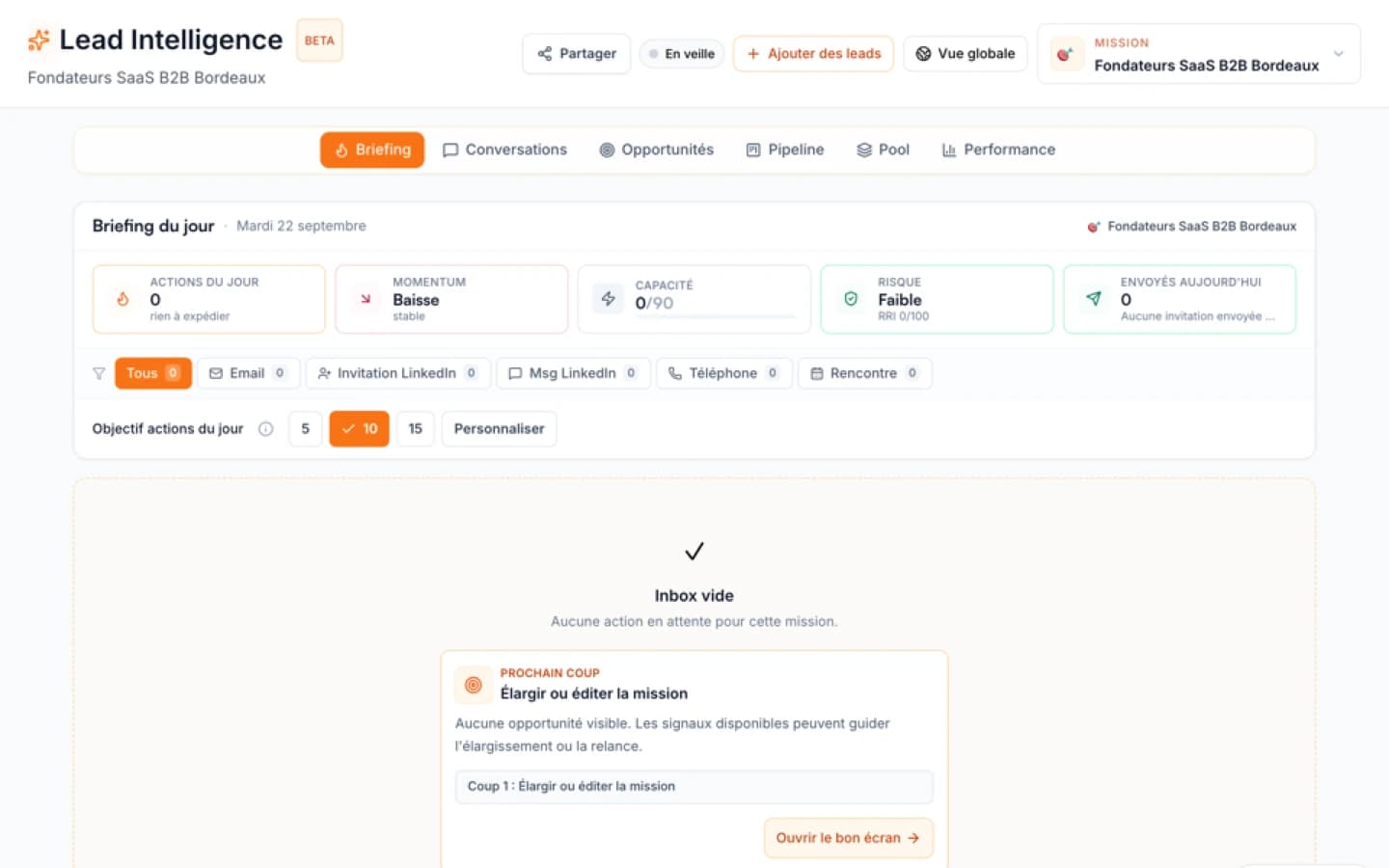
Ember addresses this challenge through its Lead Intelligence capability, which acts as an agentic research and prioritization engine. Instead of relying on a minimum contact threshold, Lead Intelligence finds and prioritizes the contacts itself, whatever the starting number of contacts (Lead Intelligence). The mechanism works by analyzing the mission context or an imported contact file (Excel or CSV) to identify what context is missing for a sales decision. It then monitors real-time signals about people and companies, classifying accounts into clear opportunities to watch, act on, or set aside. When a sequence stalls, Lead Intelligence does not just recommend another email. It provides a clear next action, identifying who to contact, why now, which channel to use, and the exact angle to take based on the updated context. This ensures that re-engagement feels like a timely, personal interaction rather than a cold outreach mistake.
Concrete examples
To re-engage a stalled outbound sequence without burning the domain or the contact, sales teams can draw on concrete examples. The Martal Solutions guide (source) is a reminder that re-engagement is not about "sending a different message": the real work is understanding why the original sequence stopped, whether the contact changed roles, the company shifted priorities, or the timing was wrong. Apollo's typical buyer, described by Factors.ai, is a sales leader or a RevOps manager at a company already running structured outbound; their buying committee often includes a VP of Sales, an SDR team lead, and a finance contact. For a founder without a sales team, qualifying B2B leads means prioritizing contacts automatically, whatever the starting number, as Lead Intelligence does. That founder should contact the VP of Sales or the SDR lead first, since they are the ones who own the pipeline and the workflow. Apollo's volume model works for teams that already know their ICP. But that model rewards volume rather than results: the more emails a team sends, the more credits it consumes, even if few meetings result. For an effective re-engagement, it is better to target the right roles with a message adapted to their context than to multiply the number of emails sent.
When to use this diagnosis
This diagnosis is designed for Business-to-Business (B2B) sales teams and founders who find their outbound sales for startups hitting a wall. You should deploy this approach when your open rates drop, your reply rates flatline, or your Customer Relationship Management (CRM) system is cluttered with unresponsive contacts. Re-engagement is usually taught as simply sending a different message, but as noted by Martal Solutions, the harder and more important question is what to do when the original sequence stopped because the contact changed roles, the company changed priorities, or the timing was wrong.
Traditional cold outreach platforms encourage volume-driven outbound where the unit economics depend on sending more emails and booking more meetings per Sales Development Representative (SDR). However, when a sequence stalls, continuing to push volume through these platforms risks burning your domain reputation and permanently alienating valuable prospects. You should use this diagnosis when you need to transition from blind volume to precise, context-driven B2B prospecting.
This framework also directly addresses how a founder qualifies B2B leads without a sales team. When building a prospect list from scratch, an early-stage founder often struggles with who to contact first as a founder. Instead of exporting thousands of unverified records that consume expensive credits, this diagnosis helps you execute early lead qualification and lead scoring based on real-time signals. By focusing on why a lead is relevant right now, you can protect your sender score and rebuild your sales pipeline safely.
To put this into practice, Ember offers a tailored solution. With Lead Intelligence, the platform finds and prioritizes the contacts itself, whatever the starting number of contacts. This allows you to run highly targeted re-engagement campaigns without the noise of traditional bulk emailing, ensuring that every message you send is backed by a clear, contextual reason to connect.
In practice, Lead Scoring for Small B2B Sales Teams Without a Marketing Team completes this framework with another angle on the same topic.
When not to use it
This context-first re-engagement strategy is not a universal remedy for every sales team. If your Business-to-Business (B2B) prospecting model relies entirely on high-volume saturation where domain health is a secondary concern, a highly tailored approach is not the right fit. For organizations running structured outbound sales for startups where the primary metric is the sheer quantity of outbound activity, traditional sales engagement platforms are highly effective. For example, Apollo is optimized for volume-driven outbound where the unit economics depend on sending more emails and booking more meetings per Sales Development Representative (SDR). If your team is set up to absorb the high bounce rates and domain risks associated with blasting thousands of prospects, continuing with automated, volume-based sequences remains a viable path.
Similarly, this methodology is unnecessary if your Customer Relationship Management (CRM) system is already clean and your target accounts are experiencing zero organizational or priority shifts. When a contact has not changed roles, the company has not changed priorities, and the timing is perfectly aligned, standard cold outreach sequences will suffice without deep signal monitoring. Re-engaging a stalled sequence by manually digging into contextual shifts is a poor use of time if your basic lead qualification is already yielding high conversion rates.
This methodology is also not designed for early-stage teams that have not yet defined their target market. When building a prospect list from scratch, founders often ask: who should an early-stage founder contact first? If you are in the initial discovery phase, you need broad market feedback rather than precise re-engagement. However, for those wondering how does a founder qualify B2B leads without a sales team, the answer lies in transitioning from random volume to signal-based prioritization. If you lack the resources to manage complex lead scoring systems, or if you do not have a dedicated sales pipeline manager, trying to execute a multi-layered re-engagement campaign manually will overwhelm your team. In those scenarios, utilizing an automated agentic system like Ember Lead Intelligence is more appropriate, as it finds and prioritizes the contacts itself, whatever the starting number of contacts.
Next step
To successfully re-engage a stalled outbound sequence without burning your domain or alienating your prospects, your Business-to-Business (B2B) sales team must transition from generic cold outreach to context-driven b2b prospecting. As highlighted by Martal Solutions, traditional re-engagement efforts often fail because teams simply send a different message, ignoring the fact that the original sequence may have stopped because the contact changed roles, the company shifted priorities, or the timing was wrong. To prevent domain damage and protect your sales pipeline, you need a systematic approach to lead qualification and timing.
For early-stage founders asking how does a founder qualify B2B leads without a sales team, the strategy begins with automation that prioritizes the right Ideal Customer Profile (ICP), the right person to contact first, and the right channel, relying on the mission context and signal-based prioritization. This approach avoids burning the contact and builds a prospect list from scratch by targeting the right decision-makers, the way a Sales Development Representative (SDR) would, but with automated tools.
Before deciding, How should a small B2B sales team build a repeatable lead generation system in 2026 without a marketing function or a dedicated SDR? helps connect this method with adjacent priorities.
Sources and methodology
To construct a reliable framework for re-engaging stalled outbound sales sequences, our methodology combines platform mechanics, and established Business-to-Business (B2B) prospecting strategies. We began by analyzing the operational differences between volume-driven outbound systems and context-first approaches. Apollo is highly effective for sales teams with a validated Ideal Customer Profile (ICP) who require broad channel coverage across email, phone, and social media. However, as noted by Factors.ai, the typical buyer for these high-volume platforms is a sales leader or Revenue Operations (RevOps) manager focused heavily on pipeline coverage and workflow speed, which can sometimes lead to domain fatigue if sequences are not carefully managed. To understand why sequences stall and how to recover them, we integrated strategic insights from Martal Solutions, which highlights that re-engagement must go beyond simply changing the message. True recovery requires diagnosing whether the prospect changed roles, the target company shifted its internal priorities, or the timing was incorrect. Additionally, the core components of successful, modern sequences are documented by Apollo Solutions, emphasizing the balance between automated outreach and precise data enrichment. Our research also directly addresses critical tactical questions for early-stage companies. When considering how a founder qualifies B2B leads without a sales team, the methodology highlights the value of automated intent signals and structured criteria to evaluate fit before initiating contact. This helps clarify who an early-stage founder should contact first, pointing founders toward decision-makers at organizations experiencing active trigger events, such as leadership changes or strategic shifts, rather than generic, cold lists. For teams seeking to implement these targeted workflows, Ember developed Lead Intelligence, which allows users to find and prioritize contacts whatever the starting number of contacts (Lead Intelligence).
Sources
- Re-engagement is usually taught as 'send a different message.' The harder question is what to do when the original sequence stopped because the contact changed roles, the company changed priorities, or the timing was wrong. This piece gives
- Outbound Sales Strategy: 7 Plays That Actually Work in 2026
- What Makes an Outbound Sales Sequence Work in 2026?
FAQ
Free diagnostic
Test your sales file
Drop an Excel or CSV and check its readiness without sending its rows to Ember.