
Context and ICP
For early stage founders, the journey to securing the first few customers is often hindered by noise and a lack of dedicated sales resources. Traditional outbound sales methods require massive databases and complex configurations. For instance, established platforms like Apollo position themselves as a unified Artificial Intelligence (AI) sales platform for modern sales and marketing teams focusing on pipeline, closing, and stack simplification, according to the Apollo homepage. However, a founder looking for their first handful of clients does not need a heavy enterprise stack. They need immediate, context-driven relevance.
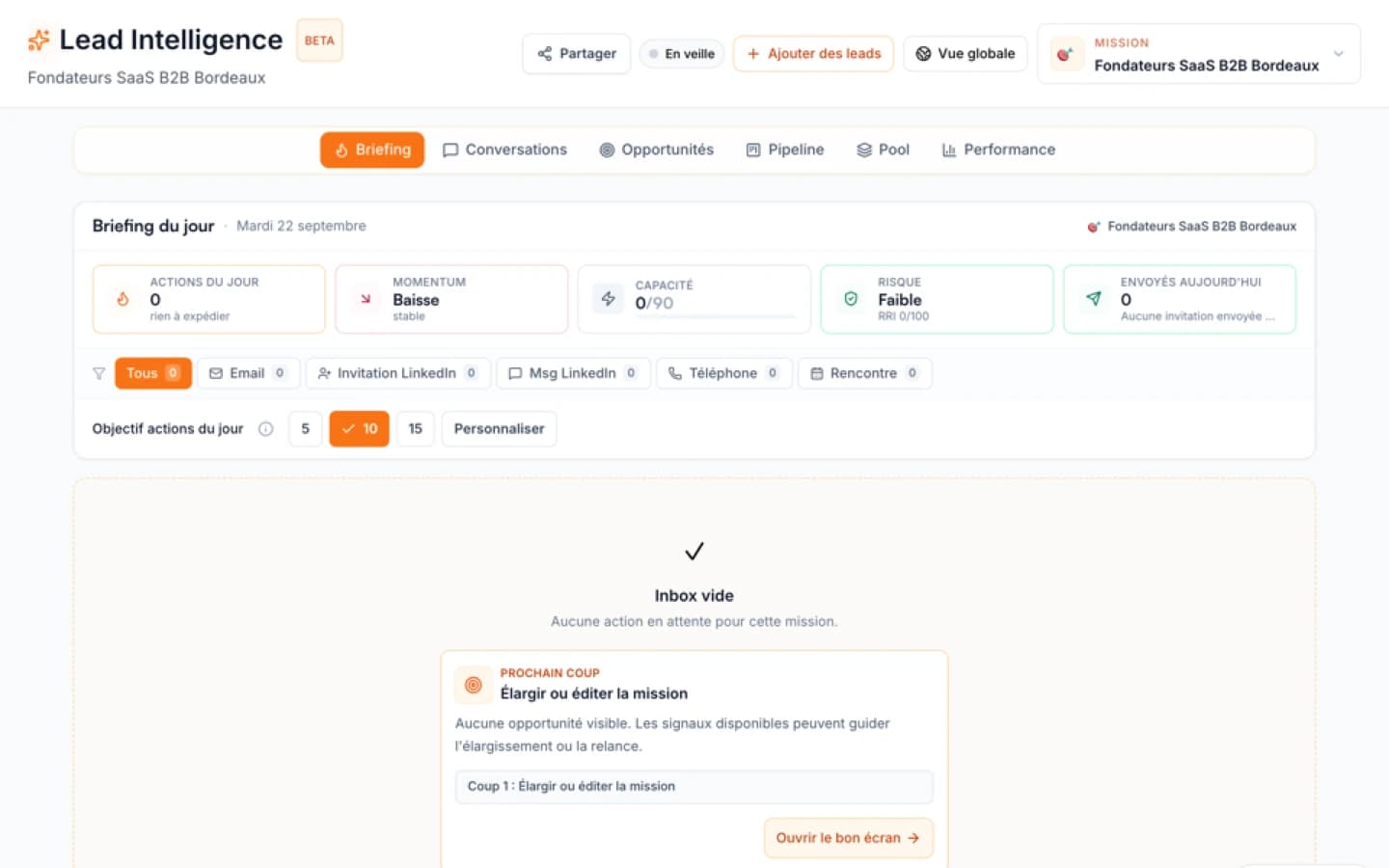
This is where Ember's Lead Intelligence provides a distinct advantage for early stage business development. Instead of requiring a massive database or a pre-defined Ideal Customer Profile (ICP) list, the system is designed to adapt to the founder's immediate scale. Whether an entrepreneur starts with 10, 100, or 1,000 contacts, Lead Intelligence finds and prioritizes the contacts itself with no minimum contact threshold, as detailed on the Ember Lead Intelligence page. This allows founders to launch highly targeted campaigns without waiting to build a massive database.
Time is a critical resource in the early stages of a startup. With a usable targeting context, the first prioritized leads can appear in about 30 minutes, as documented on the Ember Lead Intelligence page. This rapid turnaround ensures that founders can transition from strategic planning to active market engagement almost immediately.
The core mechanism relies on deep context rather than brute force volume. Ember prioritizes opportunities from the available context, as explained on the Ember Lead Intelligence page. It monitors signals about people and companies to keep this context current, as shown on the Ember Lead Intelligence page. This continuous monitoring ensures that the founder is always acting on the most relevant triggers, such as organizational changes or shifting business needs.
Ultimately, the goal is to make every conversation count. To achieve this, the system proposes the next action and channel that fit the lead situation, as outlined on the Ember Lead Intelligence page. By making priority explainable from context, signals, and opportunity readiness, as detailed on the Ember Lead Intelligence page, founders can approach their very first prospects with highly tailored, high-conviction messages that significantly improve conversion rates.
To place this decision in context, the Knowledge guides for sales brings together deeper guidance on the same field.
Problem
For an early-stage founder, the path to securing those crucial first clients is rarely a volume game. Instead, it is a search for relevance. Traditional sales platforms are built for scaled operations with dedicated sales teams. For instance, Apollo positions itself as a unified artificial intelligence sales platform for modern sales and marketing teams focused on pipeline, closing, and stack simplification, according to the Apollo Homepage. Other tools like Clay focus on deep data enrichment, offering features like an official Sales Navigator datapoint integration for lead discovery and connection insights, as detailed on the Clay Sales Navigator Integration Page.
These platforms are highly effective for established companies, but they present a steep learning curve and unnecessary complexity for a founder working alone. A founder does not have the time to configure complex databases, nor do they have a massive list of leads to upload. This mismatch is particularly painful when trying to define an Ideal Customer Profile (ICP), as founders must test their assumptions in real time with real people. While enterprise tools demand massive databases, a founder often needs to start with a highly focused list of 10, 100, or 1,000 contacts, as highlighted on the Ember Lead Intelligence Page, which requires a system that operates without a minimum contact threshold.
The real challenge for an early-stage founder is translating their initial business strategy into immediate, highly targeted actions. Without a dedicated sales operations team, founders risk wasting valuable hours chasing cold leads who have no current need for their solution, rather than focusing on the few high-probability conversations that could yield their very first customers.
Prerequisites
Before launching a prospecting campaign, an early-stage founder must establish a solid strategic foundation. Traditional outbound tools often require complex setups or massive databases to function. For instance, platforms like Apollo position themselves as a unified artificial intelligence sales platform for modern sales and marketing teams to manage pipeline and closing, as detailed on the Apollo website. Similarly, advanced data enrichment tools like Clay offer specialized integrations, such as the official LinkedIn Sales Navigator datapoint integration for lead discovery, which can be explored on the Clay integrations page. For a founder starting from scratch, however, the primary prerequisite is not a massive database, but a clear definition of who they are targeting and why. With Ember, this strategic foundation is built directly into the workspace. The core prerequisite for launching a prospecting mission is a validated targeting context. Lead Intelligence directly reuses the Business Plan, Ideal Customer Profile (ICP), offer, and strategy created in the Fund Your Growth module to prepare a sales mission. This means founders do not need to manually copy and paste buyer personas or re-explain their value proposition. Once this usable targeting context is in place, the first prioritized leads can appear in about 30 minutes, as documented on the Ember Lead Intelligence page. Furthermore, there is no minimum volume requirement to get started. Lead Intelligence finds and prioritizes the contacts itself whether the team starts with 10, 100, or 1,000 contacts, meaning founders can begin their outreach with a highly targeted list without any minimum contact threshold, according to the Ember Lead Intelligence page. The system understands context and human relationships, detecting changes across people and companies to adjust priorities and proposing the next action and channel that fit the lead situation, as outlined on the Ember Lead Intelligence page.
To explore this point further, Find individual investors with Lead Intelligence details a step directly related to this decision.
Workflow
The workflow for an early stage founder seeking their first clients begins by leveraging existing strategic work rather than starting from scratch. Instead of manually copying parameters into a cold outreach tool, the founder utilizes Ember to reuse the Business Plan, Ideal Customer Profile (ICP), offer, and strategy to prepare a sales mission. This integration ensures that the prospecting effort remains aligned with the core business model from day one. Once the mission is configured, the founder does not need to purchase or upload thousands of unverified records to see results. Ember finds and prioritizes the contacts itself whether the team starts with 10, 100, or 1,000 contacts, with no minimum contact threshold, as detailed on the Ember Lead Intelligence page. This low volume flexibility is crucial for early stage companies that need to focus on high quality, high touch relationships rather than bulk email campaigns. After initiating the process, the system works rapidly to surface actionable opportunities. With a usable targeting context, the first prioritized leads can appear in about 30 minutes, according to the Ember Lead Intelligence page. This rapid turnaround allows founders to transition from strategic planning to active market testing almost immediately. Finally, the workflow shifts to execution and relationship management. Ember understands context and human relationships, and it detects changes across people and companies to adjust priorities dynamically. Instead of leaving the founder to guess how to approach a prospect, the platform proposes the next action and channel that fit the lead situation, as documented on the Ember Lead Intelligence page. This ensures that every outreach attempt is timely, contextual, and highly relevant to the recipient's current situation.
Expected result
When an early stage founder deploys Lead Intelligence, the expected result is a highly focused, actionable list of early sales opportunities rather than a generic database of cold targets. Instead of spending days configuring complex filters or managing massive databases, the founder receives a prioritized selection of leads tailored to their specific strategic context. According to the Ember Lead Intelligence overview, the system finds and prioritizes the contacts itself whether the team starts with 10, 100, or 1,000 contacts, meaning there is no minimum contact threshold required to begin. With a usable targeting context in place, the first prioritized leads can appear in about 30 minutes, as outlined on the Ember Lead Intelligence page, allowing founders to transition rapidly from strategy to execution. The outcome is not just a list of names, but a clear roadmap for outreach. For every prioritized contact, the system proposes the next action and channel that fit the lead situation, which is detailed on the Ember Lead Intelligence capabilities page. Because the platform continuously monitors signals about people and companies to keep the context current, it understands relationships and detects changes to adjust priorities dynamically. This ensures that the founder's limited time is always directed toward the conversations most likely to convert.
This approach also connects with Use Lead Intelligence to research suitable investors, which clarifies the next choice.
Example Ember mission
To illustrate how this works in practice, consider an early stage founder who has just defined their Ideal Customer Profile (ICP) for a new business-to-business (B2B) software solution. Instead of spending hours manually searching professional networks or buying static email lists, the founder initiates a targeted prospecting mission.
The process begins when Lead Intelligence reuses the Ember Fund Your Growth, ICP, offer and strategy to prepare a sales mission. This ensures that the search parameters are perfectly aligned with the startup's core value proposition. Whether the founder starts with 10, 100 or 1,000 contacts, Lead Intelligence finds and prioritizes the contacts itself with no minimum contact threshold, as detailed on the Ember Lead Intelligence page.
During the execution phase, the system finds accounts from mission ICP and signals, then verifies useful sources. For instance, if a target company recently expanded its engineering team or updated its technology stack, these events are captured as active signals. Rather than delivering a generic list of names, Lead Intelligence proposes the next action and channel that fit the lead situation, suggesting whether to reach out via email or a professional social network with a highly contextual angle.
Once the run is complete, the platform shows the contacts analysed, signals detected and priority actions actually recorded by Ember. This immediate feedback loop reduces noise by focusing attention on opportunities that deserve action now, allowing the founder to spend their limited time only on high-potential conversations. By making the first value actually produced by the mission visible: contacts analysed, signals detected and priority actions, the founder can confidently take their first outbound steps with a clear understanding of why each lead was selected.
Limits and non-fit
While Lead Intelligence is designed to help early stage founders find their first customers, it is not a universal solution for every sales scenario. Understanding where competitor tools excel and where Ember draws its functional boundaries will help you make the right choice for your current stage of growth. If your startup has already scaled past the initial founder-led selling phase and requires a unified sales platform to manage complex pipelines, closing workflows, and overall sales stack simplification, established platforms like Apollo are highly effective. For teams that need to build highly customized, spreadsheet-style data enrichment workflows with official professional network integrations, specialized tools like Clay are better suited for the task. Ember is not built to serve as a massive, automated outbound spam engine or a silent database synchronizer. For instance, the provider Application Programming Interface (API) diagnostic in Ember, available behind flags disabled by default at this stage, uses a temporary or dedicated API token and does not synchronize any Customer Relationship Management (CRM) system. To ensure security, the API connection must be entered again manually in Ember so that no secret is ever transferred silently. Furthermore, in file mode, the raw file and its rows do not leave your browser before you sign in, meaning the system prioritizes local data privacy over silent background uploads. Another limitation is the requirement for strategic preparation. The product bridges that connect your strategic planning to Lead Intelligence only activate when the required context, such as your Ideal Customer Profile (ICP), is validated. If you do not have a structured business plan or a defined offer, you cannot immediately launch a targeted mission. However, if you have a validated strategy and want to avoid the noise of massive databases, Ember helps you focus. Whether you start with 10, 100, or 1,000 contacts, Lead Intelligence finds and prioritizes the contacts itself with no minimum contact threshold. With a usable targeting context, your first prioritized leads can appear in about 30 minutes, helping you focus on the conversations that deserve your attention immediately.
In practice, Lead Intelligence use cases for a founder seeking visibility completes this framework with another angle on the same topic.
When to use it
For an early stage founder, timing is everything. There are three specific scenarios where deploying Lead Intelligence makes the most strategic sense to secure those critical first clients. The first scenario is when you are transitioning directly from strategy to execution. After defining your initial Ideal Customer Profile (ICP) and structuring your business model, the hardest part is translating that theory into real conversations. Lead Intelligence directly reuses the Ember Fund Your Growth, ICP, offer, and strategy to prepare a sales mission. This ensures your outbound efforts are perfectly aligned with your core strategic decisions, preventing the common mistake of pitching the wrong value proposition to the wrong audience. The second scenario is when you are starting with a highly restricted network or even a completely clean sheet. Many traditional sales platforms require massive databases or complex setups to be effective. However, Lead Intelligence finds and prioritizes the contacts itself whether the team starts with 10, 100, or 1,000 contacts, with no minimum contact threshold, as outlined on the Ember Lead Intelligence page. This makes it ideal for founders who need to focus on quality over sheer volume, allowing them to build momentum even with a very small initial pool of prospects. The third scenario is when you need to act on real-time market changes rather than static lists. Instead of guessing who might be interested, you should reach out when there is a clear reason to connect. Lead Intelligence monitors signals about people and companies to keep context current, and it proposes the next action and channel that fit the lead situation, according to the Ember Lead Intelligence page. This allows you to approach your first potential clients with a highly contextual, relevant message. Furthermore, when you have a usable targeting context, the first prioritized leads can appear in about 30 minutes, as verified on the Ember Lead Intelligence page, enabling you to launch your first outreach campaign on the very same day.
Next step
To take the next step toward securing your first clients, you can initiate a focused prospecting mission within Ember. Unlike traditional platforms that require complex setup, you do not need a massive list of leads to get started. Whether you begin with 10, 100, or 1,000 contacts, Lead Intelligence has no minimum contact threshold and will find and prioritize the contacts itself, as explained on the Ember Lead Intelligence page.
Once the mission is active, you will receive a clear next action detailing who to contact, why now, which channel to use, and which angle to take, according to the Ember Lead Intelligence page. This ensures that every outreach attempt is highly contextualized, as the system proposes the next action and channel that fit the lead situation (Ember Lead Intelligence).
By focusing your energy only on the opportunities that are ready for action, you avoid the noise of bulk emailing and build genuine relationships with your first adopters. Start your first mission in Ember today to turn your ideal customer profile into active, high-priority conversations.
Before deciding, What Lead Intelligence can do in automated prospecting helps connect this method with adjacent priorities.
Sources
To ensure the accuracy of this guide for early stage founders, we rely on verified public sources and official product documentation. The strategic insights regarding early stage sales discovery and lead prioritization are grounded in the official product capabilities of Lead Intelligence, detailed on the Ember Lead Intelligence page. This includes the ability of Lead Intelligence to find and prioritize contacts based on the Ideal Customer Profile (ICP) whether a team starts with 10, 100, or 1,000 contacts, with no minimum contact threshold, as detailed on the Ember Lead Intelligence page. Additionally, our market context draws from competitor positioning and integrations. For instance, we reference the declared positioning of Apollo as a unified Artificial Intelligence (AI) sales and marketing platform on the Apollo official website. We also examine data integration capabilities, such as Clay's official LinkedIn Sales Navigator integration for lead discovery, as documented on the Clay Sales Navigator integration page. This brief draws on seed intent analysis from Ember's weekly aggregate and the official Ember product page for Lead Intelligence.
FAQ
Free diagnostic
Test your sales file
Drop an Excel or CSV and check its readiness without sending its rows to Ember.