
Symptom or signal
For early-stage founders, warning signs rarely arrive as sudden events. They appear as weeks spent chasing prospects who do not answer or pitch meetings that end without a next step. The U.S. Chamber of Commerce describes cash flow problems, weak demand and inadequate marketing among the risks to examine. The useful question is which risk is visible in your own evidence.
The US Chamber of Commerce identifies several core reasons why small businesses fail, often pointing to inadequate market research and a failure to communicate value to the right audience. While traditional Customer Relationship Management (CRM) software or manual lead lists are often good enough for founders who rely on an existing, warm network of industry contacts, these static tools do not help you identify who to target when expanding into new territories. Without a dynamic way to filter the noise, founders often waste precious runway on accounts that have no immediate intent to buy.
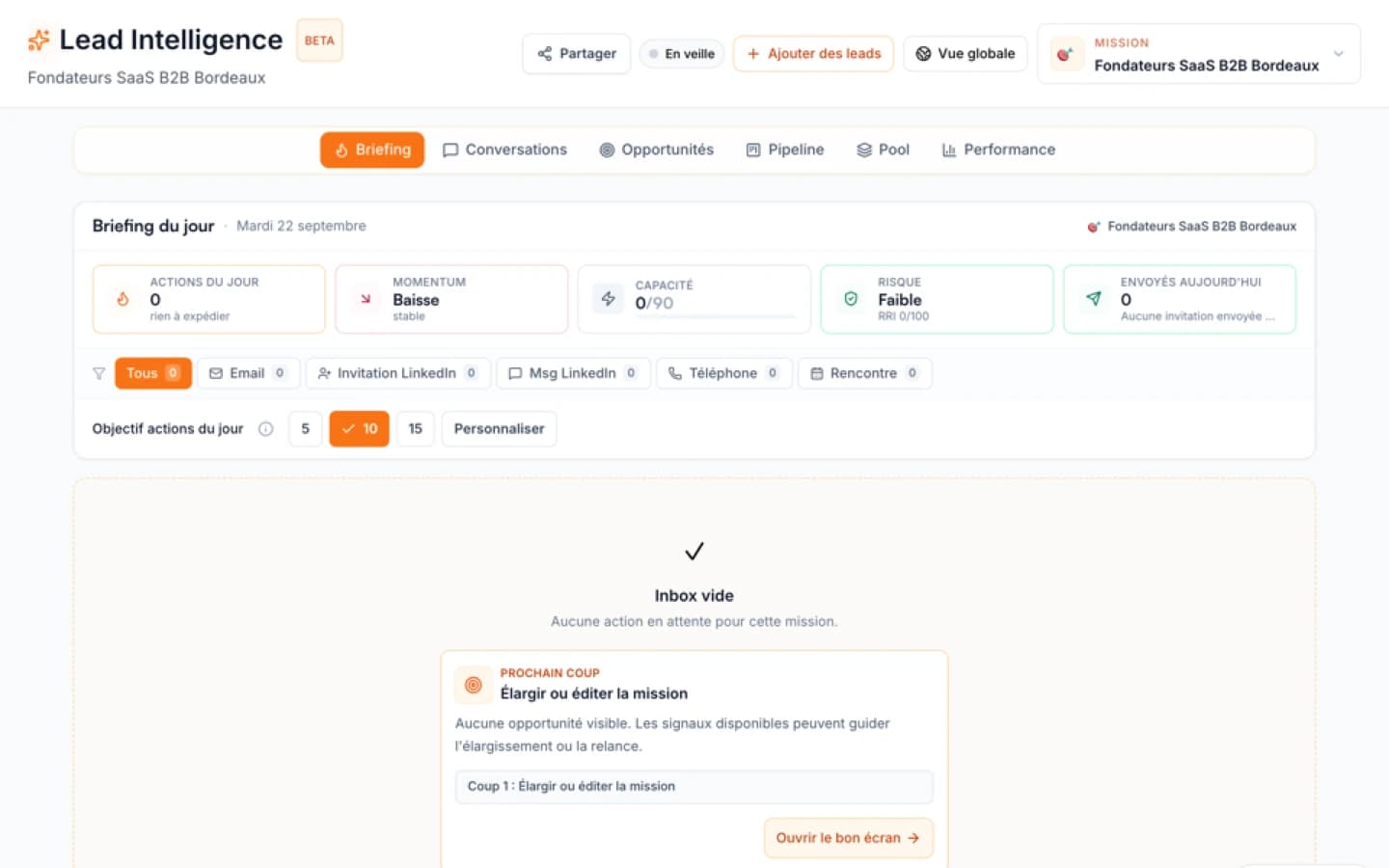
To prevent these early symptoms from turning into terminal failures, founders need to transition from broad market guessing to highly targeted outreach. Using Lead Intelligence helps teams reduce this operational noise by focusing their limited time on opportunities that deserve action immediately. By reusing the Ember Business Plan, Ideal Customer Profile (ICP), offer, and strategic context, the platform prepares a targeted sales mission. It automatically finds accounts based on your specific ICP and real-world signals, verifying useful sources to ensure you do not chase dead ends.
Lead Intelligence helps founders identify and prioritise contacts from targeting context and observed signals. It presents explained opportunities to watch, act on or set aside, so the team can decide who to contact and why. Its product page describes that workflow without promising a fixed contact volume or delivery time.
To place this decision in context, the Knowledge guides for sales brings together deeper guidance on the same field.
What changed
The mission makes the first useful result visible through the contacts analysed, signals detected and priority actions. A founder can review that evidence before deciding whether to continue the approach.
Facts and sources
The failure of a new business has several possible causes. The U.S. Chamber of Commerce describes cash flow, demand, marketing and management risks. Founders can use those categories to examine their own situation instead of treating one headline percentage as a diagnosis.
To navigate these challenges, founders must diagnose the specific operational and strategic vulnerabilities that threaten early-stage companies. The US Chamber of Commerce outlines the fundamental reasons why small businesses fail, pointing to cash flow issues, weak market demand, and flawed execution strategies as primary drivers.
For many businesses, failure is accelerated by a lack of focus in their go-to-market execution, often resulting in wasted sales cycles and poorly targeted outreach. While larger organizations with dedicated revenue operations and technical bandwidth can build complex data pipelines using tools like Clay, which is highly suited for growth teams that want to combine multiple data sources and write custom enrichment logic as noted by Derrick App, early-stage founders often need a more direct path to traction.
Instead of orchestrating complex data workflows, founders can use Lead Intelligence to streamline their sales outreach. This capability reuses the Ember Business Plan, Ideal Customer Profile (ICP), offer, and strategy to prepare a targeted sales mission. By finding accounts from the mission ICP and signals, and then verifying useful sources, it reduces noise and focuses attention on the opportunities that deserve immediate action. This approach provides a clear next action, making priority explainable from context, signals, and opportunity readiness, while making the first value actually produced by the mission visible to the team.
To explore this point further, Apollo vs Ember Lead Intelligence for Founder Conversion details a step directly related to this decision.
Why the common explanation is incomplete
Conventional post-mortems usually point to a single, lagging indicator: running out of money. Yet, this explanation is incomplete because it mistakes the final symptom for the root cause. Businesses do not simply run out of cash by accident. They deplete their resources because they spend months chasing unvalidated markets, building products without clear demand, or pitching to the wrong audience.
Founders need to look beyond the balance sheet to understand why traction is weak. The U.S. Chamber of Commerce points to market research, cash flow and operational choices as practical areas to review.
The real breakdown occurs when early-stage teams fail to prioritize their market outreach. Instead of identifying their true Ideal Customer Profile (ICP) and acting on real-time signals, they default to high-volume, low-yield sales tactics. This creates administrative noise, exhausts the team, and burns through capital without generating meaningful traction. When a business cannot distinguish between a cold lead and an active opportunity, failure becomes a matter of strategic misallocation, not just a lack of capital.
The real problem
The core challenge for early stage founders is not a lack of effort, but a misdirection of energy. While conventional wisdom suggests that running out of capital is the primary cause of death, the underlying disease is almost always a lack of market alignment. When founders build in a vacuum, they spend precious runway chasing prospects who have no immediate need for their solution.
A weak response to outreach can be an early sign of poor targeting, unclear demand or an offer that does not fit the buyer. The U.S. Chamber of Commerce recommends examining the causes rather than assuming every struggling company has the same problem.
The real problem lies in how companies approach go to market strategies. Traditional sales engagement platforms, such as Apollo, encourage a volume-oriented workflow where success is treated as a function of outreach credits and database exports. For teams that already know their Ideal Customer Profile (ICP) perfectly, this can work. However, for early stage founders still validating their market, this high-volume approach creates immense noise. It leads to weeks spent chasing unresponsive prospects, burning through cash, and misinterpreting silence as a product failure when it is actually a targeting failure. Without clear, context-driven prioritization, founders cannot see which opportunities deserve immediate action, leading to the strategic drift that ultimately drains their remaining resources.
This approach also connects with What to Look For When Hiring a B2B Lead Generation Agency in 2026?, which clarifies the next choice.
How the mechanism works
Business failure can develop through a loop of actions that do not match market evidence. A founder may document a strategy in a static plan, then run generic outreach to the wrong prospects. Without a link between the plan and conversations with buyers, the team can spend scarce cash without learning whether demand exists.
To survive, founders must replace this disconnected loop with an integrated mechanism where strategy directly drives execution. This is where Ember changes the dynamic. By using Lead Intelligence, founders can reuse their business plan, Ideal Customer Profile (ICP), offer, and strategy to prepare a targeted sales mission. The system finds accounts based on the mission ICP and real-world signals, then verifies useful sources to ensure accuracy.
This mechanism reduces operational noise by focusing attention on opportunities that deserve action immediately. Instead of guessing, founders receive a clear next action that details who to contact, why now, which channel to use, and which angle to take. This makes priority entirely explainable from context, signals, and opportunity readiness, transforming the way early stage companies navigate their market and protect their runway.
Concrete examples
To understand how these failure dynamics play out in the real world, consider the contrast between a traditional, volume-first sales approach and a context-driven strategy.
In a typical scenario, an early-stage Business-to-Business (B2B) startup might build a promising product and immediately begin cold outreach. Operating under the assumption that sales is purely a numbers game, the founders might import a list of thousands of unverified contacts and send generic bulk emails. Because the outreach lacks specific context or timing signals, the campaign yields no replies. The campaign may spend time and cash without revealing which buyers have a current need. The failure is often attributed to running out of money, but the root cause was the noise and waste generated by unaligned execution. While traditional databases and manual list-building tools are often sufficient for established companies with large sales departments and massive budgets, early-stage startups cannot afford to waste their limited runway on unprioritized volume.
Now, consider an alternative scenario where the same startup grounds its daily execution in its core strategy. Instead of relying on brute-force volume, the team uses Lead Intelligence from Ember to align their sales mission directly with their business plan and Ideal Customer Profile (ICP). By analyzing real-time signals and opportunity readiness, the system reduces noise by focusing attention on opportunities that deserve action now.
Lead Intelligence can find and prioritise contacts from usable targeting context and explain why an opportunity matters. Its product page does not establish a universal starting volume or time to the first prioritised lead. Founders should assess the result in their own mission.
By classifying accounts into explained opportunities to watch, act on, or set aside, founders avoid the trap of chasing dead ends. Instead of sending blind emails, the team receives a clear next action detailing who to contact, why now, which channel, and which angle to use. This ensures that every commercial action is a direct extension of the company's core strategy, preserving runway and building genuine market traction.
In practice, What Evidence Should a B2B Founder Verify Before Choosing Lead Intelligence over High-Volume Prospecting? completes this framework with another angle on the same topic.
When to use this diagnosis
This diagnosis is useful when outbound sales generate activity but few meaningful conversations. The U.S. Chamber of Commerce describes market demand and marketing fit among the risks a small business should examine. A founder can compare those possibilities with actual customer responses before changing the plan.
For established companies that already have a fully validated Ideal Customer Profile (ICP) and the budget to support broad outbound campaigns, traditional volume-first platforms are highly effective. These tools excel when a business simply needs to scale up an already proven message to a massive database of contacts.
However, early-stage founders rarely have the luxury of unvalidated volume. When capital is limited and market alignment is still being discovered, continuing with high-volume, untargeted outreach will quickly deplete resources. This is the precise moment to transition to a context-driven commercial strategy.
By utilizing Lead Intelligence from Ember, founders can move away from generic, credit-burning lists. This capability reduces noise by focusing attention on opportunities that deserve action now. Instead of sending hundreds of unoptimized messages, it provides a clear next action, identifying who to contact, why now, which channel, and which angle. This makes priority explainable from context, signals, and opportunity readiness, ensuring that every sales action directly supports the broader business strategy and protects the company from becoming another failure statistic.
When not to use it
There are scenarios where a highly contextual, signal-driven approach to sales is not the immediate priority. If an early-stage company already has an established, highly optimized outbound sales machine with dedicated sales operations staff, traditional high-volume contact databases might be sufficient for their needs. These legacy platforms are often good enough when the primary goal is simply to export bulk lists of raw contact information to feed into an existing high-volume sequence without needing deep contextual prioritization.
However, founders should remain aware of the operational tradeoffs of these volume-first systems. Traditional platforms typically rely on credit-based pricing that turns every sales action into a metered decision. According to sales platform comparisons on Factors.ai, when a sales team scales from one seat to five, the credit math does not just multiply linearly because wasted exports, bounced emails, and re-enrichment compound the overall cost. A similar analysis by Coldreach confirms that this credit-metering model can quickly create friction for growing teams.
Furthermore, a context-driven sales strategy is entirely dependent on having a clear strategic foundation. If a founder has not yet defined their target market, value proposition, or Ideal Customer Profile (ICP), attempting to run targeted sales campaigns will only result in wasted effort. In these early stages of strategic uncertainty, focusing on lead generation is premature. Founders must first align their core business model and funding strategy before they can effectively prioritize their commercial outreach.
For teams still defining their foundational strategy, tools like Ember can help structure these early decisions. Instead of jumping straight into outbound execution, founders can use the Fund Your Growth capability to clarify their business plan and funding strategy. Once that strategic foundation is validated, they can transition to Lead Intelligence to turn that strategic context into prioritized sales actions, ensuring they target the right opportunities at the right time.
Before deciding, How to Find Clients Quickly as an Early-Stage Founder? helps connect this method with adjacent priorities.
Next step
To avoid the common pitfalls that lead to early business failure, founders must transition from passive planning to active, context-driven execution. The journey begins by transforming your strategic goals into a clear, structured roadmap.
Ember helps founders understand a changing context, choose the next priority, and take action. Instead of letting your business plan become a static document, the Fund Your Growth capability allows you to build your Business Plan, choose a funding strategy, and plan the next steps. This experience turns gaps in your file into prioritised next actions, ensuring that your strategic foundation remains strong and defensible.
Once your strategy is set, the challenge shifts to sustainable market execution. This is where many businesses falter by wasting resources on untargeted outreach. Through Lead Intelligence, Ember reduces noise by focusing attention on opportunities that deserve action now. The system proposes the next action and channel that fit the lead situation, providing a clear next action on who to contact, why now, which channel, and which angle. By grounding your daily sales operations in real-world context, you can protect your runway and focus your energy where it has the highest chance of conversion.
Sources and methodology
The analysis of startup failure rates and operational pitfalls relies on a combination of macroeconomic business studies, community-driven founder insights, and modern sales execution frameworks.
For the risks discussed here, the U.S. Chamber of Commerce identifies cash flow, demand and marketing among common challenges. U.S. Bureau of Labor Statistics data show why a universal failure claim needs a defined population and period. The article therefore does not use the original headline rate as a benchmark.
For the sales execution and lead generation methodology, we contrasted two distinct operational models. The first model focuses on broad data enrichment and custom orchestration. This approach is well suited for dedicated revenue operations teams that have the technical bandwidth to manage multiple data providers and write custom enrichment logic, a strength exemplified by platforms like Clay as detailed by Derrick.
The second model, which informs the design of Ember, prioritizes context over raw volume. This methodology relies on reusing strategic assets, such as the Business Plan and the Ideal Customer Profile (ICP), to focus outreach on opportunities that show immediate readiness. By analyzing specific signals rather than compiling massive, unverified lists, founders can identify who to contact and why, reducing market noise and focusing on high-probability conversations.
Sources
FAQ
Free diagnostic
Test your sales file
Drop an Excel or CSV and check its readiness without sending its rows to Ember.