
Definition
In modern outbound sales, business-to-business (B2B) teams face a flood of intent data. Salesmotion groups buying signals into three families: first-party signals (website visits, content downloads, email engagement), third-party signals (activity on review sites, topic research) and contextual signals (job postings, leadership changes, funding rounds). A small team without a data analyst cannot act on all of them, and trying to do so scatters its effort. To build a reliable pipeline, the team must decide which few signals actually lead to a sales conversation. The question is especially sharp for an early-stage founder: how do you qualify B2B leads without a sales team? Without a sales development representative (SDR) or an analyst to filter the noise, a founder should rely on a few contextual signals that give a clear "why now", rather than on raw volume.
To place this decision in context, the Knowledge guides for sales brings together deeper guidance on the same field.
Prerequisites
Before a small team or an early-stage founder builds a pipeline, a few foundations are needed. When building a prospect list from scratch, the main challenge is not a lack of data but the volume of noise. Three prerequisites help before buying any intent data. First, a clearly defined ideal customer profile (ICP), so that no effort goes to accounts that will never convert. Second, a customer relationship management (CRM) system set up to record the signals you decide to track. Third, an understanding of the difference between first-party, third-party and contextual signals, as outlined by Salesmotion. According to that guide, first-party signals are the highest-confidence ones but only cover accounts that already know you, while third-party signals expand visibility but need corroboration from other signal types.
Many teams jump straight to buying a large database. Apollo, for example, presents itself on its homepage as giving access to 240M contacts and 30M companies, and its pricing page explains that export credits are consumed whenever a contact is exported outside Apollo. For a small team without an analyst, that means part of the cost follows the volume of exports, so it pays to choose the accounts first. Clay, for its part, presents on its homepage a data marketplace of 200+ providers and workflows for revenue teams, which suits teams that have someone to build and maintain them.
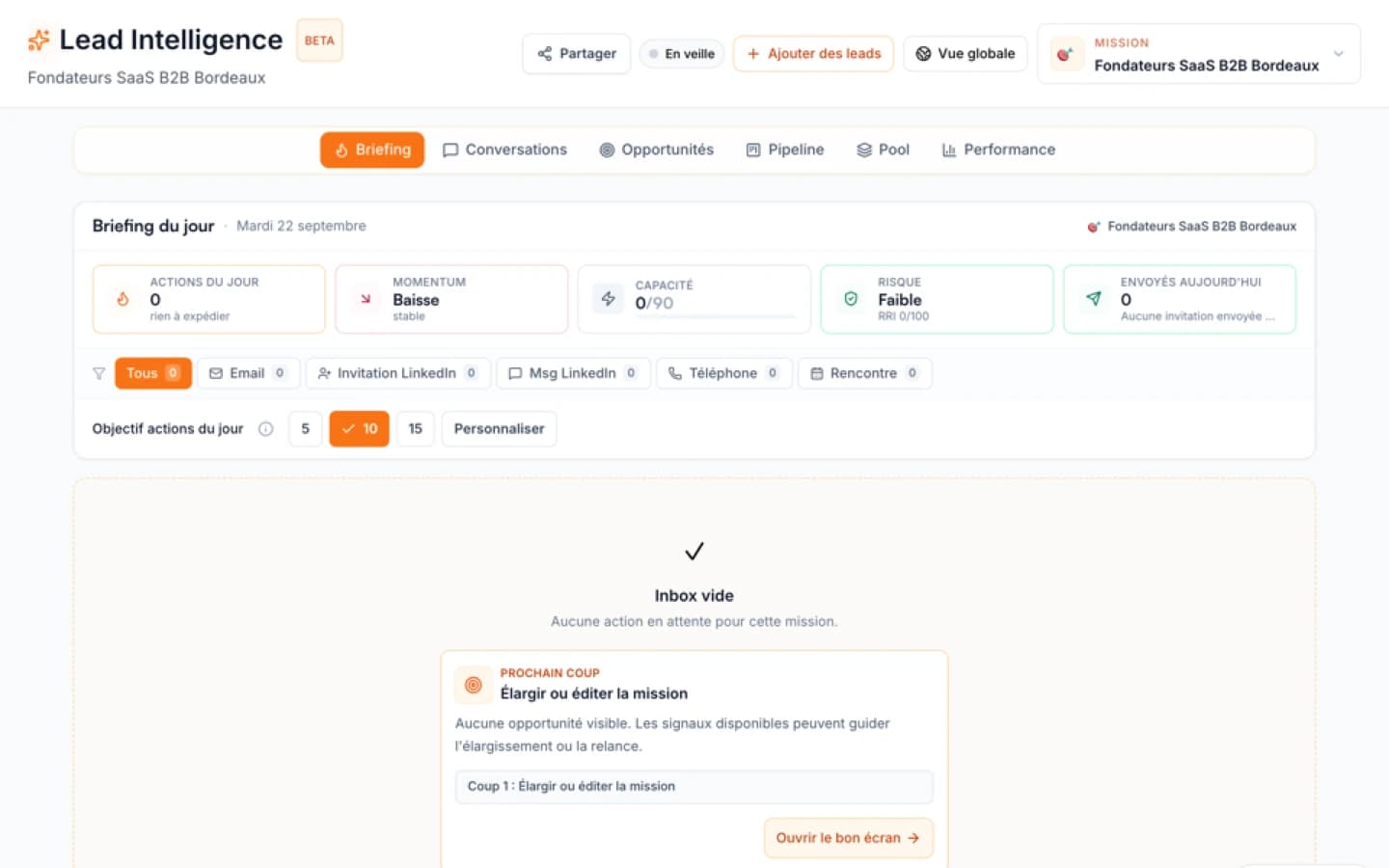
For a small team, the last prerequisite is to avoid complex data engineering and to focus on a few signals that indicate a clear "why now" for outreach. Ember, the publisher of this article, offers Lead Intelligence, which reuses the Business Plan, the ICP, the offer and the strategy from Ember to prepare a sales mission and helps prioritize the conversations that deserve attention now.
Steps
To build a signal-based workflow without a dedicated analyst, a B2B sales team can follow three steps. First, write the ideal customer profile in two lines and list a small number of accounts that match it. Second, choose two or three signals only, ideally one contextual signal (a new sales leadership role, a funding round, a leadership change) combined with one first-party signal (a pricing page visit, a content download): Salesmotion notes that several signals together indicate an active evaluation with urgency, where each alone is only interesting. Third, decide in advance what action each combination triggers and who does it, then review the results every week.
To explore this point further, How do solo B2B founders actually get their first 10 customers without an existing list? details a step directly related to this decision.
Worked example
Consider a founder without a sales team who wants to contact the ten accounts most likely to be receptive this month. The founder lists accounts that match the ICP, then watches two signals on each: a new sales or operations leadership role, and a funding round, both contextual signals described by Salesmotion. An account that shows both, and whose team has also visited the founder's pricing page, moves to the top of the list. The founder writes to the most relevant decision-maker first, with a message that refers to the specific event. Accounts with no signal stay in a "watch" pile instead of receiving a generic message.
For teams that prioritize sheer volume, established platforms can be a good fit. A sales leader focused on speed may prefer Apollo, whose pricing page mentions a Chrome extension, integrations with tools such as Salesforce and HubSpot, and a large contact database. That choice is sensible when a team of SDRs needs immediate outbound activity and has the capacity to process it.
Common mistakes
When building a B2B pipeline from scratch, small teams often make the same mistakes when deciding which signals to act on. Without an analyst, it is easy to mistake raw activity for genuine buying intent.
The first mistake is the volume trap: treating all signals as equal. Salesmotion warns that third-party signals are inherently imprecise, since a company researching a topic might be writing a blog post rather than buying software. Relying only on high volume often leads to chasing noisy signals instead of qualifying leads early on real buying intent. For a founder who must qualify leads without a sales team, it is better to focus on signals aligned with the ICP, such as website visits and content downloads, and to use simple lead scoring in the CRM before starting outbound outreach.
This approach also connects with What does a realistic 30-day B2B outbound pipeline look like for a small team with no brand and no list: and which activities actually produce meetings?, which clarifies the next choice.
Tools
For a B2B sales team deciding which intent signals to use in 2026, with dozens of intent data providers on the market and no analyst on staff, the choice of tools matters. A directory such as Percepture's list of B2B intent data providers shows how wide the range is: it names Bombora, 6sense, Demandbase, ZoomInfo, Cognism, G2, TechTarget, Dealfront and Apollo, among others, and notes that the right provider depends on whether the team needs account-level research signals or account-based marketing orchestration.
A first step is to filter the noise with tools that connect a signal to a real sales conversation. Apollo offers a large contact database and sequence tools, with credits consumed by exports, as its pricing page explains. Clay presents itself on its homepage as infrastructure to get data, run workflows and launch go-to-market actions. A founder without a sales team can qualify B2B leads by first defining a tight ICP, then using timely signals to identify the prospects who show buying intent. The founder's first contact should be the key decision-maker who, according to the signals, is most likely to be evaluating solutions. To build a prospect list from scratch, it is better to start with a small number of accounts perfectly aligned with the ICP than to buy large lists. The best tool for a small team is the one that turns a raw signal into an opportunity for a conversation, without needing advanced technical skills.
When to use this method
This signal-based method is most valuable when a B2B sales team, or a solo founder, must build a highly targeted pipeline without a dedicated data analyst. Intent data covers many kinds of events, from website visits to funding rounds and job postings, which makes it hard to isolate the triggers that lead to a sales conversation. When a small team lacks the resources to clean and analyze these streams manually, a systematic framework helps it filter the noise and concentrate on the most promising opportunities. An early-stage founder trying to qualify first prospects without a sales team can rely on contextual signals, such as a leadership change at a target company, rather than on dozens of intent data vendors. The question then becomes who to contact first at a prospect. A well-defined ICP and a prioritization based on real buying signals, rather than on raw volume, give a coherent prospect list from the start.
In practice, Which reference data helps a pre-seed startup founder decide who to contact, why now, and with what message? completes this framework with another angle on the same topic.
When not to use it
This method is not right for every organization. If your company runs a high-volume outbound model where success depends on sending thousands of automated emails a day, a signal-filtering approach may feel too restrictive. For teams that prioritize immediate discovery of many contacts and sequence automation, established platforms such as Apollo are often a better fit, as described on its pricing page.
The method is also unnecessary if your organization has the engineering resources to build custom data pipelines. With a dedicated revenue operations (RevOps) team, you may prefer a highly customizable data engine: Clay presents itself as infrastructure for go-to-market teams and GTM engineers to get data, run agentic workflows and launch GTM actions.
Finally, if your CRM is already managed by analysts who handle lead scoring and complex data enrichment, you do not need a simplified signal-prioritization workflow. If you already have a large operations team to manage the noise, or if your economics rely entirely on unsegmented mass outreach, a highly focused signal-based workflow is not what you need.
Action plan
To answer how a founder qualifies B2B leads without a sales team, move from manual lead scoring to a workflow grounded in context. Lead Intelligence, published by Ember, reuses the Ember Business Plan, the ICP, the offer and the strategy to prepare a sales mission, as described on the Lead Intelligence page. It monitors signals about people and companies to keep the context up to date, classifies accounts into explained opportunities to watch, act on or set aside, and proposes the next action and the channel that fit the lead's situation.
Before deciding, Which signals should alert a traction-stage startup founder? helps connect this method with adjacent priorities.
Sources and methodology
This guide draws on published resources about intent data. The Percepture directory of B2B intent data providers gives the landscape of vendors. The Salesmotion guide to intent signals and its guide to lead qualification describe the signal families and how teams qualify leads. The Apollo pricing page and the Clay homepage describe the two tools mentioned. These are vendor and practitioner publications, read as descriptions of practices and products, not as independent studies. Ember, which publishes this article, is also the publisher of Lead Intelligence.
Sources
- Intent data has become a noisy category: funding events, hiring spikes, tech installs, content consumption, job changes. The piece cuts through by ranking which signals actually correlate with a sales conversation for a small team, which on
- Best B2B Intent Data Providers in 2026
- Intent Signals Guide: How B2B Sales Teams Identify and Act on Buyer Intent
FAQ
Free diagnostic
Test your sales file
Drop an Excel or CSV and check its readiness without sending its rows to Ember.