
| Criterion | HubSpot Sales Hub | Ember |
|---|---|---|
| Main category | CRM and sales software (Sales Hub). | Lead Intelligence, an Ember module driven by missions. |
| Main objective | Manage leads, activities and outreach in one workspace. | Decide who to contact, why now and with which angle. |
| Contact database | Records kept in the CRM; the product page also describes an AI agent that finds accounts. | Excel or CSV import, LinkedIn import from a connected account, or discovery from your ICP. |
| Company context | Company records and activities kept in the workspace. | Reuses the Business Plan, ICP, offer and strategy already in Ember. |
| People context | Contacts and their activities in one workspace. | Sources and a "why now" shown on each prospect sheet. |
| Signals | Real-time tracking of prospect engagement. | Watching of signals on people and companies, run daily. |
| Buying committee | An AI agent that sources buying committees, per its product page. | Searches the accounts and people that matter for the mission. |
| Channels | Automated multi-channel outreach. | LinkedIn through a connected account; sending stays manual. |
| Sequences | Sequences that adapt to prospect engagement. | A cadence that plans and proposes, and never sends on its own. |
| Agenticity | An AI agent for prospecting outreach. | A mission that discovers, checks sources and ranks opportunities. |
| Learning | Reporting to measure performance. | A loop linking actions, replies, meetings and outcomes. |
| Cross-module context | Part of the wider HubSpot platform. | Reuses context from other Ember modules, such as Fund Your Growth. |
| Personalization level | Personalized outreach automated, per its product page. | Message drafts generated on request, editable, in French or English. |
| Ideal user | Sales teams, from startups to enterprises. | Founders and sales teams, small businesses as a secondary audience. |
| Best use | Running the pipeline and outreach day to day. | Choosing priorities before outreach starts. |
| Main limitation | Professional and Enterprise tiers require a paid one-time onboarding. | Public page labelled Beta; sending is manual; some functions limited to eligible accounts. |
| Price | Free plan for up to 2 users, then paid tiers per seat (see hubspot.com/pricing/sales). | See the Ember pricing page. |
Do agencies, software and hybrid models solve the same need?
They share a goal, more qualified conversations with the right companies, but they buy you different things. An agency sells time and a method run by other people. Software sells a workspace that you operate yourself. A hybrid model mixes the two, for example software you own with an external team that fills it. Before comparing prices, write down which of these three you are actually short of: hands, method or tooling.
To place this decision in context, the Knowledge guides for sales bring together deeper guidance on the same field.
Neutral presentation of a software option: HubSpot Sales Hub
Ember publishes this article and sells Lead Intelligence, so the comparison below is not neutral by position. To keep it fair, every statement about HubSpot comes from hubspot.com pages opened on 29 September 2026.
What it is
HubSpot describes Sales Hub as "Sales software that scales with you". Its product page promises to "manage leads and activities on one AI-powered workspace".
Who it is for
The page says sales teams use it to "convert opportunities faster with AI", across company sizes from startups to enterprises.
Strengths
The page lists automated multi-channel outreach that adapts to prospect engagement, real-time engagement tracking, meeting scheduling and reporting. It also describes an AI agent that can "find accounts, source buying committees, and execute personalized outreach".
Limitations
A CRM is only as useful as the process and data put into it. HubSpot's own page shows what it offers, not what your team will get out of it. Someone must configure it, feed it and keep it clean.
Pricing
The pricing page shows a free plan for up to 2 users and paid tiers per seat: Starter, Professional and Enterprise. It states that Professional and Enterprise require a one-time onboarding fee, and that HubSpot Credits are included in each tier. Check the official page for current amounts, which change.
When to choose HubSpot
Choose it when you want one workspace to run your pipeline, your team already knows how to operate a CRM, and you accept owning the setup work.
Neutral presentation of Ember
What it is
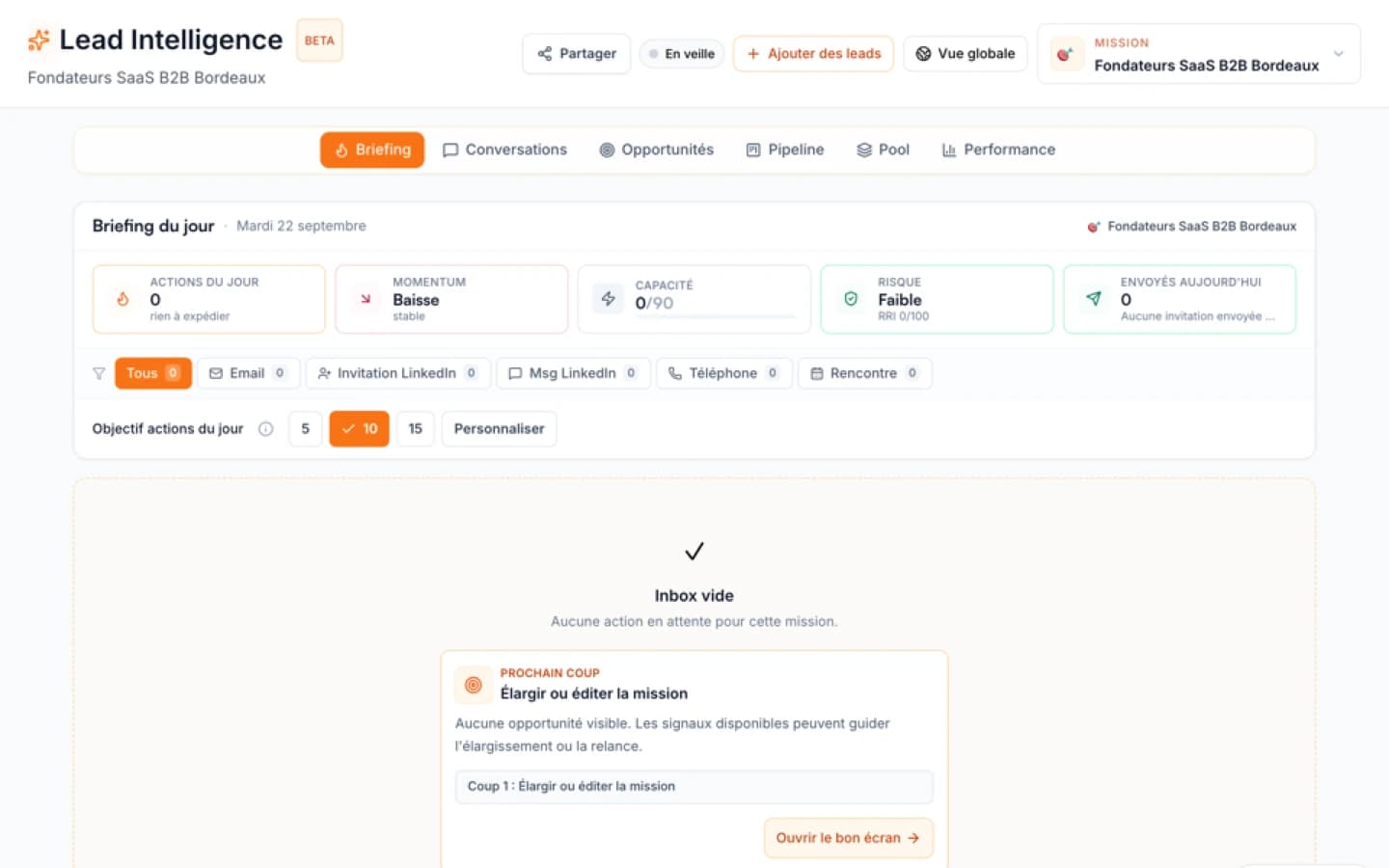
Lead Intelligence is the Ember module that turns a mission, sales prospecting or fundraising, into contacts, signals and next actions. It reuses the Business Plan, ICP, offer and strategy already in Ember. Its public page carries a Beta label.
Who it is for
Founders and sales teams are the main audience, small businesses the secondary one. It works whether you start from 10, 100 or 1,000 contacts, with no minimum threshold.
Strengths
It searches accounts and people from your ICP, checks sources, ranks opportunities as explained, to watch, to handle or to discard, and proposes a next action and a channel. Weak leads stay in a Pool with a visible reason instead of disappearing.
Limitations
Sending is manual: Ember plans and proposes, you validate and send. LinkedIn features need a LinkedIn account that you connect. Some functions, such as contact detail search, are limited to eligible accounts, and no result is guaranteed.
Pricing
Ember shows no price in this article. See the Ember pricing page for current terms.
When to choose Ember
Choose it when the hard part is deciding who to contact, why now and with which angle, more than storing records.
Classic versus agentic approach
The classic approach, whether an agency or a CRM, relies on people to decide and on tools or contractors to execute. An agentic tool moves part of the research and prioritisation to software, while a human keeps the decision. The useful question is where you want the judgement to sit.
To explore this point further, Solo Outbound: Build a Week You Can Sustain for B2B details a step directly linked to this decision.
What each model does in practice
An agency usually covers research, copywriting, sending and reporting under an agreed scope. According to the Visdum guide to B2B lead generation agencies, a monthly retainer covers "an agreed campaign scope", which may include a contact volume, a number of campaigns or a selection of channels. A CRM gives you the place to store and follow leads. Lead Intelligence gives you a mission that searches and ranks. None of the three replaces a clear offer.
Company context
An agency starts with a brief and learns your market over the first weeks. A CRM knows only what you enter. Lead Intelligence starts from the context already written in Ember, your Business Plan, ICP, offer and strategy, so the first question for any model is the same: is your target written down clearly enough to hand over?
People and buying committee
Most B2B purchases involve several people. HubSpot's page describes an AI agent that sources buying committees. Ember searches the people who matter for the mission and shows on each prospect sheet the sources and a "why now". An agency will do this by hand, which can be more nuanced but depends on the person doing it.
Personalizing messages
Personalization is where the models differ most. Software can draft at scale, an agency can write by hand, and both can produce generic text. In Lead Intelligence, opening a sheet never generates a message: you click to generate a draft in French or English, edit it, and can regenerate it with your instructions. Whatever the model, read the message as your prospect would. To qualify leads before writing to them, How to qualify B2B leads without a marketing department? offers a lightweight method.
Four starting situations
No process yet
Without a written target or offer, an agency will invent one for you and software will stay empty. Start by writing the ICP.
A manual process
If you already prospect by hand and it works, software saves time. An agency is useful only if your bottleneck is capacity.
A tooled process
If a CRM is running, adding a discovery tool or an external team is an incremental choice. Measure what is missing first.
A proven process
If you know your conversion rates, an agency on a performance basis or a scaled tool both become testable against your own numbers.
Incentives
The way you pay shapes behaviour. The Visdum guide describes performance-based deals, where the client pays "for meetings that meet an agreed standard", and per-lead pricing, where lead definitions "vary widely". It warns that a campaign can book many meetings without creating meaningful pipeline. With software, you pay for access and the incentive to use it well is yours. Ask each provider what exactly triggers a payment.
Channels
HubSpot's page describes automated multi-channel outreach. In Lead Intelligence, a LinkedIn account is connected through a hosted authentication page, Ember does not store your credentials, and it picks between an invitation and a direct message depending on the connection degree. Whoever sends, respect the platform rules and keep the volumes modest.
Ownership of knowledge and learning
The Visdum guide lists what you should ask to own at the end of a contract: domains, inboxes, contact data, campaign copy, CRM records, automation workflows, reporting dashboards and research files. With software, this knowledge stays in your account. Lead Intelligence adds a learning loop linking actions, replies, meetings and outcomes.
In practice, Most Promising French Startups: A Practical Guide for Founders completes this framework with another angle on the same subject.
Pricing and total cost
Compare total cost, not the sticker price. For HubSpot, read the official pricing page, including the onboarding fee for the higher tiers. For an agency, the Visdum guide advises reviewing "the minimum term, setup charges, cancellation notice, performance conditions, and ownership of campaign assets". For Ember, see its pricing page. Then add your own time for setup, review and correction.
Practical test
Give the same segment to each option for a fixed period. Record who writes the assumptions, how many results you had to correct and how long it took you. Compare the quality of the decisions returned to your team, not the number of contacts. Stop the test if a result cannot be explained.
Strengths and limitations
An agency can accelerate without transferring its method. Software can stay empty without discipline. A hybrid model needs clear responsibilities on who does what. Each limit is a question to ask before signing, not a reason to exclude an option.
Verdict by profile
A solo founder with no process should write the ICP first, then try software. A small team that already runs a CRM should test a discovery layer on one segment. A team short of hands and with a proven offer can test an agency on a short, well-defined scope.
Before deciding, B2B Lead Vendor Shortlist With Seven Evidence Checks helps connect this method to neighbouring priorities.
Complementary use
The hybrid case is common: a CRM as the system of record, a discovery tool to find and prioritise, and occasionally an external team for a launch. What matters is that one person owns the target and the final decision.
Sources and methodology
HubSpot facts come from hubspot.com/products/sales and hubspot.com/pricing/sales, opened on 29 September 2026. Agency contract and pricing models come from the Visdum guide "Best B2B Lead Generation Agencies in 2026". Ember facts come from Ember's own product documentation. Vendor pages state what a vendor offers, not what you will obtain.
Update history
Article revised on 29 September 2026: HubSpot facts were re-read on hubspot.com and the comparison table was corrected.
Sources
FAQ
Free diagnostic
Analyse your HubSpot data
Measure whether HubSpot contacts contain enough context for sales action.