
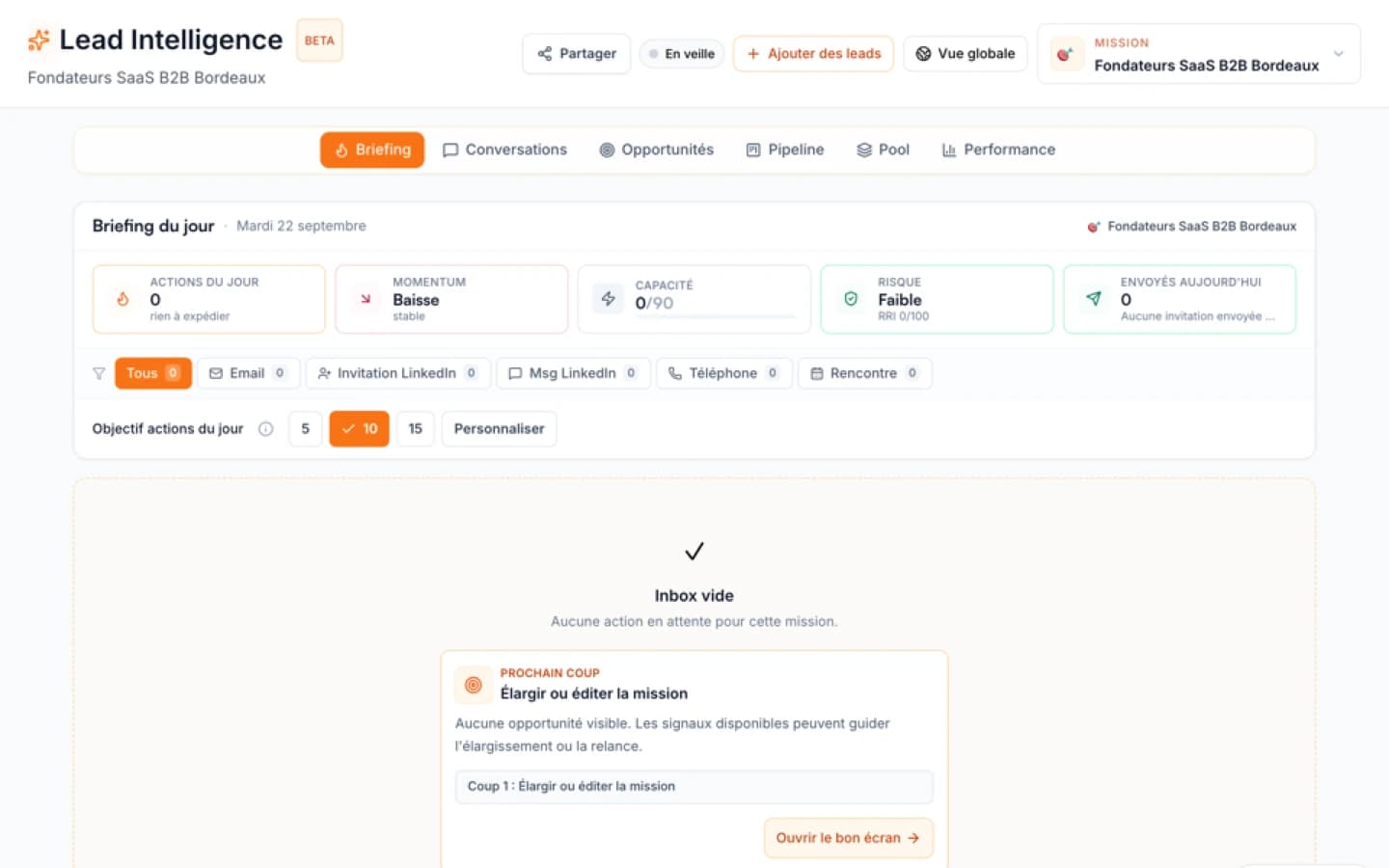
Choosing between an outreach-automation platform and an acquisition-intelligence layer means locating the friction point in your sales cycle. If you already know who to contact and your positioning is validated, automating touchpoints saves valuable time. If the difficulty is knowing which accounts are genuinely ready for a conversation, more volume simply accelerates contact burnout.
La Growth Machine and Lead Intelligence answer two distinct stages of outbound prospecting. La Growth Machine is an execution engine orchestrating multi-channel workflows on LinkedIn and email. Lead Intelligence is a decision layer that evaluates business signals, context and timing to identify who deserves contact before any message is scheduled.
Outreach execution versus contextual engagement decisions
Prospecting splits into two disciplines:
- The engagement decision: which accounts face a pressing stake, which event justifies immediate outreach, which channel fits and which angle makes the conversation relevant.
- Sequence execution: scheduling multi-channel sends, enrolling contacts in programmed follow-ups, switching channels when a connection request stays pending and grouping replies.
Platforms like La Growth Machine concentrate on the second discipline: deliverability, sequence branching and reply handling once the list exists. Lead Intelligence positions itself on the first. On its product page, the module presents itself as an acquisition-intelligence layer that turns timing into meetings: it answers four editorial questions (who to contact, why now, on which channel, with which angle) rather than reducing outbound to raw volume.
How La Growth Machine orchestrates multi-channel sequences
According to its product documentation, La Growth Machine handles conditional email and LinkedIn sequences, including switching channels when a connection request is not accepted. The platform documents A/B testing, custom attributes, AI message assistance and voice-message introductions. LinkedIn and email replies share an inbox filterable by identity, campaign or status, where teams qualify responses.
The official pricing reflects that execution role: billing applies per sending identity, while invited collaborators can draft campaigns or handle replies in the workspace. Daily send volume stays bound by the connected channels' limits: unlimited lead capacity does not mean unlimited delivery.
The upstream challenge: why volume alone stalls pipeline
When response rates drop, the standard reaction is to push more contacts into automated sequences. This approach assumes outbound is a pure probability equation.
In reality, unsolicited outbound fails primarily because of poor timing and non-existent context. In his July 2013 essay Do Things That Don't Scale, Paul Graham noted on paulgraham.com that the most common unscalable thing founders have to do at the start is to recruit users manually. Rushing to scale outreach before confirming whether a prospect actually has an urgent problem usually yields silence or domain reputation damage.
Executing cold sequences against broad lists creates hidden costs:
- Domain and profile fatigue: high-volume outreach without verified triggers increases spam reports and risks profile restrictions.
- Operational drag on sales reps: sales representatives spend hours triaging low-intent replies, out-of-office notifications or angry opt-out requests rather than holding consultative calls.
- Lost market goodwill: contacting key accounts with generic copy closes doors that could have produced contracts had the outreach coincided with a relevant trigger.
How Lead Intelligence drives the decision layer
Lead Intelligence starts from the commercial mission and customer profile to prioritize relevant accounts. Check current contact import and enrichment limits in the application before a large campaign.
The module classifies accounts into explained opportunities (to watch, to handle or to discard), monitors signals on people and companies, proposes the next action and channel consistent with the lead's situation, then links actions, replies, meetings and results to identify what converts. To go deeper on trigger management and how signal value decays, The Half-Life of Buying Signals in Outbound Sales explains the mechanics.
| Criterion | La Growth Machine | Lead Intelligence |
|---|---|---|
| Primary objective | Multi-channel sequence execution and centralized reply handling | Contextual qualification, timing analysis and action prioritization |
| Channels covered | LinkedIn and email sequences with conditional branching | Account search via LinkedIn or Sales Navigator from a connected account, plus CSV imports |
| Volume model | Billed per sending identity; daily sends bounded by connected channels | Set mission size to the need; check current limits |
| Contact ingestion | List import into campaigns for immediate enrollment | Check current import and enrichment options |
| Decision deliverables | Cadenced sending, A/B tests and shared reply inbox | Explained priority, recommended channel, personalized angle and learning loop |
| Team fit | SDR teams running planned cadences at high follow-up volume | Founders and revenue leaders aligning outreach timing with ICP strategy |
Selecting the right foundation for your sales process
The choice depends on your sales maturity and current constraint.
Choose La Growth Machine if:
- You have already validated your target, value proposition and messages through successful direct outreach.
- Your main constraint is time spent manually sending connection requests, follow-up emails and tracking.
- Your reps need a unified inbox to process incoming replies.
- You want to run methodical A/B tests on message variants across defined prospect cohorts.
Choose Lead Intelligence if:
- You need to know which accounts have a tangible reason to talk today before putting your domain reputation at risk.
- You want prospecting grounded in your strategy, ICP and observable signals rather than static databases.
- You prefer targeted outreach to a shortlist of highly relevant accounts over generic sequences at scale.
- You require an explanation for each recommended action and a loop connecting actions, replies and held meetings.
For many organizations, the two technologies play complementary rather than competing roles: a decision layer upstream to detect, verify and rank accounts carrying a timely signal, then an execution engine to orchestrate the technical send. Review your recent performance: if sequences generate steady engagement, accelerating execution frees capacity; if campaigns meet silence, strengthen the decision layer first with Lead Intelligence.
Sources
FAQ
Free diagnostic
Test your sales file
Drop an Excel or CSV and check its readiness without sending its rows to Ember.