
Automating sales outbound has shifted from basic email sequencing to multi-agent architectures that attempt to handle prospecting autonomously. With the introduction of Agent Hub, HubSpot has centralized the tracking and management of AI agents across marketing, sales, and service, including an AI prospecting agent designed to automate pipeline generation, alongside an Agent Builder to configure custom logic.
For commercial teams evaluating these developments, the core challenge remains unchanged: volume creates noise. Deploying automated agents can easily scale outbound activity, but without genuine qualification and clear prioritization, teams risk overwhelming their prospect base with uncoordinated outreach.
What HubSpot Agent Hub and the AI Prospecting Agent Bring to Sales Teams
HubSpot launched Agent Hub as a centralized control center to supervise AI agents across go-to-market workflows. According to HubSpot's product updates, the platform brings every AI agent running the go-to-market into a single view: what is active, what each agent is doing, and what results it drives across marketing, sales, and customer service.
Within this system, HubSpot includes an AI prospecting agent intended to identify and engage high-value leads, as well as an Agent Builder that creates an agent from a description of its role, triggered by an automation, a schedule, or a third-party integration, with no technical team required per the same source. This move addresses a clear need for organizations deeply rooted in HubSpot: coordinating inbound lead capture, CRM records, and automated outbound triggers in one shared environment.
When an organization already manages its full customer lifecycle inside HubSpot, running agents directly from the CRM simplifies governance. However, automating outbound touches directly from an existing CRM often surfaces a structural limit: agents work primarily with whatever data, contacts, and historical tags are already logged in that database. If outbound requires net-new discovery, external signal monitoring, and deep qualification before any message is sent, relying solely on CRM-centric automation can leave reps sorting through generic lists.
To place this decision in context, autonomous prospecting agents or intelligent CRM strategy brings together deeper guidance on the same field.
The Operational Tradeoff: Execution Volume vs. Opportunity Prioritization
Sales outbound fails when teams confuse activity with progression. Automated agents can generate dozens of drafted emails or push contacts through sequences quickly. Yet, commercial reps do not need more unvetted leads; they need to know exactly who deserves their attention today and why.
When assessing automated outbound systems, commercial teams face three distinct operational challenges.
1. Sourcing Context Beyond CRM Boundaries
Standard CRM prospecting workflows lean heavily on existing lists or basic demographic filters. True outbound relevance, however, requires grounding outreach in market discovery, external signals, and the broader strategic narrative of the company, such as its ideal customer profile (ICP), strategic positioning, and specific value drivers.
2. Explainability Over Automated Black Boxes
When an autonomous agent flags an account or schedules an email, sales reps need to understand the underlying rationale. If an algorithm assigns an arbitrary score without revealing the context, signals, and opportunity readiness, reps lose confidence in the recommendations and revert to manual vetting. The guide on qualifying a B2B lead without a scoring tool or a CRM details what a genuinely explainable qualification must make visible.
3. Avoiding False Thresholds
Many outbound automation systems demand a substantial baseline of imported data or extensive warm-up periods before delivering actionable outputs. A practical sales workflow should remain equally effective whether a team is targeting 10 high-value enterprise accounts or 1,000 mid-market organizations.
This approach also connects with signal-based selling to transform outbound prospecting, which clarifies the next choice.
Strategic Discovery with Lead Intelligence
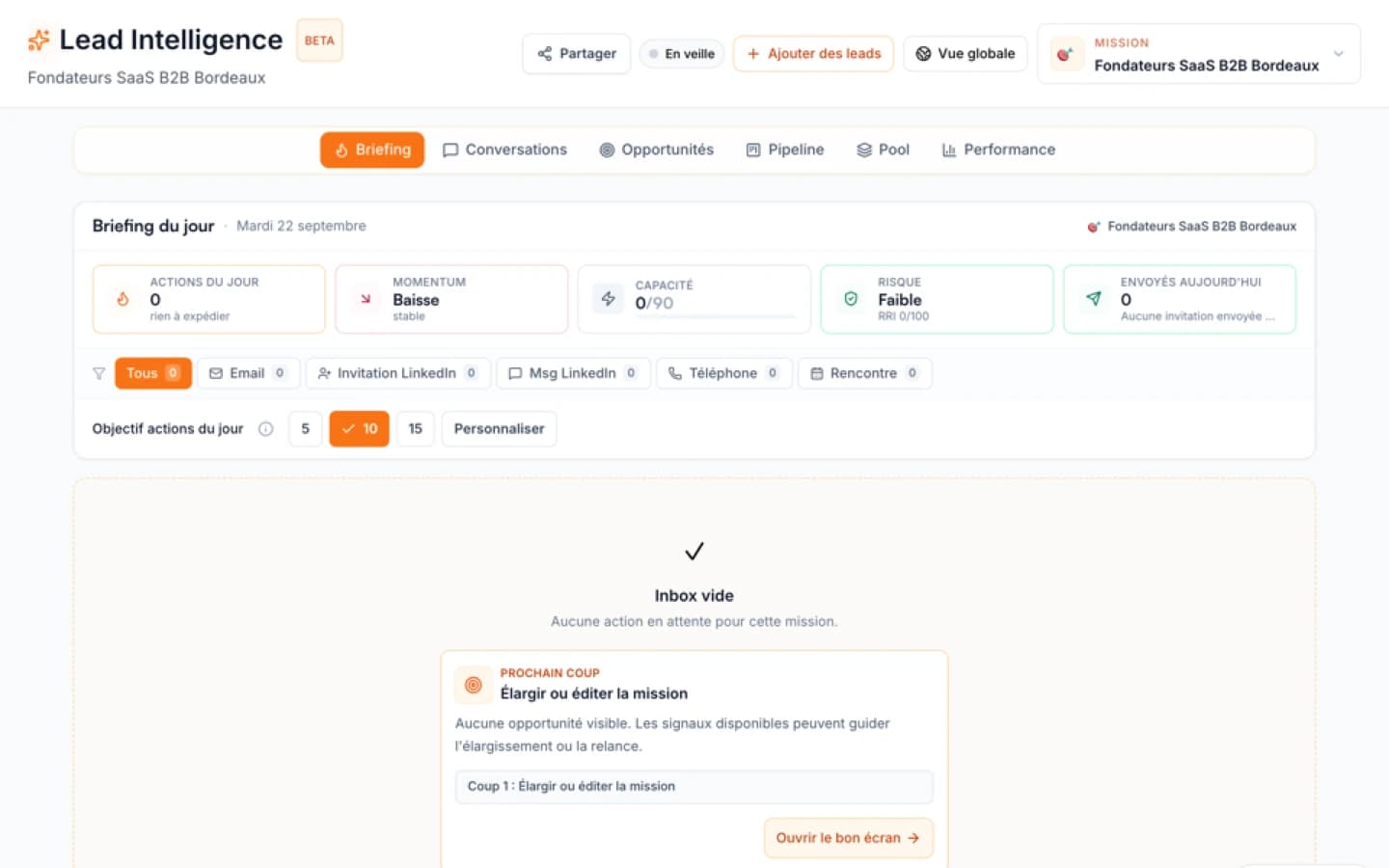
Where centralized platforms like HubSpot organize agent execution across an established CRM ecosystem, Lead Intelligence approaches outbound from the perspective of signal-grounded decision making. Rather than acting as a simple messaging sequencer, Lead Intelligence focuses on identifying who to contact, why now, and which angle makes strategic sense.
Grounding Outbound in Core Business Context
Outbound should never operate in a silo detached from commercial strategy. Lead Intelligence reuses the Business Plan, ICP, offer, and overall strategy to frame each sales mission. For ventures pursuing capital alongside commercial expansion, it can also prepare a fundraising mission from Fund Your Growth, targeting investors by investment thesis and prioritizing those contacts after founder confirmation.
Signal Monitoring and Account Classification
Instead of pushing unvetted contacts into sequences, Lead Intelligence finds accounts from mission ICP criteria and real-world signals, verifying useful sources along the way. It classifies accounts into clearly explained opportunities to watch, act on, or set aside. This reduces outbound noise by focusing rep attention exclusively on accounts that justify immediate engagement.
Volume Independence and Observable First Value
Sales teams cannot afford complex onboarding hurdles before seeing whether an approach works. With Lead Intelligence:
- Usable targeting context allows the first prioritized leads to appear in about 30 minutes.
- The platform finds and prioritizes contacts whether a team starts with 10, 100, or 1,000 contacts, operating with no minimum contact threshold.
- Reps can search and import profiles directly through LinkedIn or Sales Navigator from a connected account.
- Every mission provides visible, observable first value, displaying the contacts analysed, signals detected, and priority actions recorded.
In practice, the half-life of buying signals in outbound sales completes this framework with another angle on the same topic.
| Evaluation criterion | HubSpot Agent Hub and the AI prospecting agent | Lead Intelligence |
|---|---|---|
| Primary operational role | Centralized management of automated agents within CRM workflows | Contextual discovery and explainable opportunity prioritization |
| Context foundation | Native HubSpot CRM data and platform activity | Business Plan, ICP, offer, strategy, and external signals |
| Contact sourcing | Existing CRM contacts and platform triggers | LinkedIn/Sales Navigator import and autonomous account search |
| Volume dependency | Tied to HubSpot platform configuration and CRM records | Volume-independent, usable with no imposed minimum threshold |
| Output focus | Interaction automation and multi-hub pipeline tracking | Clear next action: who to contact, why now, which channel and angle |
Comparing Go-to-Market Outbound Approaches
Choosing between an embedded CRM agent ecosystem and a dedicated contextual intelligence engine depends on team maturity and technical structure.
HubSpot is well suited for organizations that require unified governance over multiple automated tasks across customer service, marketing, and sales directly within their existing HubSpot database. Conversely, when the goal is to cut through outbound volume, detect genuine commercial timing, and give sales teams an explainable path to conversation, Lead Intelligence delivers the necessary strategic clarity. The comparison with Apollo vs Ember Lead Intelligence for Founder Conversion extends the analysis to another outbound tool.
Before deciding, Apollo vs Ember Lead Intelligence for Founder Conversion helps connect this method with adjacent priorities, and the evidence to check before choosing Lead Intelligence sets the validation criteria.
Sources
FAQ
Free diagnostic
Analyse your HubSpot data
Measure whether HubSpot contacts contain enough context for sales action.