
The debate is often framed as a duel: autonomous prospecting agents on one side, an "intelligent" CRM on the other. It is the wrong question, for a simple reason: the two solve different problems. An agent acts: it writes, sends, follows up. A CRM governs: it knows who may edit a record, what decision was made on an account, what was promised to the customer. Confusing the two is like comparing a driver with the fleet registry: both serve transport, not the same function.
What this debate misses is the layer that connects your company context to the account to contact. Without it, tools optimize form more than decision. You see teams automating outreach on poorly targeted lists, or filling their CRM with meeting notes nobody re-reads.
The real trade-off for an SMB is therefore not "agent or CRM", but three distinct functions: running sequences, keeping commercial memory, and deciding who to contact first. The third function is the most outsourced of all, even though it determines the value of the other two.
What the market is already doing
Three recent moves show automation gaining autonomy and consolidating, without automatically solving prioritization. On March 4, 2026, Apollo launched its AI Assistant, described by the vendor as an agentic GTM operating system that executes full workflows (research, enrichment, sequences) in natural language, after a beta that opened in October 2025. On October 14, 2025, Salesforce announced general availability of Agentforce 360, its platform designed to connect humans and AI agents in one system. And on December 3, 2025, Clari and Salesloft completed their merger, forming a single vendor covering data, workflows, and sales engagement.
These three moves tell the same story: the execution layer is industrializing and consolidating. Meanwhile, the decision layer, the one that picks the account and the signal, remains mostly split between a rep's intuition and static filtering rules. Efficiency rises; the relevance of target selection does not automatically follow.
| Criterion | Autonomous agents (Apollo-type) | Intelligent CRM (Salesforce-type) | Context and signal prioritization (Lead Intelligence-type) |
|---|---|---|---|
| Primary role | Execute: find contacts, launch sequences | Govern: data, permissions, pipeline, history | Decide: prioritize accounts and signals based on your mission |
| What it optimizes | Action volume and execution speed | Process compliance and traceability | The relevance of the account to contact now |
| Core strength | Fast execution on named targets | Memory, permissions, pipeline visibility | Priority grounded in your ICP, offers, and observed signals |
| Typical limit | Requires that you already picked the right accounts | Does not pick accounts for you | Replaces neither execution nor governance: sits on top |
| When it breaks | When the market shifts or targeting runs on intuition | When setup and governance costs exceed your team's stage | When no strategic context exists yet |
| Cost | Depends on the plan chosen and the export credits used (see the vendor's pricing page) | Varies with modules and level of integration | See Ember's pricing page |
The three layers do not replace each other, they complement each other. Picking an agent without a decision layer means executing faster in a possibly wrong direction. Picking a CRM without an execution layer means documenting an activity that stays manual. Having no prioritization layer means choosing accounts by gut feel, even with the best tools on the market.
Why the decision layer remains the weak link
Most SMBs buy execution and memory, then improvise prioritization. It is understandable: execution is visible (emails go out), governance is reassuring (processes exist), while the decision seems "free" because it happens in the founder's head.
That reasoning gets expensive when the market moves or the team grows. Buying signals have a short half-life, and a missed opportunity often stays missed for months. Three mechanisms explain why the decision layer gets neglected:
- Visibility bias: a sent email is visible, a deprioritized account is not. Investment flows where progress is immediately measurable.
- Problem displacement: CRMs are excellent at ordering what already entered the pipeline; they do not decide who should enter it.
- Cognitive load: the more tools an SMB adds, the more choices there are to make. When everything becomes a decision, nothing truly is.
The result: reps spend most of their time not selling. In Salesforce's State of Sales study (5,500 professionals across 27 countries, surveyed March 8 to April 18, 2024), reps spend 70% of their time on non-selling tasks. The survey adds that 81% of teams are experimenting with or have deployed AI, and that teams using it report revenue growth more often (83% versus 66% without AI).
On the user side, HubSpot's synthesis on AI in B2B sales reports that 64% of reps say automation saves them 1 to 5 hours per week, and that sellers genuinely working with AI are 3.7 times more likely to hit quota.
Gartner tempers the enthusiasm: according to a forecast reported by CRM Magazine, by 2028 AI agents could outnumber human sellers ten to one, yet fewer than 40% of sellers would report that these agents actually improved their productivity. Volume does not create value: without prioritization, agents accelerate noise as much as signal.
When each layer is enough, and where Lead Intelligence fits
Not every SMB needs all three layers at the same level of sophistication:
- CRM alone suffices: when the cycle is simple, the pipeline short, and one person tracks everything.
- Execution agent first: when you have solid targeting and a stable market, but not the hands to run it. A product like Apollo is optimized for exactly that.
- Decision layer first: when you sell on signals, when accounts look too similar to rank by intuition, or when your targeting depends on market movements.
- All three layers: when you sell B2B with complex cycles, multiple decision-makers, and scattered signals. This is not an enterprise luxury: it becomes a necessity as soon as the number of decisions exceeds what a founder can arbitrate each week.
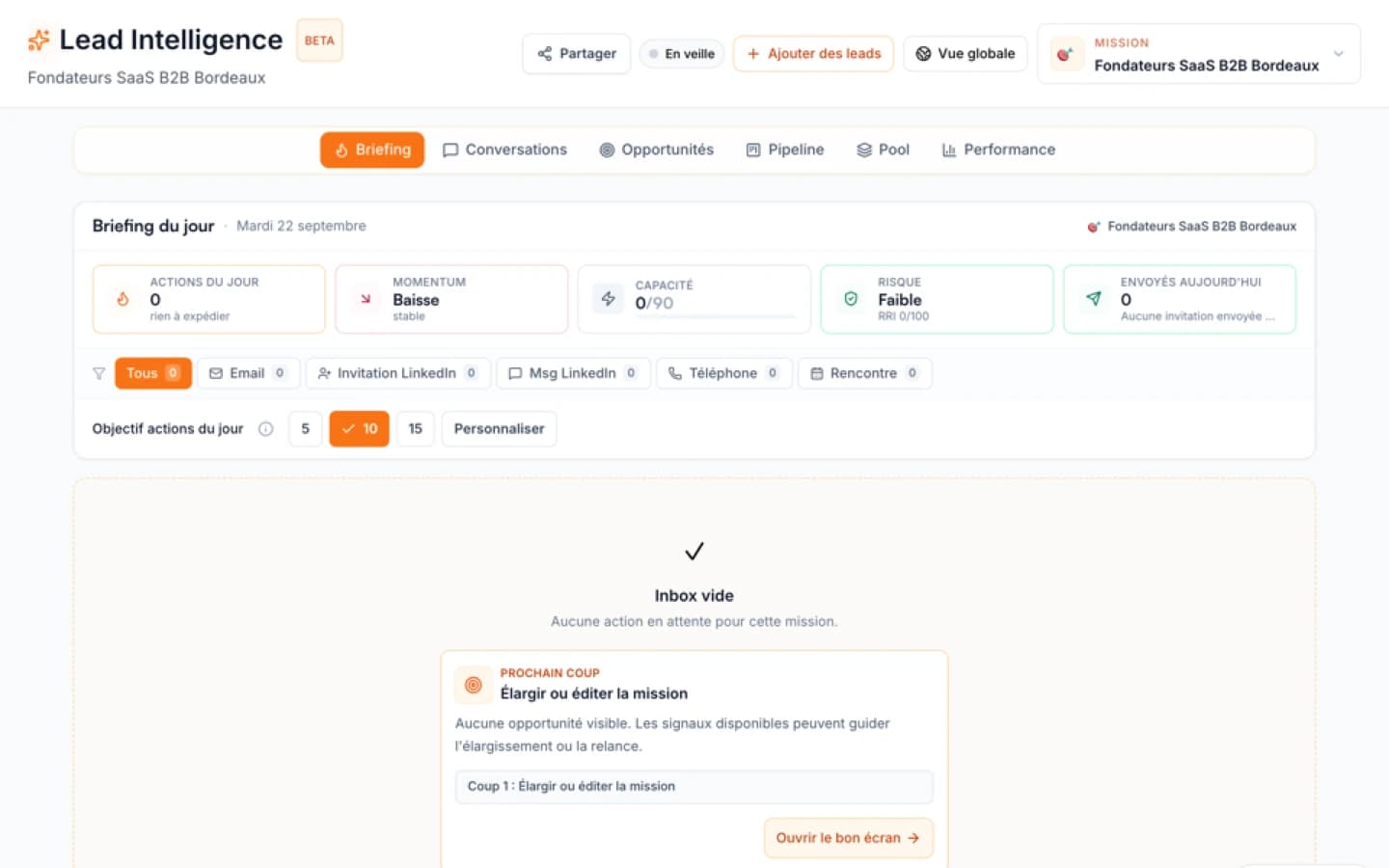
Lead Intelligence positions itself as the decision layer. It starts from strategic context (ICP, offers, constraints), applies the declared mission, and produces an explained priority: which account, why now, through which channel, with which angle. According to the product, first prioritized leads can appear in about 30 minutes when usable targeting context exists, and the module works with bases of 10, 100, or 1,000 contacts with no minimum threshold. Import can prepare up to 3,500 valid contacts from Excel or CSV after cost confirmation, and a mission can come from a Fund Your Growth file. It replaces neither sequence execution nor the CRM: it sits upstream of both.
The question to ask before any purchase is therefore simple: in your team, which layer is already solid, and which still runs on intuition? That is the one to tool first. To go further, Signal-Based Selling: How to Turn Timing into Pipeline details how to turn timing into pipeline, and The Half-Life of Buying Signals in Outbound Sales explains why signal freshness changes everything. On the product trade-off, Apollo vs Ember Lead Intelligence for Founder Conversion and Apollo vs Ember Lead Intelligence for Founder Conversion address the choice directly, and HubSpot Agent Hub vs Lead Intelligence for Sales Outbound covers the other major CRM option.
Sources
- Apollo Launches AI Assistant, Powering End-to-End Agentic Workflows in the First AI-Native All-in-One GTM Platform
- Welcome to the Agentic Enterprise: With Agentforce 360, Salesforce Elevates Human Potential in the Age of AI
- Clari and Salesloft Complete Merger, Appoint Steve Cox as CEO to Build First Predictive Revenue System
- New Salesforce Research: AI Adoption Soars Among Sales Teams
- AI in B2B Sales: How Teams Use AI to Sell Smarter
- AI Agents Poised to Reshape Sales, Gartner Says
- Apollo pricing
- Ember Lead Intelligence
FAQ
Free diagnostic
Analyse your Apollo data
Check whether your Apollo contacts are complete and recent enough to prioritise.