
Signal-based selling replaces speculative outbound with timely outreach triggered by verifiable buying signals. Instead of blasting thousands of generic emails to static lists, sales teams track real operational indicators such as executive hiring, software installations, website engagement, and funding milestones. Reaching out when a company is already experiencing the friction your product solves turns cold interruption into consultative timing.
For small and medium-sized businesses (SMBs), this transition has moved from a tactical experiment to an operational necessity. Spam filters are stricter, inboxes are saturated, and buyers ignore self-centered pitches. According to PulpMeUp, the average response rate on generic cold outreach sequences in 2026 hovers near 0.8%. Continuing to blast unqualified lists burns market reputation and exhausts sales team morale. Shifting to intent-led selling protects domain health while driving higher conversion from a fraction of the outbound volume.
The structural breakdown of mass cold outbound
The classic outbound playbook relied on brute force: export a static contact list from a database, filter by industry and company size, write a sequence explaining what your product does, and blast it to thousands of inboxes.
This model fails because it ignores timing. Even if your Ideal Customer Profile (ICP) definition is accurate, only a tiny percentage of those companies are actively in a buying window. When you reach out three months after a prospect has committed budget to an incumbent vendor, the highest quality pitch in the world lands flat.
Mass prospecting creates three specific liabilities for growing B2B teams:
- Domain and deliverability degradation. Major email providers aggressively throttle and filter domains that exhibit high bounce rates, low reply rates, and frequent spam reports. Burning your primary domain destroys customer communication channels well beyond sales outreach.
- Brand burnout. High-velocity, irrelevant messages educate your total addressable market that your outreach does not warrant attention. Once key decision-makers tune out your brand, re-engaging them later becomes twice as difficult.
- Sales fatigue. Sales development representatives spending hours logging unqualified conversations, chasing disengaged contacts, and managing manual data cleaning experience rapid burnout without building pipeline.
What constitutes a B2B buying signal?
A buying signal is an observable event indicating that a target organization has entered a transitional phase, encountered a bottleneck, or gained budget to solve a problem. Sales teams categorize these indicators into three primary tiers.
First-party intent signals
First-party signals stem directly from your own digital properties. They represent the strongest purchase readiness because the prospect is already interacting with your brand.
- High-intent URL visits, such as repeated reviews of your pricing page, API documentation, or customer comparison guides.
- Re-engagement on past proposals, such as a contact from a stalled deal reopening quotes or case studies months later.
- Inbound engagement with product assets, technical whitepapers, or interactive calculators.
Third-party intent signals
Third-party signals reflect research activity taking place across external platforms.
- Topics consumed across independent industry publications and research networks, indicating active problem exploration.
- Product category comparisons and competitor profile evaluations on software review platforms.
Contextual and operational triggers
Operational triggers are public changes in an organization that reliably precede an operational purchase. For B2B sales teams targeting mid-market accounts, these are often the most actionable entry points.
- Leadership changes: the arrival of a new VP of Sales, CTO, or Head of Operations usually comes with fresh budget, new mandate priorities, and an appetite to evaluate modern tooling.
- Hiring patterns: a company opening several account executive positions signals upcoming pressure on pipeline generation and Customer Relationship Management (CRM) infrastructure.
- Technology stack updates: the public deployment or removal of specific software frameworks highlights internal transformation programs.
- Capital events: seed, Series A, or private equity investments create immediate expectations for headcount expansion and operational efficiency.
Not all signals age the same way: a pricing-page visit goes stale within days, an appointment stays actionable for a few weeks. On this point, prioritizing B2B buying signals by half-life explains how to adjust reaction tempo. To explore the product trade-off further, Apollo vs Ember Lead Intelligence for Founder Conversion details a step directly related to this decision.
| Dimension | Traditional mass outbound | Signal-based selling |
|---|---|---|
| Target selection | Static data based only on industry, size, and job title | Dynamic data crossing the target profile with recent operational events |
| Trigger | Arbitrary calendar or periodic contact-list imports | Observable event such as an appointment, a hiring wave, or a website visit |
| Message framing | One-sided presentation of product features | Immediate framing around the transition the prospect is living |
| Address volume | Mass sending to broad segments | Selective outreach focused on active buying windows |
| Key success metric | Open rate and volume of messages sent | Qualified account engagement rate and pipeline progression |
This approach also connects with Apollo vs Ember Lead Intelligence for Founder Conversion, which clarifies the next choice.
How to build a signal-driven sales routine
Transitioning your team requires altering both how you uncover prospects and how you write messages. The objective is never to sound like an automated surveillance tool, but rather an informed advisor who understands the business implications of an event.
1. Define two to three high-confidence triggers
Avoid tracking every possible event simultaneously. For SMB sales teams, signal overload creates as much paralysis as list fatigue. Begin with two or three triggers that have historically appeared across your closed-won deals.
If your solution streamlines new-hire onboarding, watch hiring waves. If your technology improves commercial data hygiene, track revenue operations (RevOps) leadership appointments.
2. Absorb the context before writing
The signal sets the tempo, but contextual analysis provides the discussion angle. As soon as a trigger appears, analyze its impact on the concerned decision-maker's daily reality.
A funding announcement does not call for an automated congratulations message followed by a demo pitch, but for a step back: this stage typically forces leadership to accelerate execution without needlessly multiplying structural costs.
3. Adopt the relevant-problem method
An effective outreach relies on a three-step logical progression:
- Relevance: mention the triggering event naturally, whether it is a hiring phase or an infrastructure change, without technical indiscretion.
- Operational insight: formulate the concrete challenge most organizations face at this same stage, sharing an observation drawn from similar experiences.
- Low-friction invitation: replace the systematic 30-minute meeting request with a targeted resource, a methodological benchmark, or a precise question that invites a fluid exchange.
In practice, first customers: deciding who to contact first completes this framework with another angle on the same topic.
Orchestrating context and execution with Lead Intelligence
Many teams attempt to assemble signal-based prospecting by connecting standalone databases, scraping tools, and spreadsheets. While dedicated point solutions can handle individual enrichment steps, small teams often find the maintenance overhead unsustainable.
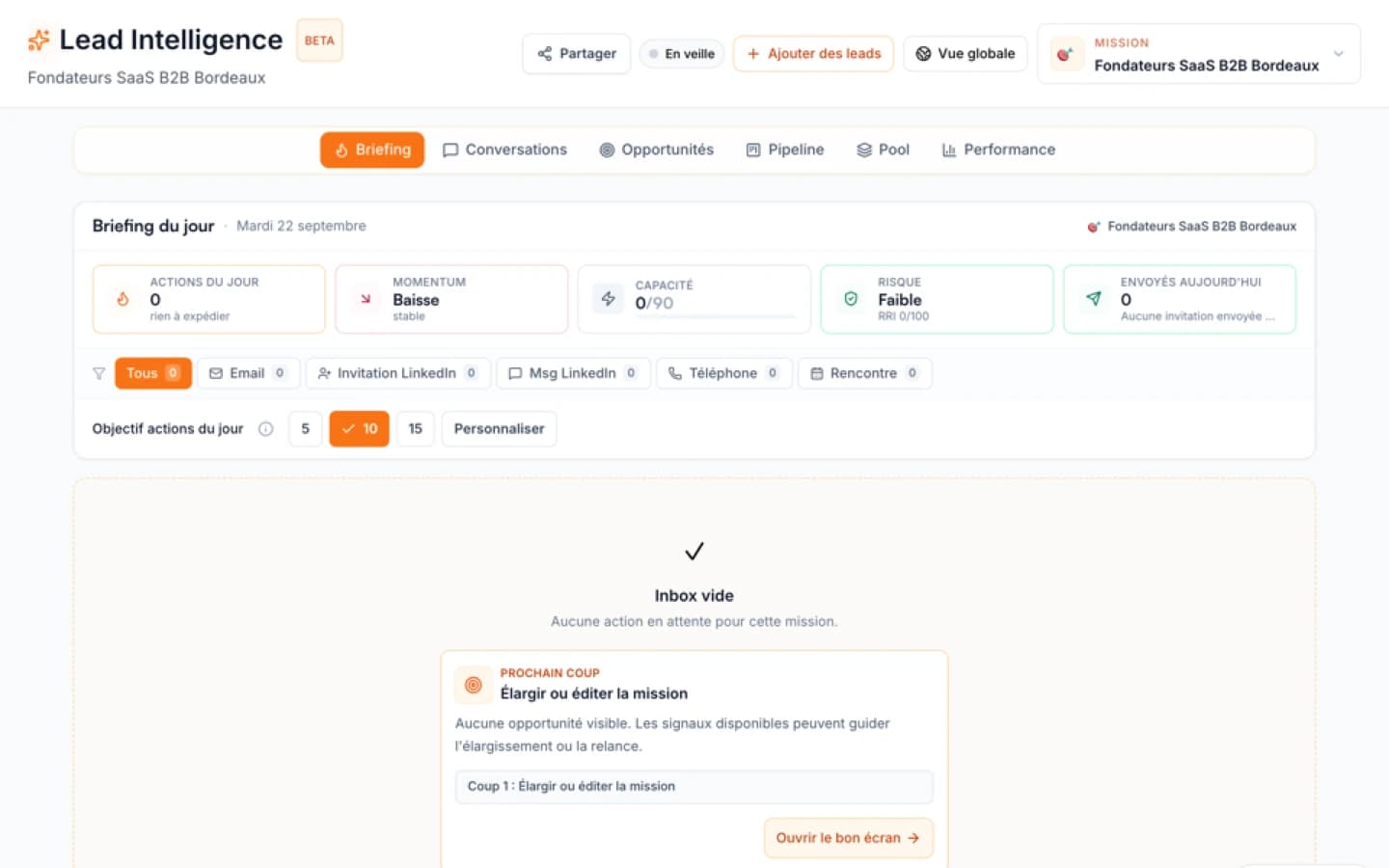
Ember approaches sales prioritization through Lead Intelligence. Rather than forcing sales teams to operate across fragmented tools, Lead Intelligence reuses project context, business strategy, and target definitions directly from your workspace.
The platform monitors external signals across companies and key people, evaluates incoming events against your Ideal Customer Profile, and prioritizes opportunities based on opportunity readiness. Instead of delivering an unstructured table of raw alerts, it classifies accounts into clear recommendations to watch, act on, or set aside.
For each account requiring outreach, Lead Intelligence suggests the next appropriate action, identifying the right contact, the optimal channel, and the contextual angle to take.
Following each initiative, the platform reports the actual contacts analyzed, signals detected, and priority actions recorded, keeping the process grounded in verifiable account progression.
Before deciding, qualifying a B2B prospect without a CRM or scoring tool helps connect this method with adjacent priorities, and HubSpot versus Ember depending on your case clarifies the trade-off with a classic CRM.
Reading market shifts to outpace generic outreach
The first indication of a market turn lies in the steadily falling profitability of historical outbound methods. As email providers tighten their protections, the acquisition cost of mass sending rises while the value of the commercial relationship degrades.
Systematic detection of buying signals does the opposite: it turns prospecting into a mutually relevant intelligence service. By intervening only when the prospect's maturity and operational needs align, sales teams concentrate their resources on high-value conversations, which contributes to building a steadier pipeline that is more resilient to deliverability shocks.
Sources
FAQ
Free diagnostic
Test your sales file
Drop an Excel or CSV and check its readiness without sending its rows to Ember.