
Symptom or signal
As an early-stage founder, you might find your calendar packed with tasks but empty of meaningful customer conversations. You have imported thousands of contacts into your Customer Relationship Management (CRM) tool, yet your email open rates are declining and your response rates are flat. The primary symptom is a feeling of constant noise. You are spending hours tweaking email templates or managing credit-based prospecting platforms, but you still do not know who to contact, why now, and with which message. This disconnect is a classic signal that your go-to-market efforts are spread too thin, diluting your focus across low-potential leads instead of concentrating on the high-value opportunities that drive growth.
To place this decision in context, the Knowledge guides for sales bring together deeper guidance on the same field.
What changed
In the early days of B2B sales, outbound success was treated as a pure numbers game. Founders were advised to scrape massive databases, build giant lists, and send generic automated sequences to hundreds of targets daily. However, the rise of automated outreach has flooded executive inboxes with low-quality noise. Buyers have developed high resistance to generic templates. Today, success is no longer about who can send the most emails; it is about who can identify the most relevant context. Modern sales intelligence platforms have scaled aggressively to support volume-driven outbound, but this has created a compounding cost in both credit consumption and wasted team hours.
Facts and sources
The 80/20 rule, originally formulated by economist Vilfredo Pareto, is a well-established business principle showing that a small fraction of inputs typically produces the majority of results source. In a commercial setting, this often manifests as 80% of a company's profits or sales coming from 20% of its customer base source. Applying this to early-stage startups, the rule suggests that the vast majority of your early traction will come from a highly concentrated group of ideal customers source. Meanwhile, massive sales engagement platforms like Apollo have scaled to meet the demand for volume, reaching 150 million dollars in annual recurring revenue in 2025 by offering large contact databases and automated sequencing source. Yet, many teams find that credit-based pricing models turn every single export or verification into a metered decision, compounding costs without necessarily improving conversion rates source.
To explore this point further, How to Qualify B2B Leads Without BANT or MEDDICC? details a step directly related to this decision.
Why the common explanation is incomplete
Most business guides explain the 80/20 rule as a simple call to do more of what works and less of what does not. They tell you to look at your existing revenue, find your top customers, and find more like them. But for an early-stage founder, this advice is incomplete because you do not have enough historical data yet. You cannot analyze a massive customer base if you only have a handful of active design partners. The common explanation assumes you already know your Ideal Customer Profile (ICP) cold and have a stable pipeline. It fails to address the real challenge of early-stage discovery: how to find the initial small core of high-intent prospects when you are starting from scratch or working with a highly limited contact list.
The real problem
The real problem is that volume creates noise, and noise kills early-stage startups. When founders focus on raw contact volume, they treat every lead as equal. This leads to wasted credits, bounced emails, and generic messaging that damages their brand reputation. Traditional prospecting platforms encourage this behavior because their business models are built on credit consumption for exports and enrichment source. The actual bottleneck for a founder is not a lack of names; it is a lack of actionable context. Without knowing which companies are experiencing active changes or which stakeholders are facing immediate pain points, you cannot craft a message that resonates.
This approach also connects with Clay vs Ember: when each one fits, which clarifies the next choice.
How the mechanism works
To apply the 80/20 rule effectively, you need a mechanism that filters out the mass of noise and highlights the small share of high-potential opportunities. This requires moving away from static lists and moving toward dynamic context. Instead of treating prospecting as a linear database search, you must monitor real-time signals across companies and people. By analyzing organizational changes, hiring patterns, and market shifts, you can identify which accounts are entering a window of readiness. This context-driven approach allows you to prioritize your outreach based on opportunity readiness rather than arbitrary volume, ensuring that your limited sales hours are spent only on conversations that have a genuine chance of converting.
Concrete examples
Consider an illustrative scenario: a hypothetical B2B software startup targeting engineering teams. Under a volume-first approach, the founder might export a list of 2,000 engineering managers and send them a generic sequence. This consumes hundreds of database credits, yields a fraction of a percent in reply rates, and offers no insight into why some replied and others did not.
Under an 80/20 approach powered by Lead Intelligence, still within this illustrative scenario, the founder starts with a highly targeted list of 100 contacts. The system monitors active signals, such as a recent technology stack change or a new executive hire. It identifies that 15 of these companies are currently undergoing a transition that makes them highly receptive to the startup's solution. The founder receives a clear next action, including who to contact, why now, and which angle to use. By focusing only on these 15 high-priority opportunities, the founder achieves a higher conversion rate with a fraction of the effort and zero wasted credits.
In practice, Does Real-Time Lead Qualification Replace BANT for Small Teams? completes this framework with another angle on the same topic.
When to use this diagnosis
You should apply this 80/20 prioritization framework if your team has plenty of contact names but struggles to choose the next conversation. It is highly effective when you are launching a new product, testing a new ICP, or operating with a small sales team that cannot afford to waste hours on cold, unverified outreach. If you need to make your priority explainable from context and real-time signals rather than relying on gut feeling, this diagnosis is the right fit.
When not to use it
This prioritization-first approach may not be necessary if your startup is operating in a highly transactional, low-average-contract-value market where success depends entirely on massive, automated email volume. If your primary goal is simply to build a massive contact database for long-term nurturing, or if you have a large team of Sales Development Representatives (SDRs) whose sole metric is the volume of outbound activities, a traditional prospecting platform or standard CRM may be sufficient for your needs.
Before deciding, No brand or contact list: choose first B2B outreach targets helps connect this method with adjacent priorities.
Next step
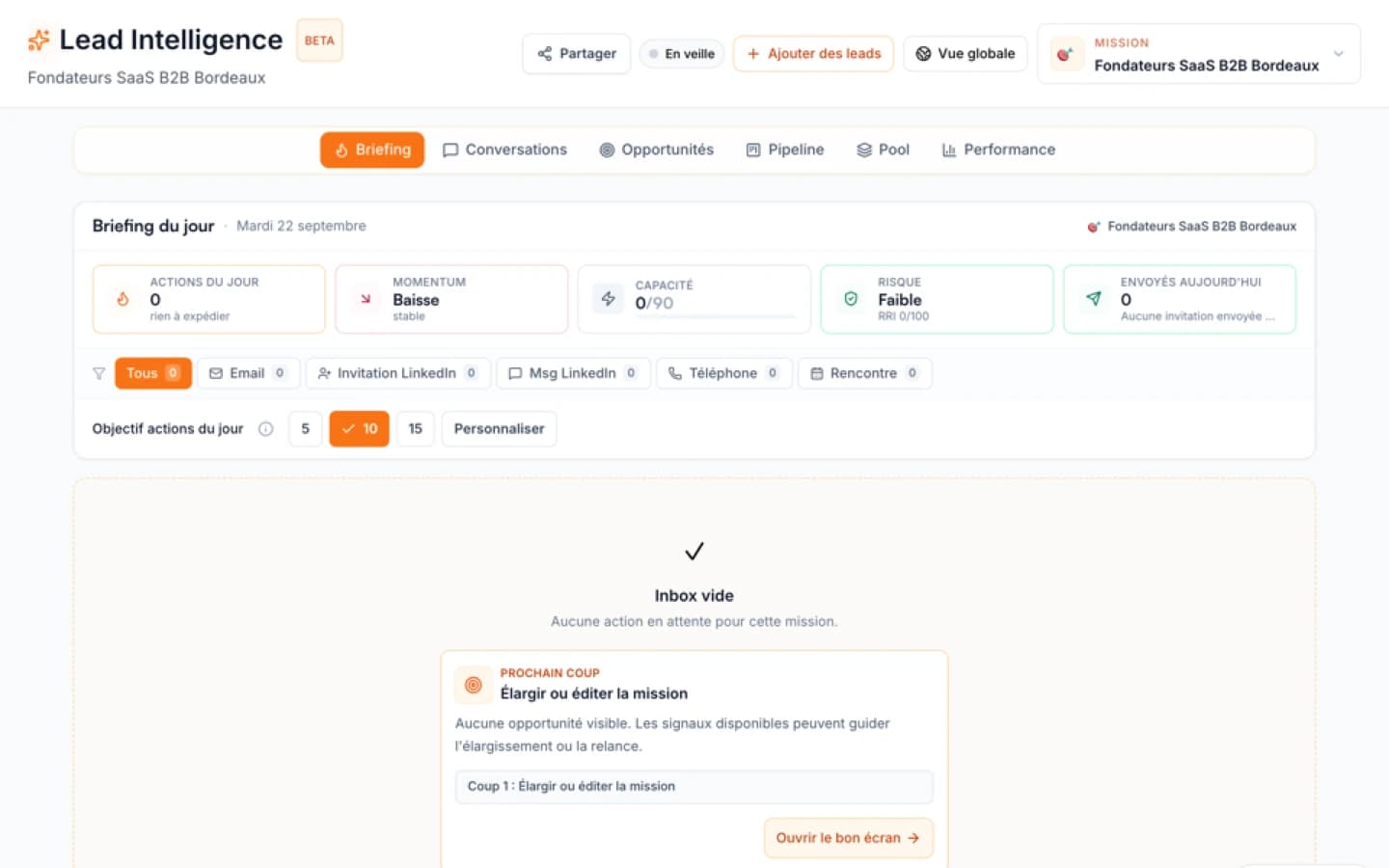
If you are ready to stop chasing volume and start focusing on the conversations that actually move the needle, you need a system built for prioritization. Ember's Lead Intelligence helps early-stage founders and sales teams decide who to contact, why now, and with which angle. By analyzing your business context, monitoring signals about people and companies, and providing clear next actions, Lead Intelligence reduces noise and focuses your attention on the opportunities that deserve action today. You can learn more about how to prioritize your sales pipeline by visiting the Lead Intelligence page.
Sources and methodology
This article is based on established business frameworks regarding the Pareto principle and its application to corporate efficiency source. It also incorporates market data regarding sales intelligence platforms, including revenue figures published by Apollo (source), alongside the official product capabilities of Ember's Lead Intelligence module.
| Criteria | The alternative | Ember |
|---|---|---|
| Targeting philosophy | Contact volume and mass exporting | Prioritization based on context and business signals |
| Pricing model | Credit-based billing for exports and enrichment | Plan details are presented on the Ember pricing page |
| Recommended action | Automated email sequences and generic templates | A clear next action: who to contact, why now and with which angle |
| Minimum contact threshold | Requires large volumes to get statistical results | No minimum threshold, works with 10, 100 or 1,000 contacts |
Sources
FAQ
Free diagnostic
Test your sales file
Drop an Excel or CSV and check its readiness without sending its rows to Ember.