
Under United States federal law, a B2B email that mixes operational updates with a sales pitch is classified by its primary purpose. If the recipient would reasonably conclude from the subject line or the opening paragraphs that the message promotes a product or service, the email is legally commercial. The Federal Trade Commission (FTC) makes no exception for business-to-business communications: a mixed email deemed commercial must satisfy every standard requirement of the CAN-SPAM Act, including a functional opt-out mechanism and a valid physical address.
Sales teams frequently try to blend product announcements, upsell offers, or demo invitations into invoices, onboarding notes, and customer check-ins. Understanding how federal regulations classify these communications prevents costly compliance oversights while protecting sending reputation.
The Primary Purpose Standard Under 16 CFR 316.3
The legal test for mixed communications is codified in the Code of Federal Regulations at 16 CFR 316.3. This rule establishes clear criteria for evaluating messages containing both commercial promotion and transactional or relationship content:
- The Subject Line Test: If a recipient reasonably interpreting the subject line would likely conclude that the message contains a commercial advertisement or promotion of a commercial product or service, the entire email is deemed commercial.
- The Body Placement Test: If the transactional or relationship content does not appear, in whole or in substantial part, at the beginning of the body of the message, the message is classified as commercial.
Beyond placement and the subject line, the regulation explicitly instructs evaluators to examine visual prominence. Relevant criteria include the proportion of the message dedicated to commercial content and how color, graphics, type size, and styling highlight the promotional elements over the transactional substance.
According to the official FTC CAN-SPAM Act compliance guide for business, the five statutory categories of transactional or relationship messages are read strictly and narrowly. An email sent to an existing client is not automatically transactional. If an account manager sends an invoice titled "Your Monthly Invoice" but opens the body copy with three paragraphs about an upgraded tier, that communication fails the body placement test and becomes a commercial email.
Does CAN-SPAM Apply to B2B Outbound?
A persistent misconception among sales teams is that business-to-business prospecting operates outside CAN-SPAM. The FTC explicitly addresses this assumption: the statute makes no exception for business-to-business email, as stated in the FTC CAN-SPAM Act compliance guide for business.
Commercial messages sent between companies must comply with standard statutory obligations:
- Accurate header and routing information (From, To, Reply-To).
- A non-deceptive subject line that accurately reflects the content.
- A clear and conspicuous disclosure that the message is an advertisement.
- A valid physical postal address for the sender.
- A clear mechanism allowing the recipient to opt out of future commercial messages.
Opt-out handling is strictly enforced. The sender must honor an opt-out request within 10 business days according to the FTC CAN-SPAM Act compliance guide for business. Furthermore, outsourcing cold outreach to an agency does not absolve the brand: both the business whose product is promoted and the entity actually transmitting the message can be held legally responsible.
Under 16 CFR 1.98, civil penalties assessed after January 17, 2025, reach up to $53,088 per violation under Section 5(m)(1)(A) of the FTC Act.
| Message Element | Transactional Qualification | Commercial Qualification |
|---|---|---|
| Subject Line | Accurately describes the transaction or service relationship | Mentions offers, savings, new tiers, or product pitches |
| Body Order | Transactional information appears in full or in substantial part first | Promotional hook or pitch appears before transactional details |
| Formatting and Design | Operational details remain prominent without visual promotion | Banners, bold callouts, or contrasting buttons emphasize the offer |
| Core Legal Burden | Requires truthful routing and non-misleading headers | Requires postal address, ad disclosure, and working opt-out |
Classifying Real-World B2B Sales Scenarios
Sales development and account management teams encounter mixed email classifications across routine customer workflows. Evaluating these through the FTC standard clarifies when full commercial disclosures must be inserted.
Account Updates and Invoicing
Consider a monthly billing receipt sent to an active corporate subscriber. If the subject line reads "Invoice for Order #4812" and the opening body contains the receipt details, balance due, and payment confirmation, the primary purpose remains transactional. Adding a brief, unstyled note at the bottom regarding an upcoming feature release does not convert the message into a commercial email.
Conversely, if the subject line reads "Save 20% on Annual Renewal plus your monthly receipt", the subject line leads the recipient to expect a commercial promotion. Under 16 CFR 316.3, that single phrasing choice classifies the entire email as commercial. The message must provide a valid postal address, clear ad disclosure, and a functioning opt-out method.
Onboarding and Feature Follow-Ups
When customer success representatives follow up during trial onboarding, operational instructions often blend with upsell opportunities. If the message focuses on completing workspace configuration, it qualifies as relationship facilitation. However, if the text pivots to pitching dedicated account tiers before addressing the user setup questions, the email fails the placement test. Sales teams looking to build disciplined multi-touch cadences can explore practical strategies in the Knowledge guides for sales.
Multi-Channel Outbound Workflows
Modern prospecting rarely relies on email alone. SDRs blend LinkedIn messages, phone outreach, and email touches. Because email carries strict primary-purpose rules and statutory opt-out deadlines, coordinating identity verification and contact preference across channels is vital. You can read more about identity hygiene in our guide on Why LinkedIn Verification Matters for Outbound Sales?.
Operational Checklists for Sales Teams
To avoid accidental CAN-SPAM violations on mixed emails, sales operations and revenue leaders should implement three standard safeguards:
- Separate Pure Transactions from Lead Generation: Do not force SDR pipeline goals onto automated billing, password resets, or contractual notices. Keep administrative notifications clean and unburdened by promotional banners.
- Review Subject Lines for Commercial Intent: Ensure subject lines for mixed messages describe solely the transaction. If the subject mentions an incentive, discount, or new product, treat the draft as a commercial campaign and include the required footer.
- Automate Global Do-Not-Contact Lists: When an opt-out arrives, whether through an automated unsubscribe link or a direct reply saying "unsubscribe", the record must be suppressed across all systems within 10 business days.
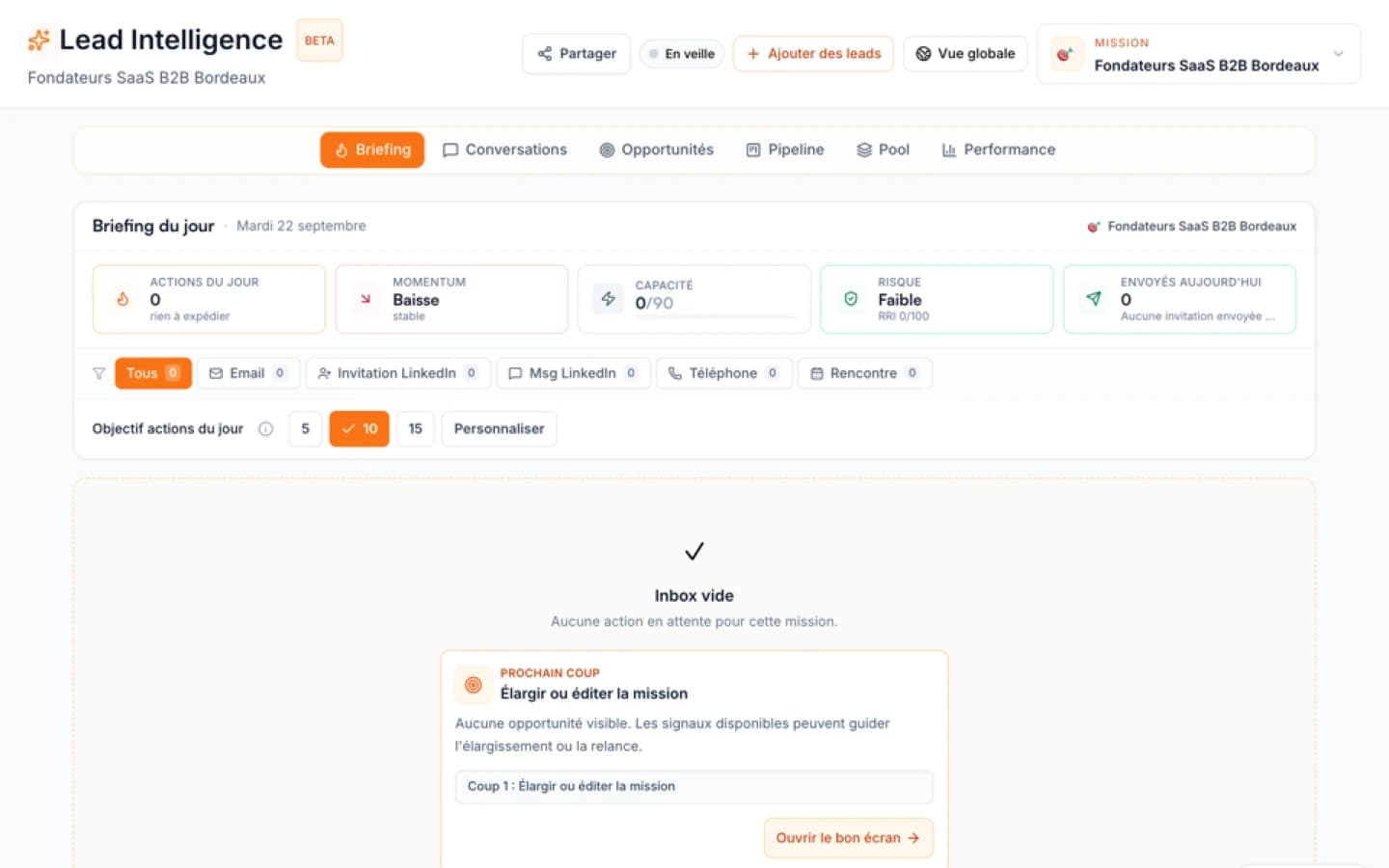
For teams running outbound prospecting alongside relationship marketing, Ember Lead Intelligence provides contextual prioritization by identifying verified accounts and qualified buyer timing. When objections or do-not-contact requests are logged, Ember automatically stops follow-ups, monitoring, and active actions for that contact, helping teams maintain structured compliance while focusing their efforts on receptive accounts.
Sources
- FTC : CAN-SPAM Act, guide de conformité pour les entreprises: source S1
- eCFR : 16 CFR 316.3, Primary purpose: source S2
- FTC CAN-SPAM compliance guide: business-to-business email is covered, with a 10 business day opt-out rule: source S2
- Page publique Lead Intelligence : reçu S8
- Page juridique données prospects : reçu S9
FAQ
Free diagnostic
Test your sales file
Drop an Excel or CSV and check its readiness without sending its rows to Ember.