
Choosing the right platform for business development hinges on a fundamental distinction: are you trying to organize your existing relationships, or are you trying to identify whom to contact right now and why?
A lightweight Customer Relationship Management (CRM) platform like folk centralizes contacts, syncs communications, and manages pipeline stages across shared lists. In contrast, an opportunity intelligence platform like Ember Lead Intelligence determines commercial priority by analyzing company context, real-world signals, and opportunity readiness before outreach begins. Choosing between them comes down to whether your operational bottleneck lies in managing address books or uncovering timely reasons to initiate a conversation.
What folk Solves: Centralizing Relationships and Lightweight Pipelines
For founders, agencies, and small commercial teams, traditional enterprise CRMs often demand too much configuration and maintenance. Tools like folk address this friction by offering an intuitive, spreadsheet-like workspace designed to gather contacts from mailboxes, calendars, and social networks into clean, collaborative tables.
According to the official folk pricing page, the platform offers a Standard plan at $24 per member per month billed annually (or $30 billed monthly), which includes pipeline management, email campaigns, 500 contact enrichments per month, and calendar or messaging sync. Its Premium plan costs $48 per member per month billed annually (or $60 billed monthly) and adds custom objects, deals, dashboards, and automated email sequences with 1,000 email enrichments per month, while an Enterprise tier begins at $80 per member per month on an annual commitment. A two-week free trial with premium features is activated upon signup.
In day-to-day operations, folk excels when you already have relationships or inbound prospect lists that need structured tracking. It is well suited for managing investor updates, PR media outreach, influencer collaborations, or boutique client pipelines where personal touchpoints matter most. If your primary goal is to eliminate scattered spreadsheets and maintain a single source of truth for your professional network, a lightweight contact CRM fulfills that role effectively.
What Ember Lead Intelligence Solves: Signal-Driven Opportunity Discovery
While a relationship CRM provides a place to store names, it leaves the burden of strategic timing entirely on the user. Sales development representatives and founders often spend hours manually scrolling through profiles, wondering whether an account has an active need or if an outreach angle will resonate.
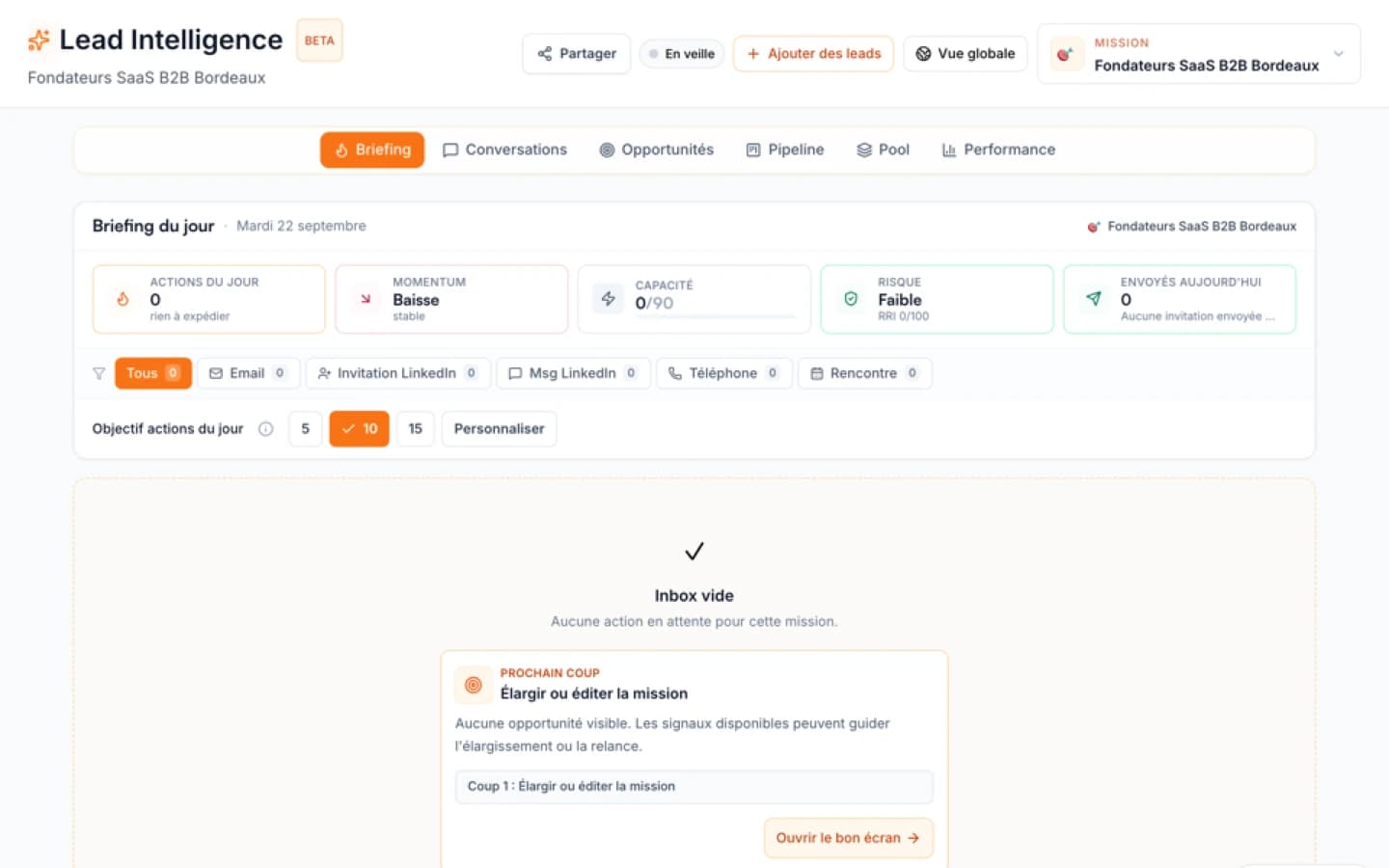
Ember approaches the acquisition challenge from the opposite direction. Rather than acting as a static database, Ember Lead Intelligence serves as an acquisition layer designed to turn timing into qualified meetings. It directly incorporates your business model, ideal customer profile (ICP), strategic positioning, and core offer to determine commercial priority.
The core mechanism rests on account qualification and readiness. Ember evaluates public sources, web signals, and business milestones to classify accounts into structured categories: accounts to watch, accounts to act on immediately, or accounts to set aside. Each identified opportunity comes with an explainable verdict and a distinct reason detailing why the contact is relevant right now. Instead of forcing sales teams to blast entire lists, Ember structures the workflow into actionable batches, allowing users to import up to 3,500 contacts and process them in waves of up to 200 contacts.
For teams looking to benchmark outbound effectiveness across different approaches, reviewing Cold Email Reply Rate Benchmarks and Practical Metrics highlights how strongly contextual timing influences outreach outcomes compared to static list broadcasting.
Structural Comparison: Contact Repository vs Prioritization Engine
Understanding how these platforms handle data, timing, and outbound actions reveals two distinct product philosophies:
| Dimension | folk | Ember Lead Intelligence |
|---|---|---|
| Primary Objective | Organize contacts and track stage pipelines | Uncover qualified opportunities and buying timing |
| Core Data Unit | Contact cards and shared workspace tables | Verified opportunities with contextual signals |
| Qualification Method | Manual tags, custom properties, and AI fields | Context matching against ICP, offer, and business signals |
| Outreach Execution | Integrated mass emailing and automated sequences | Suggested channel angles and draft generation with manual dispatch |
| Baseline Input | Imported contact lists, mailbox sync, calendar entries | Strategy brief, target ICP definition, and verified business triggers |
| Database Philosophy | Permanent repository for broad relationship histories | Active candidate pool preserving qualified leads and explicit reject reasons |
In folk, qualification is largely declarative: you create custom fields, filter by location or company size, and assign pipeline stages. Ember Lead Intelligence, by contrast, evaluates whether an opportunity is ready for action before a message is drafted. Within Ember's candidate pool, accounts that fail criteria are not deleted; they remain visible with documented disqualification reasons, ensuring teams do not waste credits or repeat disqualified outreach.
Furthermore, their approaches to messaging diverge. While folk supports automated sequential email sends on its Premium tier, Ember keeps dispatch deliberate. The platform prepares suggested message angles and drafts tailored to the specific opportunity readiness, but sending remains manual by design to maintain executive control over relationship quality and account reputation. Teams evaluating sales workflows can also consult comparisons like Close CRM vs Ember Lead Intelligence for Outbound Teams to see how execution-heavy sales environments differ from signal-based prioritization.
How to Choose Based on Your Acquisition Bottleneck
To select the right tool, examine where your commercial workflow currently loses momentum:
Choose folk if:
- Your core objective is contact organization: You need a shared team address book to track partners, journalists, active candidates, or existing clients.
- You have established inbound flows: Opportunities already reach your inbox, and you need a visual pipeline to track them from discovery call to signature.
- You rely on automated sequence broadcasting: You want a self-contained environment to build multi-step email campaigns directly across your uploaded contact lists.
- You require broad integration: You need plug-and-play connections with personal tools like WhatsApp, Google Calendar, and everyday inbox clients.
Choose Ember Lead Intelligence if:
- Your core challenge is prospect timing: You struggle to identify which target accounts are experiencing the exact inflection point your product solves.
- You want explainable outreach: You need every outbound action to be justified by clear business signals rather than arbitrary guesswork.
- You want to protect domain and brand reputation: You prefer sending fewer, highly targeted messages supported by real business context rather than running high-volume automated cold blasts.
- You seek strategic alignment: You want prospecting workflows that dynamically reflect your business plan, core positioning, and ICP without complex CRM architecture.
For broader perspectives on outbound strategy and target selection, browse the Knowledge guides for sales.
Aligning Systems for Scalable Outbound
These two product types are not mutually exclusive. Many organizations find that a lightweight CRM and an opportunity engine serve complementary stages of the revenue cycle.
A team can run Ember Lead Intelligence to monitor market signals, filter prospects against an ICP, and isolate the accounts ready for a conversation this week. Once an opportunity responds, converts into an active dialogue, or enters an advisory relationship, the contact record can be tracked inside a relationship CRM like folk to coordinate ongoing stakeholder management, contract negotiations, and internal notes.
Evaluating your immediate priority will dictate where to invest first. If your team cannot keep track of existing warm contacts, start by establishing an intuitive relationship repository. If your team has the capacity to talk to buyers but lacks a clear answer to who needs your offer today, deploying a signal-based opportunity layer provides the clarity needed to drive productive pipeline conversations.
Sources
FAQ
Free diagnostic
Test your sales file
Drop an Excel or CSV and check its readiness without sending its rows to Ember.