
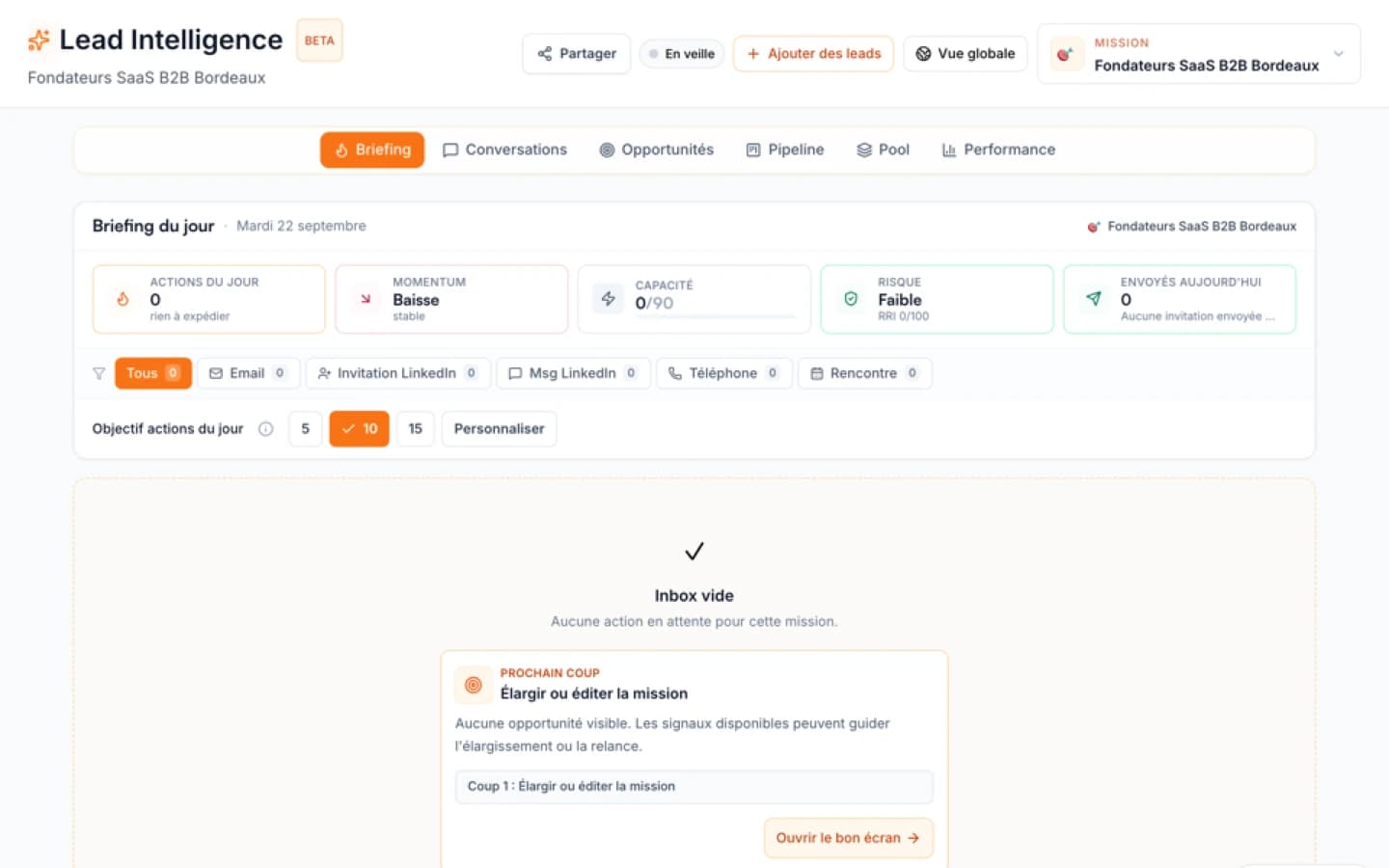
Modern outbound prospecting divides teams into two distinct operational camps: those who run a contact-enrichment engine measured in database credits, and those who run an acquisition-intelligence workflow driven by timing, business signals, and buyer context.
The distinction matters. When outbound fails, teams often assume they lack valid email addresses or direct dials. In reality, the issue is rarely contact data alone. Most outbound falls flat because teams contact buyers at the wrong moment, with an uncalibrated angle, or without a documented reason to reach out today.
Choosing between Zeliq and Ember Lead Intelligence comes down to whether your primary bottleneck is filling a contact database via credit waterfalls or qualifying outbound momentum based on strategic signals.
The Architectural Divide: Credit-Based Contact Mining vs Strategic Signal Prioritisation
Credit-based sales platforms approach outbound from a data-volume perspective. Their architecture centers on massive, indexed databases of individuals and companies. In this paradigm, your team pays per contact field returned: an email address, a mobile number, or an automated persona analysis. The workflow is transactional: run a search filter, deduct credits from an account balance, export records, and sequence them into automated messaging steps.
By contrast, context-driven acquisition intelligence starts from the premise that outbound volume creates operational noise. Instead of asking how many verified emails you can extract from a directory, signal prioritisation examines whether an account matches your ideal customer profile (ICP), what commercial trigger occurred, and why an outreach initiative makes business sense right now.
To decide which approach matches your revenue motion, compare how each platform structures core acquisition functions.
| Operational Dimension | Zeliq | Ember Lead Intelligence |
|---|---|---|
| Core Philosophy | Multi-channel engagement and contact enrichment platform | Acquisition intelligence layer focused on timing, strategy, and prioritization |
| Data Model | Internal directory and credit-based cascade enrichment | Signal discovery matched against ICP, strategic context, and mission rules |
| Pricing Currency | Credit tiers (emails, mobile dials, personality checks) | Usage tied to context processing and actual model generation |
| Outreach Delivery | Multi-channel sequences (email, automated actions, dialer) | Human-in-the-loop manual review with generated, contextual message drafts |
| Data Retention and Compliance | Team workspace sharing and CRM synchronization | Documented GDPR balancing tests, automated suppression blocks, strict retention limits |
How Zeliq Operates: Contact Cascades, Credits, and Multi-Channel Sequences
Zeliq is built as an all-in-one sales workspace designed to help sales development representatives (SDRs) and commercial teams consolidate contact sourcing and multi-channel outreach.
The Credit Currency and Feature Tiers
Zeliq monetizes data enrichment through a structured credit system, detailed across its pricing page and credit help documentation. Credits serve as the internal transactional currency across the platform and its Chrome extension:
- Enriching a verified email address costs 1 credit.
- Enriching a mobile phone number costs 10 credits.
- Generating an AI-driven personality analysis (using DISC profiling) costs 5 credits per profile.
If contact data cannot be located, credits are refunded automatically, and unused credits roll over without expiring according to the Zeliq credit documentation.
According to Zeliq's official pricing, subscription tiers govern platform capabilities and credit allocations:
- Basic Plan ($0 / month): Offers a free entry point allowing imports of up to 100 leads per month from Zeliq Search, two active email-only sequences, and dialer connectivity. Additional credits can be purchased as needed.
- Starter Plan ($59 / user / month): Provides 750 credits per month (translating to 750 email enrichments or 75 phone numbers), advanced search filters, unlimited multi-channel sequences across email and professional networks, and automated CRM synchronization with HubSpot. Annual billing drops this base rate to $47.2 per user per month.
- Custom Plan (from $1,500 / user / year): Requires a minimum of three user licenses and includes at least 24,000 credits per user per year, dedicated workspace management with custom roles (Admin, Manager, User), and priority support, as documented in their user access guides.
A 14-day free trial gives users access to Starter features alongside 50 trial credits to test verified email and phone enrichment workflows without requiring a credit card upfront.
Where Zeliq Fits Best
Zeliq is effective when an organization needs a straightforward contact extraction and outbound sequencing engine. If your sales team spends hours hunting for mobile numbers to feed into dialers like Aircall or Ringover, or needs to launch standard multi-step cold sequences directly from a single hub, Zeliq's credit model provides predictable operational mechanics.
Its database access and native sequencing allow high-volume outbound reps to move from a search query straight into automated email steps.
How Ember Lead Intelligence Operates: Strategy, Signals, and Timed Outreach
Ember approaches pipeline creation from the opposite direction. Rather than acting as a directory with contact credits, Ember Lead Intelligence functions as an acquisition intelligence layer designed to identify who to reach out to, why the timing is favorable, and what conversational angle to adopt.
Strategy Reutilization and Signal Discovery
Instead of asking users to configure disjointed search filters from scratch, Ember ties directly into your workspace context. A Lead Intelligence mission pulls from your existing business plan, ICP parameters, product offerings, and overall commercial strategy.
Missions can be established for commercial prospecting or fundraising initiatives:
- Commercial missions evaluate market signals, company indicators, and public domain data against your specific ICP criteria to surface actionable opportunities.
- Fundraising missions target individual investment professionals (fund partners, principals, analysts, and business angels) by mapping their public investment thesis against your company context, rather than treating investment firms as generic accounts.
Because volume creates noise, Ember does not require large contact batches to function. A discovery run operates effectively whether an organization starts with 10, 100, or 1,000 potential records, avoiding arbitrary minimum pipeline volumes.
The Pool, Wave Processing, and Manual Safeguards
Contacts identified during discovery are gathered in a centralized Pool. Ember handles candidate evaluation transparently:
- Weak matches or out-of-scope contacts are never deleted silently. They remain visible in the Pool marked with a clear rejection reason.
- Contacts presenting contradictory theses, elevated risks, or low confidence flags are surfaced for human review.
- An operator can reverse a rejection decision at any point, moving the contact back into an identified stage while preventing future discovery runs from filtering that contact out.
When importing existing external lists via Excel or CSV, Ember supports files up to 3,500 rows, 10 MB, and 200 columns. To protect data hygiene, imports are transmitted in blocks of up to 500 lines, while enrichment actions process in dedicated waves capped at 200 contacts at a time. If an import encounters network friction, verified rows remain intact while the system reports exact line numbers for unconfirmed entries.
Contextual Drafting and Intentional Execution
A contact card in Ember surfaces only verified intelligence: company identity, observable sources, and the strategic "why now" reasoning. Additional details such as viability scores and recommended next steps populate as enrichment completes.
Message generation follows an intentional, human-controlled model:
- Opening a contact profile never triggers automated messages.
- Draft creation is requested on demand, generating copy in French or English based on the mission parameters, contextual triggers, and the prospect's profile.
- Users can refine and modify message drafts dynamically, adjust channel routing, and verify tone before any outreach happens.
- Execution remains strictly manual by design. The system recommends and schedules the cadence, but the human operator approves and triggers every send.
For teams managing professional network outreach, Ember manages connection states and account rate limits through Unipile. Default outbound quotas safeguard account safety across account tiers:
- Standard accounts: 70 invitations per ISO week, 50 messages per day.
- Premium accounts: 150 invitations per ISO week, 80 messages per day.
- Sales Navigator accounts: 200 invitations per ISO week, 100 messages per day.
To protect new connections, limits are multiplied by 0.75 during the first 14 days after connecting an account. If a recipient replies, incoming message webhooks pause the cadence automatically.
Regulatory Architecture and Privacy Frameworks
Data handling represents a fundamental dividing line between mass directory scraping and contextual B2B intelligence.
Outbound teams operating under European data protection standards must maintain defensible processing grounds. According to Ember's prospect data rights documentation, B2B data processing rests on the legitimate interest basis of Article 6(1)(f) of the General Data Protection Regulation (GDPR), backed by documented balancing tests that restrict data processing to information relevant to business-to-business professional engagements.
Ember treats client organizations as data controllers for their outreach missions, while acting as a data processor for lead workflows. This framework enforces operational constraints:
- Suppression Management: When a prospect objects or enters a do-not-contact list, the system blocks active outreach, follow-ups, monitoring, and paid enrichments for that contact.
- Retention Ceilings: Prospect data is retained only for the mission duration and deleted or anonymized no later than three years after the last contact point, adhering to established B2B prospecting standards.
- Audit Trails: Rights requests are routed to manual administrative review rather than automated or unverified drawer exports.
For teams navigating cross-border compliance, understanding how to handle B2B prospect opt-outs under GDPR rules is essential to safeguarding brand reputation and legal standing.
Decision Criteria: Evaluating Your Sales Bottleneck
Selecting between a credit-driven contact database and an acquisition intelligence layer depends on where your sales cycle currently loses momentum.
Choose Zeliq if:
- Your main operational obstacle is contact data gaps: Your team already knows who to target and has honed their messaging, but reps lack verified mobile phone numbers and email addresses.
- You rely heavily on cold telephone outreach: You need a native connection to dialers like Aircall or Ringover to run high-volume calling blocks.
- You require automated multi-channel sequences: You want a single subscription that combines prospect lookups with automated email drip steps and task management.
Choose Ember Lead Intelligence if:
- Your outreach suffers from timing and relevance issues: Your team can find contact names easily, but your response rates lag because emails lack a compelling commercial trigger.
- You want outbound anchored in strategic company assets: You need prospecting workflows that inherit your validated business plan, ICP boundaries, and offer positioning without re-entering parameters.
- You prioritize conversational quality over volume: You favor human-reviewed messaging drafts and structured qualification pools over mass automated sequencers.
- You are running founder-led outreach or fundraising: You need to map direct investor theses and executive-level targets rather than spraying unsegmented accounts.
For additional perspectives on aligning tooling with outbound strategy, browse the Knowledge guides for sales or review our comparative analysis in Hunter or Ember Lead Intelligence: Which Fits Your Team?.
To see how signal qualification and strategic timing replace raw contact volume, explore Ember Lead Intelligence.
Sources
- Des Plans pour Votre Prospection B2B | Essai Gratuit
- Crédits ZELIQ | Centre d'aide
- Plans Zeliq et niveau d'accès utilisateur | Centre d'aide
- Zeliq : plans Basic, Starter et Custom, prix en dollars, crédits d'enrichissement, e-mails et numéros de téléphone : source S1
- Page publique Lead Intelligence : reçu S8
- Page juridique données prospects : reçu S9
FAQ
Free diagnostic
Test your sales file
Drop an Excel or CSV and check its readiness without sending its rows to Ember.