
When a prospect replies to an outbound campaign with "remove me from your list," most sales development teams take a shortcut. They mark the lead as unresponsive, pause the sequence, or delete the record from their immediate sales dialer.
That shortcut creates immediate regulatory exposure. On September 9, 2026, the French Data Protection Authority (CNIL) published a deliberation from July 21, 2026, issuing a €300,000 fine against IT consulting firm EXTIA. The core breach was not illegal outreach itself, but a failure to process rights requests under the General Data Protection Regulation (GDPR). Out of 265 erasure requests received by EXTIA in 2024, more than three-quarters were either ignored or handled unsatisfactorily. Specifically, 12 requests went unprocessed, 166 individuals were never informed about what happened to their data, and 27 were notified past the legal one-month deadline with delays spanning multiple months.
Crucially, EXTIA argued that candidate profiles were purged automatically by software. The CNIL rejected that defense, establishing that automated deletion does not exempt an organization from informing individuals of the outcome of their request within the statutory one-month window.
While the EXTIA ruling originated in recruitment and human resources files, the enforcement mechanism applies across all B2B customer relationship management systems and cold outreach operations. If your sales engine treats an opt-out as an informal email unsubscribe while ignoring backend suppression synchronization and formal communication, you are running the exact playbook the CNIL penalized.
Here is how to audit your B2B prospect data workflows, align your suppression lists with regulatory guidance, and isolate non-compliance signals before your growth stack triggers enforcement.
The Operational Fallacy: Opt-Out versus Full Erasure
In day-to-day sales development, revenue teams frequently confuse two distinct legal mechanisms: the right to object to commercial prospecting and the right to erasure (the right to be forgotten).
When a B2B recipient states they do not wish to be contacted, they exercise an absolute right to object. As detailed in the CNIL guidance on commercial prospecting, B2B outreach conducted under legitimate interest requires offering an easy, cost-free mechanism to object at collection and inside every subsequent message.
However, when a contact explicitly demands data deletion, two operational mistakes consistently emerge across sales stacks:
- Purging the contact without a suppression entry. Completely wiping an email address from your database means that the next time your sales development team enriches an account list from a data broker, that same prospect is re-imported as a brand-new contact. The objection is lost, and the prospect receives another sequence months later.
- Silently removing the address without closing the loop. Pausing a sequence or removing a record via automated script satisfies operational mechanics, but it fails the transparency mandate highlighted in the EXTIA ruling. The data subject has a legal right to know that their request was executed.
To prevent re-contacting opted-out prospects, the CNIL guidance on suppression lists issued on June 10, 2026, recommends maintaining a dedicated exclusion list (fichier repoussoir) for a minimum of 3 years. This suppression file must serve no other commercial purpose than enforcing the objection.
| Outreach Workflow Stage | Common Vulnerability | Compliant Architecture |
|---|---|---|
| Prospect reply ("Stop messaging me") | Sequence is paused in outreach tool, but CRM contact remains active | Global suppression event fires across all tools and mailboxes |
| List re-enrichment from third parties | New CSV imports re-add previously opted-out contacts | Imports are scrubbed against a master suppression file before ingestion |
| Explicit erasure request ("Delete my data") | Record is hard deleted with zero notification back to the sender | Backend data is purged, suppression hash is stored, written confirmation sent within 30 days |
| Retention of inactive prospect lists | Unresponsive cold contacts stored indefinitely in dialers | Systematic purge or opt-in renewal after 3 years without inbound engagement |
Five Non-Compliance Signals to Audit Across Your Outbound Stack
Evaluating your exposure requires examining data pipelines across customer relationship management platforms, sequence engines, enrichment APIs, and individual rep mailboxes.
1. Decentralized Inboxes Trapping Manual Opt-Outs
The most common point of failure in cold prospecting happens in manual reply threads. While link clicks on an unsubscribe URL generally register in a sequence tool, plain-text replies such as "Please take me off your database" often languish in an individual sales development representative's personal inbox.
If your team does not maintain a unified intake procedure to route manual objections into a centralized queue, requests go unanswered. Under the EXTIA decision, failing to process requests or informing subjects beyond the one-month legal window constitutes a sanctionable failure. Teams optimizing their deliverability through the Knowledge guides for sales should ensure that inbound opt-out handling receives identical priority to technical inbox maintenance.
2. Siloed Suppression Lists Across Sales Tools
High-velocity outbound setups often deploy multiple tools: one for multi-channel cadence automation, another for account intelligence, and a central CRM.
If a prospect asks to be removed inside your sequencing software, does that suppression automatically propagate to your CRM and your enrichment scrapers? When tools operate in silos, a marketing automation platform might suppress the contact while a junior rep running manual cold outreach re-discovers and re-contacts the same email three weeks later.
3. Missing Cryptographic Hashing for Stored Suppressions
Maintaining a suppression list presents an apparent paradox: how can you remember not to contact someone without keeping their personal data?
The CNIL clarifies that organizations can minimize held data by storing cryptographic hashes (fingerprints) of the email address or phone number rather than plain text. A cryptographic hash transforms an email address into a fixed-length string that cannot be reverse-engineered into the original address. When a new list from an external broker is imported, the software computes the hash of incoming records, matches them against the suppression hash database, and purges duplicates.
It is critical to note that under European data protection laws, cryptographic hashes derived from email addresses remain personal data. They must be secured with the same operational discipline as unhashed fields.
4. Relying on Email Opens to Extend Data Retention Windows
How long can you legally store a cold B2B lead who never responded?
According to the CNIL benchmark for commercial management activities, non-customer prospect data may be retained for up to 3 years starting from data collection or from the last inbound contact initiated by the prospect.
Many growth marketing teams attempt to reset this three-year clock whenever a tracking pixel records an email open. The CNIL explicitly rejects this approach: the mere opening of an email should not be treated as inbound contact initiated by the prospect. Inbound contact requires a positive action, such as clicking a documented link toward the promoted offering or submitting a form. Indefinitely recycling dormant lists based on open rates violates basic retention principles.
Furthermore, as discussed in the analysis of why cold Google Calendar invites kill sales outreach, aggressive tracking and unsolicited scheduling tactics often prompt immediate complaints directly to privacy regulators.
5. Third-Party Profiling Without Independent Legal Foundations
A frequent oversight among revenue operations leaders involves the scope of regulatory benchmarks. The CNIL published a clarification on its commercial management reference framework noting that its 3-year guideline does not automatically cover processing that involves profiling built on data collected from third-party sources.
If your outbound strategy enriches contact records with scraped firmographic attributes, intent signals, and predictive scoring bought from external data brokers, you cannot casually rely on standard commercial management templates. You must independently validate your lawful basis, document legitimate interest assessments, and ensure your data provenance can withstand regulatory scrutiny.
Implementing a Resilient Erasure and Suppression Protocol
Remediating these vulnerabilities does not require halting outbound growth. It requires transforming suppression from a sequence setting into an architectural rule.
Step 1: Establish a Unified Rights Log
Implement an automated intake mechanism for every deletion or objection request received, whether submitted via link or freeform email. This registry does not need complex software, but it must document:
- The date the request was logged.
- The specific channel of origin.
- The date the backend erasure was executed.
- The timestamp and copy of the acknowledgment sent to the individual.
Closing the communication loop protects your business from the exact finding that penalized EXTIA, where companies erased records automatically but failed to inform the individuals within 30 days.
Step 2: Implement Cross-Stack Exclusion Firewalls
Your exclusion database must sit upstream from all outbound activity. Before any list of contacts is enriched, scored, or loaded into mailboxes, it must pass through an automated suppression check.
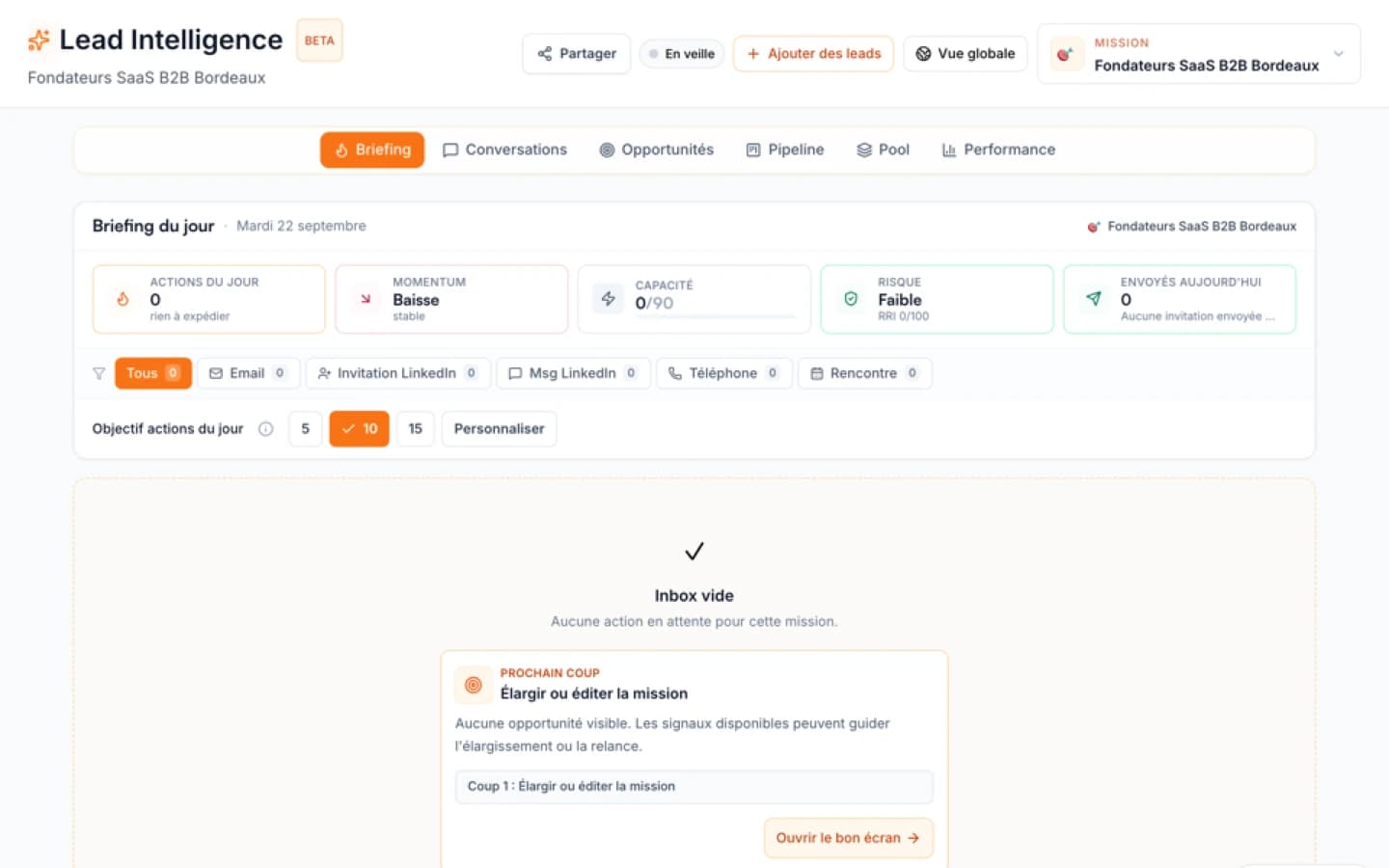
Modern lead generation infrastructure must enforce this boundary by design. With Ember Lead Intelligence, exclusion files are treated as core organizational governance, preventing previously rejected or suppressed contacts from ever reaching active sales workflows, regardless of which rep uploads a new prospect pool.
Step 3: Formalize Data Purge Schedules
Audit your CRM for records where more than 3 years have elapsed since collection without qualified inbound interaction. Automated scripts should flag these inactive records annually.
At the end of the 3-year period, organizations may either reach out once to ask if the prospect wishes to continue receiving communications or systematically purge the record, transferring the contact's identifier into a secure suppression hash list.
Clean Governance Protects Outbound Velocity
The €300,000 EXTIA penalty proves that enforcement action is rarely about technical nuance alone. It targets process negligence: failing to respond to individuals, letting requests slip past statutory timelines, and relying on disconnected software automations that do not fulfill transparency requirements.
For B2B organizations scaling revenue, compliance and deliverability go hand in hand. Just as operational hygiene helps teams fix Google Postmaster lag and Outlook 550 5.7.515 errors, disciplined suppression lists protect domain reputation and legal standing simultaneously.
By treating suppression lists as an active data asset and answering every rights request within the statutory one-month timeframe, sales organizations can run targeted, lawful outbound campaigns that scale without regulatory liabilities.
Sources
- Comment utiliser une liste repoussoir pour respecter l' ...
- La prospection commerciale
- La prospection vers les particuliers (B to C) : quelles règles ...
- CNIL, sanction EXTIA de 300 000 euros pour demandes d'effacement ignorées (décision du 21 juillet 2026, publiée le 9 septembre 2026): source S1
- CNIL, référentiel gestion des activités commerciales : durées de conservation: source S1
- CNIL, présentation des référentiels gestion commerciale et impayés: source S2
FAQ
Free diagnostic
Test your sales file
Drop an Excel or CSV and check its readiness without sending its rows to Ember.