
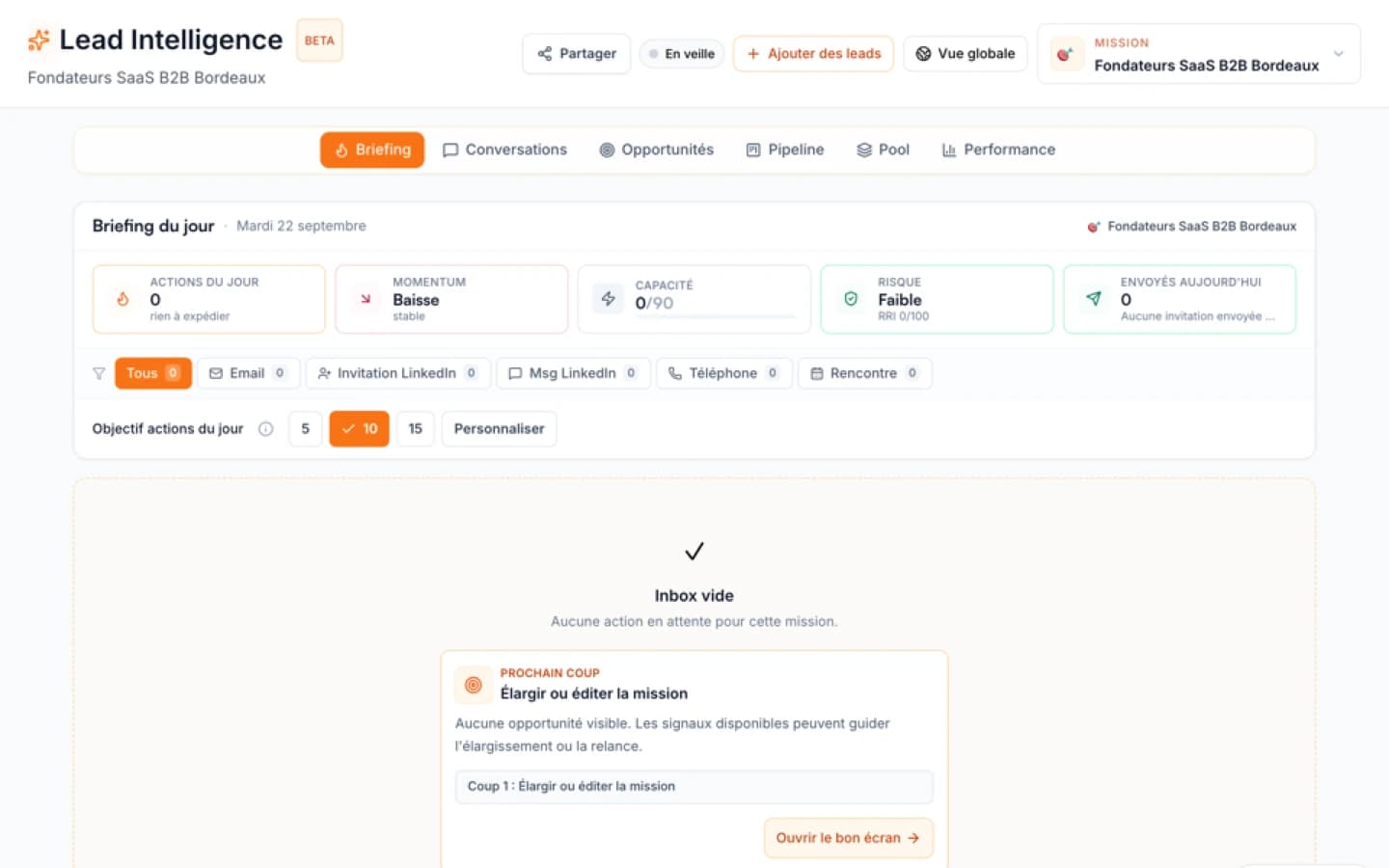
Choosing between Salesflare and Ember Lead Intelligence comes down to whether your commercial bottleneck is managing an active sales pipeline or uncovering contextually timed opportunities. Salesflare is an automated Customer Relationship Management (CRM) platform designed to pull relationship data from mailboxes, track deals, and run metered email sequences using credit allotments. Ember Lead Intelligence operates as an acquisition intelligence layer that transforms your business model and market signals into verified, prioritized conversations without requiring an established CRM database.
Teams that need an everyday operational pipeline to centralize address books, monitor deal stages, and execute multi-email drips find an effective fit in Salesflare. Conversely, teams that already know how to close but struggle with identifying who to reach out to, why the timing makes sense right now, and which conversational angle to use benefit from the signal-driven prioritization of Ember.
How Salesflare Operates: Automated Pipeline Capture and Credit-Metered Outreach
Salesflare is built around reducing manual CRM data entry for small and medium-sized business teams. By integrating directly with email inboxes, calendar events, and mobile interactions, the platform automatically logs email exchanges, detects contact details from signatures, and visualizes sales stages across visual pipeline boards.
Prospecting in Salesflare is tied to a credit-metered model called Lead Finder. As documented on the Salesflare pricing page, the entry Growth plan costs $39 per user per month on monthly billing or $29 per user per month billed annually, which includes 5 lead credits alongside automatic contact gathering and email tracking. For outbound teams requiring email sequences and role permissions, the Pro plan costs $64 per user per month on monthly billing or $49 per user per month on annual billing, providing 100 lead credits. Additional lead finder credits are sold in separate tiers, such as 250 credits for $39, 500 credits for $69, and 1000 credits for $129.
This architecture works well for companies that rely on a single, continuous system of record. When your primary challenge is keeping client interactions organized in one place so that no warm deal slips through the cracks, an automated CRM like Salesflare covers the entire customer journey from initial discovery to contract signing.
However, the credit-based prospecting approach requires you to supply the search criteria and select contacts individually or through list imports. The platform verifies email addresses and manages outbound sequences, but it leaves the evaluation of market timing, strategic fit, and contextual hooks entirely to the human representative.
How Ember Lead Intelligence Operates: Strategy-Driven Discovery and Signal Timing
Ember Lead Intelligence approaches outbound acquisition from the perspective of contextual relevance rather than raw pipeline administration. Rather than serving as an operational database of record, the module functions as a decision engine that translates strategic parameters into ready-to-engage conversations.
The engine links directly to the strategic foundations already defined in your business plan and Ideal Customer Profile (ICP). Instead of purchasing bulk static lists and expending credits to reveal email addresses, the motor discovers target accounts by scanning professional signals, verifying sources, and determining why a company is receptive today.
Prospects are collected into a dedicated qualification environment called the Pool. Inside the Pool, lower-confidence profiles are flagged for review rather than silently discarded or pushed prematurely into outreach cadences. If your team already maintains curated prospect sheets, you can import files up to 3,500 rows, which are processed in discrete enrichment waves of up to 200 contacts to guarantee that every target carries verifiable signals before any message is drafted.
Outreach within Ember is deliberate rather than automated at scale. The platform supports manual review of every generated message draft and integrates directly with LinkedIn through authenticated accounts. By prioritizing timing over pure contact volume, the objective is to reduce pointless outbound noise and focus outreach capacity on high-probability opportunities. Teams looking to pair outbound research with targeted prospecting can also start from your Sales Navigator search to prospect to feed verified accounts directly into signal analysis.
Key Architectural Differences Between Salesflare and Ember
To evaluate which tool matches your growth workflow, examine how each platform handles core acquisition mechanics:
| Dimension | Salesflare | Ember Lead Intelligence |
|---|---|---|
| Core Product Category | Automated B2B Pipeline CRM | Contextual Acquisition Intelligence Engine |
| Prospecting Model | Credit-metered search credits | Signal-based account discovery and qualification |
| Primary Input | Inbound mailboxes, address books, and manual filters | Strategy documents, ICP parameters, and market signals |
| Outbound Delivery | Automated email drip sequences | Assisted cadences with mandatory human validation |
| Data Governance | CRM system of record with user seats | Prospect processing aligned with GDPR Article 6 legitimate interest |
| Ideal User Bottleneck | Administrative pipeline friction and contact disorganization | Identifying genuine timing triggers and relevant outreach angles |
In Salesflare, the unit of progress is the deal card advancing through pipeline stages. The platform measures success through activity tracking, automated logging, and sequence open rates. For small sales teams handling relationship-heavy consultative sales where every email must be logged to a company timeline, this operational visibility is vital.
In Ember, the unit of progress is the contextualized conversation. A prospect is not simply a name and an email address bought with a credit. It is an evaluated business relationship backed by observable triggers, such as growth initiatives, leadership changes, or operational transitions. For strategic sellers, founders, and business development leaders, the value lies in spending zero time digging through spreadsheets to answer what angle to pitch.
Choosing Based on Your Operational Bottleneck
Deciding between these two platforms requires evaluating where your outbound process currently breaks down.
When Salesflare Is the Practical Choice
Salesflare is the logical fit when your commercial team lacks a unified system of record and suffers from disorganized customer data:
- You need an intuitive CRM that requires zero manual logging for daily sales emails, calendar meetings, and phone calls.
- Your sales reps primarily run targeted cold email campaigns and want discovery credits bundled directly into their pipeline subscriptions.
- You have an established outbound workflow and only need credit top-ups to fetch verified email addresses for defined target companies.
- Your priority is tracking deals from prospecting through negotiation and closing within a single dashboard.
For these operational scenarios, attempting to replace an everyday CRM with an intelligence layer would leave your pipeline tracking unsupported. Salesflare solves the CRM adoption problem cleanly.
When Ember Lead Intelligence Is the Practical Choice
Ember Lead Intelligence is the right choice when your team already has tools to manage deals or prefers to work without CRM administrative overhead, but struggles to achieve meaningful outbound response rates:
- Cold email open and reply rates have declined because generic, persona-based messaging no longer resonates with buyers.
- Your commercial reps spend excessive hours manually researching accounts on LinkedIn and industry news to find a justifiable outreach reason.
- You want acquisition to directly reflect your strategic ICP, offer structure, and value proposition rather than relying on blunt database filters.
- You need to identify target investors or strategic B2B accounts where timing, executive intent, and referral pathways determine meeting success.
To learn more about structuring outbound workflows around verified timing and high-deliverability channels, explore the Knowledge guides for sales.
Data Governance and Prospect Privacy
A critical operational difference lies in data retention and regulatory alignment. Salesflare stores contact data as long as your workspace maintains those records, acting as your customer database. When buying contact credits through Salesflare, teams must verify that the enriched data aligns with their local compliance frameworks.
Ember treats prospecting data as ephemeral mission intelligence rather than a permanent contact warehouse. In accordance with European data protection regulations, processing relies on the legitimate interest of business-to-business commercial prospecting under Article 6(1)(f) of the General Data Protection Regulation (GDPR). Prospect data is retained only for the duration of the prospecting mission, with records deleted or anonymized no later than three years after the last contact, while do-not-contact entries are preserved permanently to enforce opt-outs.
This distinction matters for organizations operating under rigorous privacy scrutiny: Ember minimizes stored personal information to what is strictly useful for a professional business interaction, ensuring that outbound discovery does not inflate compliance overhead.
Navigating the Decision
Salesflare and Ember Lead Intelligence address two entirely different layers of the modern sales stack. Salesflare excels as a lightweight, highly automated pipeline CRM that keeps small teams organized and provides credit-metered lead finding for everyday outbound lists. Ember Lead Intelligence operates as an intelligence engine upstream from the pipeline, turning strategy and market timing into verified conversations so that reps reach out only when a compelling reason exists.
If your team is missing an organized pipeline to track existing leads, implement Salesflare. If your team has the capacity to close deals but lacks the signal intelligence to start the right conversations, deploying Ember Lead Intelligence provides the contextual edge needed to convert timing into qualified meetings.
Sources
FAQ
Free diagnostic
Test your sales file
Drop an Excel or CSV and check its readiness without sending its rows to Ember.