
Building a sales pipeline forces an early operational choice: should your acquisition engine center on extracting verified contact records, or should it prioritize accounts based on timing, operational signals, and strategic fit?
Teams balancing these two paths usually compare Hunter, the established standard for credit-based email discovery, with contextual acquisition layers such as Ember Lead Intelligence. While Hunter focuses on answering where to send an email, Ember addresses who warrants an outreach effort today, why that timing makes sense, and how to frame the initial conversation. Choosing between them comes down to whether your bottleneck is raw contact data or commercial prioritization.
Core Functional Differences
Email finders and signal-led intelligence platforms solve different problems in the go-to-market workflow.
An email discovery service operates as a directory lookup engine. You feed it a domain name or a person's identity, and it queries indexed web data and mail server patterns to return a deliverable address. Its operational boundary ends once an address is verified and handed to a sequence.
A contextual lead intelligence layer begins one step earlier and continues through conversation design. Instead of treating every verified email as equally ready for outreach, it ingests your strategic foundation, monitors business context, verifies potential leads against that profile, and presents prioritized actions.
| Dimension | Hunter | Ember Lead Intelligence |
|---|---|---|
| Primary function | Domain search, email lookup, and verification | Opportunity prioritization and contextual outreach |
| Underlying model | Credit-based consumption per found or verified email | Mission-driven discovery and workspace context reuse |
| Outreach channels | Cold email campaigns and sequences | Multi-channel coordination including LinkedIn workflows |
| Contextual inputs | Manual lists, domains, and name queries | Ideal customer profile, business plans, and market signals |
| Execution mode | Automated list building and bulk sending | Human-guided review with staged message preparation |
Understanding how each tool works in practice reveals where their boundaries lie.
Hunter: Directory Lookup and Credit Economics
Hunter remains one of the simplest ways to find an inbox address for a target domain. For teams running outbound motions built on broad TAM coverage (Total Addressable Market) and high-volume email outreach, its credit model offers clear predictability.
According to the Hunter pricing page, the platform organizes access into monthly and annual plans:
- Free tier providing 50 credits per month at 0 euros.
- Starter tier providing 2,000 monthly credits at 49 euros per month billed monthly, or 34 euros per month billed yearly.
- Growth tier providing 10,000 monthly credits at 149 euros per month billed monthly, or 104 euros per month billed yearly.
- Scale tier providing 25,000 monthly credits at 299 euros per month billed monthly, or 209 euros per month billed yearly.
On all tiers, Hunter prices usage at 1 credit per email found and 0.5 credit per email verified. Monthly credits reset at each billing cycle and do not roll over, whereas annual commitments provide all credits upfront for the full year.
Hunter is effective when your team already knows precisely which organizations to contact. If your commercial reps have a static list of five hundred targeted accounts and simply need deliverable email addresses to run standard cold campaigns, using an established finder is fast and cost-effective.
The constraint appears when list volume outpaces buyer intent. A deliverable email address does not indicate whether a company is actively solving the problem you address. When reps treat every found contact as an immediate sequence candidate, reply rates drop, domain reputation faces unnecessary strain, and sales teams waste hours chasing accounts that have no immediate reason to buy. For teams refining their outreach tactics, exploring the Knowledge guides for sales provides broader guidance on avoiding generic bulk outbound.
Ember Lead Intelligence: Signal-Driven Prioritization
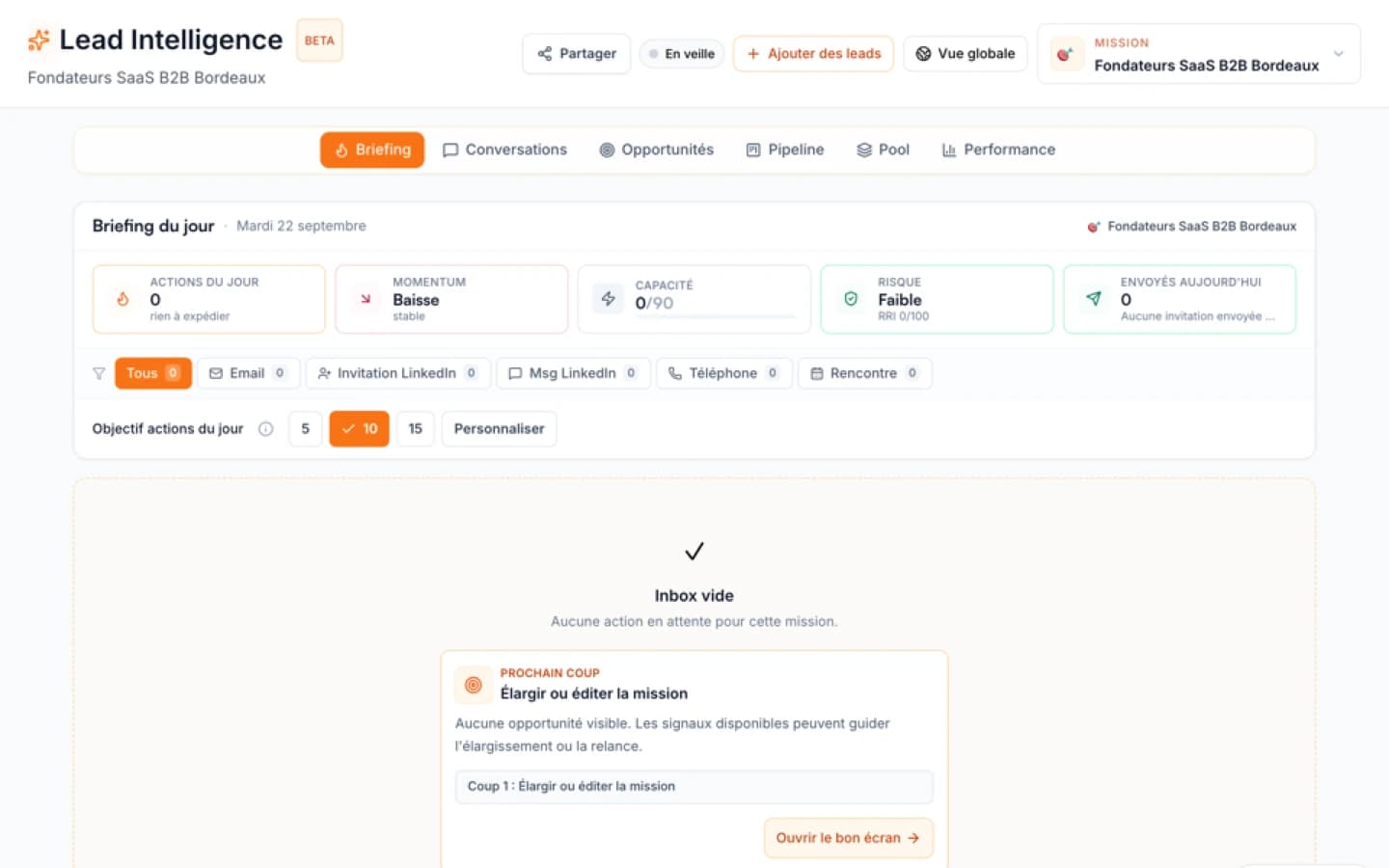
Ember Lead Intelligence takes a different operational approach: volume without relevance creates administrative noise. Instead of asking how many addresses can be extracted from a directory, it focuses on identifying who to contact, why now, and which action to launch.
The system builds upon the business plan, ideal customer profile (ICP), and strategic positioning already defined within your Ember workspace. Missions can run for commercial prospecting or fundraising. Rather than dumping raw contacts into an unsegmented CRM, Ember runs an agentic discovery and vetting process:
- Strategic Discovery: The engine evaluates candidate accounts against your specific ICP criteria and active business signals. It works without requiring a strict minimum threshold of contacts, whether an organization starts from 10, 100, or 1,000 records.
- The Pool and Review Safeguards: Discovered profiles enter a centralized Pool. Candidates that do not meet thesis criteria are not deleted in secret; they remain visible with explicit rejection reasons. Profiles flagged with high risks or low confidence are kept for human review rather than pushed directly into generic messaging.
- Contextual Action Cards: Lead profiles display calculated intelligence, including the underlying reasons behind current timing. Full scores, verdicts, and suggested actions populate once enrichment waves process the accounts.
- Channel-Aware Preparation: Ember coordinates outreach suggestions across touchpoints. For LinkedIn workflows managed through connected accounts, it differentiates automatically between connection requests for 2nd and 3rd degree networks and direct messages for 1st degree contacts. Message generation relies on the mission's validated context, while sending remains manual by design to ensure human oversight before any communication leaves the organization.
This structure suits founders and B2B sales teams who prefer thirty relevant, well-timed conversations over five thousand untargeted cold emails.
Deliverability, Compliance, and Data Governance
Managing outbound contact data also carries regulatory and technical responsibilities that differ significantly between tools.
When sending cold email sequences through directory finders, teams bear the operational burden of domain isolation, bounce management, and manual opt-out tracking. If automated sequences trigger complaints or land in spam traps, overall domain deliverability suffers.
Contextual intelligence platforms embed governance directly into the workflow. Under the Ember Prospect Data Rights documentation, B2B prospect processing relies on legitimate interest under Article 6(1)(f) of the GDPR (General Data Protection Regulation), backed by documented balancing tests and professional safeguards. When a prospect objects or requests to not be contacted, Ember blocks active actions, follow-ups, monitoring, and paid enrichments for that record. Prospect data is retained only for the mission duration and deleted or anonymized no later than three years after last contact.
Understanding these governance guardrails is vital for modern outreach. Teams looking closely at compliance can review how to handle B2B prospect opt-outs under GDPR rules to maintain compliant workflows across all outbound channels.
How to Choose for Your Go-to-Market Model
Choosing between Hunter and Ember Lead Intelligence depends on your current sales maturity, pipeline bottlenecks, and average contract value.
Choose Hunter if:
- Your target account list is already validated and strictly defined.
- Your outbound model depends on high-volume email distribution where finding inboxes quickly is the primary friction point.
- Your team already possesses dedicated sales development reps who independently research company timing, news, and personalized hooks before drafting emails.
- You only need a simple, self-serve credit plan to check addresses against domain records.
Choose Ember Lead Intelligence if:
- Your team struggles to determine which accounts within a broad market are actually worth contacting today.
- You want prospecting workflows directly aligned with your business plan, positioning, and ICP without managing disconnected spreadsheets.
- Your sales motions rely on multi-channel outreach, particularly thoughtful LinkedIn engagement, rather than cold email blasts alone.
- You prefer qualified conversations over raw lead volume and want human review before any outreach executes.
For organizations evaluating broader platform changes, comparing alternative pipeline architectures such as Salesflare or Ember Lead Intelligence: How to Choose can help clarify whether your pipeline requires a traditional contact database or an integrated intelligence layer.
Ultimately, directory finders provide reliable plumbing for contact discovery, but finding an address does not create an opportunity. If your operational priority is identifying timing signals and generating contextual conversations that convert, explore the capabilities available in Ember Lead Intelligence to align acquisition with your broader business strategy.
Sources
FAQ
Free diagnostic
Test your sales file
Drop an Excel or CSV and check its readiness without sending its rows to Ember.