
Definition
A lean nurturing journey is a sequence of buyer decisions, not a sequence of scheduled emails. Its purpose is to preserve relevance between a first qualified interaction and a clear commercial outcome when the sales team has no dedicated marketing function and only a small content library.
Use one nurture loop per account and decision. The loop records the buyer question, the strongest current evidence, the person involved, the next useful contribution, its trigger, the permitted channel and a finish or pause rule. An account can contain several loops, but each loop must answer one uncertainty.
Give every loop one state: ready, when the evidence and route are sufficient; active, when a useful exchange is underway; waiting, when a named buyer, date or event controls the next move; paused, when no near-term action is justified; and closed, when the decision, disqualification or stop rule is recorded. A generic monthly newsletter is distribution. It is not, by itself, a nurturing decision.
Prerequisites
Define the commercial boundary before writing content. Name the ICP, the problem the offer can credibly address, the buying decision, the people who may influence it and the evidence that would disqualify the account. If the team cannot explain why an account belongs in the journey, content will only make the uncertainty harder to see.
Prepare a minimum proof library from material the company already owns:
- one concise problem note that helps a buyer recognise the situation;
- one proof item with its source, scope and limitation;
- one implementation answer covering effort, dependencies and risk;
- one decision summary comparing action, delay and an alternative;
- one approved response for common security, legal or procurement questions.
Each asset needs an owner, review date, source list and a statement of what it does not prove. Reuse is allowed when the buyer question is the same. Personalisation belongs in the account context and the reason for sending, not in invented facts.
Finally, establish contact safeguards, objection handling and one shared record of buyer commitments. The method cannot begin if an opt-out can be missed, if scheduled actions can outlive a correction, or if salespeople cannot see what another colleague already promised.
Steps
1. Map buyer questions, not campaign stages
List the uncertainties that stop the next decision: problem recognition, priority, fit, proof, implementation, internal alignment, risk and commercial terms. Keep only the questions that genuinely apply to the offer. Do not invent a long funnel to make the process appear sophisticated.
2. Connect each question to the smallest useful asset
Choose an existing proof, answer or decision aid before commissioning new material. A two-paragraph implementation note can be more useful than a broad ebook when the buyer is asking about integration. Record the exact question the asset can answer and its limits.
3. Qualify the account and route
Confirm identity, company fit, current relevance, contact rights and the person who can use the material. Keep observed facts separate from interpretations. A role change can be observed; urgency cannot be assumed from that change alone.
4. Write a trigger-based next action
Use this contract: trigger, the question, commitment, date or sourced event that creates relevance; contribution, the useful answer or proof; channel, the route coherent with the relationship; done when, the visible result; if silent, the pause or closure rule.
Replace "send case study in two weeks" with a decision-linked action such as "after the agreed technical review, send the scoped implementation answer requested by the operations lead; close the loop when the question is answered or pause if the review is cancelled."
5. Review loops weekly
Inspect active and waiting loops before adding new ones. Reconcile buyer replies, commitments, objections, changed roles and stale evidence. Protect work already promised. A calendar date never overrides a correction or a buyer's request.
6. Learn from questions, not opens
Record which questions recur, which proof is missing, which assets create clarification and which messages create confusion. Open and click data can support delivery diagnosis, but they do not prove understanding, intent or fit.
7. Close deliberately
Close when the buyer reaches a decision, the account no longer fits, the route is blocked or the declared stop rule is reached. Pause only with a named return condition. Keep the reason and evidence so the same journey does not restart unchanged.
Worked example
A two-person sales team sells operations software to a narrow group of service companies. It has no marketing colleague and only four usable assets: a problem note, a customer proof, an implementation checklist and a security answer. The team selects twelve qualified accounts for a six-week learning cycle. These numbers define the example, not a universal benchmark.
One operations director asks how long data preparation takes. The team opens an implementation loop and sends the existing checklist with the assumptions highlighted. A finance stakeholder asks for evidence that the change reduces manual reconciliation. The team does not reuse the implementation note. It sends the scoped customer proof and states what the example cannot establish for this company.
Another account has not asked a question and shows no verified change. The team does not manufacture a "checking in" message to fill the sequence. It pauses the loop with a return condition tied to a known planning period. A fourth account objects to contact, so every scheduled action stops and the loop closes.
At the weekly review, three similar integration questions reveal one content gap. The team updates the implementation checklist once instead of writing three bespoke articles. The cycle succeeds if decisions become easier to reconstruct, promises are delivered and weak journeys close. It does not succeed merely because twelve accounts received messages.
Common mistakes
Copying a content-heavy enterprise funnel
A small team cannot maintain a library built for several specialists. Start from repeated buyer questions and add an asset only when a real gap appears.
Treating every silence as a scheduled follow-up
Silence is not a trigger. Use a buyer commitment, a requested answer, a known date or a sourced change. Otherwise pause or close under the declared rule.
Personalising unsupported claims
Changing a greeting is harmless. Claiming a buyer has a priority because of a job title or company announcement is not. Show the observed fact and keep the interpretation tentative.
Using one asset for every stakeholder
An operator, finance lead and security reviewer may face different decisions. Reuse the evidence, but frame it around the actual question and preserve the same limits.
Measuring production instead of progress
Published posts and sent emails are inputs. Track answered questions, delivered commitments, corrected assumptions, explicit pauses and decisions instead.
Tools
Use one commercial record for loop state, buyer questions, source links, commitments, objections and exit reasons. Use a small approved asset library with owners and review dates. The inbox and calendar reconcile actual commitments. Automation may schedule an already approved action, but it must stop when the evidence or contact state changes.
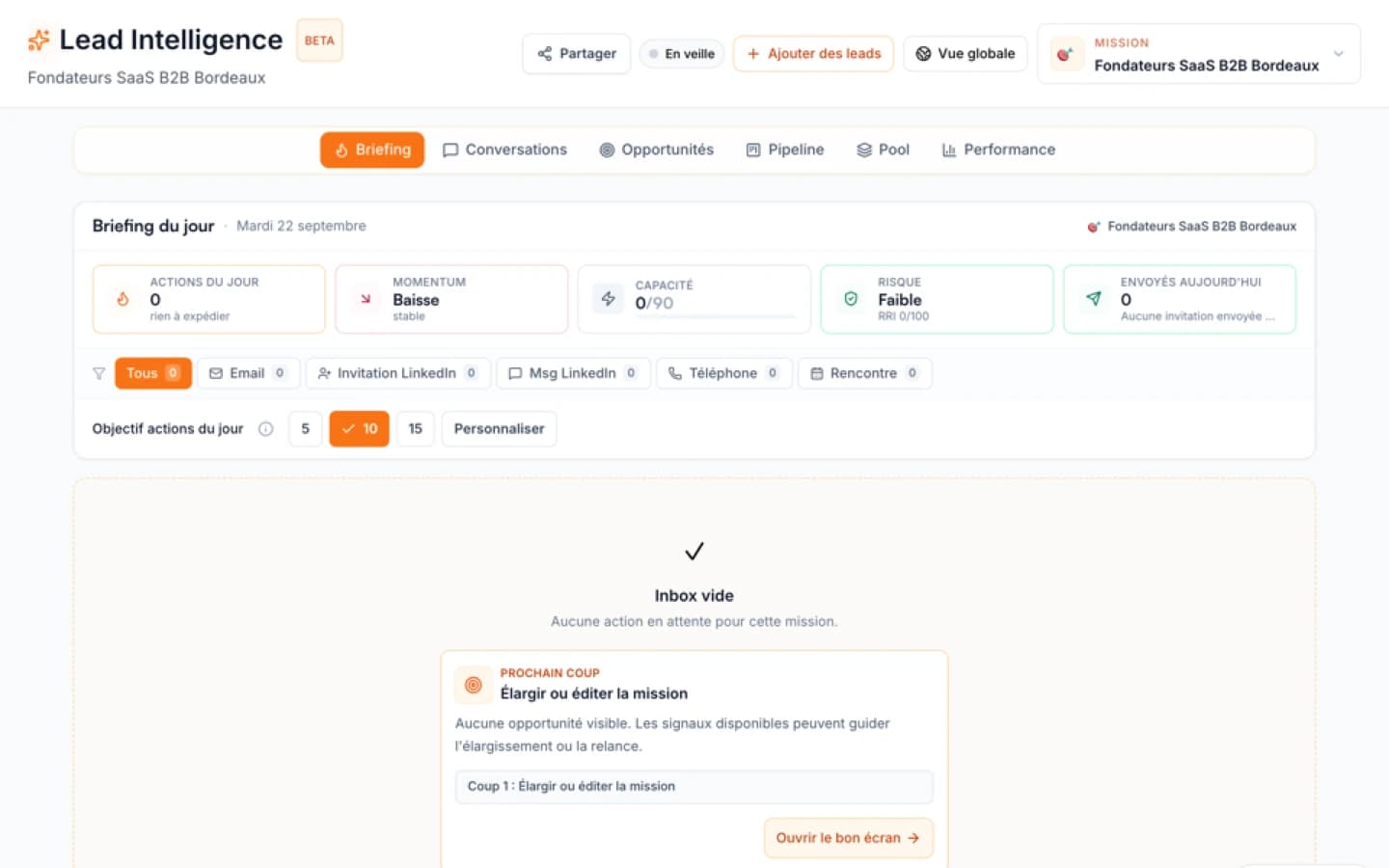
Lead Intelligence prioritises opportunities from the available context. Lead Intelligence proposes the next action and channel that fit the lead situation. The operator still validates the buyer question, evidence, permission and contribution before execution.
The minimum tool test is simple: another teammate can reconstruct why the account is active, what will be shared, when, through which route and what ends the loop. If that explanation depends on private memory, the system is incomplete.
When to use this method
Use it when one or two sellers own research, outreach, follow-up and closing; when buyers ask recurring questions; when content production competes with selling time; or when automated sequences continue without a useful reason.
It is particularly useful for focused B2B offers with multi-person decisions. A small evidence library can serve several stakeholders as long as each use answers a real question and retains the proof limits.
When not to use it
Do not use nurturing to hide weak qualification. If the account does not fit, no sequence of useful content will create fit. Close or return it to research.
Do not use this lean method as a complete marketing strategy. It does not replace broad category education, brand distribution or demand creation when those investments are justified. It also does not replace a shared account plan for complex deals owned by many teams.
Do not automate a journey whose contact rights, evidence or exit rules remain unclear. More touches increase the cost of a bad assumption.
Action plan
- Choose one narrow ICP and one buying decision.
- List the recurring buyer questions that block that decision.
- Inventory existing proofs, answers and approved documents.
- Map each asset to one question and write its limitation.
- Define ready, active, waiting, paused and closed states.
- Add trigger, contribution, channel, completion and silence rules.
- Select a bounded account sample and state the learning period.
- Review active and waiting loops every week.
- Create content only for repeated unanswered questions.
- Close the cycle with decisions, corrections and missing proof recorded.
Change one rule at a time after the first cycle. Keep the library small until repeated buyer evidence demonstrates a durable gap.
Check the next contact
Before sending another message, record the buyer question, the evidence you can share, the reason it is relevant now and the person who approves the contact. Lead Intelligence can help explain opportunity priority from available context; the operator remains responsible for the claim and the permission to contact.
Sources and methodology
The retained HubSpot article and Salesforce learning module were used as practitioner references for content mapping and sales enablement vocabulary. They were not treated as controlled evidence of a universal duration, cadence or conversion result. The official product page supports only the exact capability statements in the tools section.
Sources were reviewed on August 3, 2026. The loop states, minimum proof library, trigger contract, worked example and action plan are editorial method choices. The example quantities are explicit test boundaries, not performance benchmarks.
Sources
FAQ
Free diagnostic
Test your sales file
Drop an Excel or CSV and check its readiness without sending its rows to Ember.