
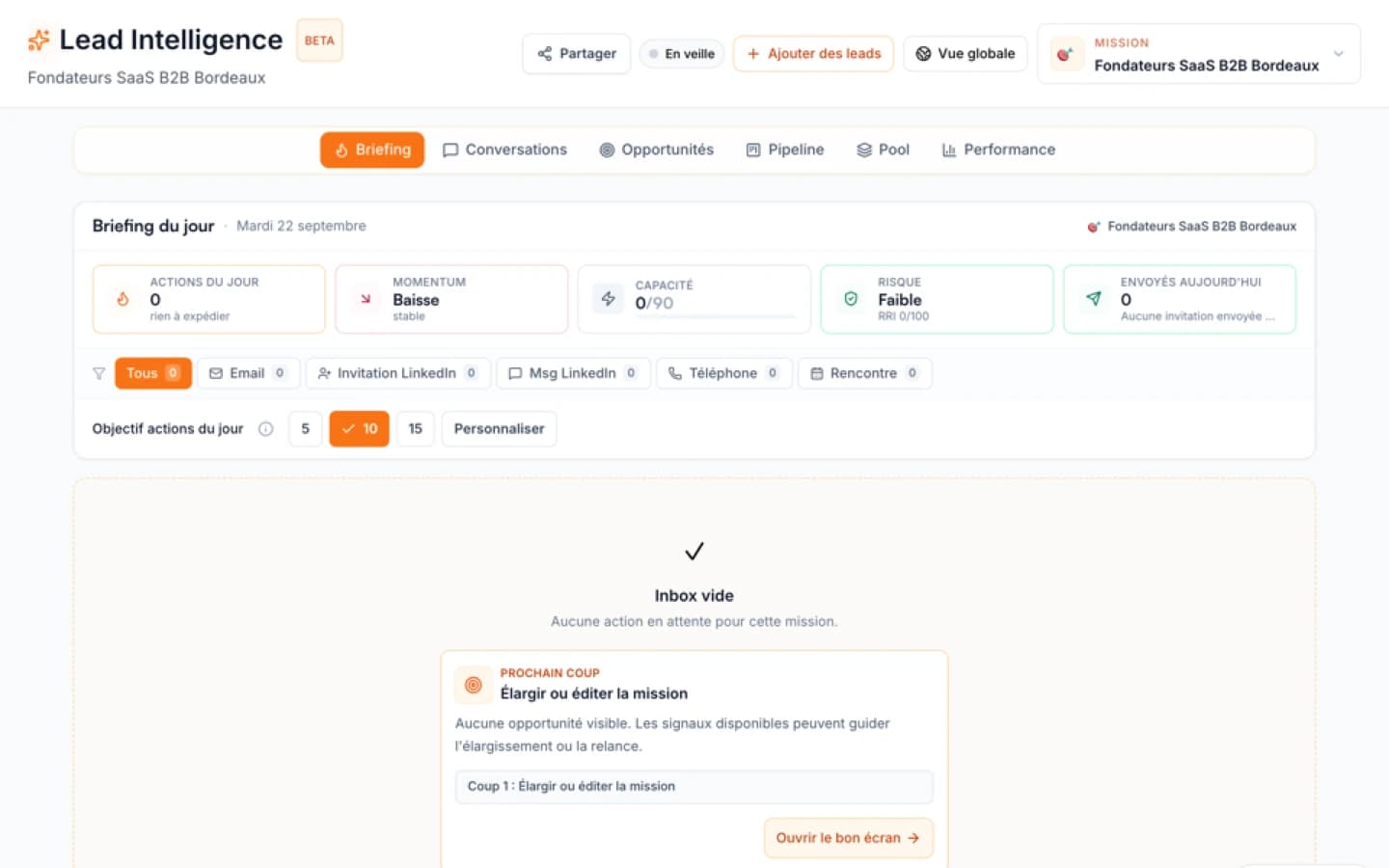
Selecting an outbound architecture comes down to a fundamental choice in go-to-market strategy: do you optimize for high-speed multi-channel contact execution, or do you optimize for contextual timing and signal-driven qualification?
Close CRM is built for fast execution inside an all-in-one sales communication platform. It unifies calling, email, SMS, and pipeline tracking so outbound teams can power through call lists and inbound follow-ups with minimal friction. Ember Lead Intelligence approaches outbound from the prior step: it discovers, evaluates, and prioritizes who to contact, why the timing makes sense right now, and which conversational angle fits the account based on validated company context.
For sales teams evaluating both platforms, the distinction is clear. If your playbook relies on high-volume phone outreach, centralized calling infrastructure, and automated dialers, Close provides an exceptional system of action. If your revenue model depends on strategic B2B accounts where timing signals, account fit, and personalized angles determine conversion, Ember Lead Intelligence ensures your team only spends time on accounts worth engaging.
Where Close CRM Excels: Consolidated Outbound Velocity
Close was engineered around a core belief: salespeople spend too much time switching tools and logging data. To solve this, Close combines native telephony, two-way email synchronization, SMS, and pipeline stages into a single workspace.
Its major operational strengths include:
- Built-in dialing infrastructure: Rather than integrating third-party telephony plugins, Close offers built-in calling, power dialers, and predictive dialing at higher tiers. Reps can dial sequentially through dynamic lead lists without leaving the screen.
- Unified communication inbox: Calling logs, call recordings, emails, and SMS messages sit on a single chronological timeline for each lead, giving teams clear visibility into previous interactions.
- Native automation and Chloe AI: On plans starting at the Growth tier, Close includes automated workflows to trigger follow-up steps. Its native AI sales teammate, Chloe, can qualify leads and run automated outbound voice calls, though voice agents are currently restricted to English and to US and Canadian phone numbers according to the Close Help Center documentation.
According to the official Close CRM pricing page, Close structures its offering across four primary tiers:
- Solo: $19 per user per month billed monthly, or $9 per user per month billed annually, limited to 1 user and 10,000 leads, with 500 AI credits per month and no workflow automation.
- Essentials: $49 per user per month billed monthly, or $35 per user per month billed annually, offering unlimited contacts and leads with built-in calling, SMS, and email, alongside 1,000 AI credits per month.
- Growth: $109 per user per month billed monthly, or $99 per user per month billed annually, introducing automated workflows, bulk email, power dialing, and 1,500 AI credits per month.
- Scale: $149 per user per month billed monthly, or $139 per user per month billed annually, adding predictive dialing, live call coaching, unlimited call recording retention, and 2,000 AI credits per month.
For teams running high-velocity inside sales, transactional B2B cycles, or high-volume cold calling in North America, Close provides a polished and rapid execution engine.
The Volume Trap: Why Dialing Faster Does Not Solve Qualification
While high-velocity platforms make outreach frictionless, activity volume on its own does not guarantee pipeline. When sales teams point high-speed dialers and automated email sequences at unverified, poorly timed lists, they often burn through addressable market segments without generating qualified pipeline.
Outbound benchmarks highlight the friction of untargeted outreach. According to cold outreach research published on the Gong Labs blog, an average sales rep has to send 344 cold emails to land a single meeting. When outreach lacks genuine relevance or timing, teams compensate by pushing higher send and call volumes, risking domain reputation and burning lead pools. You can explore broader engagement patterns in our analysis of Cold Email Reply Rate Benchmarks and Practical Metrics.
Fast dialers and sequence runners cannot tell reps whether an account is currently restructuring its stack, hiring in a relevant department, or confronting a strategic pain point. That gap is where timing intelligence becomes necessary.
How Ember Lead Intelligence Approaches Outbound
Ember Lead Intelligence operates as an acquisition intelligence layer rather than a transactional dialer. Its purpose is to answer three decisive questions before any sales action is initiated: who should you contact, why should you reach out right now, and what conversational angle gives you the highest probability of opening a dialogue?
Instead of treating leads as flat rows in a database, Ember builds prospecting missions around your strategic foundation:
- Context reuse from strategy: Lead Intelligence draws directly from your defined ideal customer profile (ICP), value proposition, and business plan. The platform searches for accounts and decision-makers whose business signals align with your commercial criteria.
- Signal-based qualification and transparent scoring: Contacts are brought into a discovery pool where company signals, public sources, and context are evaluated. When a candidate shows contradictory fit or low confidence, Ember keeps the lead in the pool marked as rejected with an explicit, visible reason, rather than discarding records blindly or pushing unqualified contacts into active outreach.
- Controlled multi-channel preparation: For approved prospects, Ember identifies the channel and prepares tailored draft messages based on detected timing triggers. When connecting LinkedIn via Unipile, Ember manages account quotas systematically. Default settings enforce conservative thresholds (70 weekly invitations and 50 daily messages on standard accounts, up to 200 weekly invitations and 100 daily messages on Sales Navigator), with quotas scaled down by 25 percent during the first 14 days to protect account safety.
- Human oversight by design: Outbound sending in Ember is strictly manual by design. The system surfaces the timing, rationale, and draft messaging, but the sales rep reviews the angle and initiates the touchpoint. This prevents robotic automation from jeopardizing strategic relationships.
For deeper perspective on how signal layers contrast with standard scrapers and contact finders, see our evaluation of Zeliq vs Ember Lead Intelligence for Outbound Strategy and our review of Hunter or Ember Lead Intelligence: Which Fits Your Team?.
Close CRM vs Ember Lead Intelligence: Feature and Architecture Comparison
To choose the right tooling, sales leaders must evaluate how each platform handles list creation, communication channels, AI leverage, and execution control.
| Dimension | Close CRM | Ember Lead Intelligence |
|---|---|---|
| Primary Purpose | High-velocity sales communication and CRM pipeline management | Signal-driven lead discovery, timing analysis, and contextual prioritization |
| Lead Discovery | Built-in web forms, CSV import, manual entry, or third-party CRM sync | Autonomous engine discovering accounts and decision-makers matching ICP signals |
| Telephony and Calling | Native power dialer and predictive dialer with integrated recording | No native dialer, focuses on verified phone and email data discovery |
| Outreach Channels | Phone, two-way email sync, SMS, and native pipeline tasks | Contextual LinkedIn workflows via Unipile and multi-channel draft messaging |
| AI Agent Capabilities | Chloe voice agent for outbound calls and Chloe chat for CRM data | Agentic signal analysis, why now timing rationale, and draft generation |
| Voice Restrictions | Outbound only, English only, US and Canadian numbers only | Not applicable, does not run autonomous voice bots |
| Send Execution | Automated workflows and sequence triggers | Manual execution by design, keeping reps in control of every touchpoint |
| Workflow Automation | Available on Growth ($99 to $109 per user per month) and Scale tiers | Built around mission cycles and batched enrichment waves of up to 200 leads |
| Best Operational Fit | SDR teams running high-volume phone sequences and transaction pipelines | Strategic B2B sales teams prioritizing relevance, timing, and conversation quality |
How Sales Teams Should Choose
Your outbound operating model dictates whether Close CRM, Ember Lead Intelligence, or a combination of both represents the optimal investment.
Choose Close CRM If:
- Phone outreach is your primary growth lever: If your sales reps make 60 or more dials a day and need power dialing, call recording, and instant logging, Close provides an unmatched operational cadence.
- You need an all-in-one CRM: If you want to replace disconnected email clients, dialers, and pipeline tools with a single, consolidated hub for your small or mid-sized sales team, Close simplifies your stack.
- You operate primarily in North America: Close's communication features and Chloe voice agents are specifically tuned for US and Canadian business calling.
Choose Ember Lead Intelligence If:
- Timing and personalization dictate deal outcomes: If your market is defined by considered B2B purchases where irrelevant outreach destroys credibility, you need signals that tell you when an account is ready to engage.
- You want to eliminate list research overhead: If your reps spend hours manually cross-referencing LinkedIn, company announcements, and websites before drafting an email, Ember contextualizes this research automatically.
- You prioritize account safety and message control: If you refuse to let autonomous tools blast cold prospects without human review, Ember provides structured drafts, built-in LinkedIn quota protections, and complete visibility over rejected leads.
The Hybrid Playbook: Signal Prioritization Feeding CRM Execution
Many modern revenue organizations do not view this choice as mutually exclusive. A sales team can deploy Ember Lead Intelligence at the top of the acquisition funnel to discover high-fit accounts, verify timing triggers, and craft hyper-relevant angles.
Once accounts demonstrate engagement or convert into qualified pipeline opportunities, they transition into a dedicated system of action like Close to track deal progression, manage contract calls, and oversee multi-stage pipeline revenue. You can find more operational playbooks across our collection of the Knowledge guides for sales.
By aligning your tools with their core design strengths, you ensure your sales reps spend less time dialing blindly and more time closing conversations that matter.
Sources
- Pricing
- Close CRM Pricing: A Guide To Its Plans, Features & Costs
- Chloe | Close Help Center
- Close : plans Solo, Essentials, Growth et Scale, prix en dollars par utilisateur et par mois, crédits d'IA et automatisation : source S1
- Page publique Lead Intelligence : reçu S8
- Page juridique données prospects : reçu S9
- Gong Labs cold email data: 344 emails per meeting, and the gap between top and average reps: source S1
FAQ
Free diagnostic
Test your sales file
Drop an Excel or CSV and check its readiness without sending its rows to Ember.