
Definition
The first control happens before copywriting
A defensible cold email setup is not a clever template. It is a chain of decisions that can be explained later: why this person, why this professional topic, under which rule, from which data source, with which sender identity and how the person can object.
This article is an operational checklist, not legal advice. Electronic prospecting rules vary by country, recipient type, message purpose and existing relationship. Identify the applicable jurisdiction and obtain qualified legal advice when the facts are uncertain.
Prerequisites
Before starting, name the expected outcome, owner, acceptable sources and stopping condition. Keep unknowns visible. Missing data is neither negative proof nor permission to invent a conclusion.
Steps
Step 1: identify the rule that actually applies
Do not assume that "B2B" means unrestricted email.
In the United States, the FTC says CAN-SPAM applies to commercial email and has no business-to-business exception. Its guide requires accurate header information, non-deceptive subjects, a valid postal address, an opt-out mechanism and timely handling of opt-outs, among other controls (FTC compliance guide).
In France, the CNIL describes a specific B2B regime when the solicitation relates to the person's professional activity and the person can oppose it easily. The CNIL page also distinguishes prospecting from transactional communication by purpose, not only by wording (CNIL electronic communications rules).
These are different frameworks. A founder selling across borders must not combine the most convenient sentence from each one. Record the recipient's location, the sender's establishment, the data source and the message purpose, then determine the governing requirements with appropriate counsel.
Step 2: prove professional relevance
Write one sentence that connects the recipient's actual role or company situation to the problem. The evidence may be a public company announcement, a documented responsibility or an existing professional interaction.
A title alone is weak evidence. Do not infer budget, authority, urgency, health, politics or other sensitive traits from public data. If the contact reason cannot be explained without speculation, do not send.
Keep the source and review date beside the prospect record. Public availability does not remove data-protection duties, but traceability helps the team review relevance and respond to rights requests.
Step 3: make the sender unambiguous
Use the real sender name, company and domain. Do not imitate a reply, a forwarded message or an internal notification. The subject should describe the real purpose of the message.
The FTC requires accurate From, To and Reply-To information and prohibits deceptive subjects for covered commercial email (FTC compliance guide). Google also asks senders to keep headers and content accurate and not misleading (Gmail sender guidelines).
The message should answer four questions without forcing the reader to investigate:
- Who is writing?
- Why is this professional being contacted?
- What is being proposed or asked?
- How can future contact stop?
Step 4: authenticate the domain
Legal compliance does not guarantee delivery. Configure and verify the sending domain before a campaign.
Google requires all senders to personal Gmail accounts to use SPF or DKIM, and sets additional requirements for senders above its bulk threshold, including SPF, DKIM, DMARC alignment and one-click unsubscribe for relevant messages (Gmail sender guidelines). The same page warns against sudden volume increases and misleading sender identity.
Use the domain provider's instructions. Send a controlled technical test, inspect authentication results and correct failures before contacting prospects. Do not compensate for failed authentication with a new domain and the same behaviour.
Step 5: design opposition before the first send
The opt-out path must be visible, simple and operational. Decide where objections are stored, which systems read them and who verifies that future actions are blocked.
An unsubscribe link is not enough if a separate sales tool can still send a follow-up. Apply the block across manual sends, sequences, monitoring, enrichment and regenerated drafts.
Step 6: write for one evidence-based reason
A first message can stay short:
Context: the verified fact that made the account relevant.
Reason: the professional problem connected to that fact.
Question: one low-friction way to confirm or reject the hypothesis.
Identity and rights: the sender details and required opposition information.
Do not add invented familiarity, fake urgency or a claim that the recipient is "perfect" for the offer. If the evidence only supports a question, write a question.
Step 7: run a manually reviewed pilot
Start with a set small enough for one person to review every recipient, source, message and rights status. The purpose is to find process defects before scale, not to prove a universal conversion rate.
For each record, require a pass on:
- applicable rule reviewed;
- professional relevance documented;
- data source and review date recorded;
- sender identity and subject accurate;
- authentication verified;
- required address and opposition path present;
- no previous objection or do-not-contact block;
- message reviewed by a person.
After sending, inspect bounces, negative feedback, objections, replies and any mismatch between the intended and actual audience. A serious rights or identity failure stops the pilot. It is not a reason to rewrite the subject and continue.
Worked example
Example: the team reviews a record whose context changed. It retains the fact and source, marks the interpretation as an assumption, chooses one next action and sets the condition that will continue, correct or stop the work.
Common mistakes
Common mistakes include confusing activity with progression, turning an unknown into certainty, changing several variables in one test and postponing an action without revisiting its reason. Each mistake should leave a visible correction.
Tools
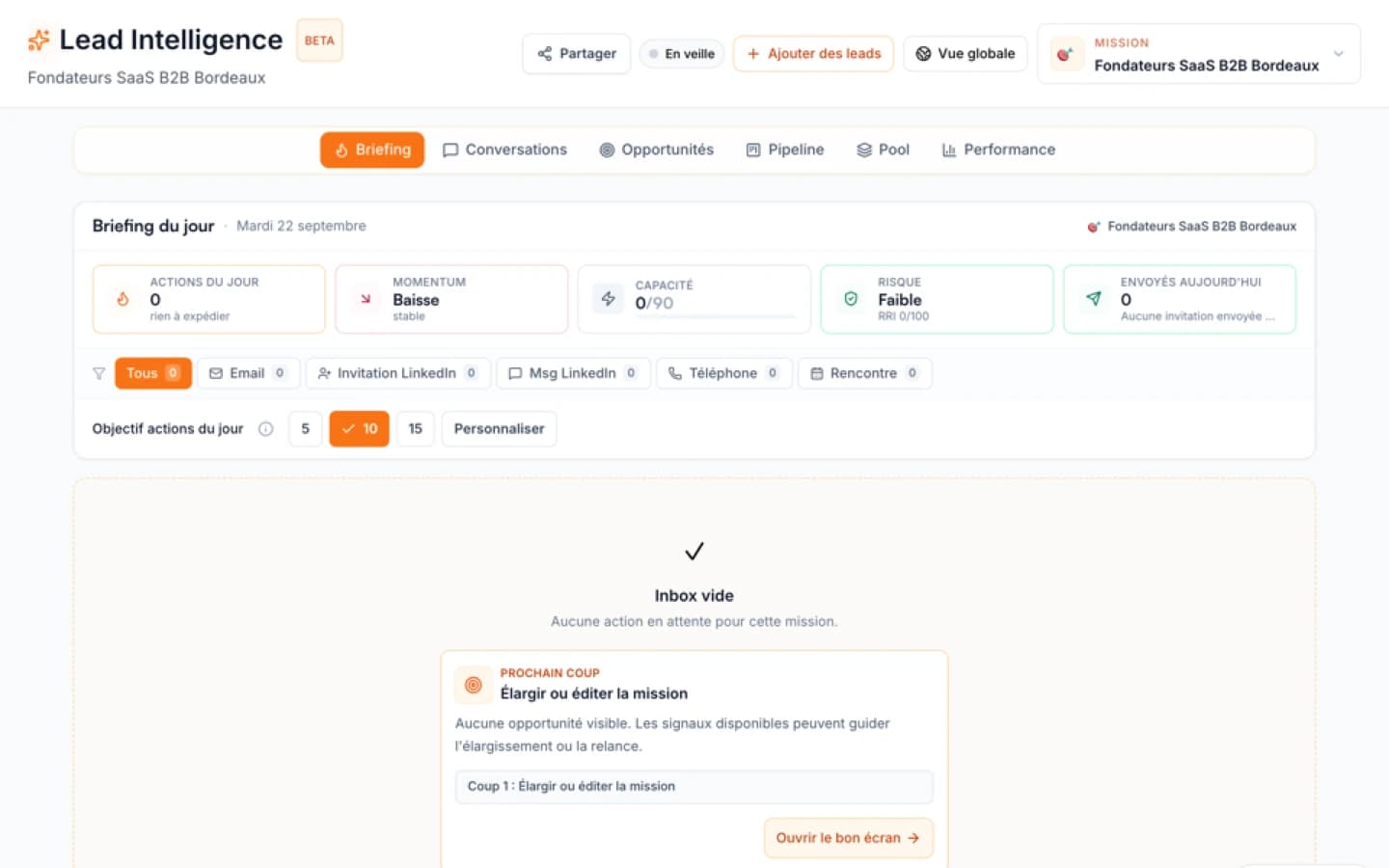
In Ember, Lead Intelligence prioritises opportunities from the available context. It classifies accounts into explained opportunities to watch, act on or set aside. It proposes the next action and channel that fit the lead situation. These capabilities support the method but do not prove buyer intent, consent, budget or an outcome.
Where Lead Intelligence fits
Use it after the organisation has defined the legal and operational controls. Keep the source, rationale and human decision visible. Apply known objections before generating, copying or sending any action.
Connect this setup to the Defensible B2B Lead Qualification Framework for Small Sales so relevance is tested before copy is written.
When to use this method
Use this method when several options appear plausible, evidence is scattered or the team must explain why one action comes before another. It is most useful for decisions that can be reviewed against an observable result.
When not to use it
Stop rules
Do not send when any of these points is unresolved:
- jurisdiction or recipient type is unknown;
- the team cannot state the applicable rule;
- the professional relevance relies on an inference;
- the data source is missing;
- sender identity or subject is misleading;
- domain authentication fails;
- opt-out processing is not tested;
- a previous objection may not propagate to every tool.
Action plan
Start with a small set of records. Apply the same decision contract, record exceptions and review outcomes on the chosen date. Keep what remains reproducible, change one rule at a time and explicitly close actions that no longer produce useful learning.
Sources and methodology
External sources are listed with their URLs to separate published facts from editorial recommendations. They frame the method rather than promise a universal outcome. Assumptions and limitations remain identified in the article.
- FTC CAN-SPAM compliance guide for business
- CNIL rules for electronic commercial communications (in French)
- Google email sender guidelines
Sources
FAQ
Free diagnostic
Test your sales file
Drop an Excel or CSV and check its readiness without sending its rows to Ember.