
Early-stage founders rarely struggle because they lack names in a database. They struggle because mass prospecting generates administrative noise instead of qualified customer conversations.
Apollo is one of the most recognizable sales platforms on the market, built to combine cold lead searching and automated outreach in a single interface. However, for a founder who needs to test product-market fit, understand customer pain points, and target a small set of high-probability accounts, large databases often lead to generic campaigns and high contact churn. Choosing an alternative depends on whether your sales motion requires high-volume cold distribution or high-context timing and qualification.
When Apollo Works Well
Apollo is designed as an all-in-one prospecting engine that bundles database searches with direct outbound capability. It is a solid choice when a business already possesses a validated ideal customer profile (ICP), knows its target messaging converts, and needs to deploy structured cold email volume.
According to its official product overview, Apollo provides automated nurture and follow-up sequences alongside direct contact discovery Apollo.io. Its search interface allows users to filter leads by job title, seniority, company size, industry, location, and intent signals Apollo.io. For sales teams with established sales development representatives (SDRs) who run standard multi-touch cadences, keeping list building and email sending under one roof reduces the need for multiple disparate software subscriptions.
Furthermore, teams running cold calling campaigns often rely on Apollo because it aggregates direct dial numbers alongside work emails. These features make Apollo an effective, utilitarian workbench for traditional sales operations that measure success primarily through pipeline throughput and weekly activity metrics.
The Bottlenecks Early-Stage Founders Face with Database Engines
Despite its breadth, Apollo introduces several operational frictions for early-stage founders who manage sales personally alongside product and operations.
Credit Economics and Unpredictable Costs
Apollo separates access by seat tiers and meters prospect data using consumption credits. On annual billing, Apollo lists its Basic plan at $49 per seat per month, its Professional plan at $79 per seat per month, and its Organization plan at $119 per seat per month with a minimum of three seats Apollo Pricing. When paying monthly, Basic increases to $65 per seat per month and Professional to $99 per seat per month, while Organization is designated as annual only Apollo Pricing.
The complexity lies in how credits are spent. Apollo deducts 1 credit per revealed email address and 8 credits per phone number Apollo Pricing. Furthermore, exporting contacts outside the platform to a CSV file or an external CRM consumes export credits Apollo Pricing. If you wish to understand the full financial impact of these consumption thresholds across growth stages, you can review our Apollo Pricing Guide: Hidden Overages and True Costs.
For a founder trying to run targeted testing, hitting credit ceilings or navigating plan rules creates friction. Moreover, Apollo specifies that cancellations take effect only at the end of the current term and mid-term downgrade refunds are not provided Apollo Pricing.
Volume Over Context
Traditional database engines encourage users to pull broad lists based on high-level demographic criteria such as company size and industry. The result is often a static list of dozens or hundreds of contacts who share a job title but have no immediate reason to buy today.
When founders send automated cold sequences to broad lists, reply rates stay low and domain reputations face deliverability risks. Early-stage outbound requires knowing why a prospect needs your solution this week, what strategic trigger occurred, and how your offer addresses their exact friction. Standard database filters can confirm that someone is a VP of Engineering, but they rarely clarify whether that leader is currently reorganizing their stack.
Operational Overhead
Apollo requires deliberate list hygiene, manual filter tuning, tag management, and deliverability maintenance. Free email accounts inside Apollo can only connect through Gmail, while connecting other mailbox providers requires upgrading to a paid subscription Apollo.io. For a founder spending five to ten hours a week on founder-led sales, configuring complex sequences and deduplicating records takes precious time away from actual customer discovery and product development.
The Context-First Alternative: How Ember Lead Intelligence Operates
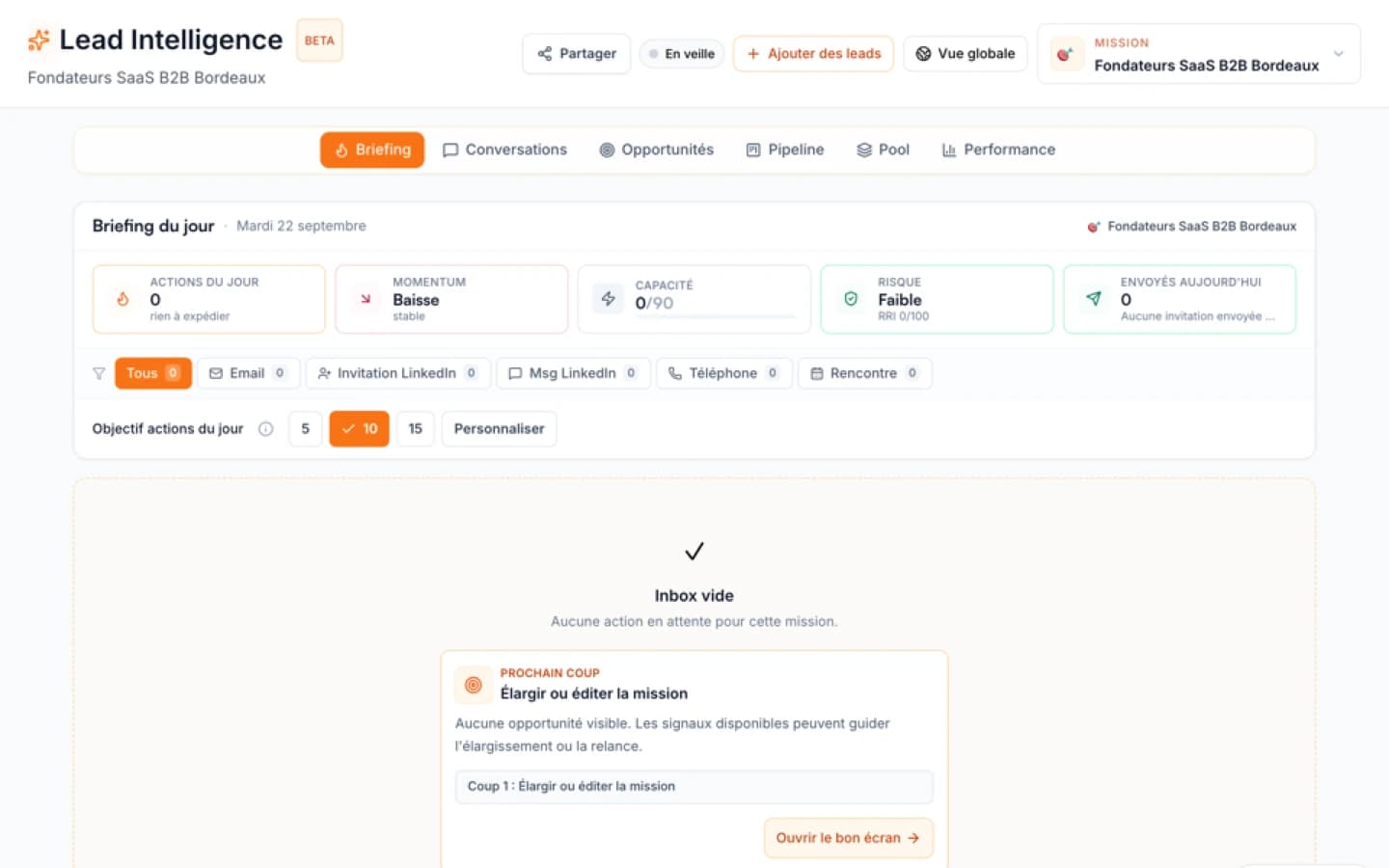
Ember takes an alternate approach designed specifically for founders and commercial teams who prioritize precision, verified timing, and strategic context over mass export volume. Through Lead Intelligence, Ember acts as an acquisition intelligence layer that transforms timing into meetings rather than pushing automated broadcast volume.
Instead of requiring you to build demographic search queries from scratch, Lead Intelligence anchors directly into your commercial context, including your offer, positioning, and ICP strategy.
Identifying Who to Contact and Why Now
The primary objective of Lead Intelligence is to determine who to reach out to, why now, and which action to execute.
Rather than delivering an uncurated list of emails, Ember assesses contextual market signals to uncover why an account is relevant at this exact moment. If an account does not match your criteria or lacks actionable momentum, Ember marks the candidate with a clear rejection reason in the candidate Pool rather than discarding the data silently. You always understand why a lead was prioritized or set aside.
Built for Iterative Growth Without Volume Penalties
Traditional data platforms require heavy subscriptions or large export batches to justify their cost. Ember Lead Intelligence operates whether a team starts with 10, 100, or 1,000 contacts, with no minimum contact threshold required to begin prospecting.
Founders can discover prospects automatically through the intelligence engine, connect their LinkedIn profile via Unipile to source relevant second and third-degree connections, or import existing lists. Ember processes file imports of up to 3,500 rows and runs enrichment in focused batches of up to 200 contacts at a time. This batch model allows founders to inspect results, adjust targeting, and validate market assumptions without burning through quarterly data credits in an afternoon.
Human-in-the-Loop Message Preparation
Automated sequence tools often push cold prospects into aggressive email drips that sound robotic and disconnect when a prospect responds unpredictably.
Ember keeps sending manual by design. The engine prepares tailored message drafts based on verified context and mission language, but the cadence suggests and plans the outreach rather than dispatching communications automatically without human oversight. This protects your brand reputation and ensures every conversation starts with authentic resonance. To understand the strategic role of profile validation before messaging, see Why LinkedIn Verification Matters for Outbound Sales?.
Apollo vs. Ember Lead Intelligence
The following comparison summarizes how Apollo and Ember differ across key operational criteria.
| Criterion | Apollo | Ember Lead Intelligence |
|---|---|---|
| Primary prospecting approach | Broad database filtering and scheduled outbound sequences | Signal-based discovery and contextual prioritization |
| Workflow entry point | Demographic search filters and keyword queries | Strategic ICP, offer definition, and commercial mission |
| Contact prioritization basis | Static persona criteria and platform intent topics | Calculated relevance, timing signals, and strategic fit |
| Outreach execution | Automated email sequences with scheduled dialer tasks | Suggested actions with human-approved message generation |
| Qualification visibility | Basic contact metadata and list tags | Detailed why now context and visible rejection rationales |
| Account data retention | Unused monthly credits expire at billing renewal | Candidate pool retains qualified leads and rejected history |
How to Choose the Right Tool for Your Sales Motion
To make the right choice, assess your team size, sales motion, and current stage of customer discovery.
Choose Apollo if:
- You have a dedicated sales development representative or outbound team that relies on high-volume daily cold outreach.
- Direct cold calling is central to your go-to-market motion, and you require direct phone numbers alongside emails.
- You already possess proven messaging, high market brand recognition, and clear outbound reply rates that justify maintaining thousands of cold email touches each month.
Choose Ember Lead Intelligence if:
- You are an early-stage founder running founder-led sales who needs to speak with genuine buyers rather than spraying cold lists.
- You want to understand the exact strategic reason to reach out to a company today before drafting an email or LinkedIn note.
- You prefer an iterative outbound motion where you can work through batches of 10 to 200 highly relevant accounts without maintaining complex sequence software.
- You value keeping your prospect discovery directly aligned with your commercial strategy and ICP.
Founders comparing modern relationship workflows can also explore our breakdown on folk vs Ember Lead Intelligence: Which Fits Your Growth? or consult the Knowledge guides for sales for tactical outbound frameworks.
If you are ready to shift your prospecting from mass data exports to contextual outbound, explore Ember Lead Intelligence and focus your efforts on the conversations most likely to convert.
Sources
- Apollo.io Pricing in 2026: What Each Plan Actually Gets You
- Apollo Pricing 2026: $0 to $149 per Seat, Real Cost | Getlead
- Credit Opportunities in 2026: From a Seller's Market to ...
- Apollo: contact discovery, outreach and export-credit conditions: source S1
- Apollo: contact discovery, outreach and export-credit conditions: source S2
- Apollo price and term receipts
- Page publique Lead Intelligence : reçu S8
- Page juridique données prospects : reçu S9
FAQ
Free diagnostic
Analyse your Apollo data
Check whether your Apollo contacts are complete and recent enough to prioritise.