
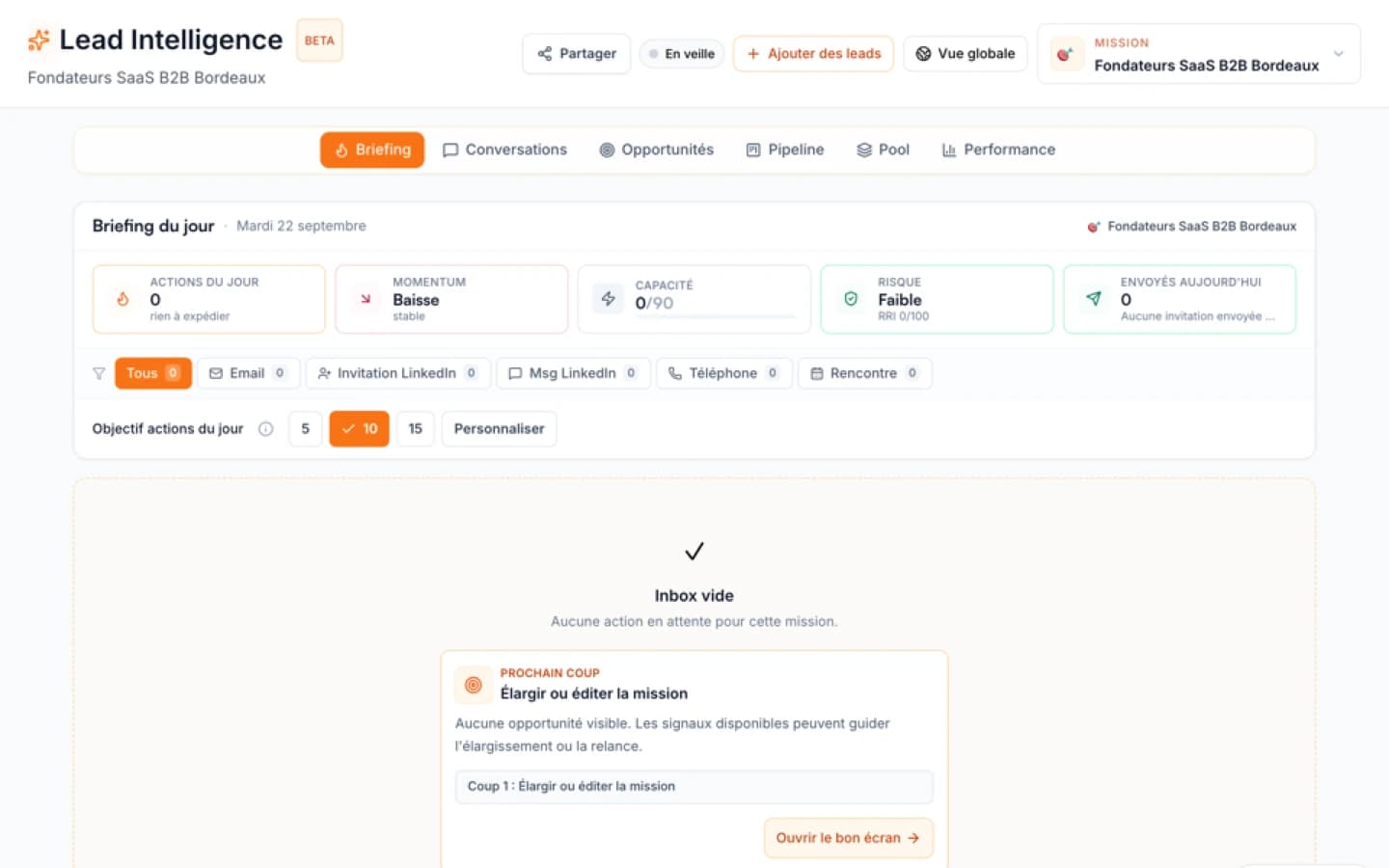
Evaluating outbound sales software requires looking past entry-level platform fees to see how data consumption, export restrictions, and team workflows actually scale. On paper, Apollo offers an accessible entry point with public tier pricing and large contact allowances. In operational reality, modern sales development teams often encounter structural limits in mailbox capacity, seat uniformity, and credit expiration that shift their actual expenditure.
For sales leaders deciding between broad database scraping and context-driven qualification, here is how Apollo structures its 2026 pricing, where overages accumulate, and how that model contrasts with the mission-based approach of Ember Lead Intelligence.
Apollo 2026 Pricing Structure and Plan Tiers
Apollo operates a hybrid subscription model combining a per-seat software fee with a usage allowance denominated in consumption credits. Billed annually, Apollo lists four tiers: a Free plan at $0, Basic at $49 per seat per month, Professional at $79 per seat per month, and an Organization tier at $119 per seat per month that mandates a three-seat minimum Apollo Pricing.
For teams requiring month-to-month flexibility, Apollo lists Basic at $65 per seat per month and Professional at $99 per seat per month, while the Organization plan displays as annual billing only Apollo Pricing.
Every paid tier grants its annual credit volume upfront upon commitment, allocating 30,000 credits per seat per year for Basic, 48,000 credits for Professional, and 72,000 credits for Organization Apollo Pricing. The Free tier allocates 900 credits per year, released in batches of 75 credits each month Apollo Pricing.
Understanding what these allowances purchase requires translating credits into individual prospect records and day-to-day sales development activities.
How the Apollo Credit Engine Really Works
Credits act as an internal currency for extracting data and triggering platform utilities inside Apollo. Because distinct actions demand vastly different credit amounts, the headline number on a plan card does not correspond directly to the volume of reachable accounts.
Across Apollo plans, accessing a verified email address consumes 1 credit, while revealing a phone number consumes 8 credits Apollo Pricing. Running an AI research prompt costs 1 credit per run, and using the built-in US dialer consumes 1 credit for every 30 seconds of call time Apollo Pricing.
This disparity fundamentally alters pipeline math for multichannel sales teams:
- Email-heavy motions: If an outbound team targets prospects exclusively through email, a Basic plan allowance of 2,500 monthly equivalent credits unlocks up to 2,500 verified email records Bizzy Apollo Pricing Analysis.
- Multichannel motions: If reps require direct dials alongside email addresses, each enriched contact costs 9 credits (1 for email plus 8 for phone). That same 2,500 monthly allocation yields fewer than 280 fully revealed contacts per rep.
- Dialer consumption: A sales development representative spending 30 minutes on phone connects through the integrated US dialer burns 60 credits purely on line time Apollo Pricing, independent of the data retrieval fees.
Crucially, Apollo enforces a strict expiration policy: unused credits expire at the end of each billing cycle and do not carry over Apollo Pricing. This lack of rollover applies both to the standard plan allocation and to extra add-on credit packages purchased by administrators Apollo Pricing. If outbound prospecting slows down during holiday weeks or quarter-end planning, unused allowances are permanently lost.
Hidden Overages and Operational Bottlenecks
Beyond credit consumption ratios, several contractual and technical rules dictate the total cost of ownership when scaling Apollo across an active revenue team.
Mandatory Tier Uniformity
Apollo requires that every seat on an enterprise or team account remain on the same subscription tier Apollo Pricing. Sales organizations cannot place front-line reps on Basic while giving operations leaders or sales directors Professional or Organization seats. If a single workflow requires features restricted to higher tiers, the entire department must be upgraded to that tier, multiplying the financial baseline across every user on the roster.
Daily Mailbox and Sending Throttles
While Basic introduces core sequencing and email warmup tools, it caps sending at 1 connected mailbox and 250 outbound emails per day per user ZoomInfo Apollo Pricing Breakdown. For sales organizations that run multi-inbox infrastructure to protect primary domain health, this cap creates an immediate bottleneck. To connect multiple mailboxes or remove daily send limits, teams are pushed to upgrade to Professional ZoomInfo Apollo Pricing Breakdown. Teams studying scalable cold email volume can examine delivery benchmarks in our analysis of Cold Email Reply Rate Benchmarks and Practical Metrics.
Export Restrictions and API Costs
Teams that use Apollo primarily as a data prospecting layer to feed an external customer relationship management platform face separate friction. Exporting contacts outside Apollo into a CRM or via CSV consumes dedicated export credits Apollo Pricing FAQ. Furthermore, programmatic API enrichment required for automated data pipelines is excluded on Basic, requiring teams to step up to Professional and frequently buy additional unlisted credit top-ups to maintain programmatic syncs Cotera Apollo Pricing Guide. For companies evaluating dedicated outbound sales engines, comparing architectural approaches in guides like Close CRM vs Ember Lead Intelligence for Outbound Teams clarifies how workflow isolation impacts software spend.
Contractual Lock-in and Non-Refundability
Apollo contracts renew automatically for subsequent terms unless the customer provides formal written notice of non-renewal at least 30 days prior to contract expiration Bizzy Apollo Pricing Analysis. In addition, plan terms specify that subscriptions cannot be cancelled mid-cycle and subscription payments remain non-refundable Bizzy Apollo Pricing Analysis. If an SDR team downsizes mid-year, the committed seats and annual balances remain payable through the end of the term.
The Ember Lead Intelligence Alternative: Context Over Raw Volume
The structural design of Apollo reflects a database-first philosophy: maintain a massive centralized repository of contacts, gate access behind unit credits, and encourage users to build wide outbound lists. For teams needing access to millions of North American profiles for manual list pulling, Apollo is a mature and proven directory.
However, modern outbound prospecting increasingly suffers from list bloat. High-volume scraping creates noisy inboxes, low reply rates, and domain deliverability risks.
Ember approaches outbound through an acquisition intelligence layer rather than a consumption-metered contact database. Instead of requiring users to buy raw credits to sift through unverified names, Lead Intelligence transforms business context into targeted prospect discovery, verification, and timing-aware next actions.
Key structural differences include:
- Strategic alignment: Missions in Ember discover accounts using target criteria, verified external signals, and specific business positioning, ensuring reps focus on verified relevance rather than burning balance credits on bulk exports.
- Controlled enrichment: Rather than running open-ended consumption where phone dials and profile views invisibly deplete an annual balance, Ember processes prospects in deliberate enrichment batches of up to 200 contacts, with clear visibility into status and stage progression.
- Preserved prospecting pipeline: In Ember, unselected or out-of-target candidates remain stored in a dedicated pool with clear rejection reasons rather than being discarded or requiring duplicate purchases. Sales teams can review, unreject, and re-engage contacts as market conditions evolve.
- Built-in multi-channel pacing: Lead Intelligence supports connected outreach through managed quotas, including calibrated weekly connection requests and daily direct messaging limits designed to protect sender profiles from sudden account suspensions.
Teams considering alternative pipeline frameworks can consult the Knowledge guides for sales or explore comparative workflows in folk vs Ember Lead Intelligence: Which Fits Your Growth?.
Head-to-Head Comparison: Operational Tradeoffs
The following table outlines how Apollo and Ember Lead Intelligence differ across primary operational dimensions for sales teams.
| Operational Dimension | Apollo Platform | Ember Lead Intelligence |
|---|---|---|
| Primary Product Architecture | Centralized B2B contact database with sequencer and credit meter | Acquisition intelligence layer converting context into prioritized actions |
| Data Access Model | Consumption credits with differentiated costs for email, phone, and dialer | Mission-based discovery and batch enrichment tied to ideal buyer profile |
| Unused Balance Policy | Credits expire at billing cycle end with zero rollover across tiers | Prospects preserved in workspace pool with visible rejection reasons |
| Mailbox and Sending Caps | Basic tier limits sending to single mailbox and 250 emails daily | Orchestrated outreach with calibrated weekly and daily delivery pacing |
| Platform Upgrades | Entire team must occupy identical paid subscription tier | Cohesive workspace missions configured directly around active targets |
| Phone Number Economics | Phone reveals consume 8 credits compared to 1 credit for email | Direct focus on timing and verified channel fit before engagement |
Choosing the Right Approach for Your Sales Team
Selecting between these two models comes down to how your sales development organization creates pipeline.
Apollo is the appropriate choice when:
- Your team needs a vast, searchable directory of North American business contacts to source cold records manually.
- You operate an established cold-calling bullpen that relies heavily on an integrated US dialer and high-volume phone number reveals.
- Your outbound model depends on broad, top-of-funnel email sequences where high send volumes outweigh deep prospect context.
Ember Lead Intelligence is the better fit when:
- Your revenue team wants to reduce outbound noise and focus outreach on high-conviction accounts showing actionable timing signals.
- You want to avoid complex consumption economics where direct dials and programmatic exports quickly exhaust upfront plan allocations.
- You require an end-to-end mission workflow that guides sales reps on who to contact, why reach out now, and which angle to leverage.
- Your priority is protecting sender reputation and sales efficiency through tightly controlled, verified prospect pools.
When sales efficiency falters, adding more contact credits rarely solves the underlying conversion problem. Teams looking to replace raw volume with contextual outbound can explore Ember Lead Intelligence to align acquisition missions with verified buyer timing.
Sources
- Tarifs Apollo.io 2026 : forfaits, crédits et conditions
- Apollo.io Pricing in 2026: What Each Plan Actually Gets You
- Apollo Pricing 2026: Plans, Credits and Hidden Costs
- Apollo : grille tarifaire lue sur la page officielle, en facturation annuelle et mensuelle, et coût en crédits des actions : source S1
- Apollo: contact discovery, outreach and export-credit conditions: source S1
- Apollo price and term receipts
- Page publique Lead Intelligence : reçu S8
- Page juridique données prospects : reçu S9
FAQ
Free diagnostic
Analyse your Apollo data
Check whether your Apollo contacts are complete and recent enough to prioritise.