
Signal of the week
For an early-stage founder, securing your first 100 customers is a defining step: according to Forbes Business Council, those early users are the initial proof that your idea resonates in the real world (Forbes). The same article advises that, before investing in ads, SEO or large-scale marketing experiments, you tap into the relationships you have already established. Instead of waiting for inbound interest, early-stage teams must also actively seek out high-intent prospects. According to PayPro Global's guide, this means identifying contacts who face the problem your solution solves and writing them personalized messages rather than generic ones (PayPro Global).
To do this effectively without wasting precious runway, you must define a sharp Ideal Customer Profile (ICP) and look for real-world triggers. Rather than manual scraping or buying static lists, modern Business-to-Business (B2B) founders leverage intelligent workflows to identify active opportunities. This is where Ember Lead Intelligence changes the dynamic. By analyzing your specific business context, it reduces noise and highlights the exact accounts that deserve action today. It tells you who to contact, why the timing is right, and which channel to use. Best of all, with usable targeting context, your first prioritized leads can appear in about 30 minutes. This allows you to focus your energy on building relationships and closing those critical early accounts that will define your company's trajectory.
To place this decision in context, the Knowledge guides for sales bring together deeper guidance on the same field.
Facts and sources
According to Forbes Business Council, your first 100 customers are the initial proof that your idea resonates, and your first users often come from circles you are already a part of (Forbes). Industry guides emphasize structured steps for Software as a Service, or SaaS, startups (PayPro Global), and PayPro Global's guide insists on personalized messages rather than generic ones.
To explore this point further, Apollo vs Ember Lead Intelligence for Founder Conversion details a step directly related to this decision.
Ember interpretation
To win your first 100 customers, a few well-chosen conversations beat broad campaigns: Forbes Business Council advises starting with the people who already know you, before investing in large-scale marketing (Forbes). Rather than getting lost in complex, multi-step frameworks, early-stage founders need a practical way to identify who to talk to right now.
This is where Ember shifts the paradigm. Instead of forcing you to build massive databases or buy generic lists, Lead Intelligence connects directly to your strategic foundation. It reuses your existing Ember Business Plan, Ideal Customer Profile (ICP), offer, and strategy to prepare a highly focused sales mission.
By analyzing real-time signals and verifying useful sources, Lead Intelligence finds accounts that match your specific mission ICP. It reduces the noise of outbound sales by focusing your attention on opportunities that deserve action immediately. It classifies these accounts into clearly explained opportunities to watch, act on, or set aside, making your priorities fully explainable based on context, signals, and overall opportunity readiness.
The system is built to scale with your current stage. Lead Intelligence finds and prioritizes contacts itself, meaning you can start whether your team has a small or large contact list, with absolutely no minimum contact threshold required to see value. Once you provide a usable targeting context, your first prioritized leads can appear quickly.
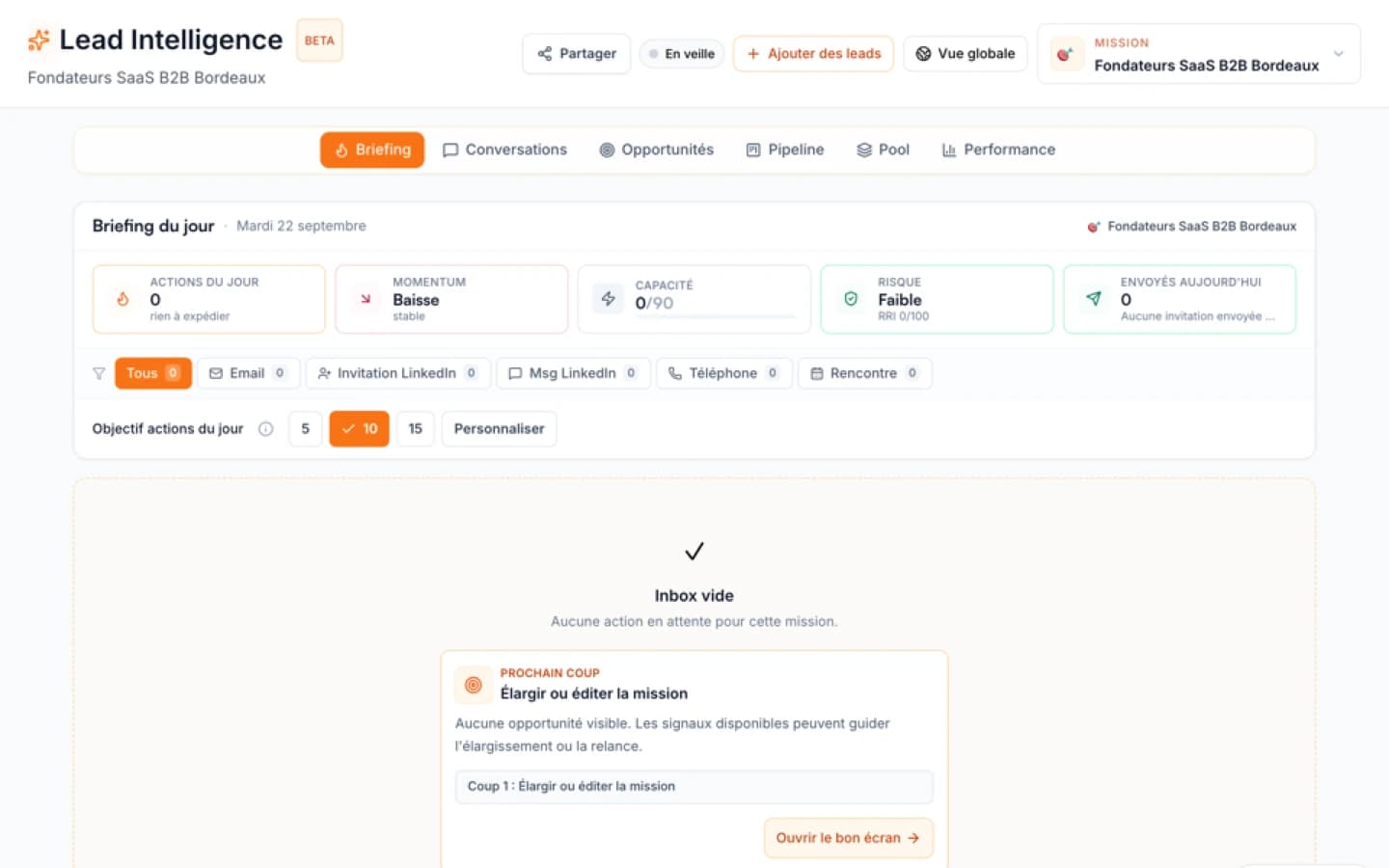
Instead of guessing your next move, you receive a clear next action detailing who to contact, why now, which channel to use, and which angle to take. This approach makes the actual value of your sales mission visible from the very beginning by showing you the exact contacts analyzed, signals detected, and priority actions recorded.
What Ember brings
To win your first 100 customers, early-stage founders benefit from focusing their energy on targeted conversations rather than broad marketing. Instead of getting lost in noisy databases, you need to focus on high-intent opportunities.
Ember helps you execute this transition by reusing your existing business plan, Ideal Customer Profile (ICP), offer, and strategy to prepare a targeted sales mission. Rather than waiting days for manual list building, Ember can surface your first prioritized leads quickly.
The system finds accounts based on your specific ICP and real-time signals, verifying useful sources. Whether you start with a small or large contact list, Lead Intelligence prioritizes them without requiring any minimum contact threshold. This approach reduces market noise by focusing your attention on opportunities that deserve action immediately.
By making the priority explainable through clear context, signals, and opportunity readiness, you always know exactly who to contact, why now, and which channel to use. This approach helps turn the daunting task of finding those first 100 users into an actionable, daily workflow.
This approach also connects with What to Look For When Hiring a B2B Lead Generation Agency in 2026?, which clarifies the next choice.
Benchmark
To win your first 100 customers, early-stage founders face a choice between high-volume outreach and context-driven targeting. Traditional business-to-business (B2B) sales engagement platforms focus heavily on volume. For instance, Apollo describes itself as an AI sales platform combining data, intelligence and execution (Apollo). This approach works well for established companies with a validated ideal customer profile (ICP), but it can introduce noise for early-stage software as a service (SaaS) startups trying to find their initial footing.
For a founder, scraping thousands of cold contacts risks leading to low reply rates and wasted budget. It is better to focus on high-intent signals and immediate relevance. This is where Ember Lead Intelligence shifts the paradigm. Rather than forcing you to manage massive, noisy databases, it reduces noise by focusing attention on opportunities that deserve action now. When you input your specific targeting context, the first prioritized leads can appear in about 30 minutes.
In practice, What Evidence Should a B2B Founder Verify Before Choosing Lead Intelligence over High-Volume Prospecting? completes this framework with another angle on the same topic.
Recommendations
To win your first 100 customers, it is better to move away from high-volume, generic outreach and focus on targeted, context-driven relationships. Instead of blasting massive databases with generic templates, the priority should be identifying high-intent accounts where you can deliver immediate value.
First, define your Ideal Customer Profile (ICP) with extreme precision. Rather than treating every lead equally, analyze specific signals that indicate a company is ready to buy. This reduces noise and spares you from spreading your energy on contacts who are not ready. Look for signals of real buying intent: a team change, a funding round, a strategic initiative.
Concretely, each outreach should answer three questions: who to contact, why now, and with which angle. If you cannot justify those three elements, the lead is probably not a priority. This is where a tool like Ember Lead Intelligence can help: it uses your project context to analyze signals, sort opportunities and propose a clear next action, with no minimum number of contacts. The first value produced by the mission, contacts analyzed, signals detected and priority actions, becomes visible quickly, which lets you adjust your targeting continuously.
In practice, prioritize about ten accounts with a strong signal, prepare a personalized message that shows you understand their situation, and measure the reply rate. This fast learning cycle can be more instructive than a broad campaign: it builds a relationship from the first exchange, and each interaction sharpens your ideal customer profile.
Detailed playbook
To win your first 100 customers, early-stage founders benefit from moving from broad marketing to more direct outreach. Instead of getting lost in noisy databases, you need to focus on prospects who have an immediate reason to buy.
This is where Ember Lead Intelligence changes the playbook. By reusing your business plan and Ideal Customer Profile, it reduces noise and focuses your attention on opportunities that deserve action now. With usable targeting context, your first prioritized leads can appear in about 30 minutes. Instead of guessing, you get a clear next action: who to contact, why now, and which angle to use. This context-driven approach helps you build genuine relationships, turning cold outreach into meaningful conversations.
Before deciding, How to Find Clients Quickly as an Early-Stage Founder? helps connect this method with adjacent priorities.
Sources
- George Baker Sr., "Acquiring Your First 100 Customers: A Guide For Early-Stage Founders", Forbes Business Council, January 7, 2026, consulted on September 28, 2026: forbes.com.
- PayPro Global, "How to Get Your First 100 Customers for SaaS in 10 Steps", consulted on September 28, 2026: payproglobal.com.
- Apollo, homepage, consulted on September 28, 2026: apollo.io.
- Functions of Lead Intelligence: product description by Ember, its publisher.
Sources
FAQ
Free diagnostic
Test your sales file
Drop an Excel or CSV and check its readiness without sending its rows to Ember.