
Going freelance raises an immediate question: where will the first missions come from? The temptation is to copy equipped sales teams, with massive lists and automated sequences. That is a calibration error: a solo independent has neither the time nor the sender reputation to play the volume game, and does not need to.
Malt's "Freelancing in Europe 2024" study, run among 5,092 respondents across six European countries, maps the real starting point: 93% of freelancers worked full-time as employees before going independent. In other words, the first network almost always exists: former colleagues, managers, clients, or partners from salaried life. It is the most accessible pool, and the only one where your work is already known first-hand.
The same study documents what makes the activity last: 70% of freelancers prioritize lasting client relationships regardless of project size, and companies re-hire the same freelancer in about 50% of cases. The first client is not a database extraction: it is the starting point of a relationship asset that compounds.
To place this decision in context, How to Prioritise Lead Conversations: A Practical Guide for Sales Teams and Founders brings together complementary analysis in the same field.
What the Data Says About Starting Channels
The Malt survey also measures the real prospecting effort: full-time freelancers spend on average four hours per week on it, against thirty-two hours of billed work. Prospecting is a bounded discipline, not a second job: a case for concentrating it where response rates are highest.
Practitioner guides converge on channel order. Freebe lists the network among the first levers to activate, before content and active outreach; InFreelancing stresses word of mouth, which only works if you clearly announce your activity around you. The documented reflex: inform your professional circle of the launch, without asking for work, simply describing the problem you solve and for whom.
A useful detail from the Malt report for precise targeting: 74% of freelancers say they are more inclined to accept a mission when the client shares their values. Selecting which first accounts to approach is not a luxury: it determines both response rate and the quality of the relationships that follow.
| Channel | Speed of first return | Effort required | When to use it |
|---|---|---|---|
| Existing network (former colleagues, clients, contacts) | Days to a few weeks | Low: personalized messages to 30-50 people | Always first: 93% of freelancers come from salaried work (Malt) |
| Freelance platforms (Malt, Upwork) | Weeks, depending on profile density | Medium: complete profile, reviews, responsiveness | Alongside the network, to capture inbound demand |
| Content and visibility (LinkedIn, communities) | Months | High and continuous | To build credibility, not for the first client |
| Signal-based targeted outbound | Weeks if targeting is tight | Medium: prior research on each account | When the network runs out, on accounts with buying signals |
Prioritize Instead of Industrializing
The tipping point comes once the close network has been activated: dozens of lukewarm contacts remain, with no evidence of who deserves a follow-up. This is exactly the problem mass prospecting claims to solve by sending more, when the answer is to sort better. A prospect who just changed roles, whose company is hiring in your specialty, or who interacted with your content shows a signal; the others do not yet.
This sorting logic, described in What Signals Actually Tell You a B2B Prospect Is Worth Contacting Now?, turns prospecting into a prioritized queue: three levels, act, watch, set aside, with a noted reason for each. It also protects reputation: fifty relevant messages beat five hundred generic ones when every send carries your name.
Sorting Lukewarm Contacts with Lead Intelligence
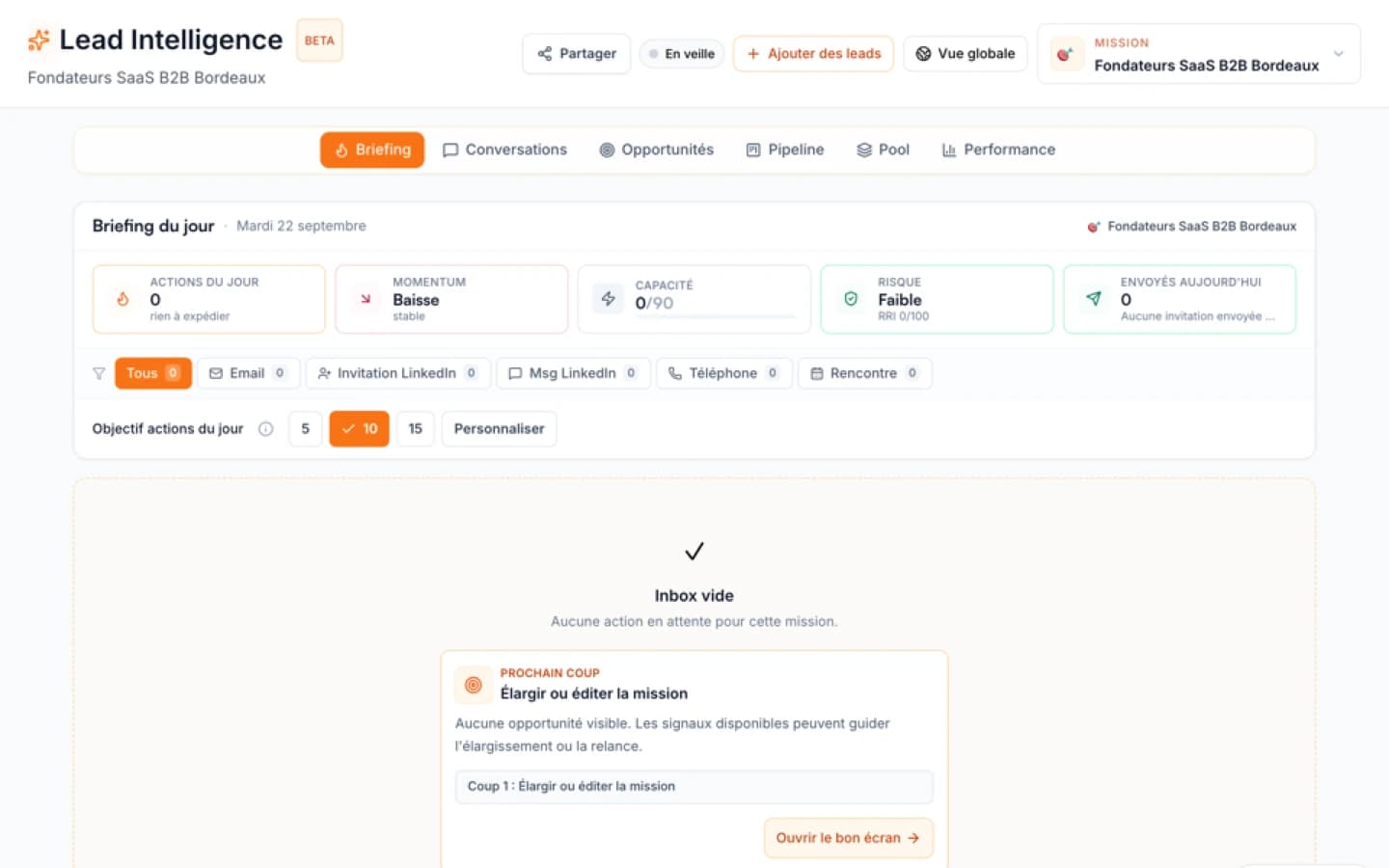
To move from network to prioritized list, Lead Intelligence, Ember's prospecting module, processes your contacts and produces an ordered list with the context needed to write. With usable targeting context, the first prioritized leads can appear in about 30 minutes, with no minimum contact threshold. Each profile gets a readable decision: act, watch, or set aside, with the signals that justify it.
Mission results persist: analyzed contacts, detected signals, and recorded actions can be re-read later, so the next week's triage does not start from scratch. No conversion-rate promise is attached to the tool; the value is a defensible working order.
Before deciding, Build a B2B Prospect List from Zero, Without Customers or a Brand helps calibrate a sustainable pace.
Sources
FAQ
Free diagnostic
Test your sales file
Drop an Excel or CSV and check its readiness without sending its rows to Ember.