
Pitch practice often fails because founders rehearse in an echo chamber. They recite slides in front of polite colleagues who nod along, or they endlessly tweak typography without testing whether their spoken logic actually holds attention. When they finally walk into an investor meeting, they encounter interruptions, confusion, and awkward silences.
A structured oral rehearsal solves this by testing both delivery and audience comprehension under realistic conditions. According to guidance on Series A pitching from Y Combinator, an effective rehearsal takes exactly one hour divided into three equal parts: a 20 minute pitch, a 20 minute open conversation, and 20 minutes of targeted feedback. Pairing this structure with slide by slide blind testing eliminates cognitive friction before high stakes meetings take place.
The 20-20-20 Rehearsal Framework
Most investor presentations are not uninterrupted monologues. In real meetings, partners interject, challenge assumptions, or request immediate clarification. Rehearsing only the delivery of a monologue leaves founders unprepared for the conversational back and forth that defines venture decisions.
To simulate the real rhythm of a meeting, assemble a test listener, such as a mentor, advisor, or another founder, and run a sixty minute session:
- The 20 Minute Pitch: Deliver the entire presentation while timing it strictly. As outlined by Y Combinator, pitches should be 15 to 20 minutes long, designed specifically to set the stage for a subsequent 40 to 45 minute discussion. Keep the pace conversational. If presenting remotely over video conference, assign delivery to a single person rather than passing control between cofounders. Keep an outline of bullet points handy, but avoid reading directly from a script.
- The 20 Minute Conversation: Immediately transition into an unscripted question and answer session. The listener should ask probing questions about unit economics, go to market velocity, defensibility, and team capability. Pay close attention to topics the listener brings up that you did not anticipate, as well as critical points you mentioned that they seemed to overlook entirely.
- The 20 Minute Diagnostic Feedback: Step completely out of character. Do not debate the feedback or defend choices made during the pitch. Instead, use this final third of the hour to inspect where the narrative succeeded and where it lost momentum.
Diagnosing Confusion and Boredom
General feedback like "that looked great" is unhelpful. When founders ask open ended questions, reviewers tend to offer polite praise or suggest cosmetic design tweaks. To extract actionable diagnostic signal during the final twenty minutes, Y Combinator suggests asking three pointed questions:
- Were you confused? If so, when? Confusion usually points to unstated premises. Founders live inside their industry domain and frequently jump straight to technical solutions without establishing the baseline problem. Knowing the exact minute or slide where a listener got lost shows where context is missing.
- Were you bored? If so, when? Pacing lags when presentations linger on background context that investors already know. If energy drops during market overviews or excessive product feature lists, those sections should be trimmed or removed.
- Did my deck help or hurt? Visual materials should clarify complex relationships, not compete for cognitive bandwidth.
This diagnostic aligns with guidance from Bpifrance Création, which notes that a pitch deck serves to illustrate spoken remarks rather than recite the presentation. If the visual display duplicates what the speaker says word for word, the listener reads ahead and tunes out the voice. A presentation must remain readable, clear, concise, and uncluttered.
The Blind Slide Flash Test
Even within a cohesive narrative, individual slides often suffer from visual bloat, cryptic charts, or ambiguous titles. The blind flash test isolates individual slides from the speaker's vocal delivery to verify their standalone clarity.
The protocol outlined by Y Combinator is straightforward: flash an individual slide to someone who has never seen it before, then ask them to explain the single point the slide is trying to make.
If the viewer cannot state the takeaway within three to five seconds, the slide has failed. Common causes include:
- Headline ambiguity: Using topical labels like "Market Size" or "Product Architecture" instead of assertive takeaways like "Serviceable Market Grows at 40 Percent Annually."
- Chart clutter: Displaying full data exports with ten series rather than isolating the primary trend line that proves traction.
- Dual focuses: Attempting to explain customer acquisition strategy and pricing models on the same canvas.
When preparing investor materials, reviewing resources like the guide on evaluating Ember Creation for pitch decks can help clarify structural requirements across different presentation styles.
| Rehearsal Method | Primary Focus | Best Used For | Key Weakness |
|---|---|---|---|
| Solo Audio or Video Recording | Pacing, cadence, filler words | Verifying delivery time under 20 minutes | Cannot measure listener comprehension |
| Blind Slide Flash Test | Standalone visual clarity | Eliminating clutter and ambiguous charts | Tests individual visuals, not oral continuity |
| 20-20-20 Rehearsal Framework | End to end narrative and Q&A | Simulating real investor discussions and Q&A | Requires a dedicated, candid external reviewer |
Clarity Over Grandiose Language
Polishing vocal cadence cannot rescue a weak value proposition. Founders sometimes try to mask uncertainties with inflated claims or buzzwords, but experienced investors see through exaggerated phrasing immediately.
In an August 2013 essay, Y Combinator cofounder Paul Graham pointed out that the most effective way to convince investors is to first convince yourself that the business is worth backing, and then explain that reality simply. Graham emphasized that investors actively use conciseness as a metric of founder competence: if you cannot explain your plans concisely, you do not truly understand them.
Before rehearsing delivery speed or stage presence, review your presentation against Graham's three core principles:
- Build something genuinely worth investing in.
- Understand exactly why it is worth investing in.
- Explain that rationale clearly without vague, grandiose marketing language.
If an explanation requires complex jargon, step back and rephrase the underlying mechanism in everyday business terms. When your internal logic is sound, oral delivery becomes vastly easier because you are reporting clear facts rather than acting out a script.
Balancing Solo Practice with Live Human Feedback
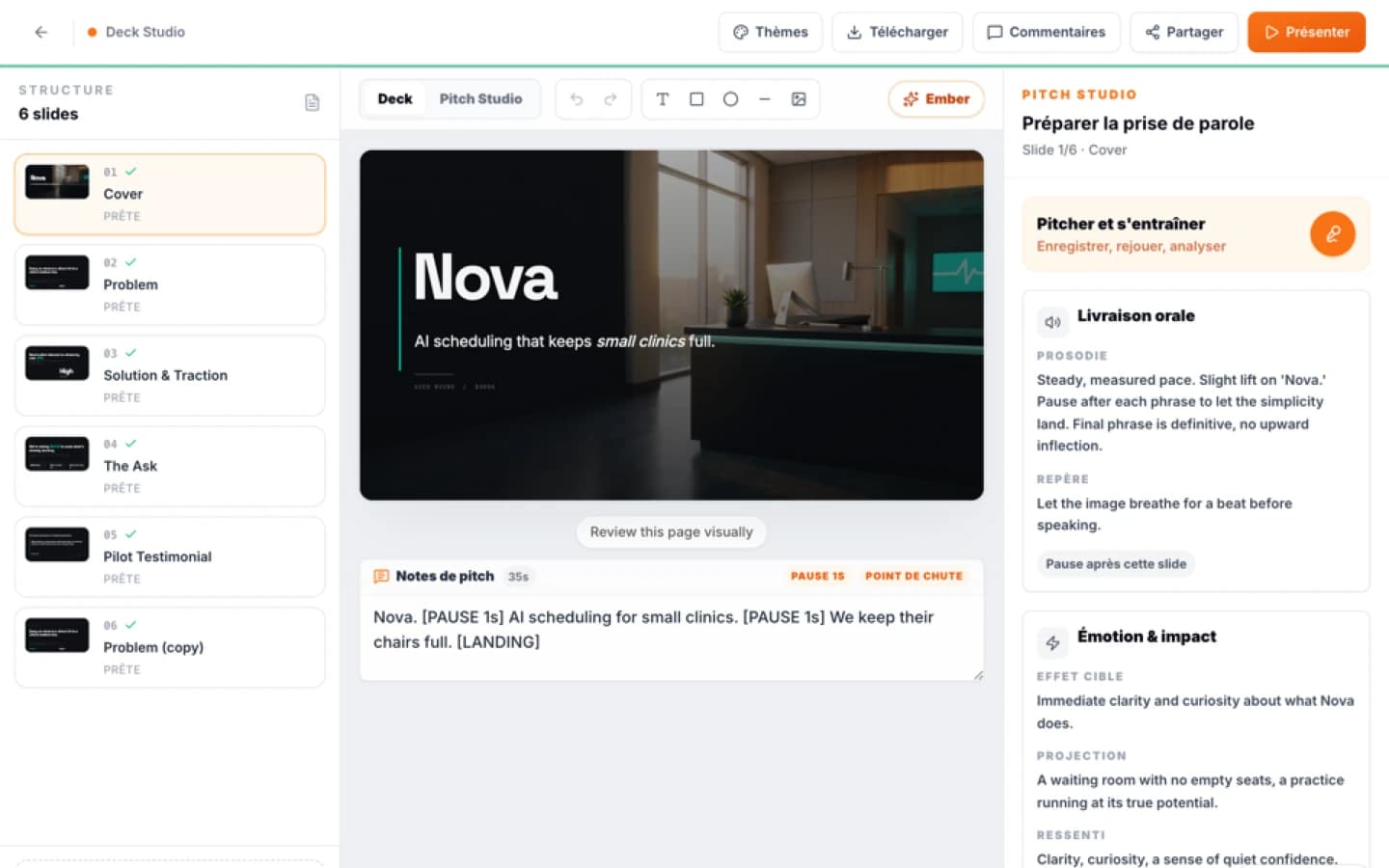
Solo repetition is valuable for mastering transitions, timing constraints, and vocal cadence. Practicing alone lets you smooth out rough phrasing and ensure your core presentation stays comfortably below the twenty minute ceiling. Dedicated tools can support this stage: for example, the Speaking practice feature in Ember's deck studio allows founders to record, replay, and refine their verbal delivery against their slide progression.
However, recording yourself is an incomplete rehearsal strategy on its own. It cannot reproduce the unpredictable questions of an investor, nor can it reveal the exact moment an external listener becomes confused.
Use software and self recording to eliminate vocal mannerisms, tighten timings, and gain personal fluency. Once your solo delivery is steady, schedule an in person or video rehearsal using the 20-20-20 framework. Gathering unfiltered feedback from people who challenge your assumptions remains the gold standard for walking into investor meetings fully prepared.
Sources
FAQ
Mini audit
Test your Pitch Deck
Get an initial diagnosis of substance, form and impact.