
Business angel pitches do not fail because a slide uses the wrong shade of blue. They fail when an early-stage founder cannot defend the narrative beneath the slides or uses generic filler to mask unverified claims.
Before adopting any production tool to build fundraising materials, early-stage founders raising from angel investors should audit three specific areas: narrative sequencing, factual attribution, and oral delivery. Evaluating Ember Creation against these standards helps establish whether it meets the bar for angel diligence or whether traditional presentation software remains the right operational choice.
1. Narrative sequencing: story architecture before slide design
Most founders assemble pitch decks backwards. They select a template, count out ten standard slides, and paste text into predetermined boxes.
This approach undermines early-stage fundraising. As Techstars Columbus managing director Tim Grace observed on the official Techstars blog, the pitch deck is just a vessel for a story, acting as a means to the end rather than the end itself. Grace explains that deck-building turns into an ineffective exercise when founders copy a generic structure found online instead of drafting their company narrative first like a script. Over-investing in visual polish while under-investing in the underlying story produces slides that look finished but cannot withstand simple investor questioning.
Early-stage founders must check whether a software tool forces layout decisions ahead of core logic. Ember Creation begins by analyzing the substance of the venture and structuring the narrative path before generating slides. It pulls directly from validated project context rather than populating a blank template with decorative phrasing. If your company story is not yet coherent in plain text, building slides in any tool will only amplify that structural weakness.
2. Evidence integrity: protecting your numbers from hallucination
Business angels invest personal capital. When they review metrics, unverified assumptions presented as hard facts destroy trust immediately.
In his essay on investor persuasion, Paul Graham highlights that convincing investors requires founders to first convince themselves, then explain their plans clearly without vague marketing jargon. Graham notes that many investors use brevity as a filter: if you cannot explain your plans concisely, you do not truly understand them.
When early-stage materials rely on automated generation, founders must verify how the platform handles missing or uncertain data:
| Evaluation criteria | Generic template workflows | Ember Creation workflow |
|---|---|---|
| Underlying context | Generic placeholder text | Validated project records |
| Missing metrics | Left blank or filled with invented estimates | Highlighted outside the layout without generating filler |
| Metric validation on structured one-pagers | Manual checking by founder | Matched against supplied citations; unverified items flagged |
| Primary export formats | PPTX, PDF, or proprietary web link | PDF or PowerPoint (.pptx) for decks; PNG for other formats |
On investor one-pagers generated in Creation, each metric value is checked against exact citations in the supplied source material. Compatible numbers lacking explicit source citations carry an approximation symbol and an explicit note identifying them as unverified assumptions. Missing information is flagged outside the canvas rather than masked by generated copy.
This boundary is critical: visual design cannot replace financial proof, and no software certifies your numbers. When founders prepare financial visualisations, reviewing accessible financial charts for executive pitch decks helps ensure data clarity remains intact.
3. Format breadth: collateral beyond the introductory slide deck
Angel rounds rarely close on an introductory presentation alone. Angel syndicates and individual investors request distinct assets depending on how the conversation progresses:
- Decks for live presentation or leave-behind review.
- Executive one-pagers for syndicate forwards and brief email introductions.
- Market maps and Business Model Canvases (BMC) to verify positioning and unit dynamics.
- Social assets and updates to maintain visibility across founder networks.
Ember Creation supports eight visual formats from a shared project context: decks, LinkedIn posts, stories, YouTube thumbnails, market maps, business model canvases, one-pagers, and Open Graph (OG) images.
Founders must check format export rules before choosing an output path. While decks export to PDF and PowerPoint (.pptx), non-deck formats such as one-pagers and market maps export from the editor as PNG files. If your angel investors require fully editable vector files or raw spreadsheets for supplementary collateral, traditional desktop software or dedicated financial models remain necessary alongside Creation.
4. Rehearsal readiness: pressure-testing your spoken delivery
Having a clean set of slides is only half of an angel pitch. The spoken presentation determines whether an angel engages during the initial minutes.
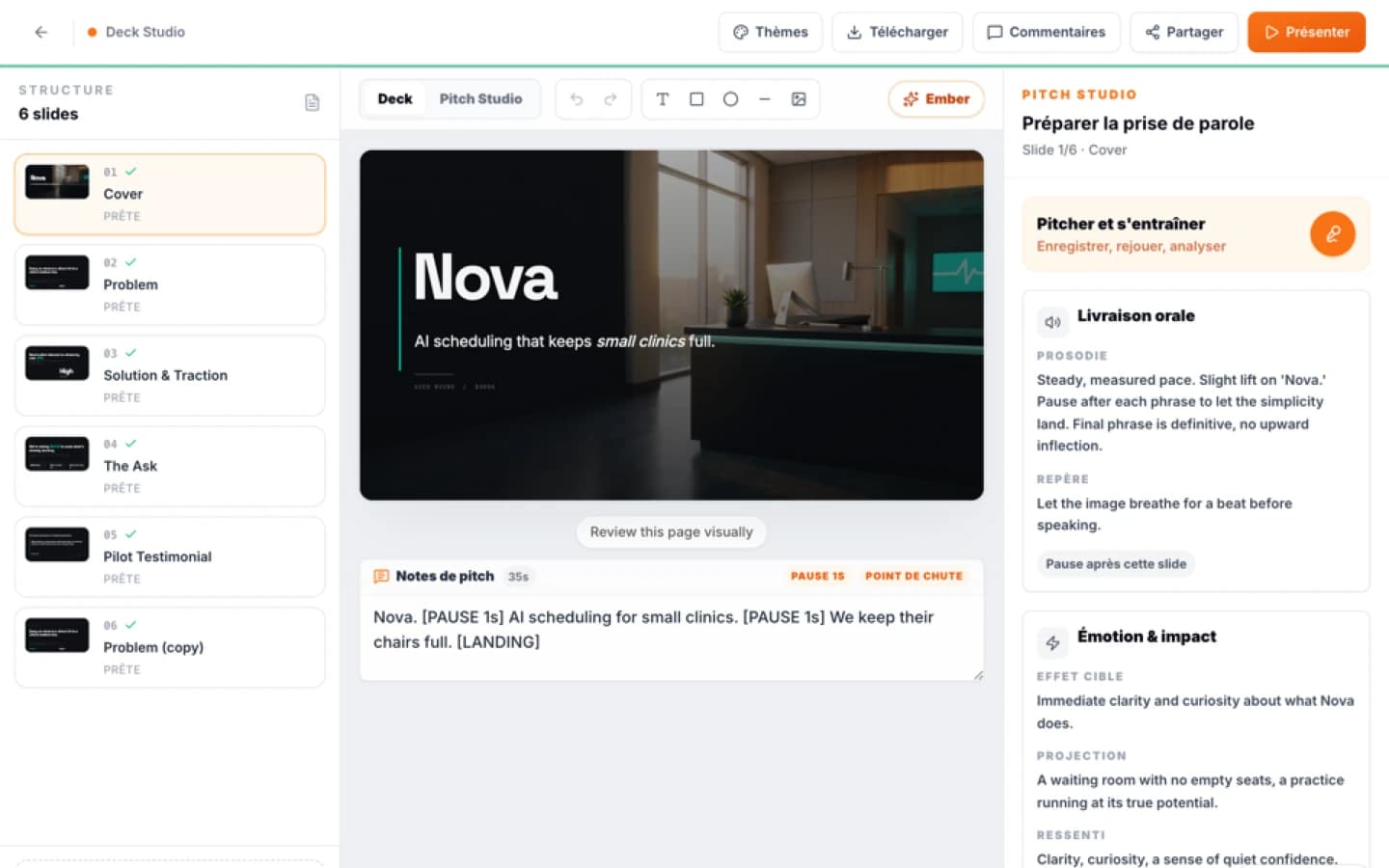
For slide decks, Creation includes Speaking practice, a dedicated environment where founders record, replay, and rehearse their presentations. The module evaluates recorded takes by listening to rhythm, pauses, clarity, impact, and structural pacing. Founders receive diagnostic feedback on speech cadence and rhetorical focus directly alongside their slides.
For teams comparing different presentation and rehearsal environments, reviewing Google Slides vs Ember Creation: Rehearse or Record Video provides a clear breakdown of workflow differences.
Making the operational decision
Before choosing Ember Creation for an active angel round, verify these concrete prerequisites:
- Your project narrative exists in plain terms. If you cannot summarize your problem, customer, and mechanics in concise sentences, establish those fundamentals first.
- Your baseline metrics are sourced. Creation flags unverified metrics and leaves missing information outside the layout, meaning the tool functions best when your underlying business records are already assembled.
- Your required formats match actual export rules. If you need a deck in PDF or PowerPoint (.pptx) alongside supporting PNG visual assets like one-pagers, Creation handles the full asset set from one project foundation.
When your source material is ready, you can generate your investor deck and collateral directly through Ember Creation, grounding every slide in your actual business context.
Sources
FAQ
Creation
Work on substance and impact
Structure the reasoning, form and mental journey of your presentation.